Life Beyond Earth
A free science worksheet ready for your classroom. Open in Kuraplan to grab the print-ready PDF, customize it for your students, or generate a fresh version in seconds.

Life Beyond Earth
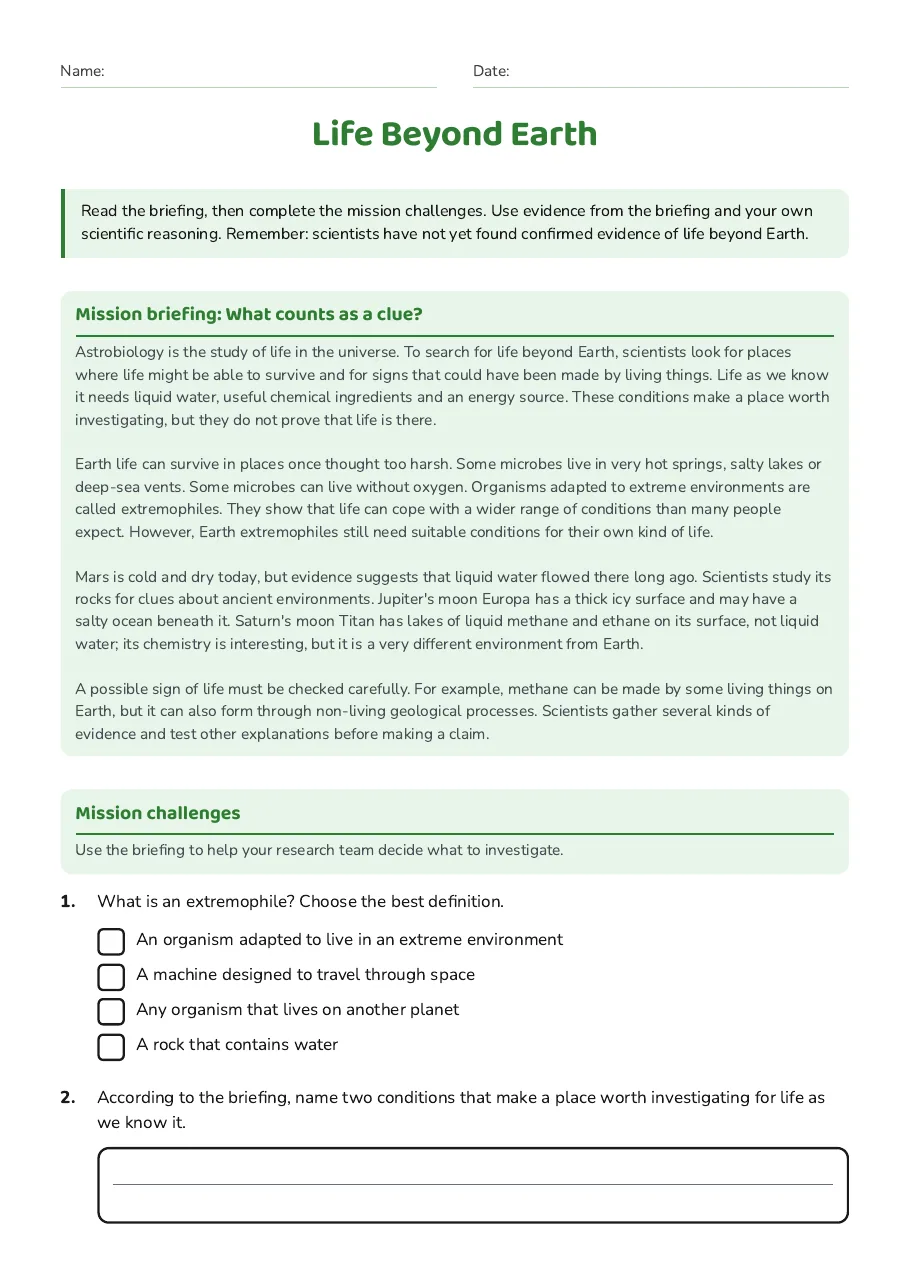
Mission briefing: What counts as a clue?
Astrobiology is the study of life in the universe. To search for life beyond Earth, scientists look for places where life might be able to survive and for signs that could have been made by living things. Life as we know it needs liquid water, useful chemical ingredients and an energy source. These conditions make a place worth investigating, but they do not prove that life is there. Earth life can survive in places once thought too harsh. Some microbes live in very hot springs, salty lakes or deep-sea vents. Some microbes can live without oxygen. Organisms adapted to extreme environments are called extremophiles. They show that life can cope with a wider range of conditions than many people expect. However, Earth extremophiles still need suitable conditions for their own kind of life. Mars is cold and dry today, but evidence suggests that liquid water flowed there long ago. Scientists study its rocks for clues about ancient environments. Jupiter's moon Europa has a thick icy surface and may have a salty ocean beneath it. Saturn's moon Titan has lakes of liquid methane and ethane on its surface, not liquid water; its chemistry is interesting, but it is a very different environment from Earth. A possible sign of life must be checked carefully. For example, methane can be made by some living things on Earth, but it can also form through non-living geological processes. Scientists gather several kinds of evidence and test other explanations before making a claim.
Mission challenges
Use the briefing to help your research team decide what to investigate.
- An organism adapted to live in an extreme environment
- A machine designed to travel through space
- Any organism that lives on another planet
- A rock that contains water
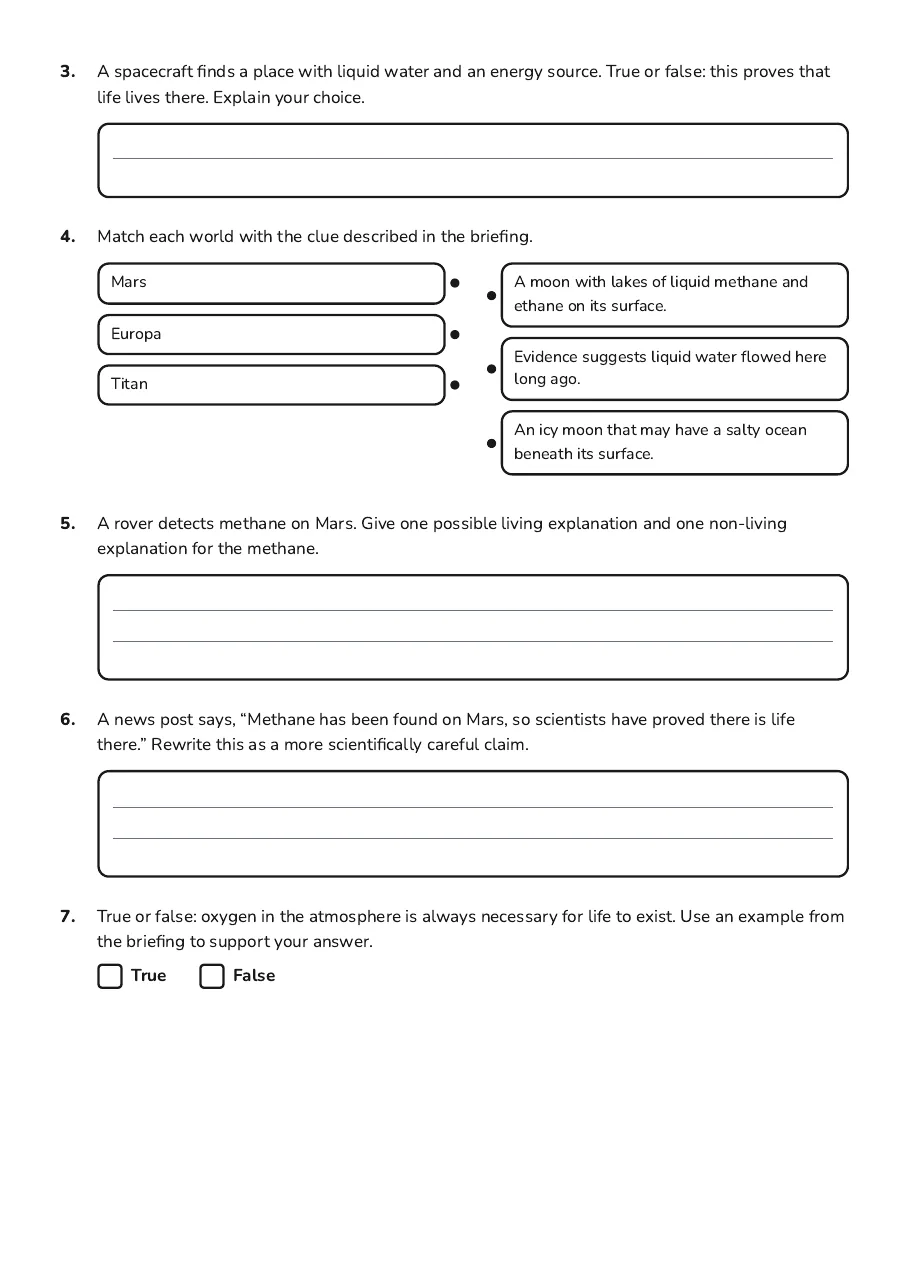
- Mars
- Europa
- Titan
- A moon with lakes of liquid methane and ethane on its surface.
- Evidence suggests liquid water flowed here long ago.
- An icy moon that may have a salty ocean beneath its surface.
3 printable pages
Page 1
Page 2
Page 3
About This Worksheet
Free in Kuraplan
Sign up free, grab the PDF, and customize it for your class.
Print-Ready
Formatted for standard paper. Clean layout, easy to read.
AI-Generated
Created with Kuraplan's AI, designed for real classroom use.
For Teachers & Parents
Use in classrooms, for homework, tutoring, or homeschool.
Need a custom version of this worksheet?
Kuraplan's AI generates custom worksheets in seconds — differentiated for every learner, aligned to your curriculum.
Generate Custom Worksheets — Free