ScienceFreePrintable

States of Matter Classification

A free science worksheet ready for your classroom. Open in Kuraplan to grab the print-ready PDF, customize it for your students, or generate a fresh version in seconds.
States of Matter Classification worksheet preview
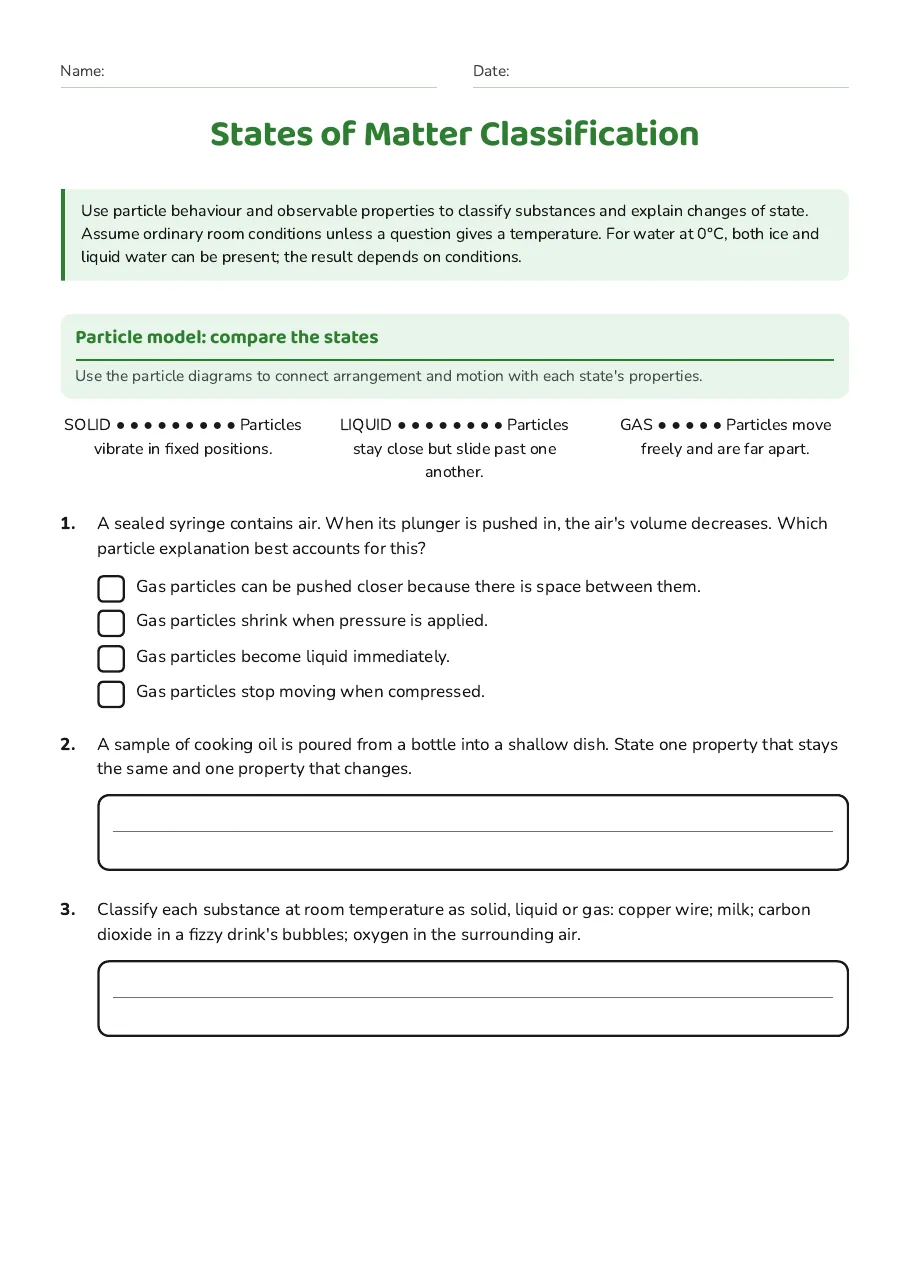
Name:Date:

States of Matter Classification

Use particle behaviour and observable properties to classify substances and explain changes of state. Assume ordinary room conditions unless a question gives a temperature. For water at 0°C, both ice and liquid water can be present; the result depends on conditions.

Particle model: compare the states

Use the particle diagrams to connect arrangement and motion with each state's properties.

SOLID ● ● ● ● ● ● ● ● ● Particles vibrate in fixed positions.

LIQUID ● ● ● ● ● ● ● ● Particles stay close but slide past one another.

GAS ● ● ● ● ● Particles move freely and are far apart.

1.A sealed syringe contains air. When its plunger is pushed in, the air's volume decreases. Which particle explanation best accounts for this?
  • Gas particles can be pushed closer because there is space between them.
  • Gas particles shrink when pressure is applied.
  • Gas particles become liquid immediately.
  • Gas particles stop moving when compressed.
2.A sample of cooking oil is poured from a bottle into a shallow dish. State one property that stays the same and one property that changes.
3.Classify each substance at room temperature as solid, liquid or gas: copper wire; milk; carbon dioxide in a fizzy drink's bubbles; oxygen in the surrounding air.
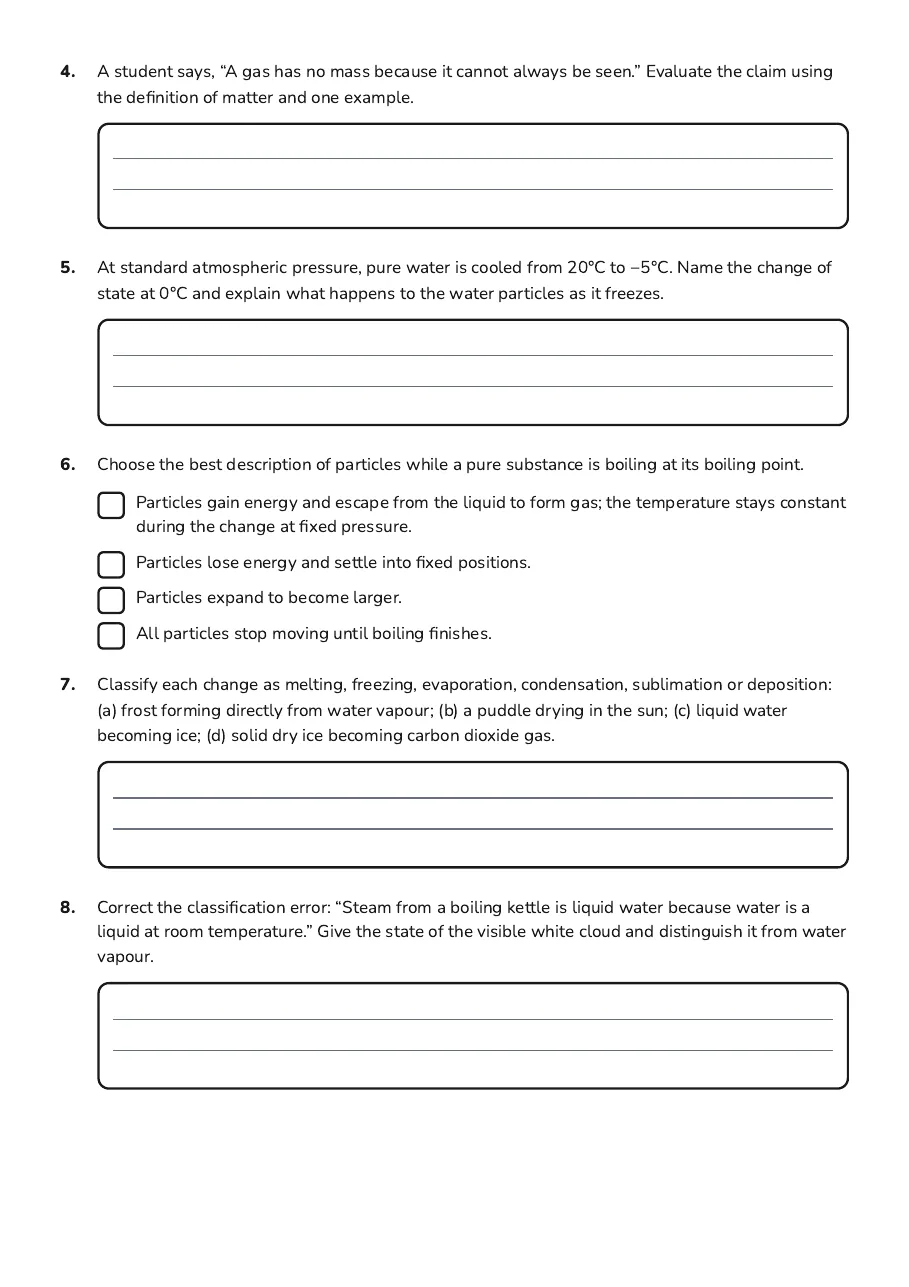
4.A student says, “A gas has no mass because it cannot always be seen.” Evaluate the claim using the definition of matter and one example.
5.At standard atmospheric pressure, pure water is cooled from 20°C to −5°C. Name the change of state at 0°C and explain what happens to the water particles as it freezes.
6.Choose the best description of particles while a pure substance is boiling at its boiling point.
  • Particles gain energy and escape from the liquid to form gas; the temperature stays constant during the change at fixed pressure.
  • Particles lose energy and settle into fixed positions.
  • Particles expand to become larger.
  • All particles stop moving until boiling finishes.
7.Classify each change as melting, freezing, evaporation, condensation, sublimation or deposition: (a) frost forming directly from water vapour; (b) a puddle drying in the sun; (c) liquid water becoming ice; (d) solid dry ice becoming carbon dioxide gas.
8.Correct the classification error: “Steam from a boiling kettle is liquid water because water is a liquid at room temperature.” Give the state of the visible white cloud and distinguish it from water vapour.
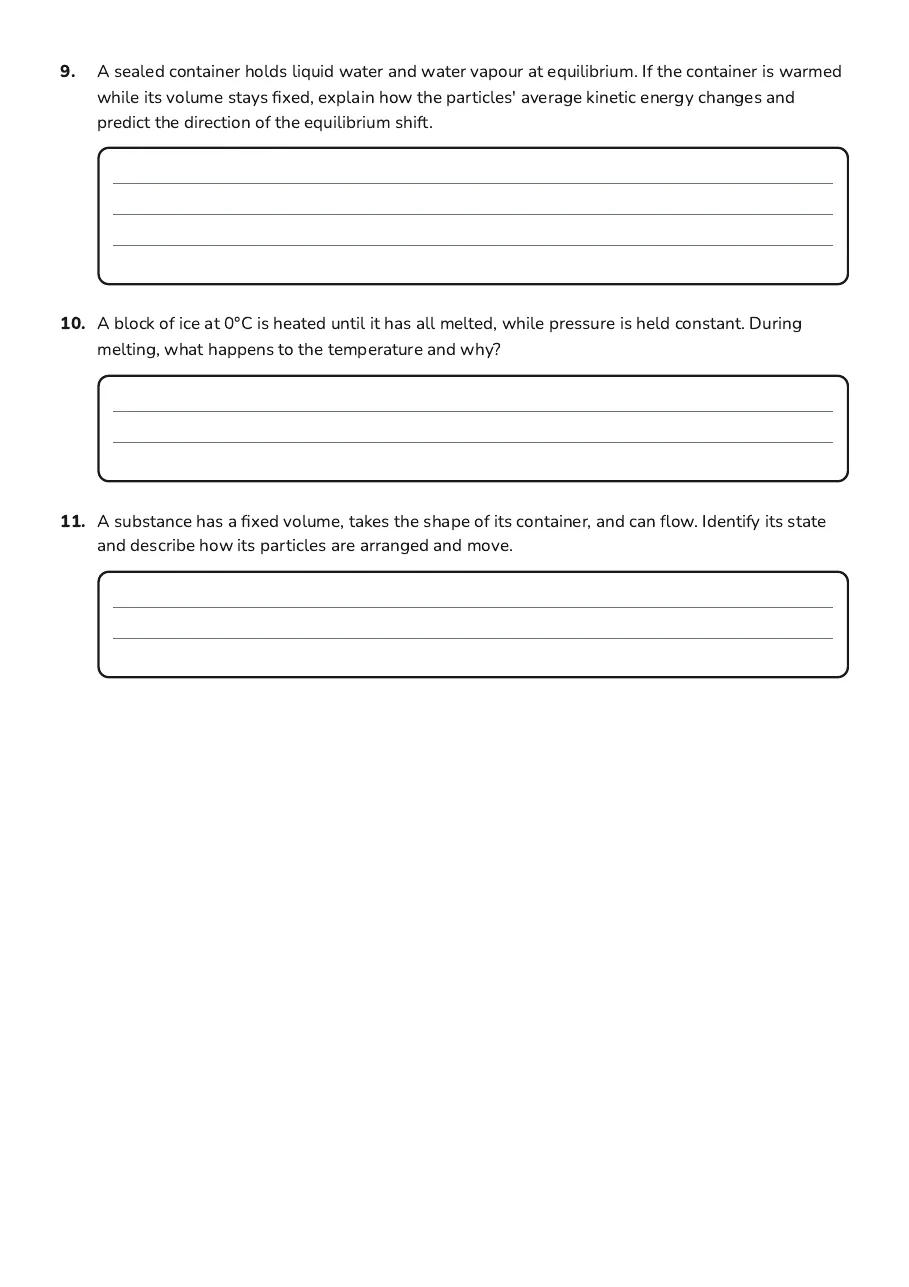
9.A sealed container holds liquid water and water vapour at equilibrium. If the container is warmed while its volume stays fixed, explain how the particles' average kinetic energy changes and predict the direction of the equilibrium shift.
10.A block of ice at 0°C is heated until it has all melted, while pressure is held constant. During melting, what happens to the temperature and why?
11.A substance has a fixed volume, takes the shape of its container, and can flow. Identify its state and describe how its particles are arranged and move.

3 printable pages

  • States of Matter Classification, page 1 of 3: Particle model: compare the states

    Page 1

  • States of Matter Classification, page 2 of 3: 4. A student says, “A gas has no mass because it cannot always be seen.” Evaluate the…

    Page 2

  • States of Matter Classification, page 3 of 3: 9. A sealed container holds liquid water and water vapour at equilibrium. If the…

    Page 3

About This Worksheet

Free in Kuraplan

Sign up free, grab the PDF, and customize it for your class.

Print-Ready

Formatted for standard paper. Clean layout, easy to read.

AI-Generated

Created with Kuraplan's AI, designed for real classroom use.

For Teachers & Parents

Use in classrooms, for homework, tutoring, or homeschool.

Need a custom version of this worksheet?

Kuraplan's AI generates custom worksheets in seconds — differentiated for every learner, aligned to your curriculum.

Generate Custom Worksheets — Free
No credit card Curriculum-aligned Under 60 seconds