ScienceFreePrintable

Living Things Workbook

A free science worksheet ready for your classroom. Open in Kuraplan to grab the print-ready PDF, customize it for your students, or generate a fresh version in seconds.
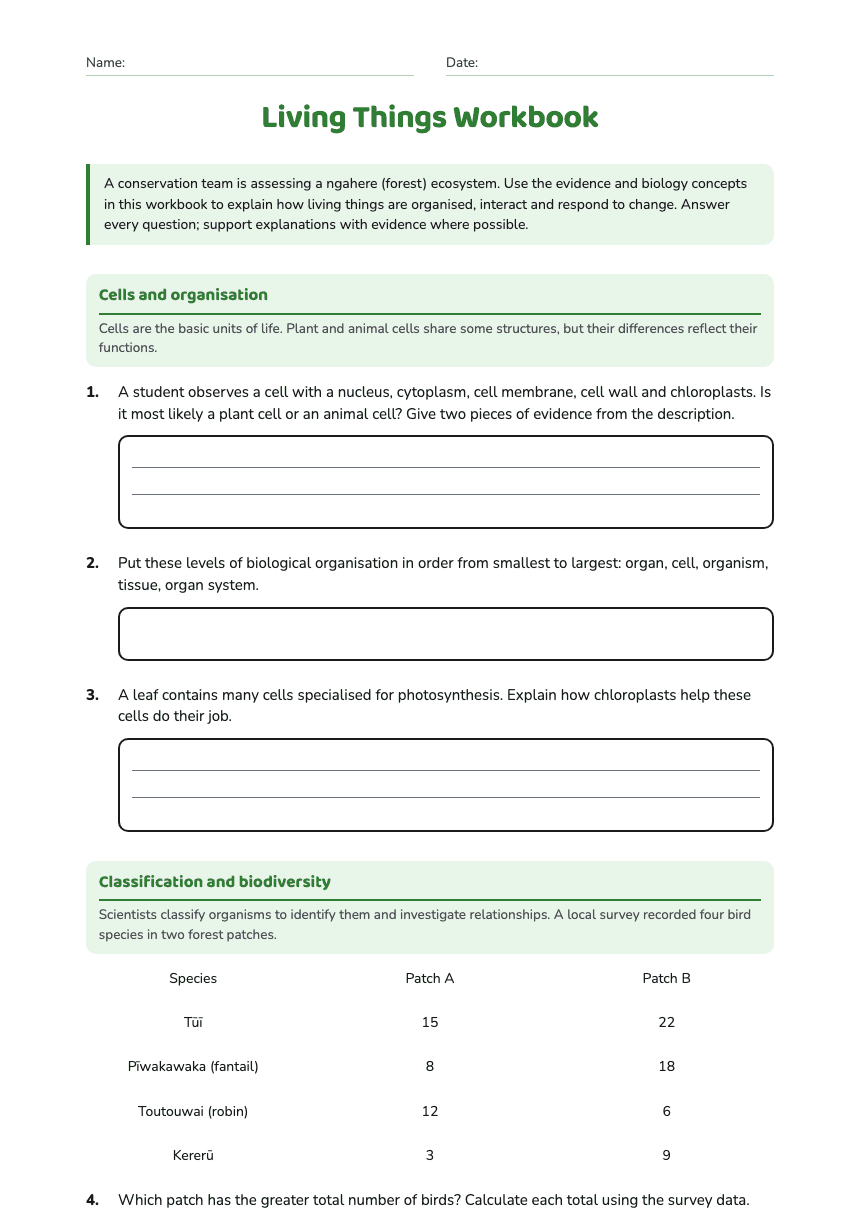
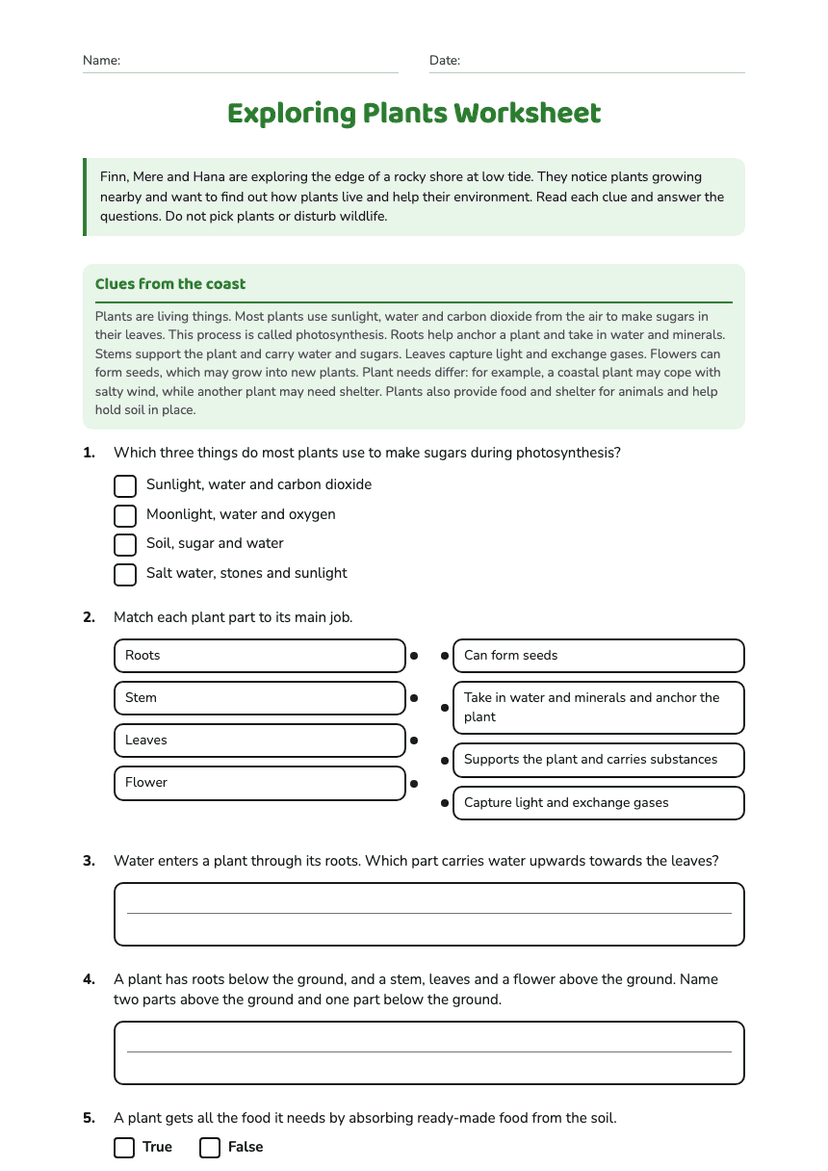
Living Things Workbook worksheet preview
Name:Date:

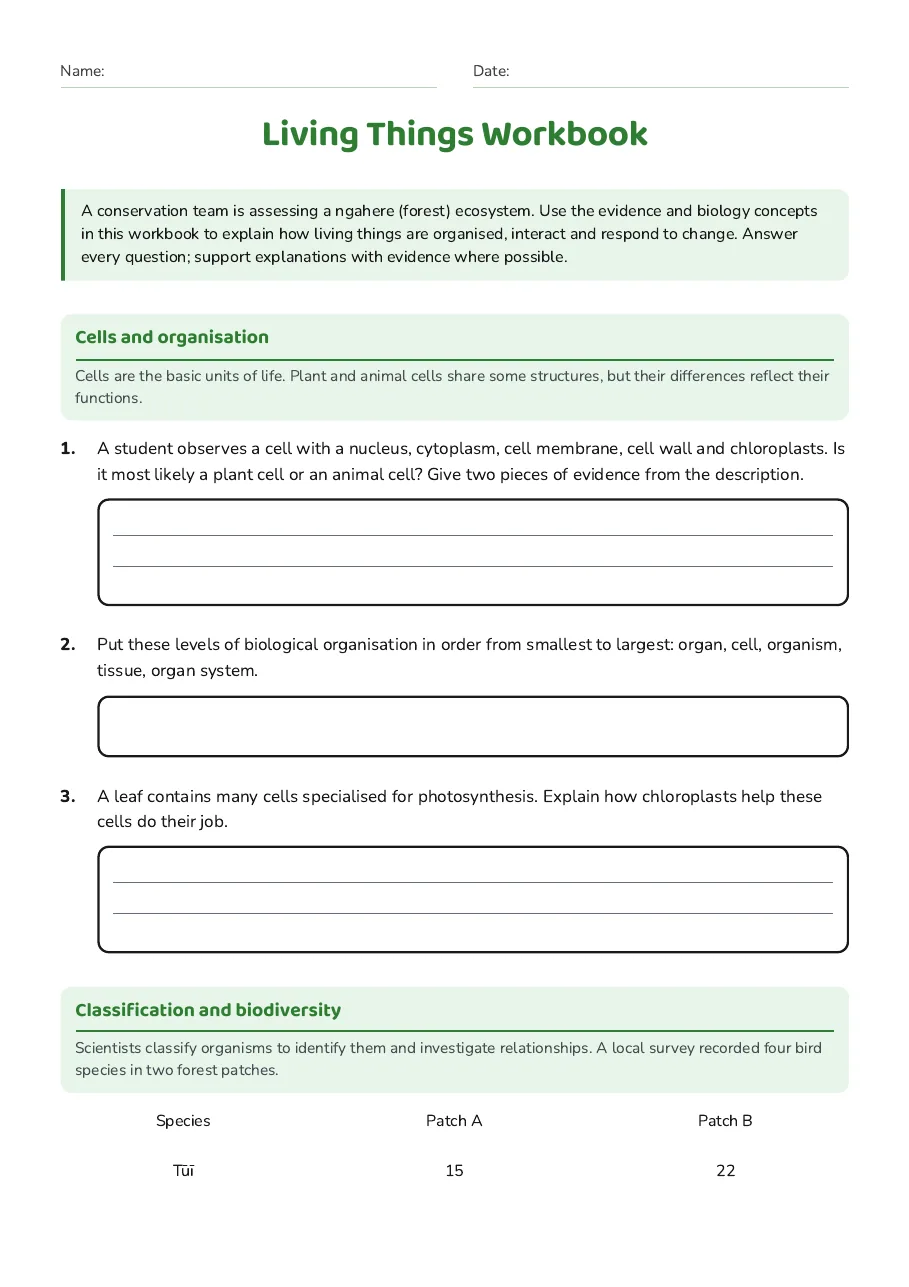
Living Things Workbook

A conservation team is assessing a ngahere (forest) ecosystem. Use the evidence and biology concepts in this workbook to explain how living things are organised, interact and respond to change. Answer every question; support explanations with evidence where possible.

Cells and organisation

Cells are the basic units of life. Plant and animal cells share some structures, but their differences reflect their functions.

1.A student observes a cell with a nucleus, cytoplasm, cell membrane, cell wall and chloroplasts. Is it most likely a plant cell or an animal cell? Give two pieces of evidence from the description.
2.Put these levels of biological organisation in order from smallest to largest: organ, cell, organism, tissue, organ system.
3.A leaf contains many cells specialised for photosynthesis. Explain how chloroplasts help these cells do their job.

Classification and biodiversity

Scientists classify organisms to identify them and investigate relationships. A local survey recorded four bird species in two forest patches.

Species

Patch A

Patch B

Tūī

15

22

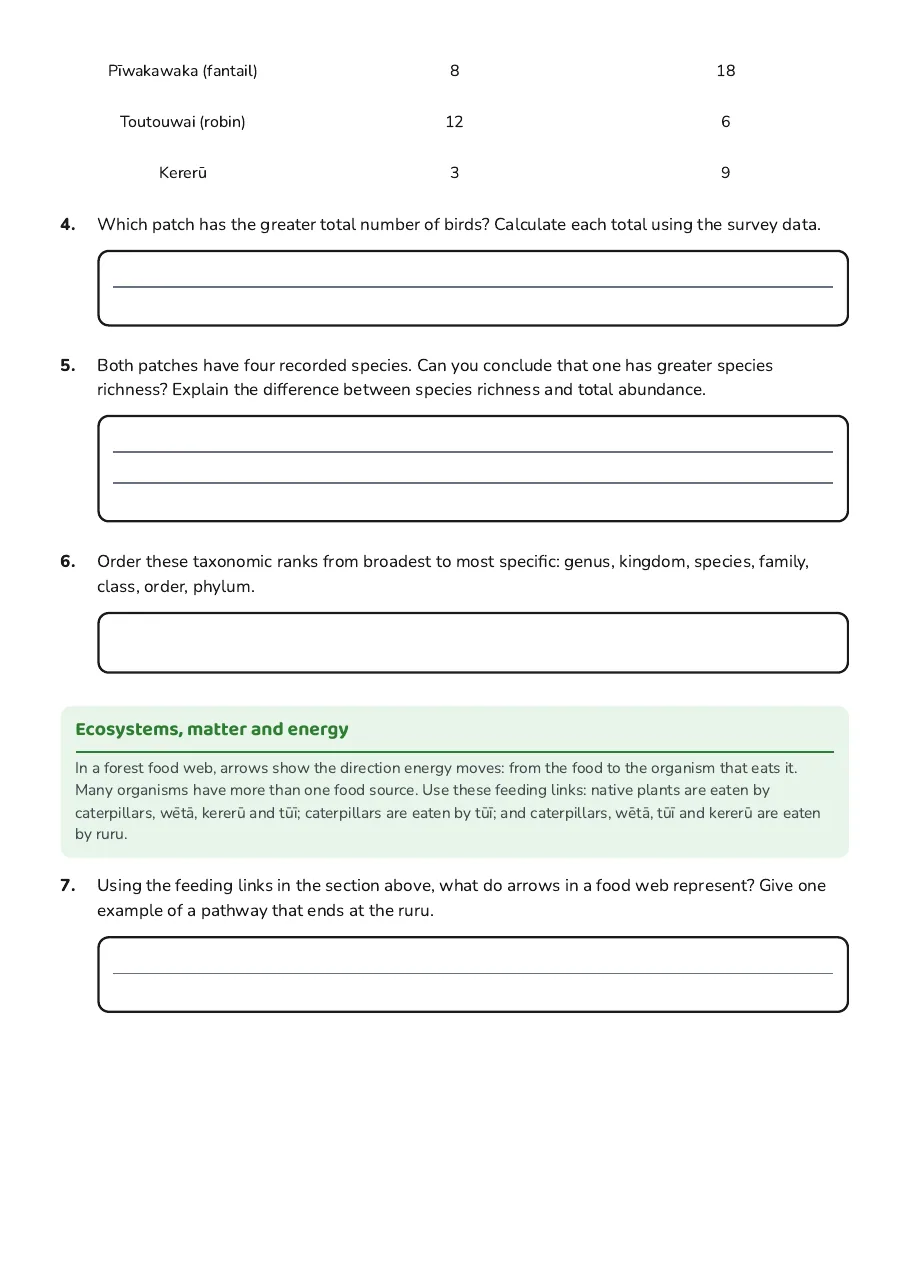
Pīwakawaka (fantail)

8

18

Toutouwai (robin)

12

6

Kererū

3

9

4.Which patch has the greater total number of birds? Calculate each total using the survey data.
5.Both patches have four recorded species. Can you conclude that one has greater species richness? Explain the difference between species richness and total abundance.
6.Order these taxonomic ranks from broadest to most specific: genus, kingdom, species, family, class, order, phylum.

Ecosystems, matter and energy

In a forest food web, arrows show the direction energy moves: from the food to the organism that eats it. Many organisms have more than one food source. Use these feeding links: native plants are eaten by caterpillars, wētā, kererū and tūī; caterpillars are eaten by tūī; and caterpillars, wētā, tūī and kererū are eaten by ruru.

7.Using the feeding links in the section above, what do arrows in a food web represent? Give one example of a pathway that ends at the ruru.
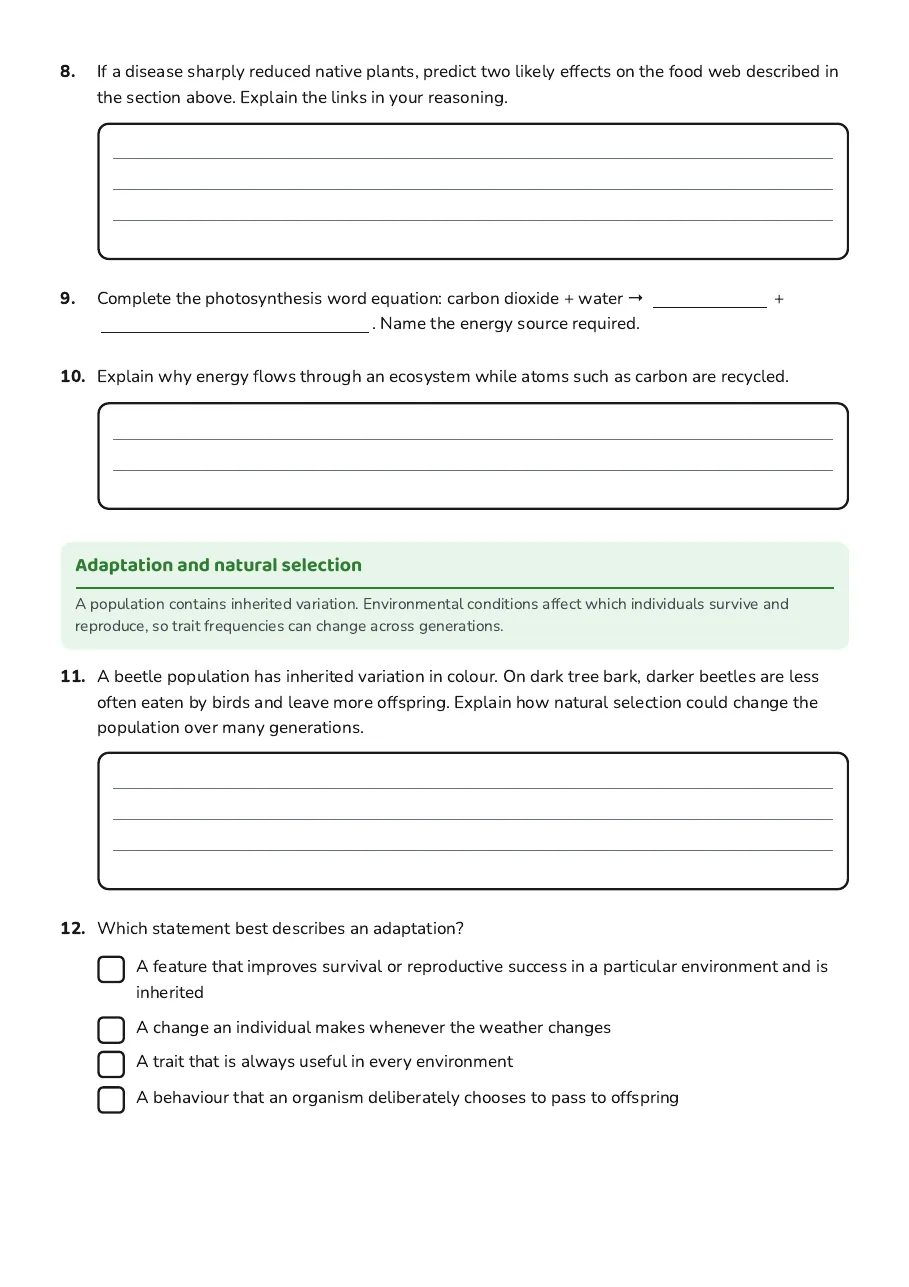
8.If a disease sharply reduced native plants, predict two likely effects on the food web described in the section above. Explain the links in your reasoning.
9.Complete the photosynthesis word equation: carbon dioxide + water → + . Name the energy source required.
10.Explain why energy flows through an ecosystem while atoms such as carbon are recycled.

Adaptation and natural selection

A population contains inherited variation. Environmental conditions affect which individuals survive and reproduce, so trait frequencies can change across generations.

11.A beetle population has inherited variation in colour. On dark tree bark, darker beetles are less often eaten by birds and leave more offspring. Explain how natural selection could change the population over many generations.
12.Which statement best describes an adaptation?
  • A feature that improves survival or reproductive success in a particular environment and is inherited
  • A change an individual makes whenever the weather changes
  • A trait that is always useful in every environment
  • A behaviour that an organism deliberately chooses to pass to offspring

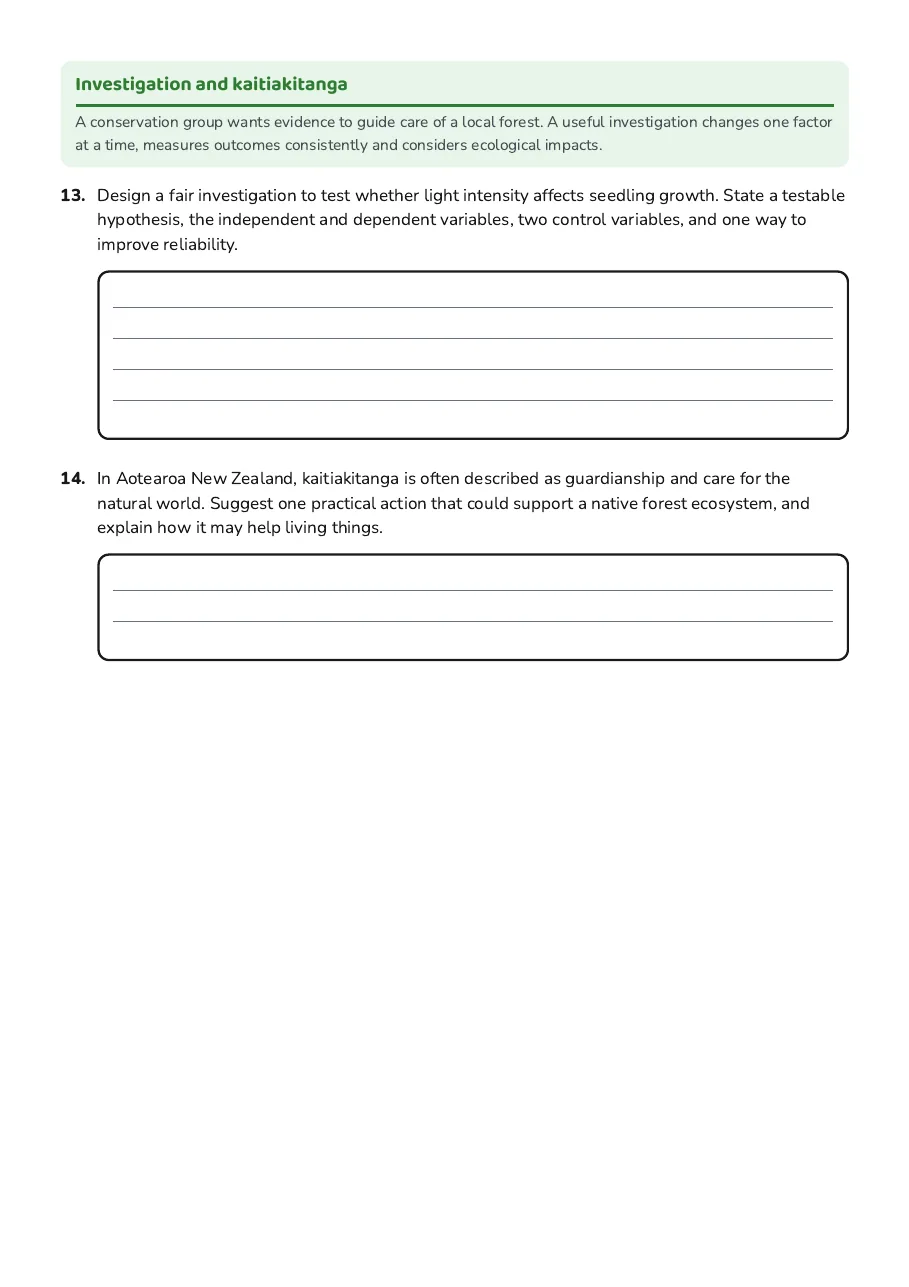
Investigation and kaitiakitanga

A conservation group wants evidence to guide care of a local forest. A useful investigation changes one factor at a time, measures outcomes consistently and considers ecological impacts.

13.Design a fair investigation to test whether light intensity affects seedling growth. State a testable hypothesis, the independent and dependent variables, two control variables, and one way to improve reliability.
14.In Aotearoa New Zealand, kaitiakitanga is often described as guardianship and care for the natural world. Suggest one practical action that could support a native forest ecosystem, and explain how it may help living things.

4 printable pages

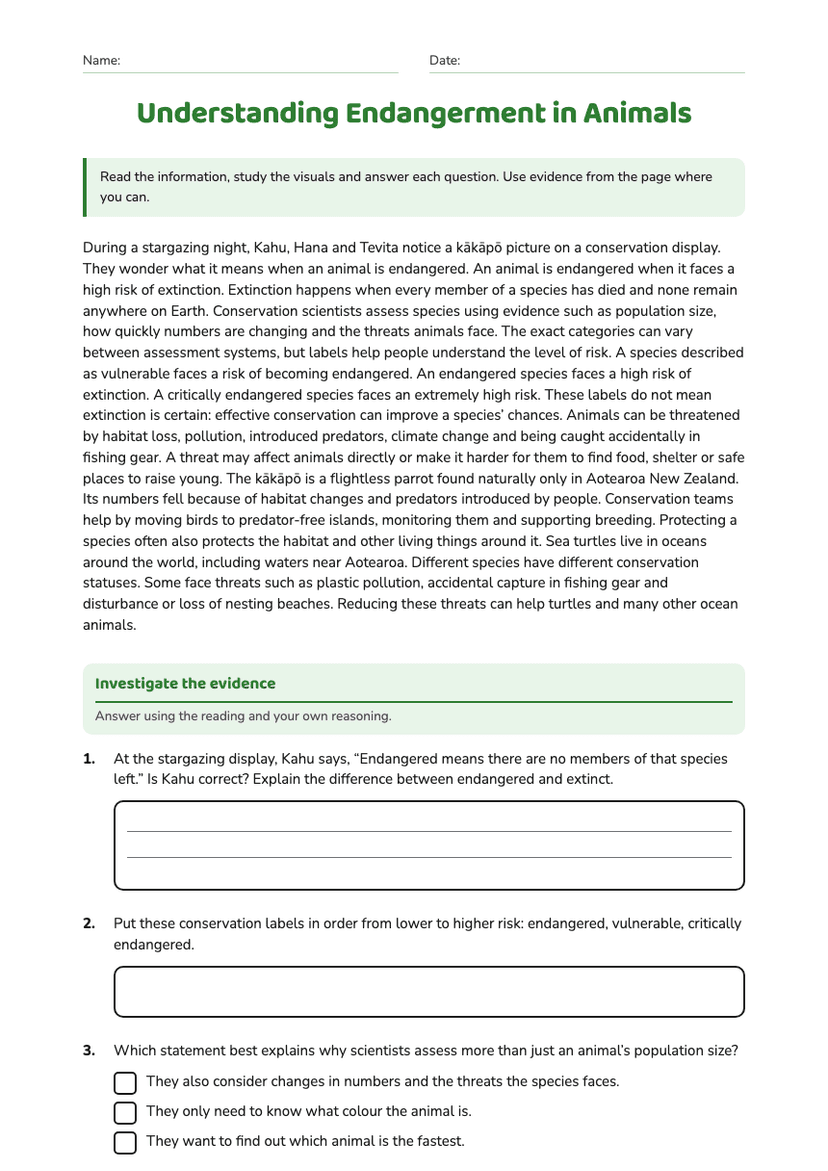
  • Living Things Workbook, page 1 of 4: Cells and organisation, Classification and biodiversity

    Page 1

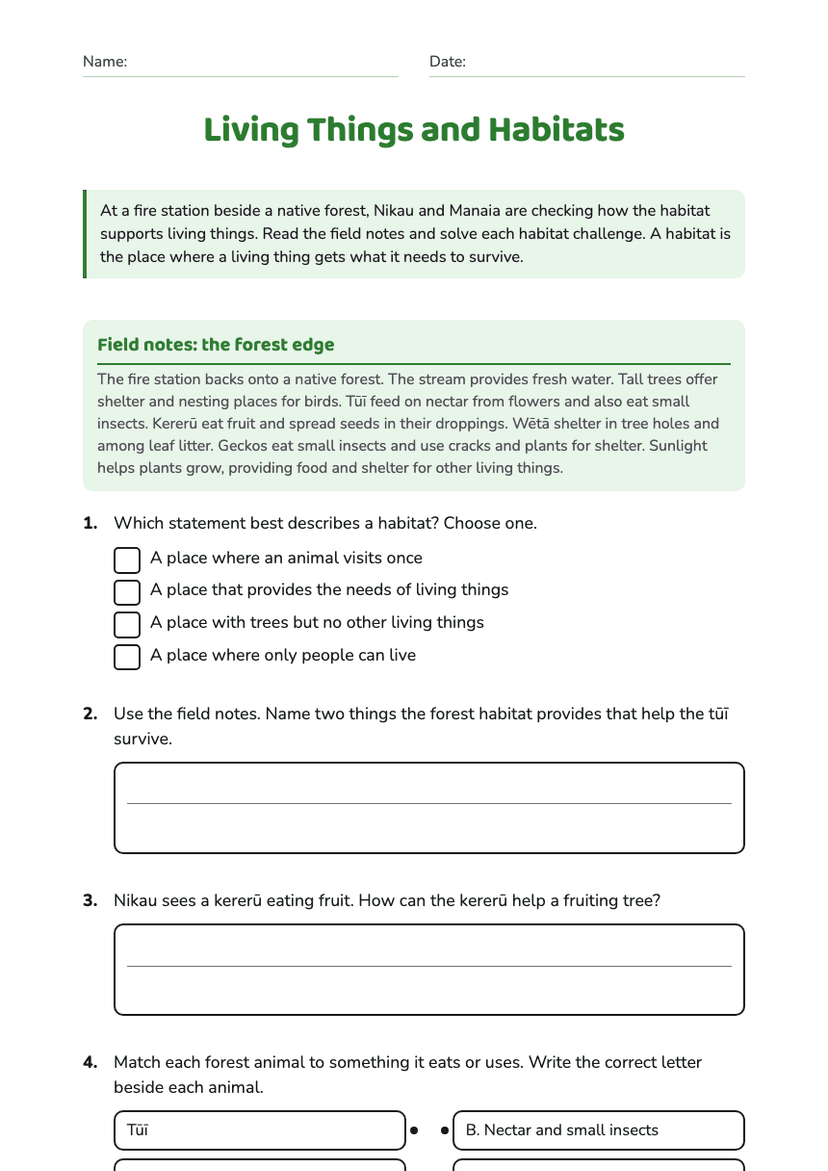
  • Living Things Workbook, page 2 of 4: Ecosystems, matter and energy

    Page 2

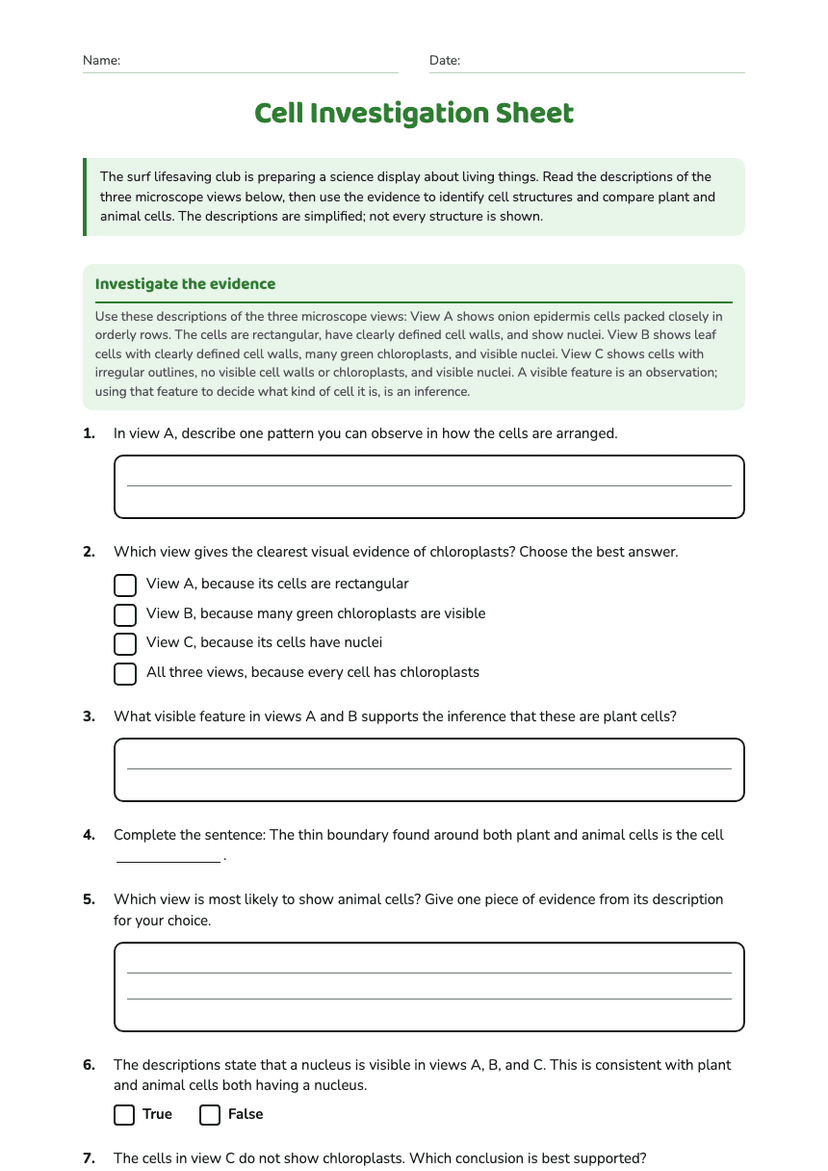
  • Living Things Workbook, page 3 of 4: Adaptation and natural selection

    Page 3

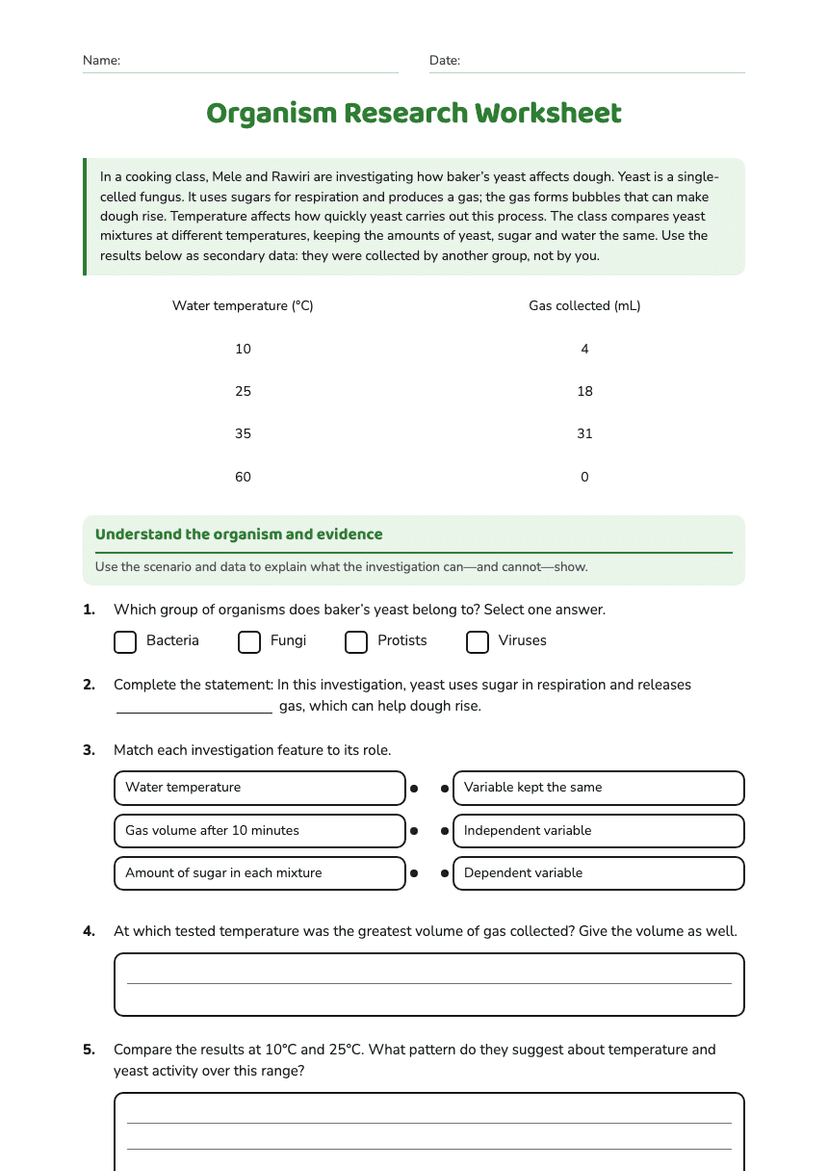
  • Living Things Workbook, page 4 of 4: Investigation and kaitiakitanga

    Page 4

About This Worksheet

Free in Kuraplan

Sign up free, grab the PDF, and customize it for your class.

Print-Ready

Formatted for standard paper. Clean layout, easy to read.

AI-Generated

Created with Kuraplan's AI, designed for real classroom use.

For Teachers & Parents

Use in classrooms, for homework, tutoring, or homeschool.

Need a custom version of this worksheet?

Kuraplan's AI generates custom worksheets in seconds — differentiated for every learner, aligned to your curriculum.

Generate Custom Worksheets — Free
No credit card Curriculum-aligned Under 60 seconds