Make Your Voice Heard
A free english worksheet ready for your classroom. Open in Kuraplan to grab the print-ready PDF, customize it for your students, or generate a fresh version in seconds.
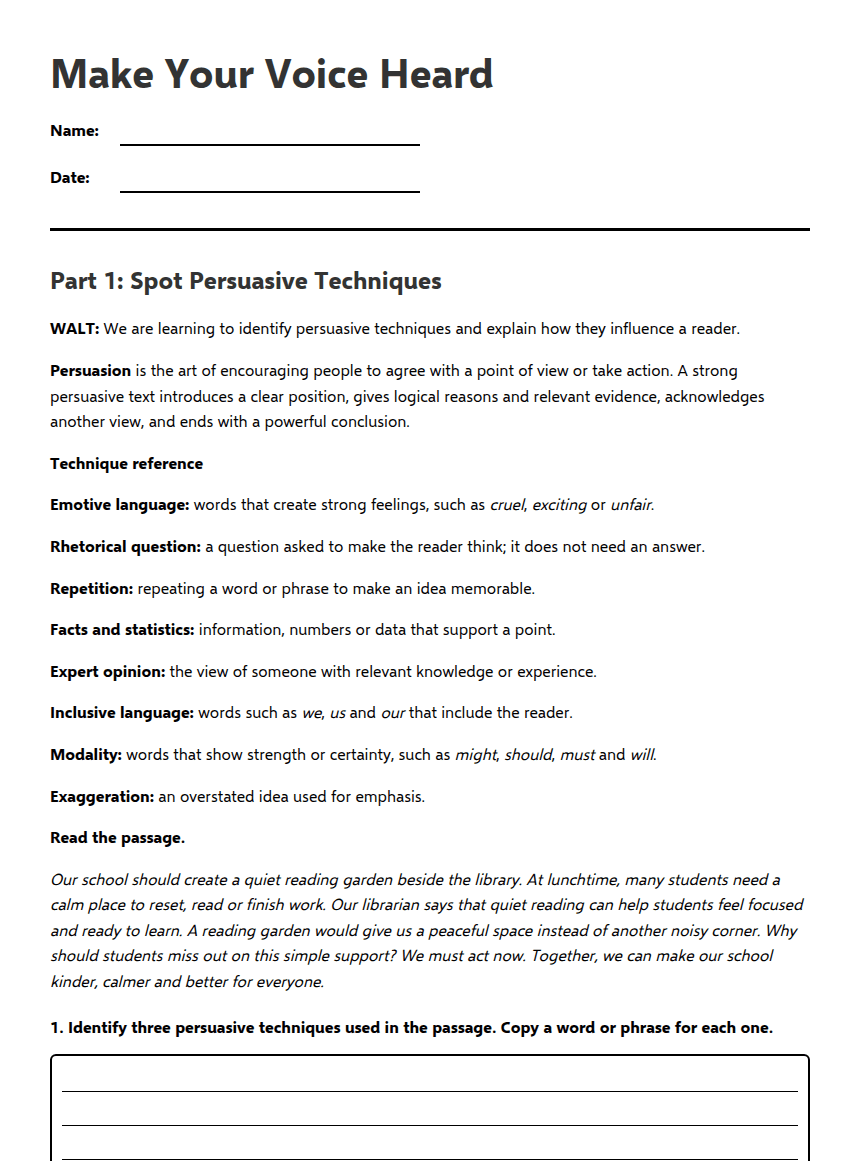
Make Your Voice Heard
Part 1: Spot Persuasive Techniques
WALT: We are learning to identify persuasive techniques and explain how they influence a reader.
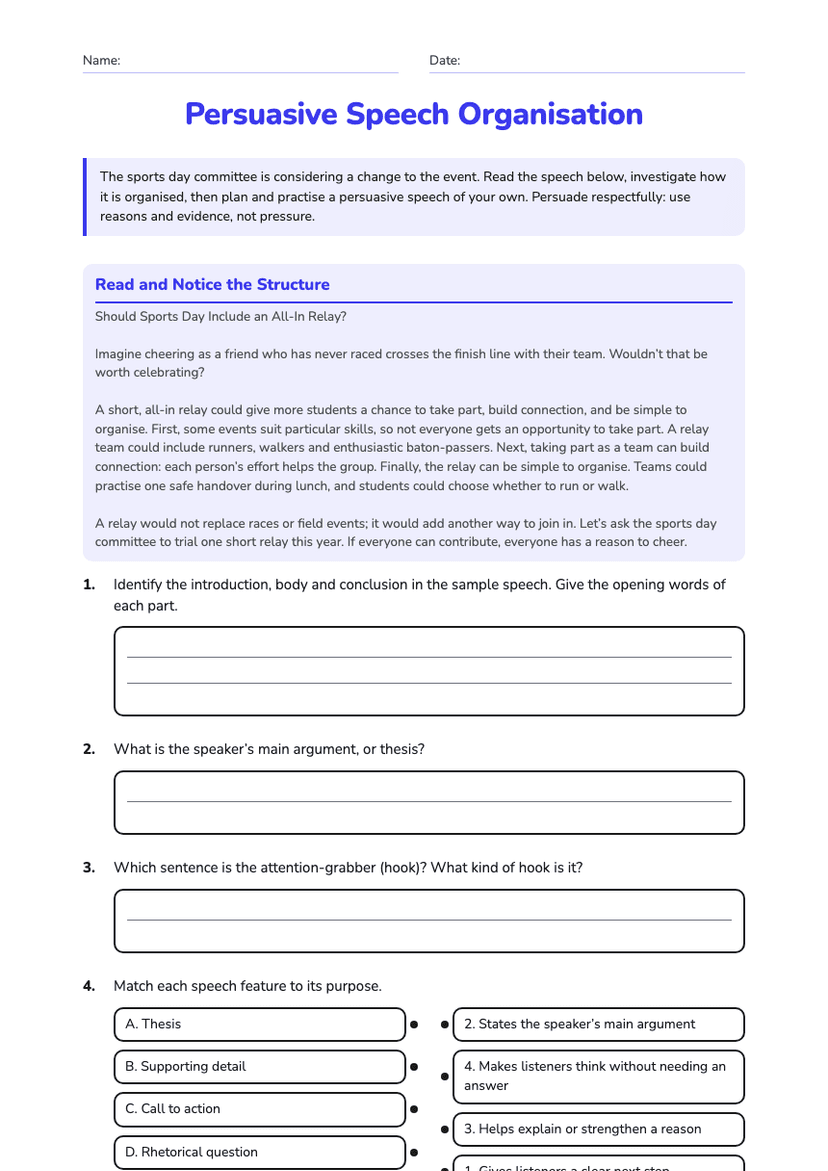
Persuasion is the art of encouraging people to agree with a point of view or take action. A strong persuasive text introduces a clear position, gives logical reasons and relevant evidence, acknowledges another view, and ends with a powerful conclusion.
Technique reference
Emotive language: words that create strong feelings, such as cruel, exciting or unfair.
Rhetorical question: a question asked to make the reader think; it does not need an answer.
Repetition: repeating a word or phrase to make an idea memorable.
Facts and statistics: information, numbers or data that support a point.
Expert opinion: the view of someone with relevant knowledge or experience.
Inclusive language: words such as we, us and our that include the reader.
Modality: words that show strength or certainty, such as might, should, must and will.
Exaggeration: an overstated idea used for emphasis.
Read the passage.
Our school should create a quiet reading garden beside the library. At lunchtime, many students need a calm place to reset, read or finish work. Our librarian says that quiet reading can help students feel focused and ready to learn. A reading garden would give us a peaceful space instead of another noisy corner. Why should students miss out on this simple support? We must act now. Together, we can make our school kinder, calmer and better for everyone.
Dyslexia-friendly option: Read the passage aloud, use a coloured ruler to track each line, or listen while a partner reads. You may answer in keywords before writing full sentences.
Part 2: Classify and Plan
WALT: We are learning to select persuasive techniques and plan a paragraph with logical reasoning and relevant evidence.
Planning a persuasive paragraph
Choose a school-relevant issue, such as homework, mobile phones, lunchtime activities, uniforms, school gardens or study spaces.
Success criteria: I can...
☐ clearly introduce my preferred position.
☐ support my position with three logical reasons.
☐ include relevant evidence or an example.
☐ acknowledge an opposing position respectfully.
☐ use persuasive techniques for a clear purpose.
☐ finish with a strong concluding sentence.
Differentiation: Use the technique reference, a word bank, speech-to-text, or a planning partner. You may draw a mind map before writing. Challenge yourself to vary sentence length and use precise vocabulary.
Extension challenge: Write the full persuasive paragraph. Include a counterargument and rebuttal, one fact or statistic, one expert opinion, and a sentence using strong modality.
Curriculum alignment: NZ-TMA-ENGLISH-Y7-8-writing-251-DOC129 — Writing to persuade: clearly introduce a preferred position, support it with logical reasoning and relevant evidence, acknowledge an opposing position, and use a strong conclusion.
Teacher Answer Key — Separate Final Page
Activity 1
1. Possible answers include: emotive language — “kinder, calmer and better”; rhetorical question — “Why should students miss out on this simple support?”; expert opinion — “Our librarian says…”; inclusive language — “we”, “us” and “our”; modality — “should” and “must”; exaggeration — “another noisy corner” may be accepted as descriptive rather than exaggeration, depending on discussion.
2. Accept explanations that link the technique to its effect. For example, the rhetorical question encourages readers to consider whether students are being treated fairly.
3. The writer believes the school should create a quiet reading garden beside the library. The writer wants the school to provide a calm lunchtime space.
4. Evidence: “Our librarian says that quiet reading can help students feel focused and ready to learn.” Opinion: “Our school should create a quiet reading garden.” Accept other valid choices with clear labels.
Activity 2
5. 1–A, 2–B, 3–C, 4–D, 5–E, 6–F, 7–G, 8–H.
Planning and paragraph
6–10. Answers will vary. Check that students state a clear position, provide three logical reasons, include relevant evidence or an example, acknowledge an opposing position, select purposeful techniques, and write a strong conclusion.
Suggested paragraph structure: position and reason → evidence or example → second reason → opposing position and rebuttal → strong conclusion.
Teacher differentiation notes: Confer with students who need help choosing an issue. Provide sentence starters such as “Our school should…”, “Some people believe…, however…”, and “For these reasons, we must…”. Encourage advanced learners to analyse which technique is most effective for their chosen audience and explain why.
About This Worksheet
Free in Kuraplan
Sign up free, grab the PDF, and customize it for your class.
Print-Ready
Formatted for standard paper. Clean layout, easy to read.
AI-Generated
Created with Kuraplan's AI, designed for real classroom use.
For Teachers & Parents
Use in classrooms, for homework, tutoring, or homeschool.
Need a custom version of this worksheet?
Kuraplan's AI generates custom worksheets in seconds — differentiated for every learner, aligned to your curriculum.
Generate Custom Worksheets — Free