ScienceFreePrintable

Material Properties Investigation

A free science worksheet ready for your classroom. Open in Kuraplan to grab the print-ready PDF, customize it for your students, or generate a fresh version in seconds.
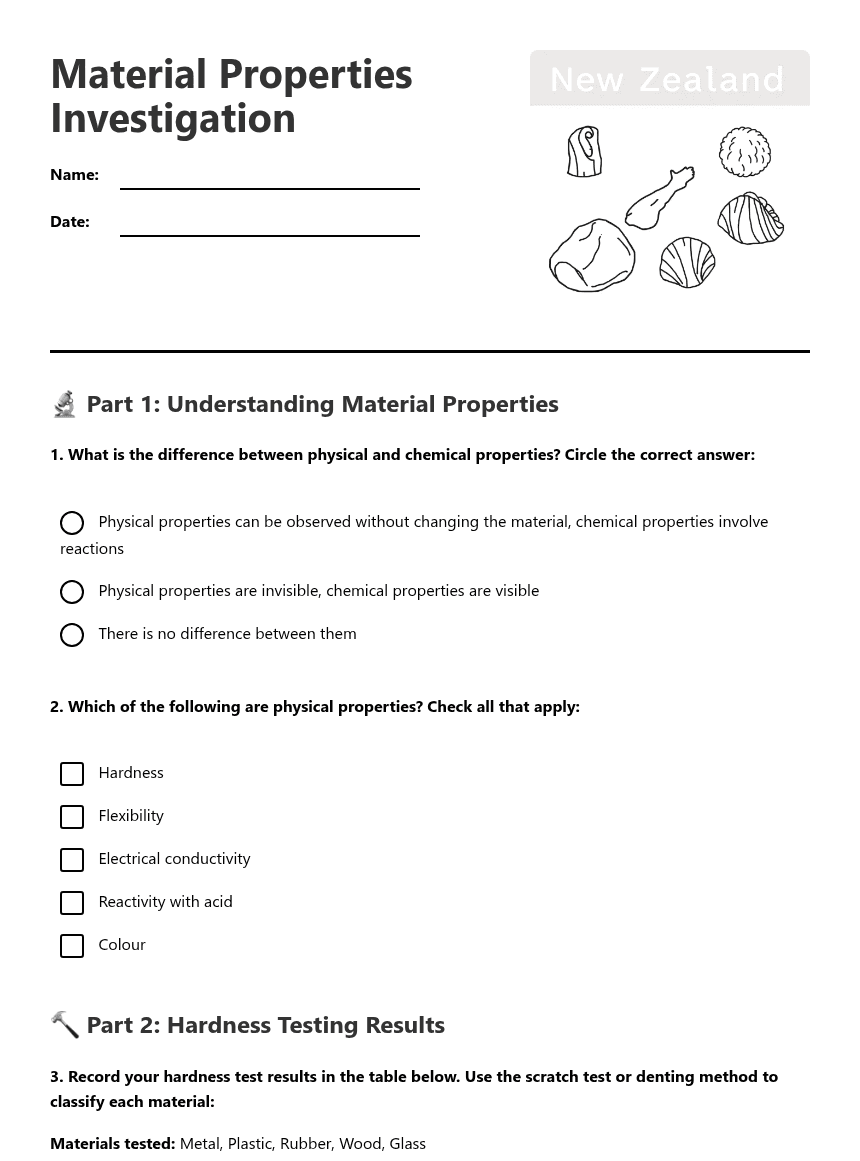
Material Properties Investigation worksheet preview

Material Properties Investigation

Material Properties Investigation

Materials and testing equipment illustration

🔬 Part 1: Understanding Material Properties

1. What is the difference between physical and chemical properties? Circle the correct answer:

Physical properties can be observed without changing the material, chemical properties involve reactions

Physical properties are invisible, chemical properties are visible

There is no difference between them

2. Which of the following are physical properties? Check all that apply:

Hardness

Flexibility

Electrical conductivity

Reactivity with acid

Colour

🔨 Part 2: Hardness Testing Results

3. Record your hardness test results in the table below. Use the scratch test or denting method to classify each material:

Materials tested: Metal, Plastic, Rubber, Wood, Glass

4. Which material was the hardest? Explain your reasoning:
5. Why might hardness be an important property when choosing materials for building construction?

🌊 Part 3: Flexibility Testing Results

6. Record your flexibility test results. Apply gentle pressure or weights to test each material's ability to bend:
7. Classify each material as either "Flexible" or "Rigid":

Metal: _____________ Plastic: _____________ Rubber: _____________

Wood: _____________ Glass: _____________

8. Give two examples of everyday objects where flexibility is essential:

⚡ Part 4: Electrical Conductivity Testing

9. Using the electrical circuit, test which materials conduct electricity. Record your observations:
10. Circle whether each material is a conductor or insulator:

Metal: Conductor / Insulator

Plastic: Conductor / Insulator

Rubber: Conductor / Insulator

Wood: Conductor / Insulator

Glass: Conductor / Insulator

11. Why is rubber commonly used to cover electrical wires?

🧪 Part 5: Chemical Properties Introduction

12. Chemical properties involve how materials react with other substances. Which of these is an example of a chemical property?

How shiny a metal surface appears

How easily iron rusts when exposed to water and oxygen

How heavy a piece of wood feels

How smooth plastic feels to touch

13. Match the material property with its real-world application:
1. High electrical conductivity
2. High flexibility
3. High hardness
4. Low electrical conductivity
A. Safety gloves for electricians
B. Copper wires in electronics
C. Diamond cutting tools
D. Yoga mats and exercise bands

💭 Part 6: Reflection and Analysis

14. What was the most interesting property you tested today? Explain why:
15. How do material properties influence how materials are used in everyday life? Give three specific examples:
16. Design a simple test to investigate one additional property of materials (e.g., density, thermal conductivity, or water resistance). Describe your method:
17. Safety Reflection: What safety precautions did you follow during today's experiments?

About This Worksheet

Free in Kuraplan

Sign up free, grab the PDF, and customize it for your class.

Print-Ready

Formatted for standard paper. Clean layout, easy to read.

AI-Generated

Created with Kuraplan's AI, designed for real classroom use.

For Teachers & Parents

Use in classrooms, for homework, tutoring, or homeschool.

Need a custom version of this worksheet?

Kuraplan's AI generates custom worksheets in seconds — differentiated for every learner, aligned to your curriculum.

Generate Custom Worksheets — Free
No credit card Curriculum-aligned Under 60 seconds