ScienceFreePrintable

Habitats and Ecosystems

A free science worksheet ready for your classroom. Open in Kuraplan to grab the print-ready PDF, customize it for your students, or generate a fresh version in seconds.
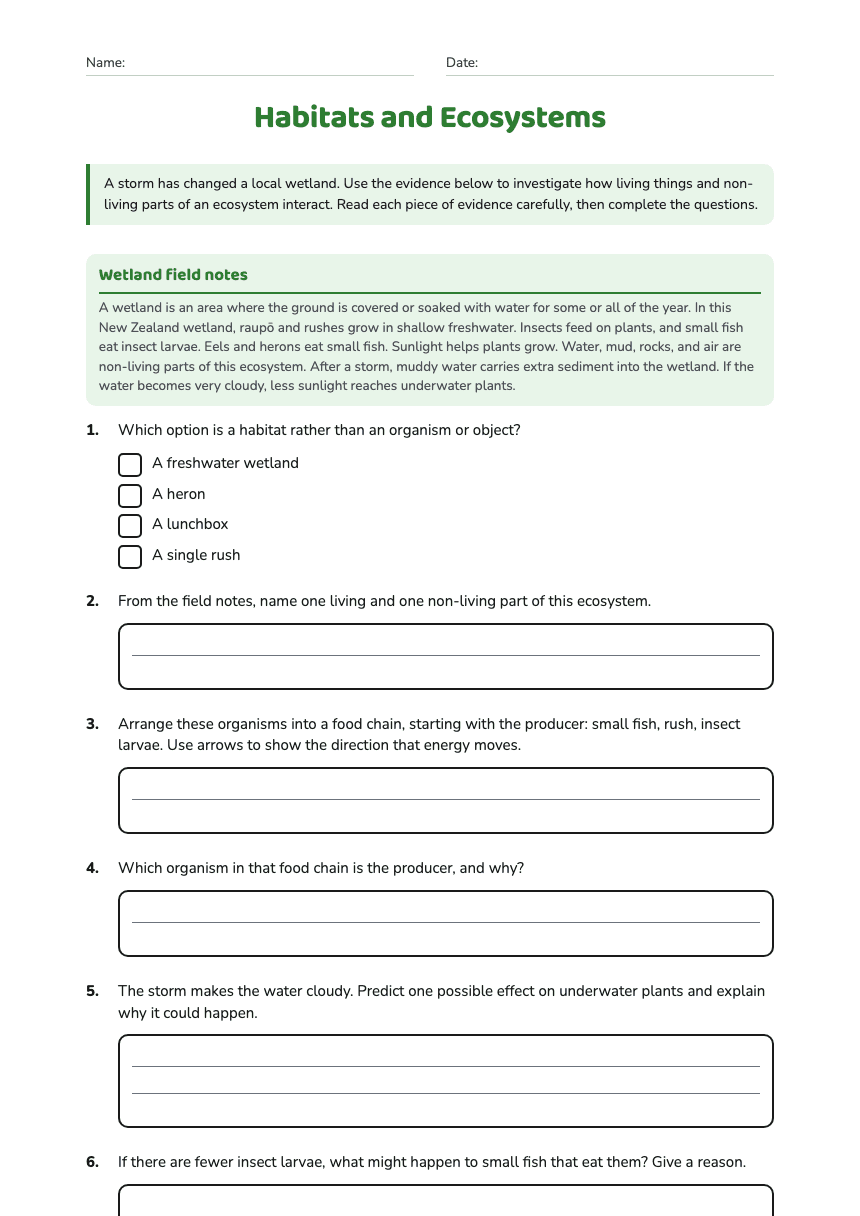
Habitats and Ecosystems worksheet preview
Name:Date:

Habitats and Ecosystems

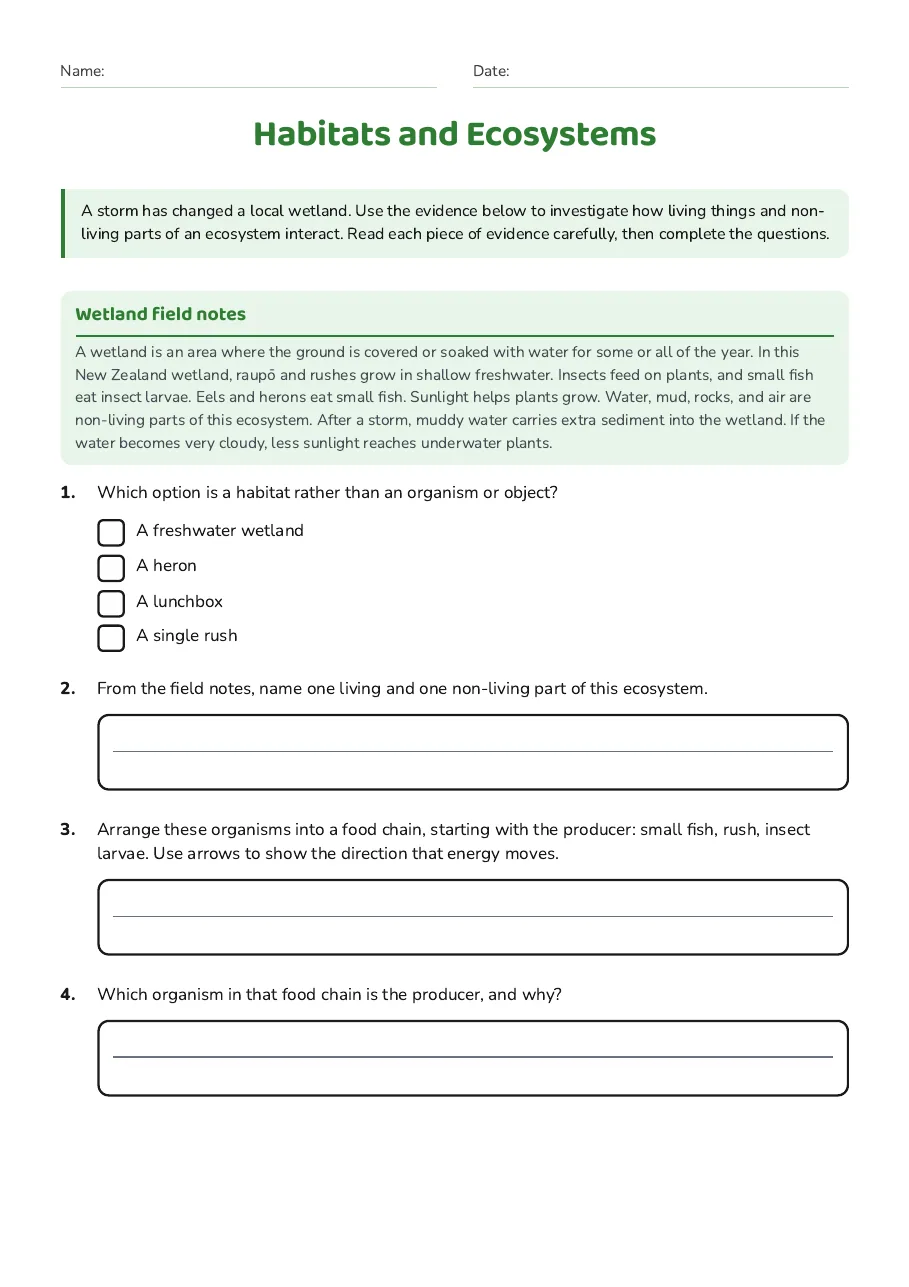
A storm has changed a local wetland. Use the evidence below to investigate how living things and non-living parts of an ecosystem interact. Read each piece of evidence carefully, then complete the questions.

Wetland field notes

A wetland is an area where the ground is covered or soaked with water for some or all of the year. In this New Zealand wetland, raupō and rushes grow in shallow freshwater. Insects feed on plants, and small fish eat insect larvae. Eels and herons eat small fish. Sunlight helps plants grow. Water, mud, rocks, and air are non-living parts of this ecosystem. After a storm, muddy water carries extra sediment into the wetland. If the water becomes very cloudy, less sunlight reaches underwater plants.

1.Which option is a habitat rather than an organism or object?
  • A freshwater wetland
  • A heron
  • A lunchbox
  • A single rush
2.From the field notes, name one living and one non-living part of this ecosystem.
3.Arrange these organisms into a food chain, starting with the producer: small fish, rush, insect larvae. Use arrows to show the direction that energy moves.
4.Which organism in that food chain is the producer, and why?
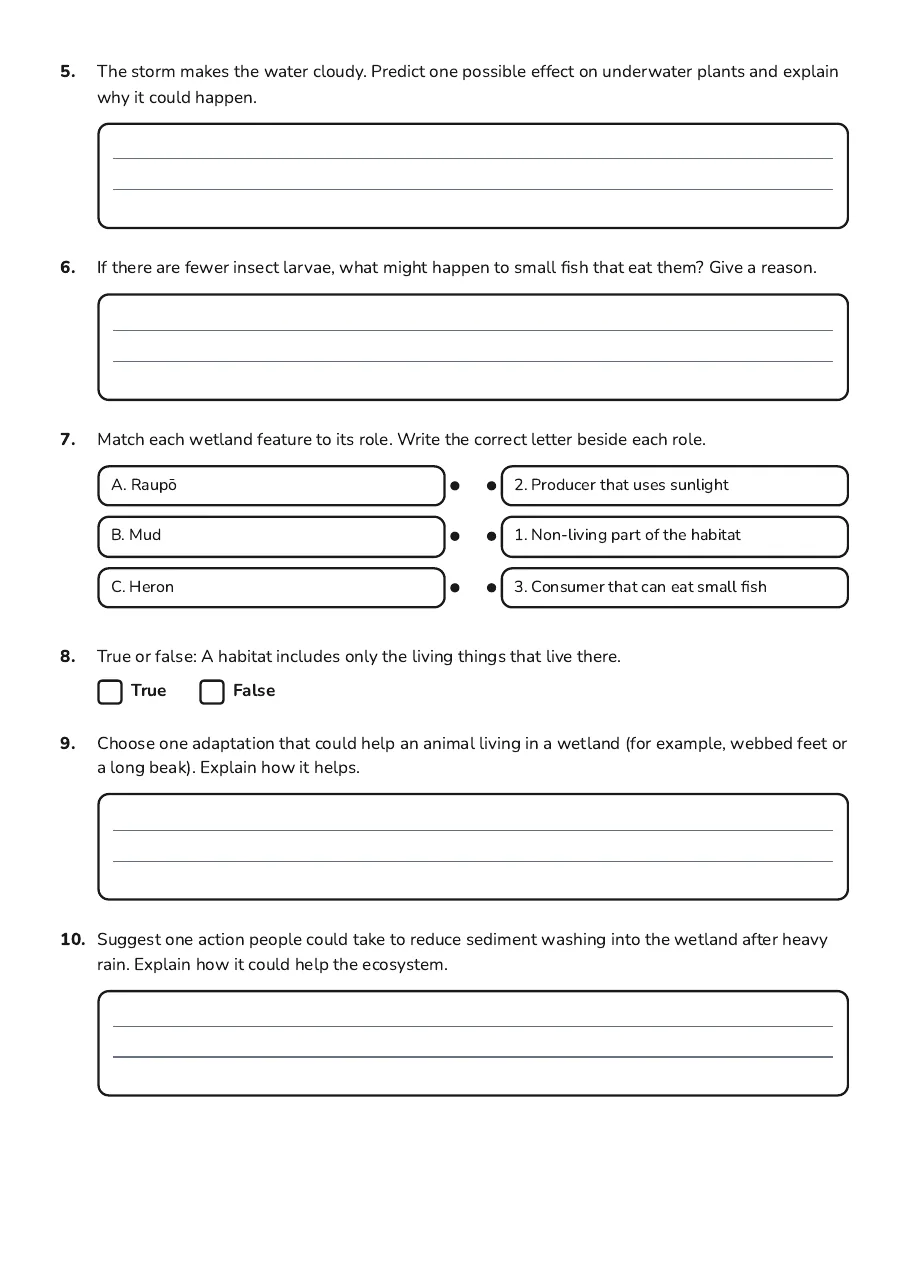
5.The storm makes the water cloudy. Predict one possible effect on underwater plants and explain why it could happen.
6.If there are fewer insect larvae, what might happen to small fish that eat them? Give a reason.
7.Match each wetland feature to its role. Write the correct letter beside each role.
  • A. Raupō
  • B. Mud
  • C. Heron
  • 2. Producer that uses sunlight
  • 1. Non-living part of the habitat
  • 3. Consumer that can eat small fish
8.True or false: A habitat includes only the living things that live there.
TrueFalse
9.Choose one adaptation that could help an animal living in a wetland (for example, webbed feet or a long beak). Explain how it helps.
10.Suggest one action people could take to reduce sediment washing into the wetland after heavy rain. Explain how it could help the ecosystem.

2 printable pages

  • Habitats and Ecosystems, page 1 of 2: Wetland field notes

    Page 1

  • Habitats and Ecosystems, page 2 of 2: 5. The storm makes the water cloudy. Predict one possible effect on underwater plants and…

    Page 2

About This Worksheet

Free in Kuraplan

Sign up free, grab the PDF, and customize it for your class.

Print-Ready

Formatted for standard paper. Clean layout, easy to read.

AI-Generated

Created with Kuraplan's AI, designed for real classroom use.

For Teachers & Parents

Use in classrooms, for homework, tutoring, or homeschool.

Need a custom version of this worksheet?

Kuraplan's AI generates custom worksheets in seconds — differentiated for every learner, aligned to your curriculum.

Generate Custom Worksheets — Free
No credit card Curriculum-aligned Under 60 seconds