Materials Classification Worksheet
A free science worksheet ready for your classroom. Open in Kuraplan to grab the print-ready PDF, customize it for your students, or generate a fresh version in seconds.
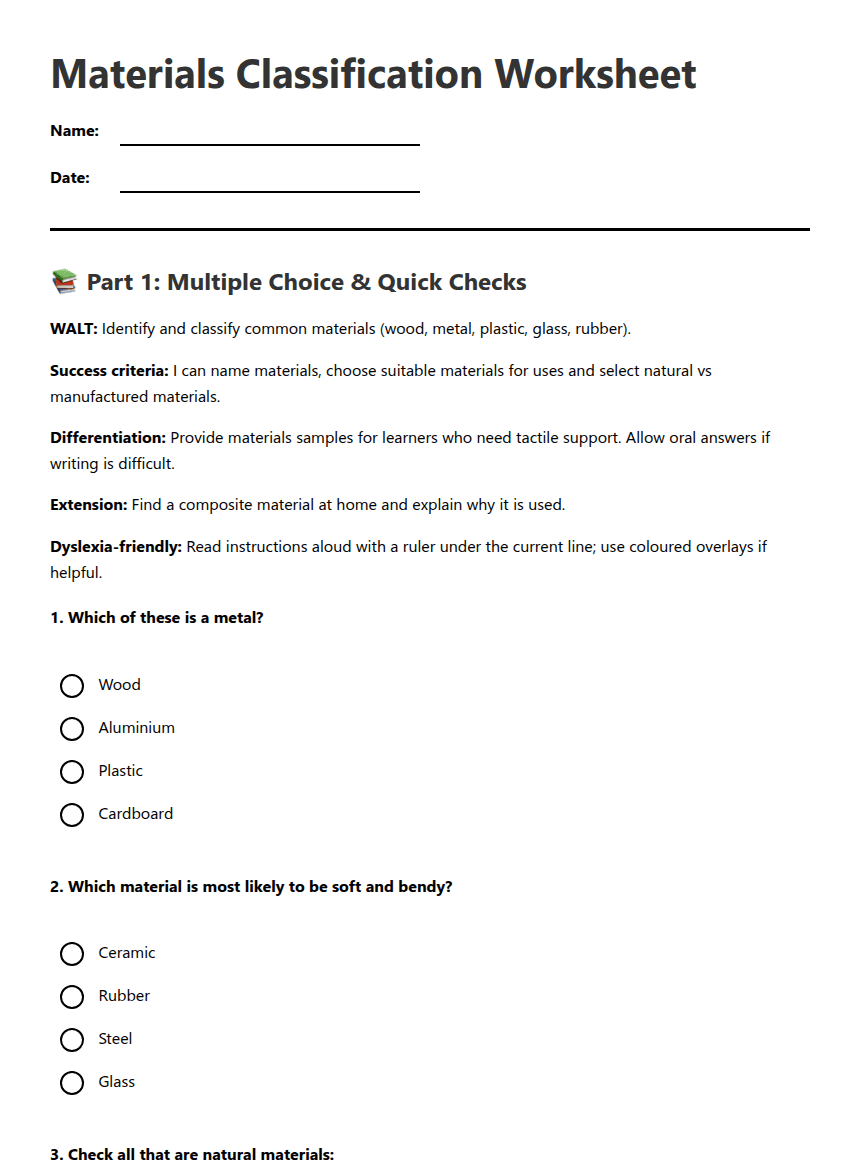
Materials Classification Worksheet
📚 Part 1: Multiple Choice & Quick Checks
WALT: Identify and classify common materials (wood, metal, plastic, glass, rubber).
Success criteria: I can name materials, choose suitable materials for uses and select natural vs manufactured materials.
Differentiation: Provide materials samples for learners who need tactile support. Allow oral answers if writing is difficult.
Extension: Find a composite material at home and explain why it is used.
Dyslexia-friendly: Read instructions aloud with a ruler under the current line; use coloured overlays if helpful.
✏️ Part 2: Short Answers & Matching
WALT: Explain why certain materials are used for specific purposes.
Success criteria: I can match materials to properties and give short reasons for choices.
Differentiation: Provide sentence starters or a word bank for learners who need writing support.
Dyslexia-friendly: Use short sentences and clear spacing for each question.
🛠️ Part 3: Practical / Extension
WALT: Apply classification skills to real objects and create labels.
Success criteria: I can draw, label and explain the material used for everyday objects.
Extension: Research a composite material and write one sentence about why it is used (e.g. fibreglass, plywood).
Differentiation: Pair learners for the activity so one can record while the other explains.
About This Worksheet
Free in Kuraplan
Sign up free, grab the PDF, and customize it for your class.
Print-Ready
Formatted for standard paper. Clean layout, easy to read.
AI-Generated
Created with Kuraplan's AI, designed for real classroom use.
For Teachers & Parents
Use in classrooms, for homework, tutoring, or homeschool.
Need a custom version of this worksheet?
Kuraplan's AI generates custom worksheets in seconds — differentiated for every learner, aligned to your curriculum.
Generate Custom Worksheets — Free