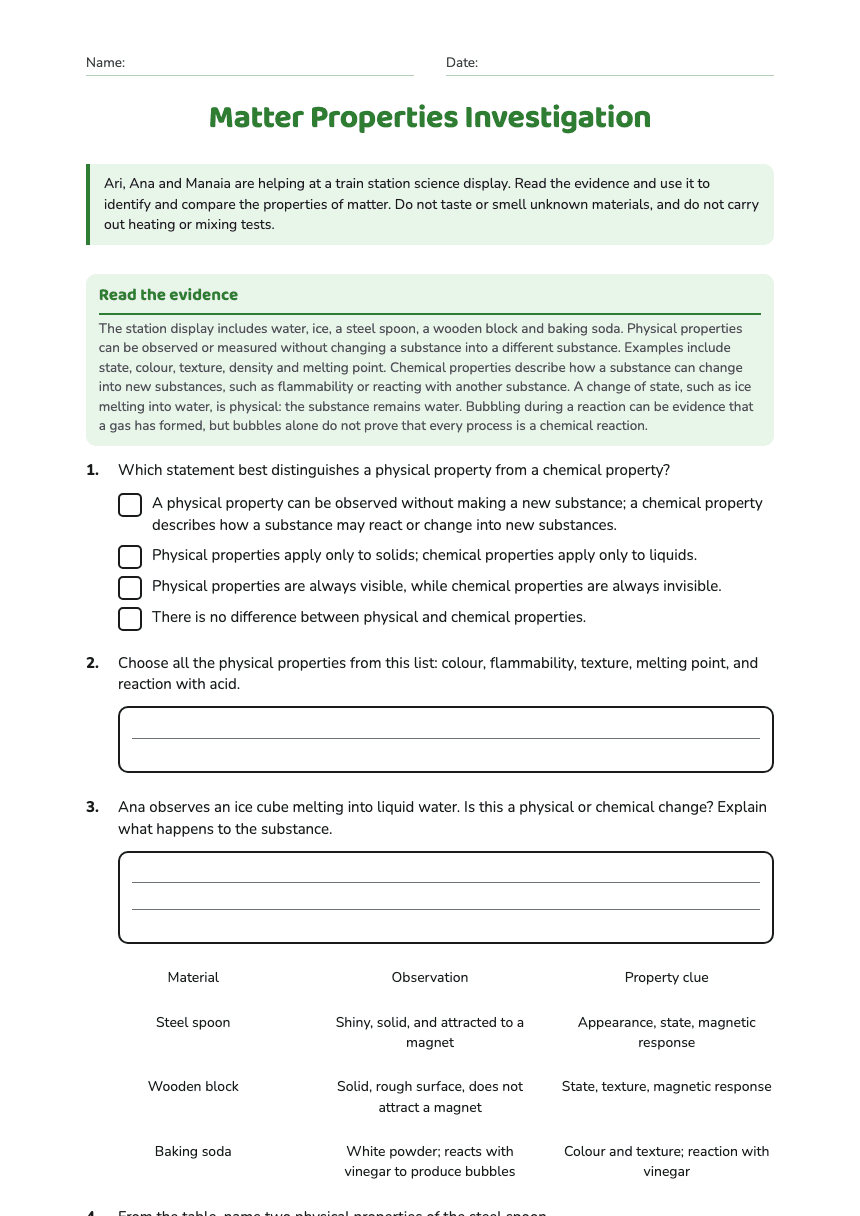
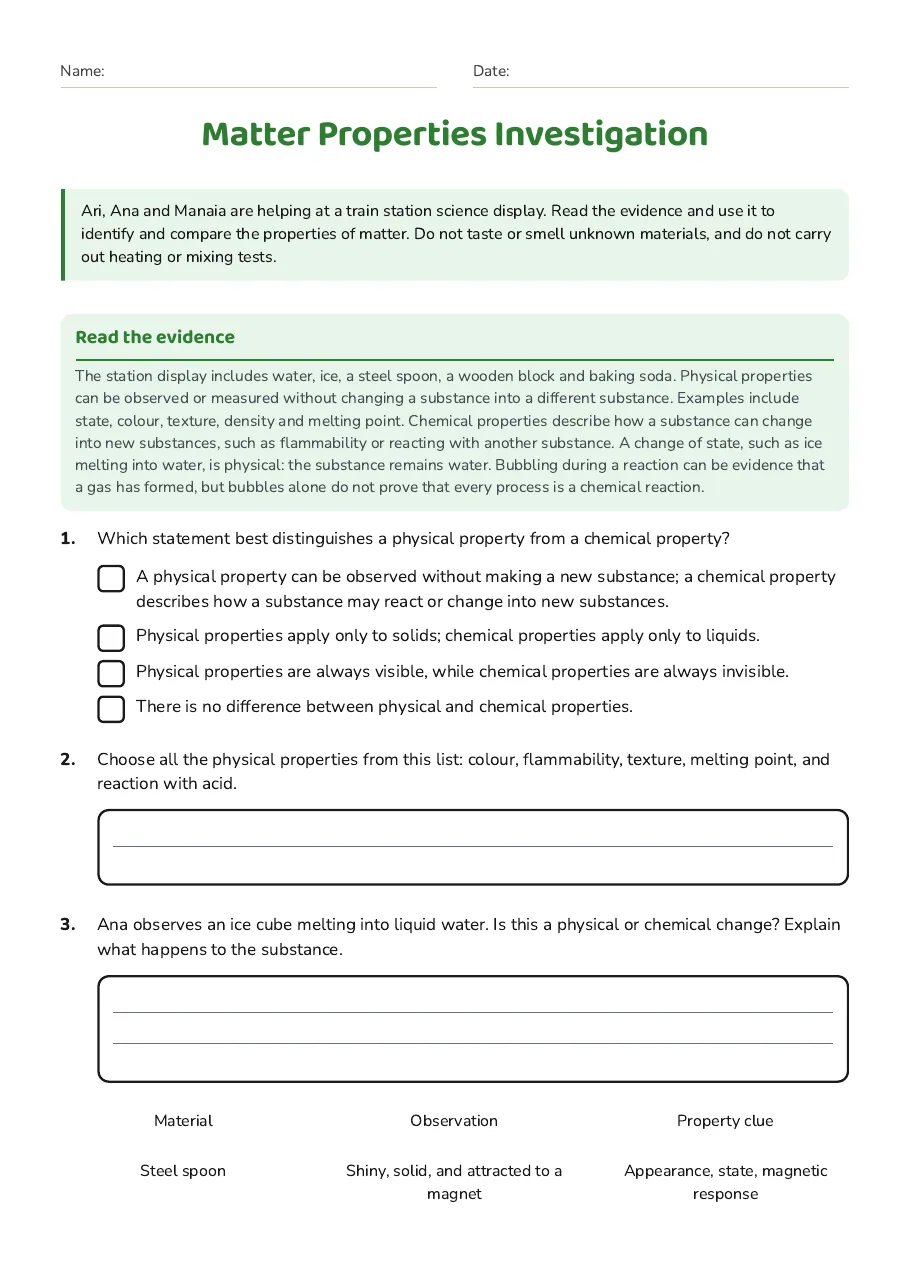
Matter Properties Investigation
A free science worksheet ready for your classroom. Open in Kuraplan to grab the print-ready PDF, customize it for your students, or generate a fresh version in seconds.
Matter Properties Investigation
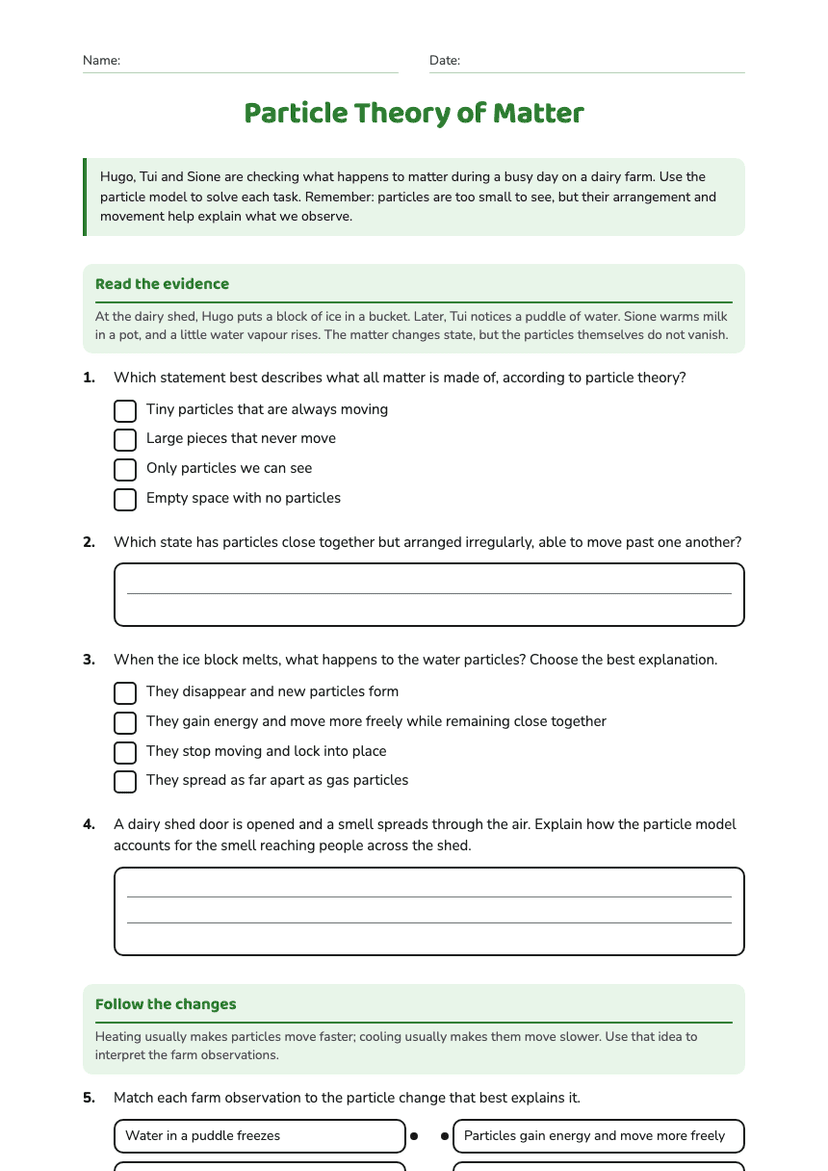
Read the evidence
The station display includes water, ice, a steel spoon, a wooden block and baking soda. Physical properties can be observed or measured without changing a substance into a different substance. Examples include state, colour, texture, density and melting point. Chemical properties describe how a substance can change into new substances, such as flammability or reacting with another substance. A change of state, such as ice melting into water, is physical: the substance remains water. Bubbling during a reaction can be evidence that a gas has formed, but bubbles alone do not prove that every process is a chemical reaction.
- A physical property can be observed without making a new substance; a chemical property describes how a substance may react or change into new substances.
- Physical properties apply only to solids; chemical properties apply only to liquids.
- Physical properties are always visible, while chemical properties are always invisible.
- There is no difference between physical and chemical properties.
Material
Observation
Property clue
Steel spoon
Shiny, solid, and attracted to a magnet
Appearance, state, magnetic response
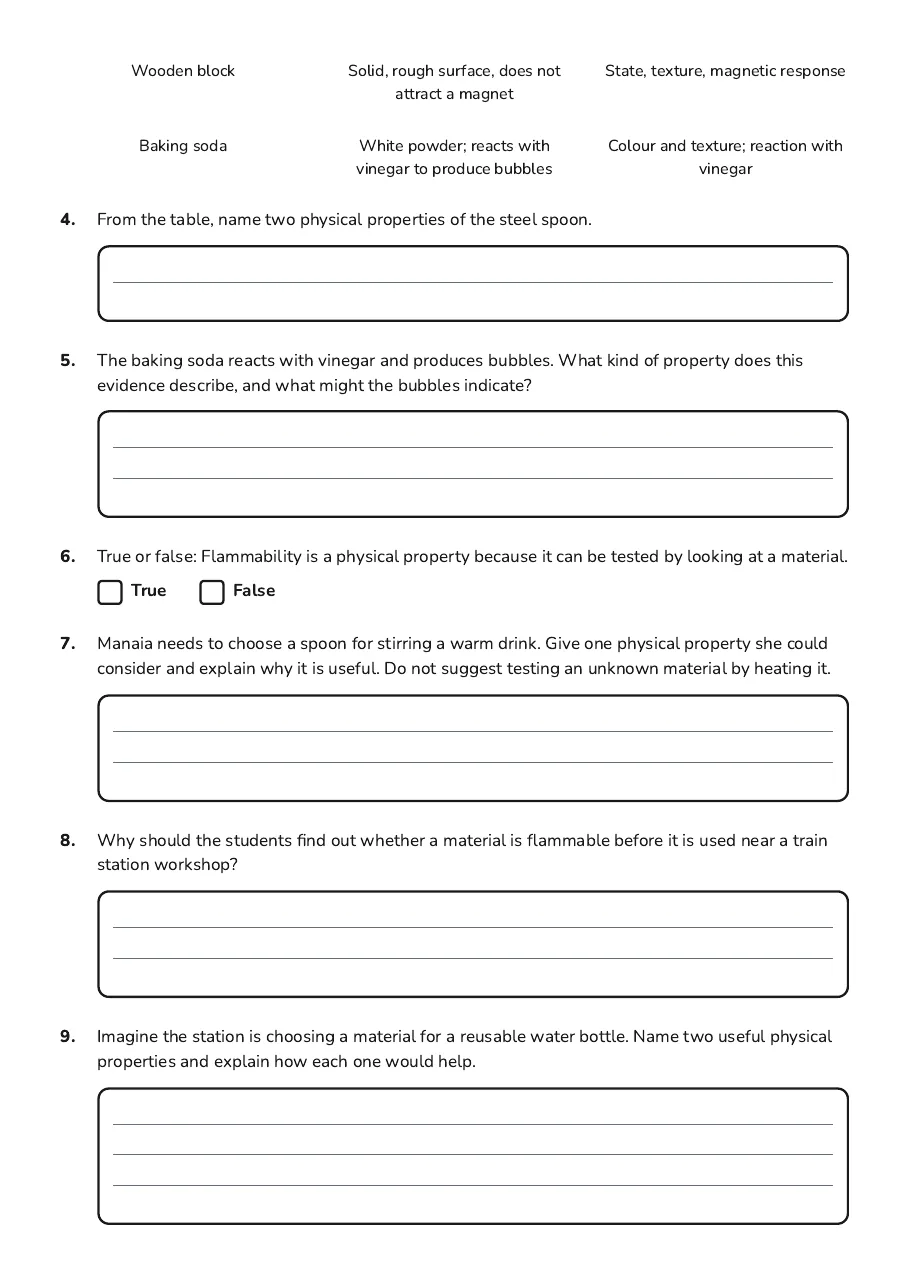
Wooden block
Solid, rough surface, does not attract a magnet
State, texture, magnetic response
Baking soda
White powder; reacts with vinegar to produce bubbles
Colour and texture; reaction with vinegar
3 printable pages
Page 1
Page 2

Page 3
About This Worksheet
Free in Kuraplan
Sign up free, grab the PDF, and customize it for your class.
Print-Ready
Formatted for standard paper. Clean layout, easy to read.
AI-Generated
Created with Kuraplan's AI, designed for real classroom use.
For Teachers & Parents
Use in classrooms, for homework, tutoring, or homeschool.
Need a custom version of this worksheet?
Kuraplan's AI generates custom worksheets in seconds — differentiated for every learner, aligned to your curriculum.
Generate Custom Worksheets — Free