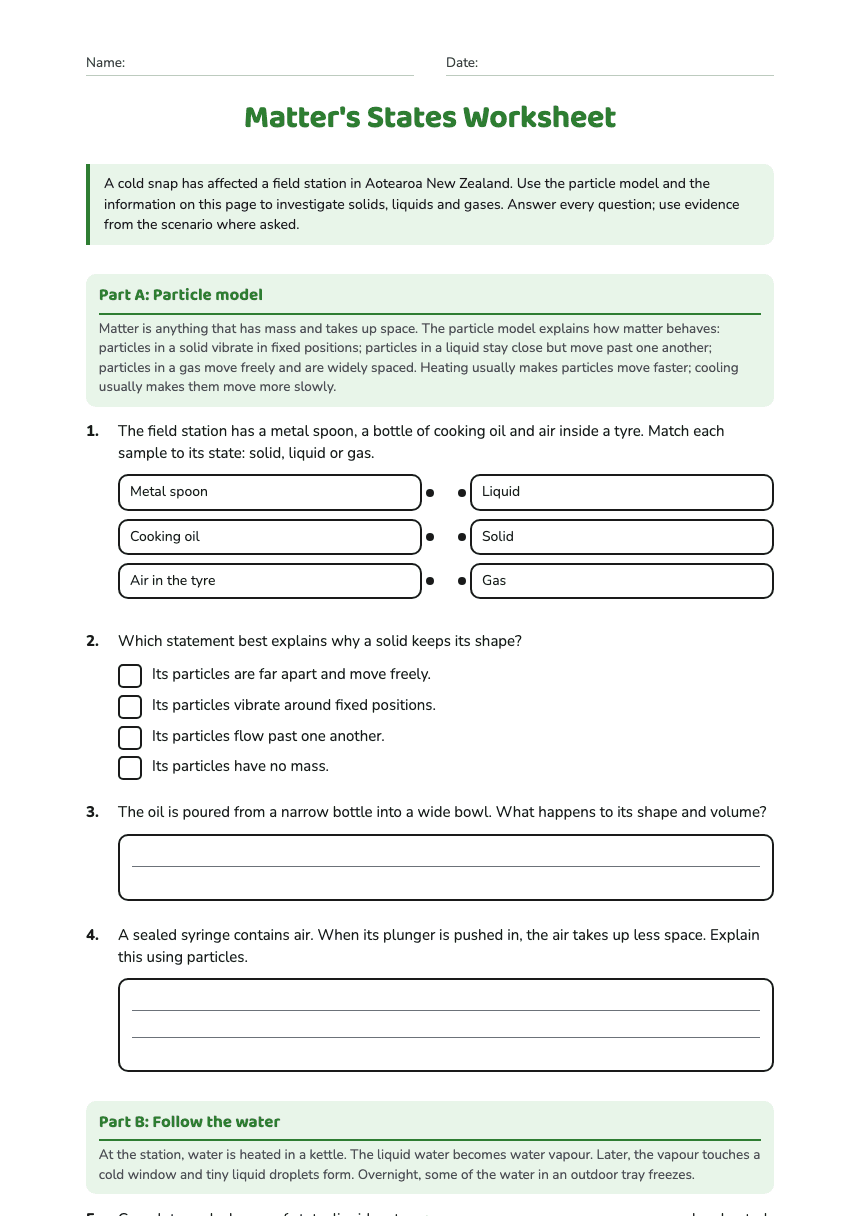
Matter's States Worksheet
A free science worksheet ready for your classroom. Open in Kuraplan to grab the print-ready PDF, customize it for your students, or generate a fresh version in seconds.
Matter's States Worksheet
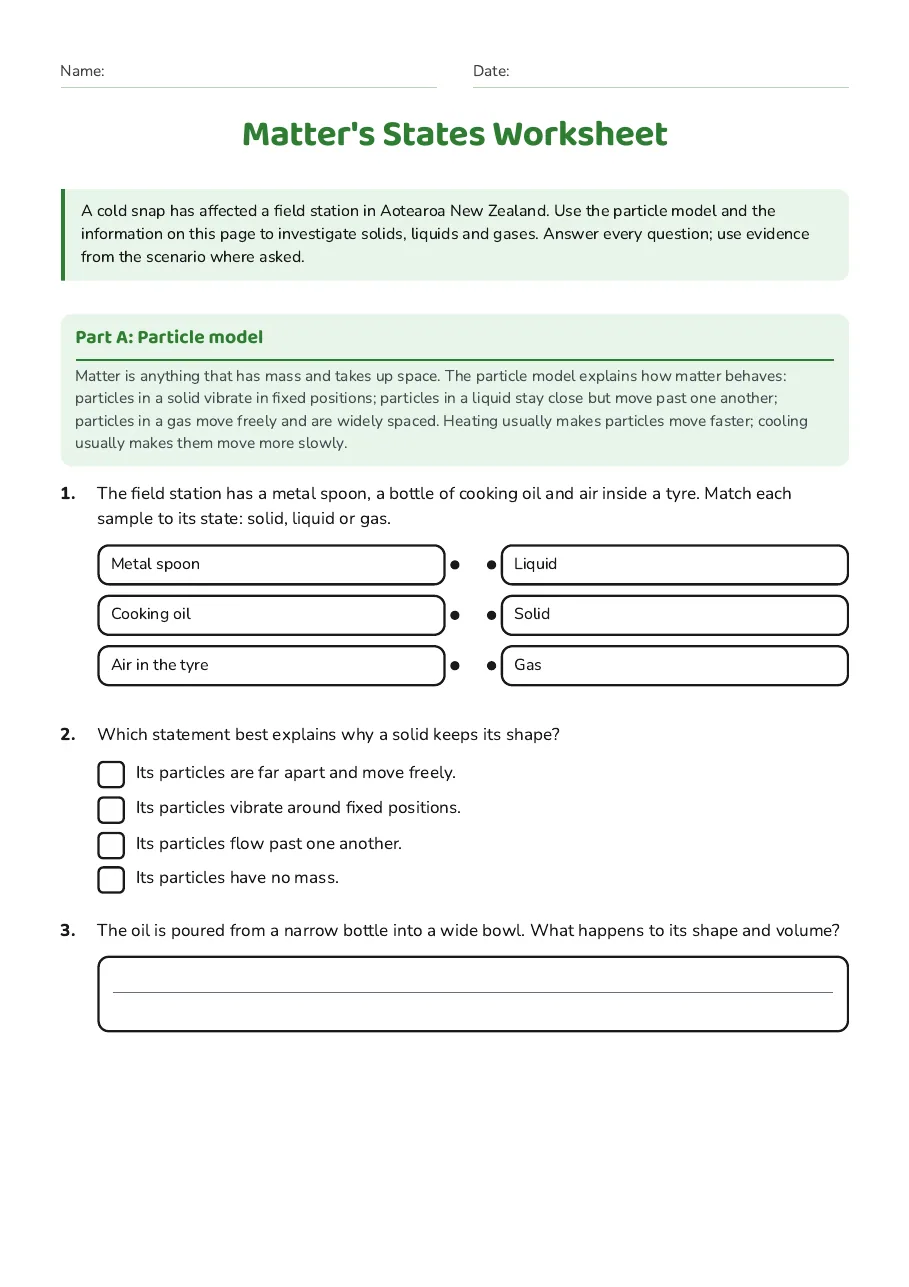
Part A: Particle model
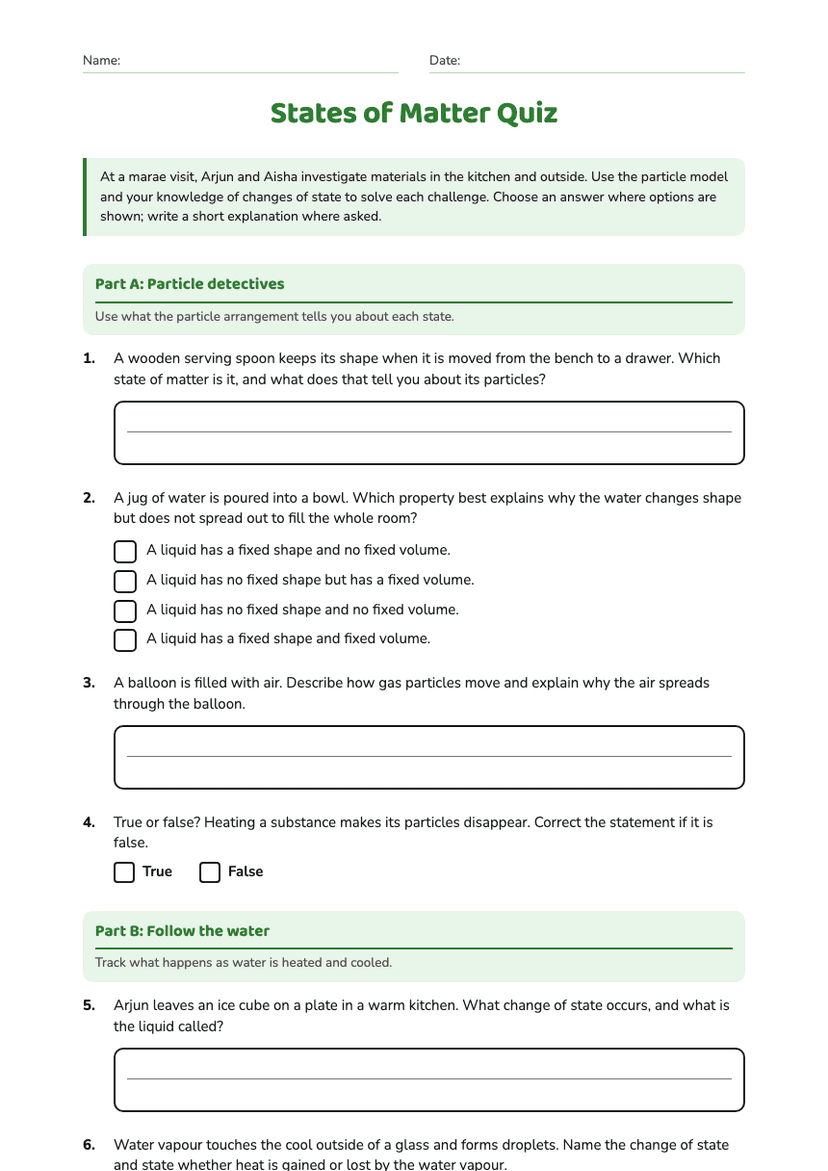
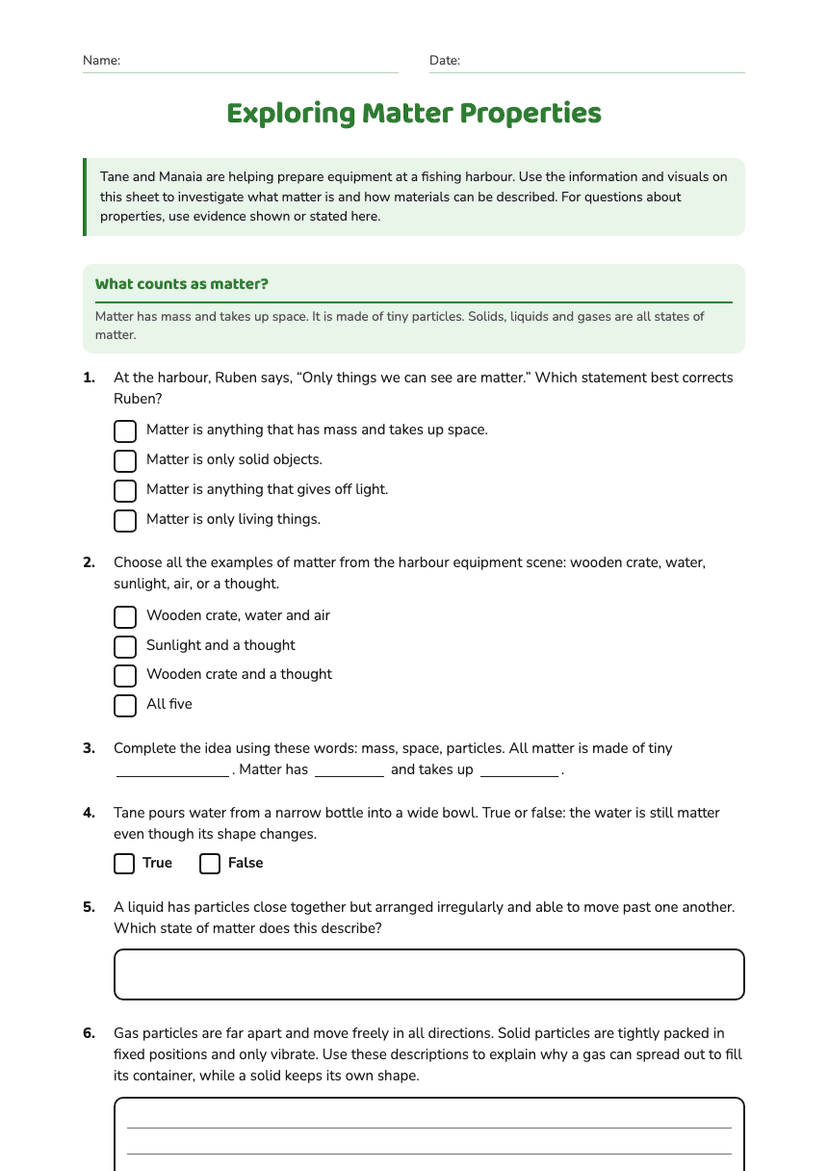
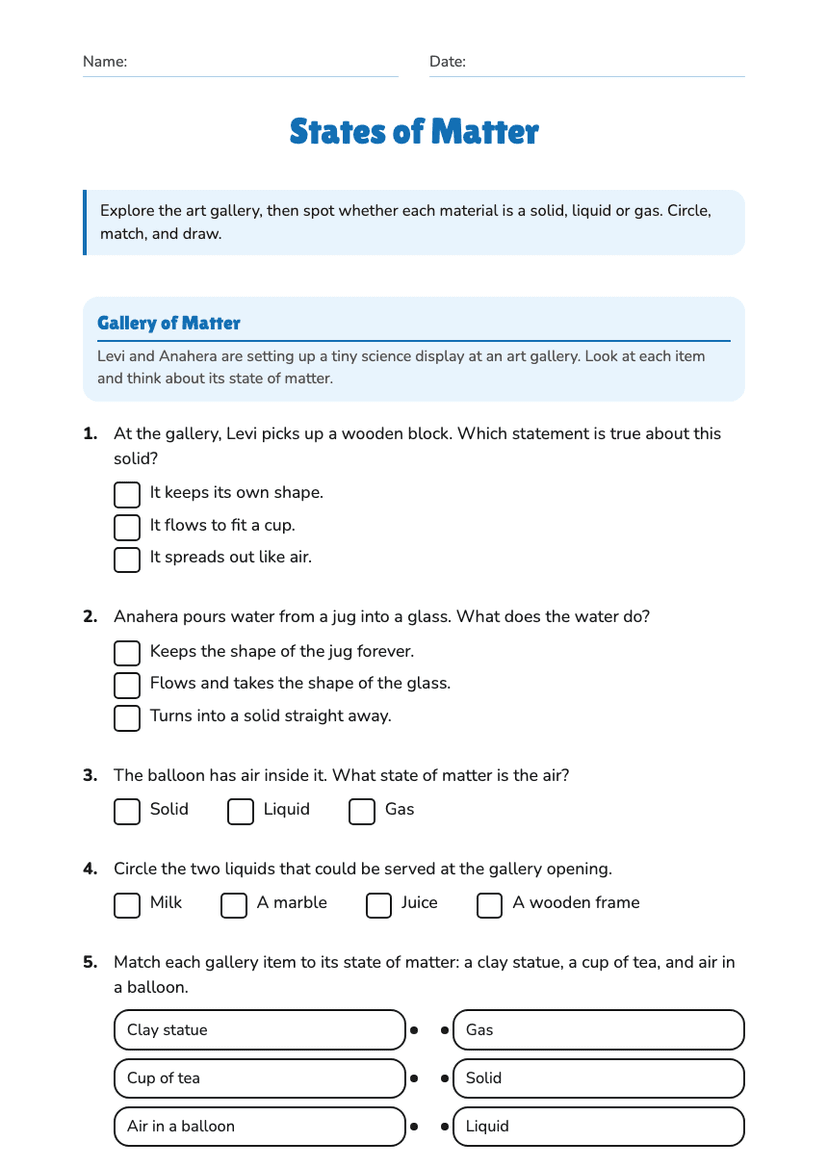
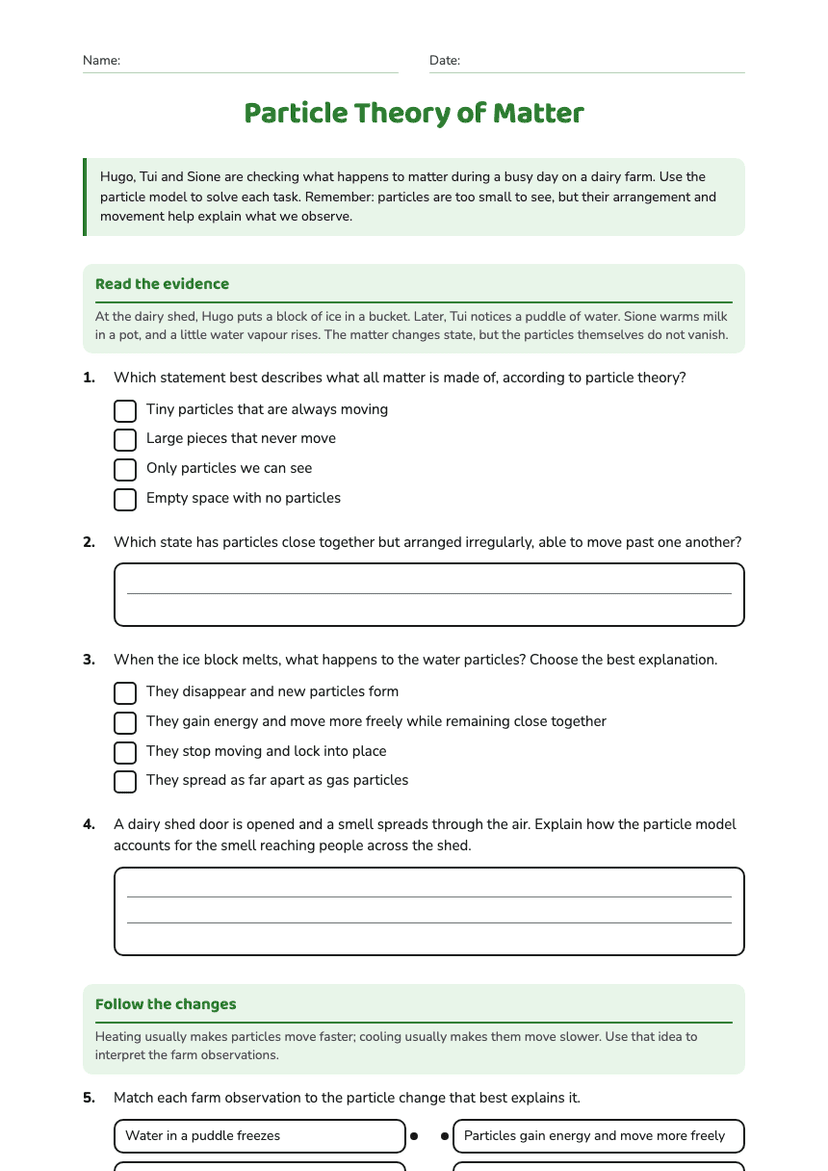
Matter is anything that has mass and takes up space. The particle model explains how matter behaves: particles in a solid vibrate in fixed positions; particles in a liquid stay close but move past one another; particles in a gas move freely and are widely spaced. Heating usually makes particles move faster; cooling usually makes them move more slowly.
- Metal spoon
- Cooking oil
- Air in the tyre
- Liquid
- Solid
- Gas
- Its particles are far apart and move freely.
- Its particles vibrate around fixed positions.
- Its particles flow past one another.
- Its particles have no mass.
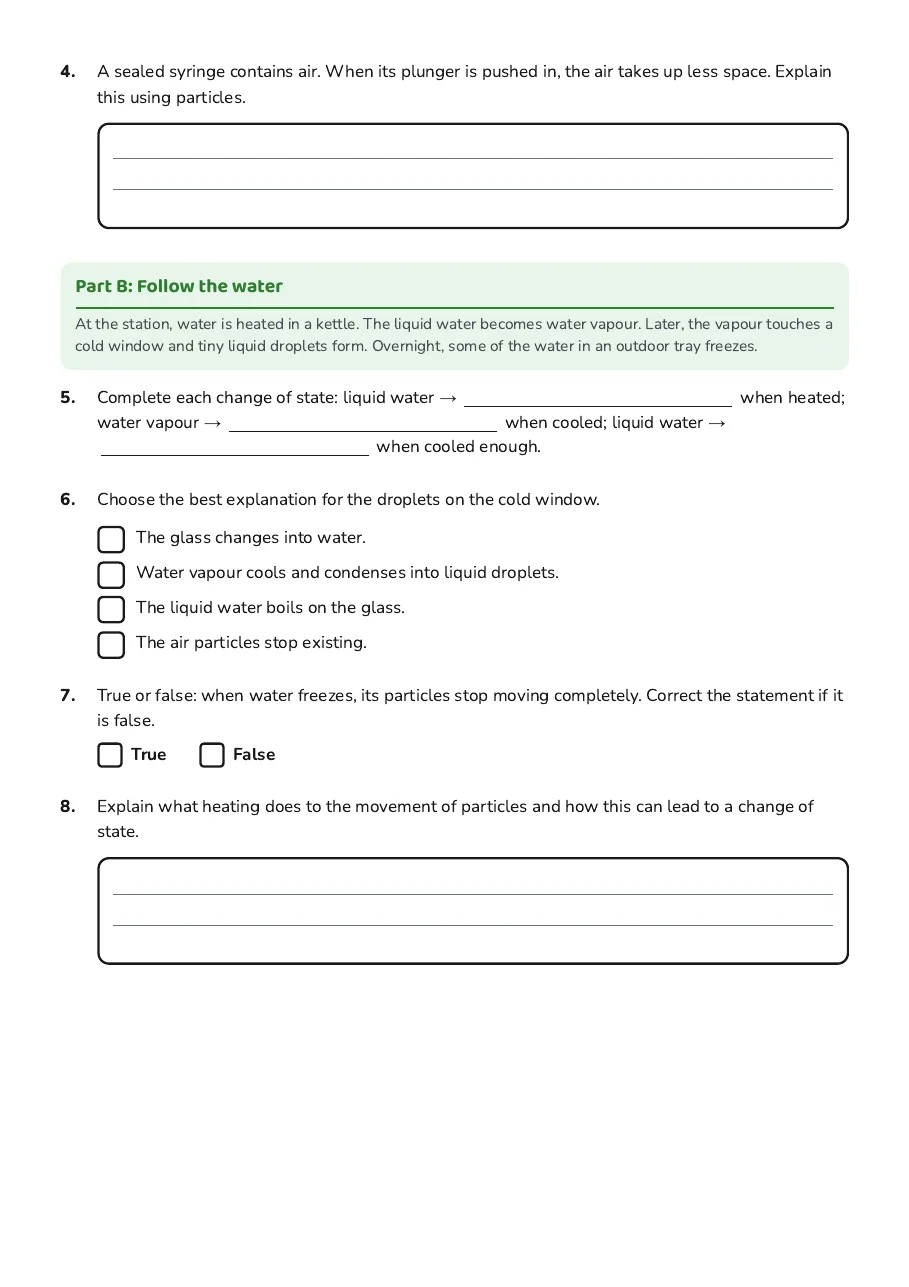
Part B: Follow the water
At the station, water is heated in a kettle. The liquid water becomes water vapour. Later, the vapour touches a cold window and tiny liquid droplets form. Overnight, some of the water in an outdoor tray freezes.
- The glass changes into water.
- Water vapour cools and condenses into liquid droplets.
- The liquid water boils on the glass.
- The air particles stop existing.
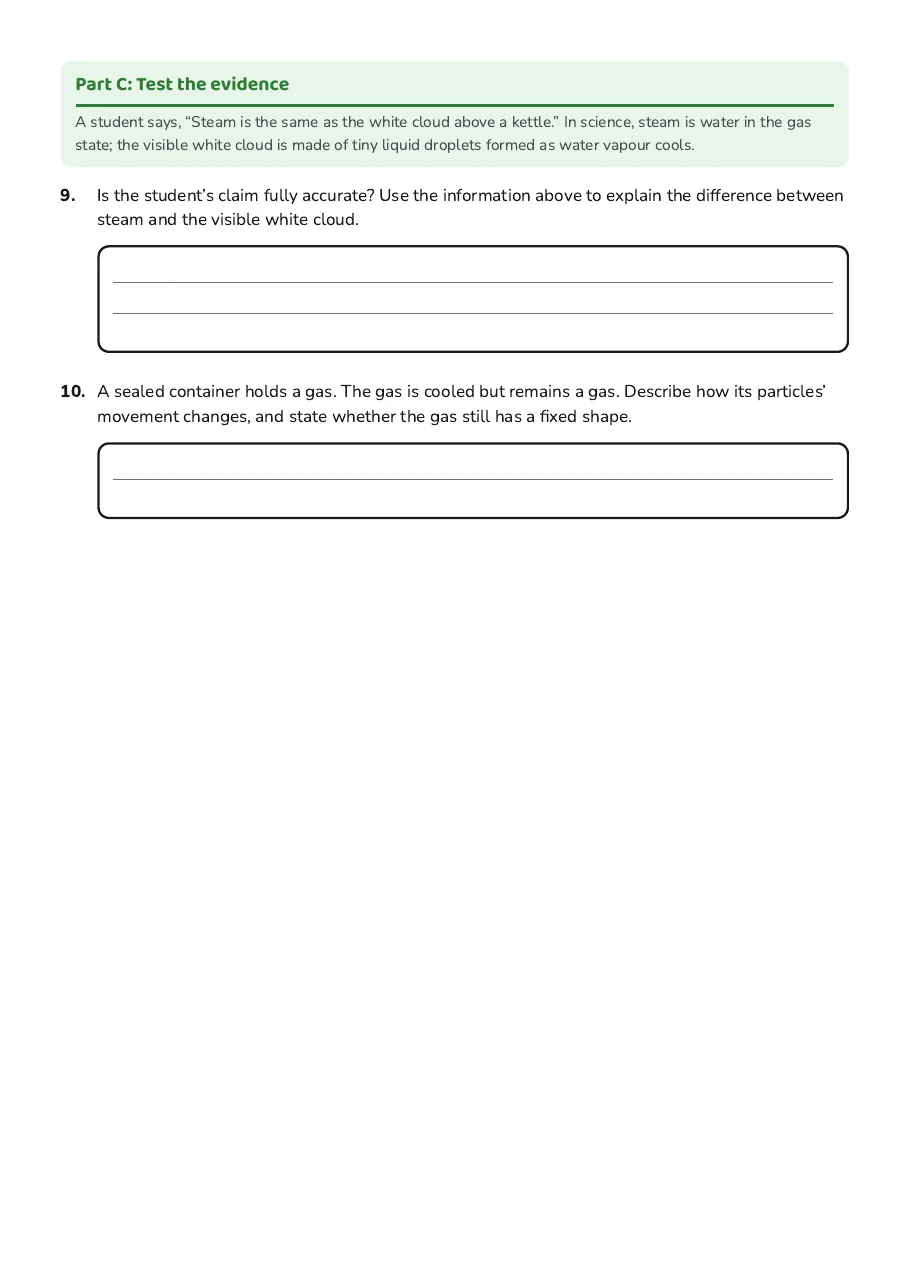
Part C: Test the evidence
A student says, “Steam is the same as the white cloud above a kettle.” In science, steam is water in the gas state; the visible white cloud is made of tiny liquid droplets formed as water vapour cools.
3 printable pages
Page 1
Page 2
Page 3
About This Worksheet
Free in Kuraplan
Sign up free, grab the PDF, and customize it for your class.
Print-Ready
Formatted for standard paper. Clean layout, easy to read.
AI-Generated
Created with Kuraplan's AI, designed for real classroom use.
For Teachers & Parents
Use in classrooms, for homework, tutoring, or homeschool.
Need a custom version of this worksheet?
Kuraplan's AI generates custom worksheets in seconds — differentiated for every learner, aligned to your curriculum.
Generate Custom Worksheets — Free