ScienceFreePrintable
Meiosis and Genetic Variation
A free science worksheet ready for your classroom. Open in Kuraplan to grab the print-ready PDF, customize it for your students, or generate a fresh version in seconds.
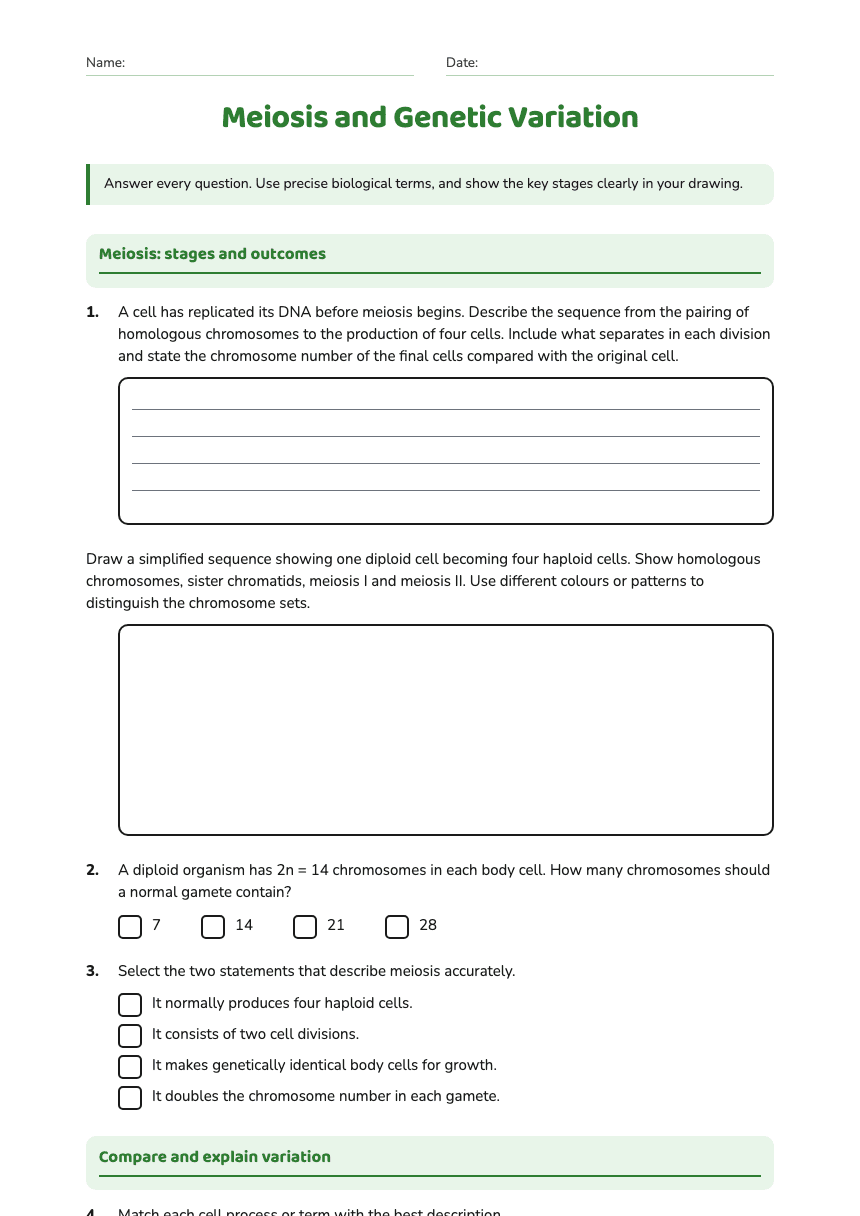
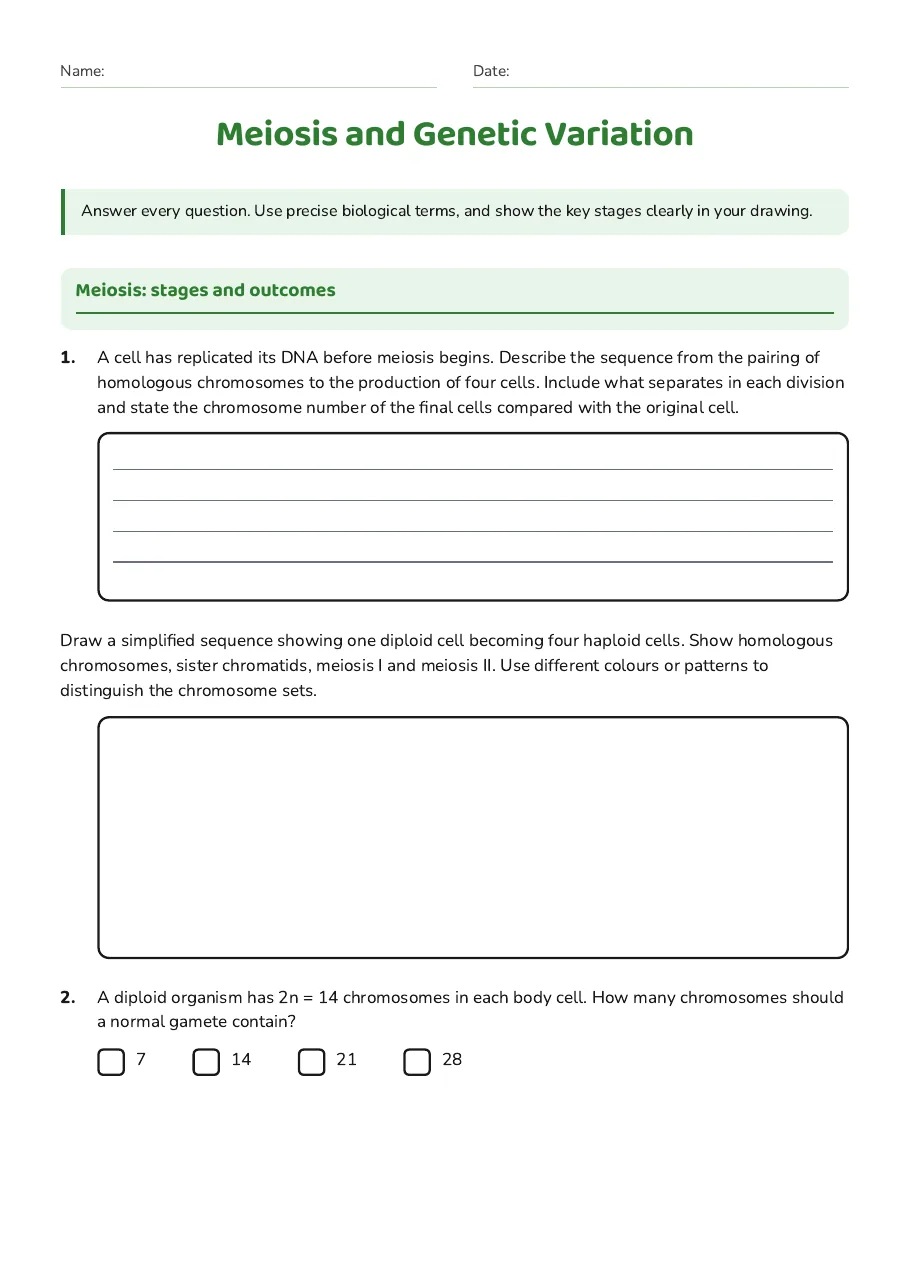
Name:Date:
Meiosis and Genetic Variation
Answer every question. Use precise biological terms, and show the key stages clearly in your drawing.
Meiosis: stages and outcomes
1.A cell has replicated its DNA before meiosis begins. Describe the sequence from the pairing of homologous chromosomes to the production of four cells. Include what separates in each division and state the chromosome number of the final cells compared with the original cell.
Draw a simplified sequence showing one diploid cell becoming four haploid cells. Show homologous chromosomes, sister chromatids, meiosis I and meiosis II. Use different colours or patterns to distinguish the chromosome sets.
2.A diploid organism has 2n = 14 chromosomes in each body cell. How many chromosomes should a normal gamete contain?
- 7
- 14
- 21
- 28
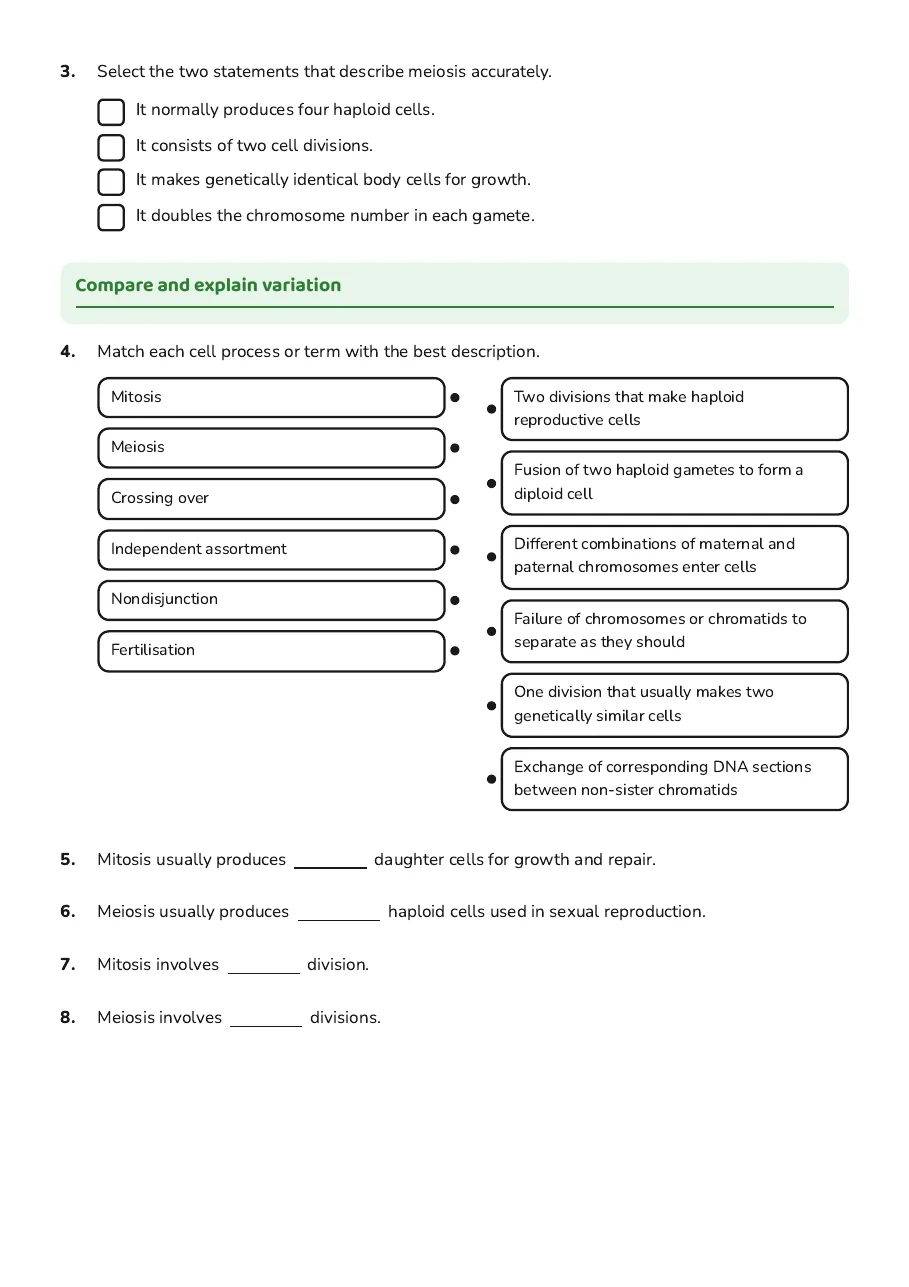
3.Select the two statements that describe meiosis accurately.
- It normally produces four haploid cells.
- It consists of two cell divisions.
- It makes genetically identical body cells for growth.
- It doubles the chromosome number in each gamete.
Compare and explain variation
4.Match each cell process or term with the best description.
- Mitosis
- Meiosis
- Crossing over
- Independent assortment
- Nondisjunction
- Fertilisation
- Two divisions that make haploid reproductive cells
- Fusion of two haploid gametes to form a diploid cell
- Different combinations of maternal and paternal chromosomes enter cells
- Failure of chromosomes or chromatids to separate as they should
- One division that usually makes two genetically similar cells
- Exchange of corresponding DNA sections between non-sister chromatids
5.Mitosis usually produces daughter cells for growth and repair.
6.Meiosis usually produces haploid cells used in sexual reproduction.
7.Mitosis involves division.
8.Meiosis involves divisions.
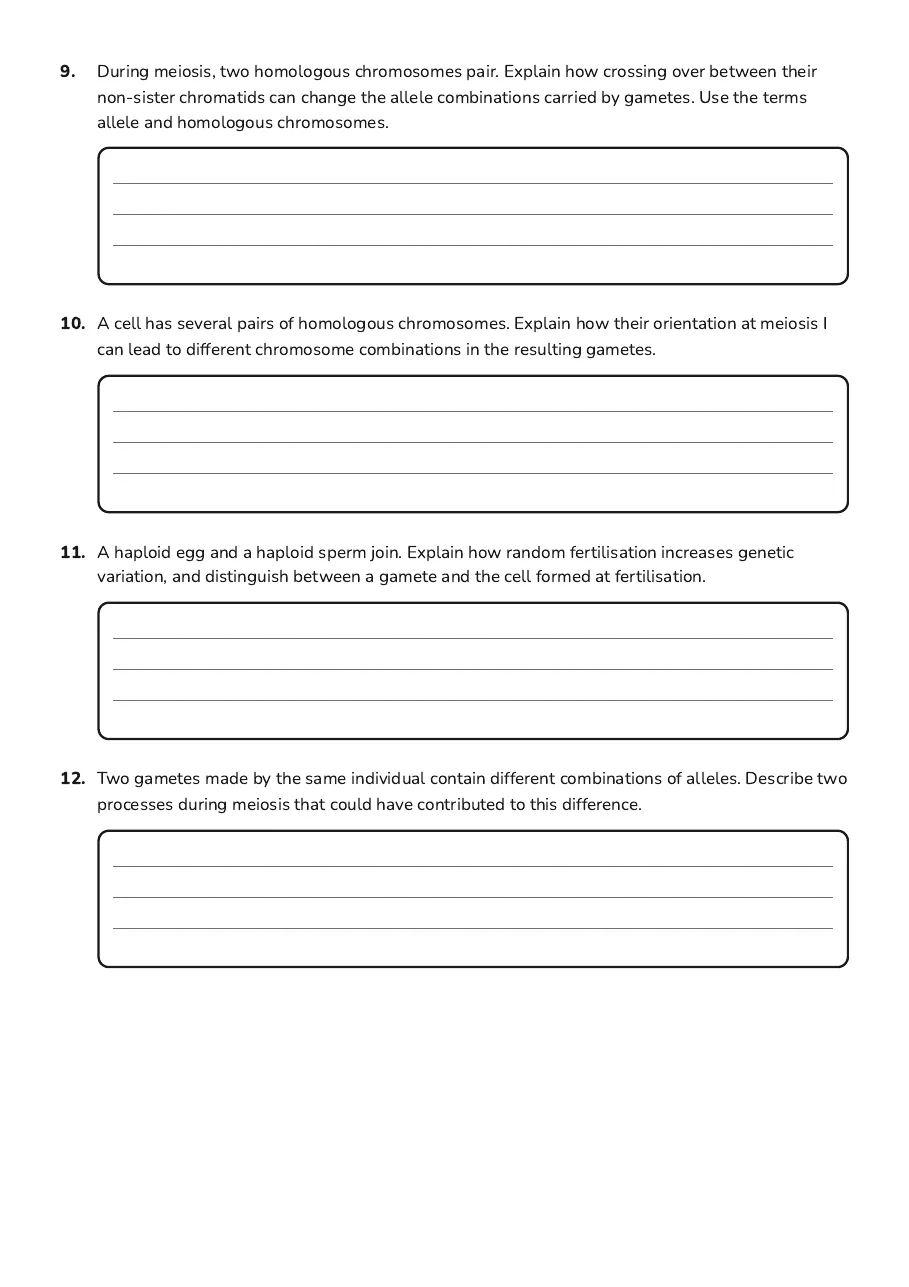
9.During meiosis, two homologous chromosomes pair. Explain how crossing over between their non-sister chromatids can change the allele combinations carried by gametes. Use the terms allele and homologous chromosomes.
10.A cell has several pairs of homologous chromosomes. Explain how their orientation at meiosis I can lead to different chromosome combinations in the resulting gametes.
11.A haploid egg and a haploid sperm join. Explain how random fertilisation increases genetic variation, and distinguish between a gamete and the cell formed at fertilisation.
12.Two gametes made by the same individual contain different combinations of alleles. Describe two processes during meiosis that could have contributed to this difference.
13.Explain why siblings with the same two biological parents are usually genetically different. Link crossing over, independent assortment and random fertilisation in your explanation.
14.During meiosis, a pair of homologous chromosomes fails to separate. Give one possible chromosome number for the affected gamete relative to the normal haploid number, then explain a possible consequence if that gamete is fertilised by a normal gamete.
4 printable pages
Page 1
Page 2
Page 3
Page 4
About This Worksheet
Free in Kuraplan
Sign up free, grab the PDF, and customize it for your class.
Print-Ready
Formatted for standard paper. Clean layout, easy to read.
AI-Generated
Created with Kuraplan's AI, designed for real classroom use.
For Teachers & Parents
Use in classrooms, for homework, tutoring, or homeschool.
Need a custom version of this worksheet?
Kuraplan's AI generates custom worksheets in seconds — differentiated for every learner, aligned to your curriculum.
Generate Custom Worksheets — Free No credit card Curriculum-aligned Under 60 seconds