PEFreePrintable

Movement & Mechanics Analysis

A free pe worksheet ready for your classroom. Open in Kuraplan to grab the print-ready PDF, customize it for your students, or generate a fresh version in seconds.
Movement & Mechanics Analysis worksheet preview
Name:Date:

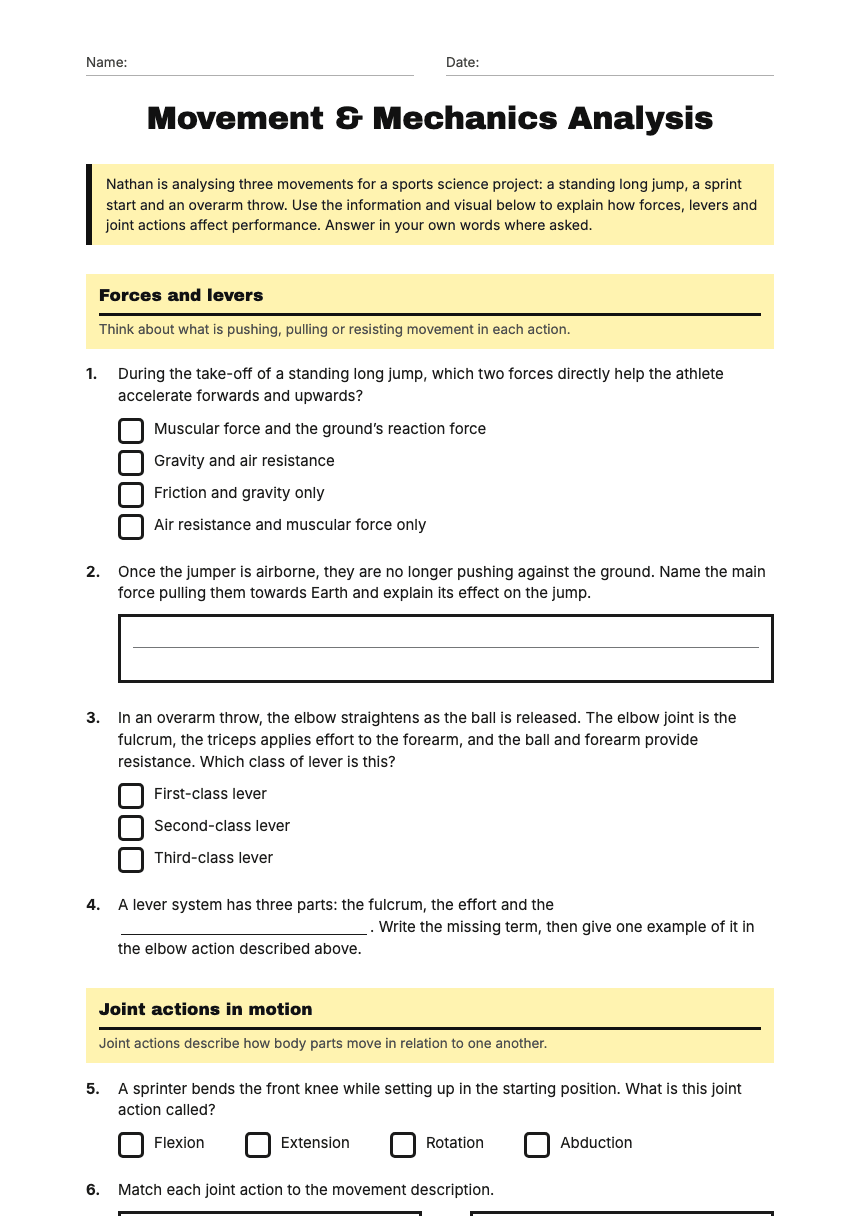
Movement & Mechanics Analysis

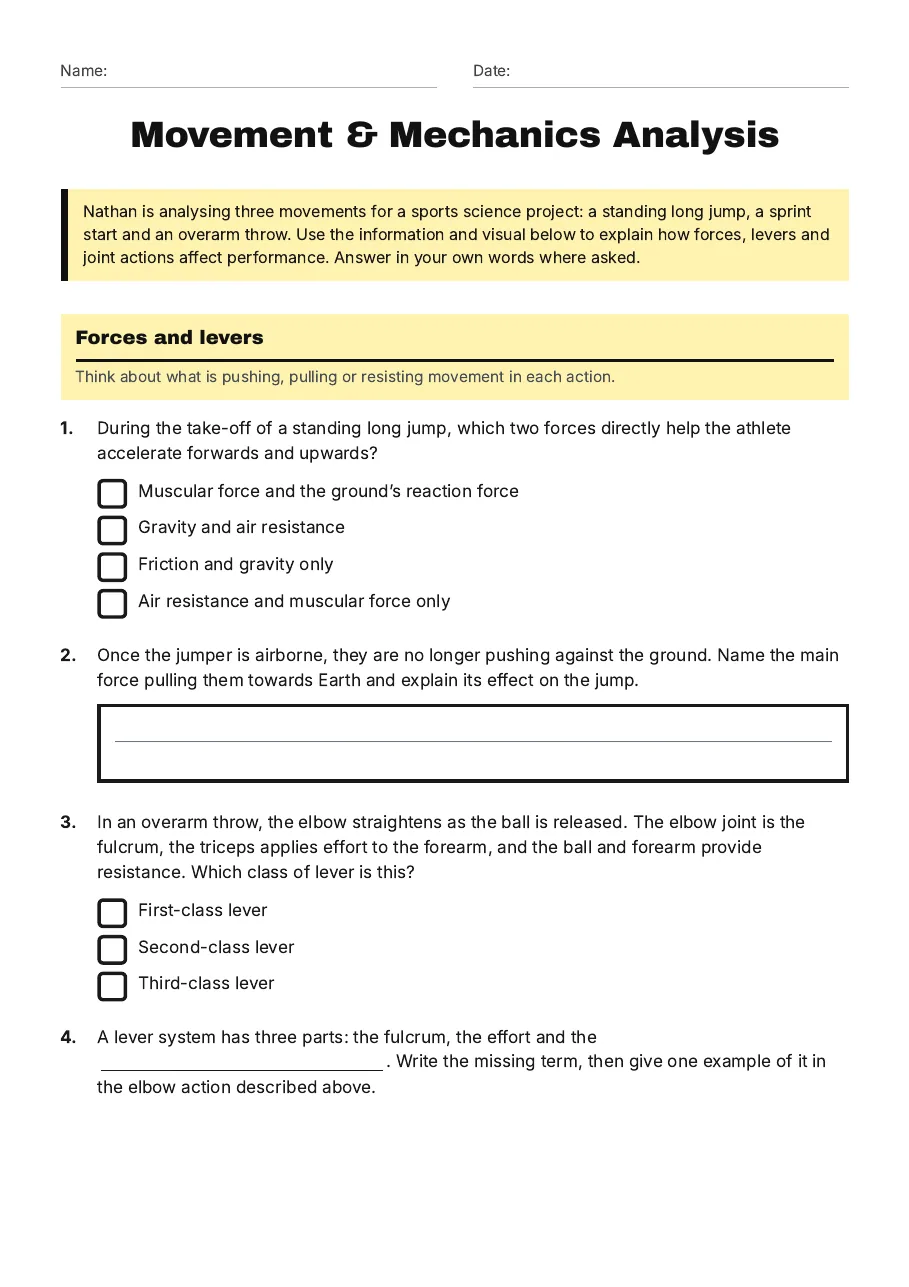
Nathan is analysing three movements for a sports science project: a standing long jump, a sprint start and an overarm throw. Use the information and visual below to explain how forces, levers and joint actions affect performance. Answer in your own words where asked.

Forces and levers

Think about what is pushing, pulling or resisting movement in each action.

1.During the take-off of a standing long jump, which two forces directly help the athlete accelerate forwards and upwards?
  • Muscular force and the ground’s reaction force
  • Gravity and air resistance
  • Friction and gravity only
  • Air resistance and muscular force only
2.Once the jumper is airborne, they are no longer pushing against the ground. Name the main force pulling them towards Earth and explain its effect on the jump.
3.In an overarm throw, the elbow straightens as the ball is released. The elbow joint is the fulcrum, the triceps applies effort to the forearm, and the ball and forearm provide resistance. Which class of lever is this?
  • First-class lever
  • Second-class lever
  • Third-class lever
4.A lever system has three parts: the fulcrum, the effort and the . Write the missing term, then give one example of it in the elbow action described above.

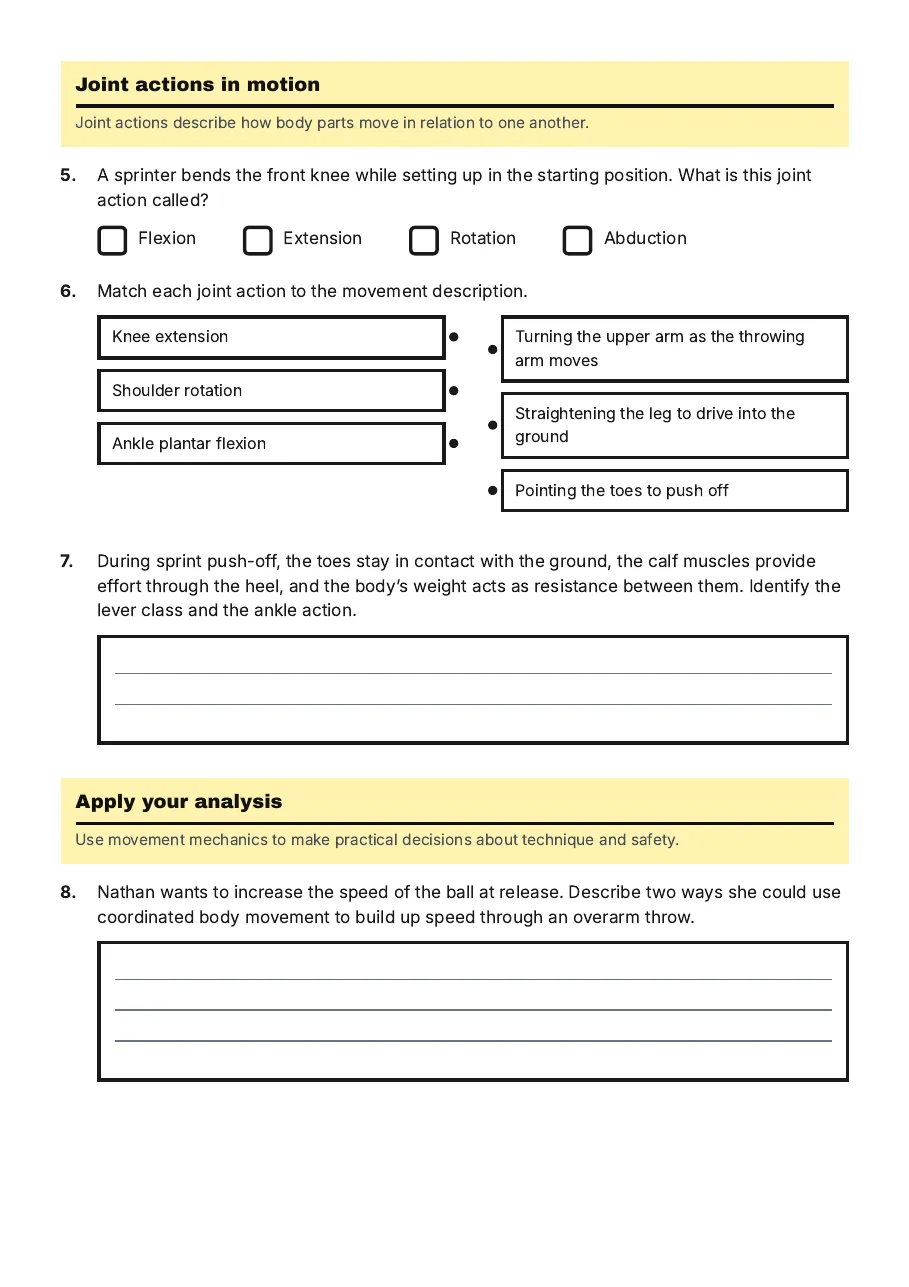
Joint actions in motion

Joint actions describe how body parts move in relation to one another.

5.A sprinter bends the front knee while setting up in the starting position. What is this joint action called?
  • Flexion
  • Extension
  • Rotation
  • Abduction
6.Match each joint action to the movement description.
  • Knee extension
  • Shoulder rotation
  • Ankle plantar flexion
  • Turning the upper arm as the throwing arm moves
  • Straightening the leg to drive into the ground
  • Pointing the toes to push off
7.During sprint push-off, the toes stay in contact with the ground, the calf muscles provide effort through the heel, and the body’s weight acts as resistance between them. Identify the lever class and the ankle action.

Apply your analysis

Use movement mechanics to make practical decisions about technique and safety.

8.Nathan wants to increase the speed of the ball at release. Describe two ways she could use coordinated body movement to build up speed through an overarm throw.
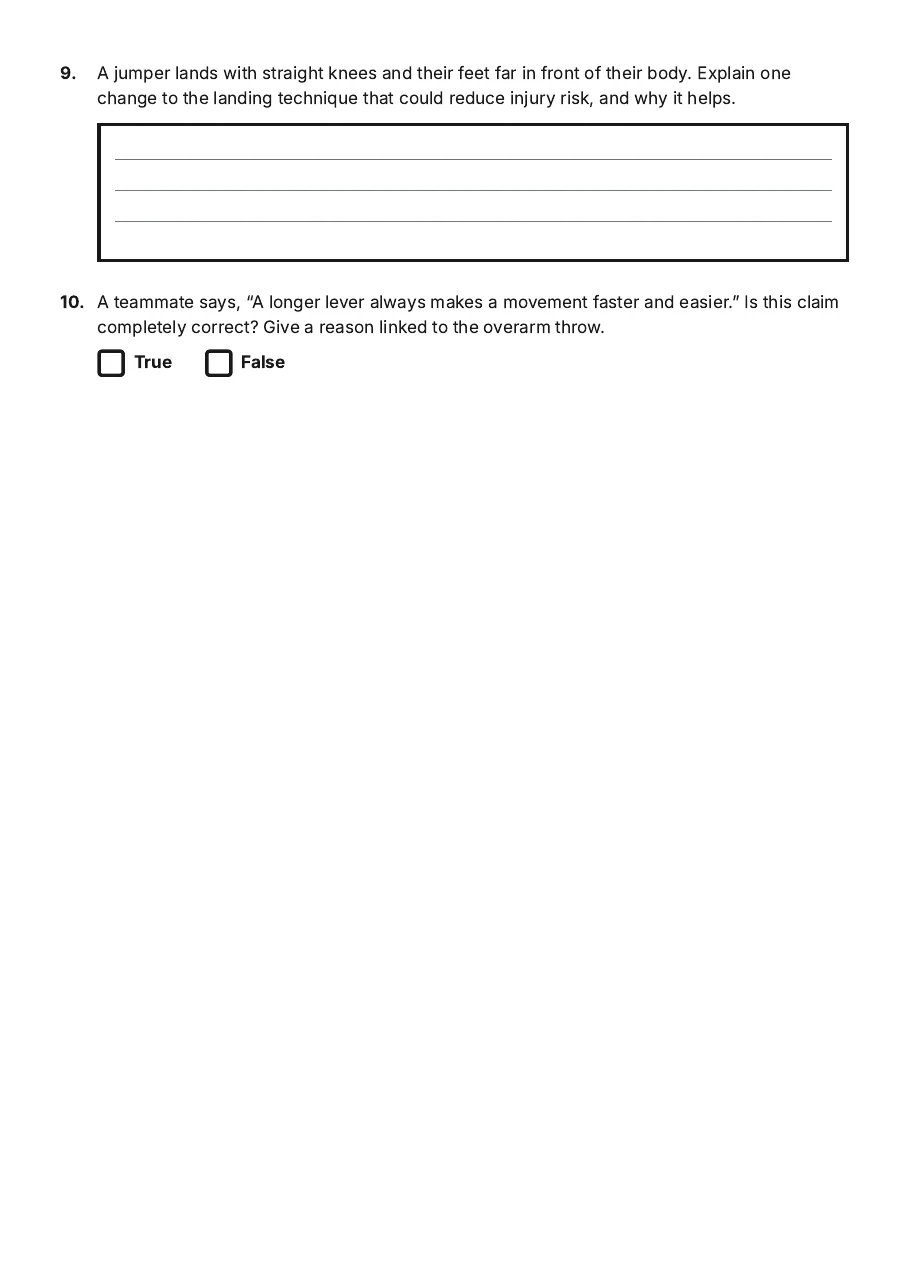
9.A jumper lands with straight knees and their feet far in front of their body. Explain one change to the landing technique that could reduce injury risk, and why it helps.
10.A teammate says, “A longer lever always makes a movement faster and easier.” Is this claim completely correct? Give a reason linked to the overarm throw.
TrueFalse

3 printable pages

  • Movement & Mechanics Analysis, page 1 of 3: Forces and levers

    Page 1

  • Movement & Mechanics Analysis, page 2 of 3: Joint actions in motion, Apply your analysis

    Page 2

  • Movement & Mechanics Analysis, page 3 of 3: 9. A jumper lands with straight knees and their feet far in front of their body. Explain…

    Page 3

About This Worksheet

Free in Kuraplan

Sign up free, grab the PDF, and customize it for your class.

Print-Ready

Formatted for standard paper. Clean layout, easy to read.

AI-Generated

Created with Kuraplan's AI, designed for real classroom use.

For Teachers & Parents

Use in classrooms, for homework, tutoring, or homeschool.

Need a custom version of this worksheet?

Kuraplan's AI generates custom worksheets in seconds — differentiated for every learner, aligned to your curriculum.

Generate Custom Worksheets — Free
No credit card Curriculum-aligned Under 60 seconds

Explore more free resources