PEFreePrintable

Movement Principles in Action

A free pe worksheet ready for your classroom. Open in Kuraplan to grab the print-ready PDF, customize it for your students, or generate a fresh version in seconds.
Movement Principles in Action worksheet preview
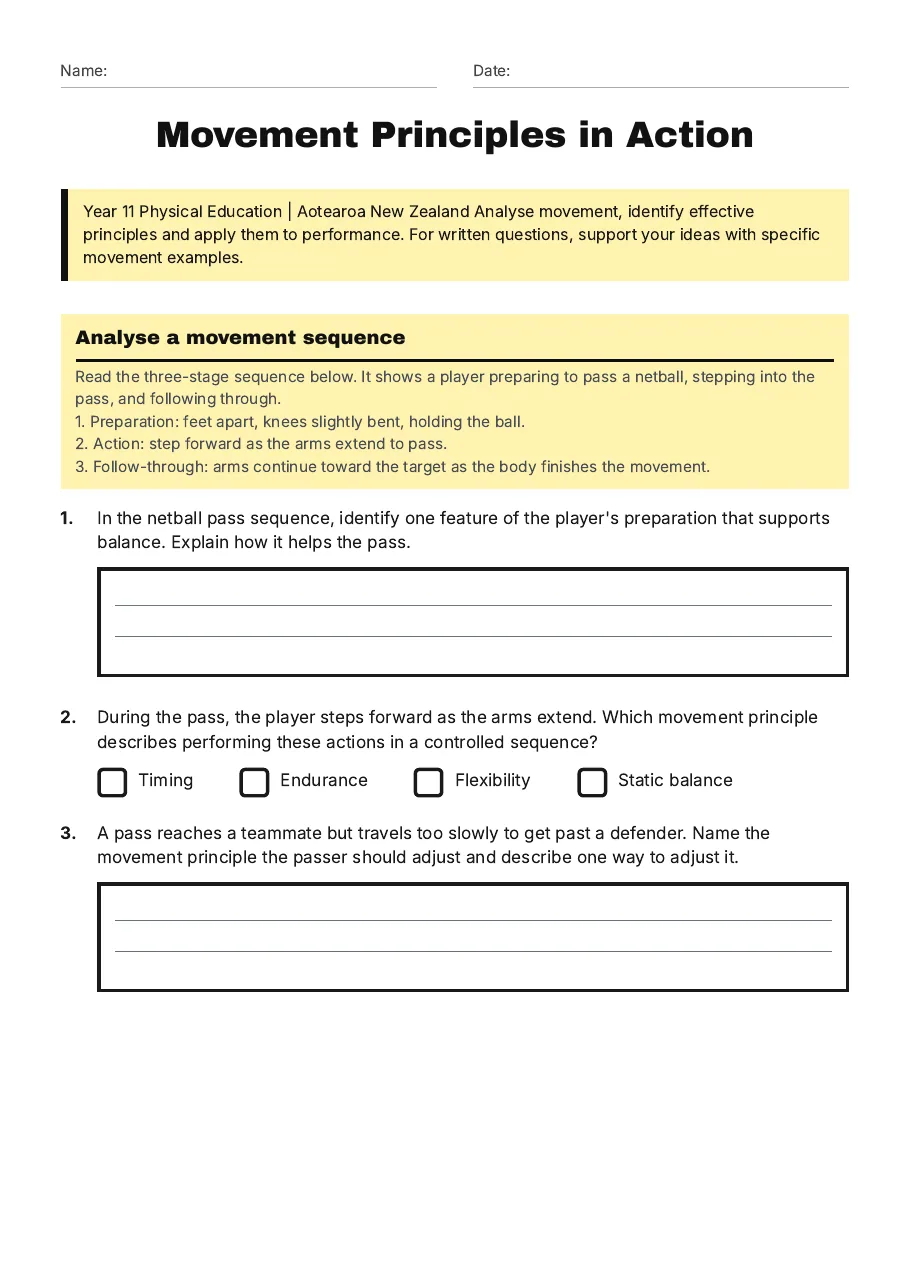
Name:Date:

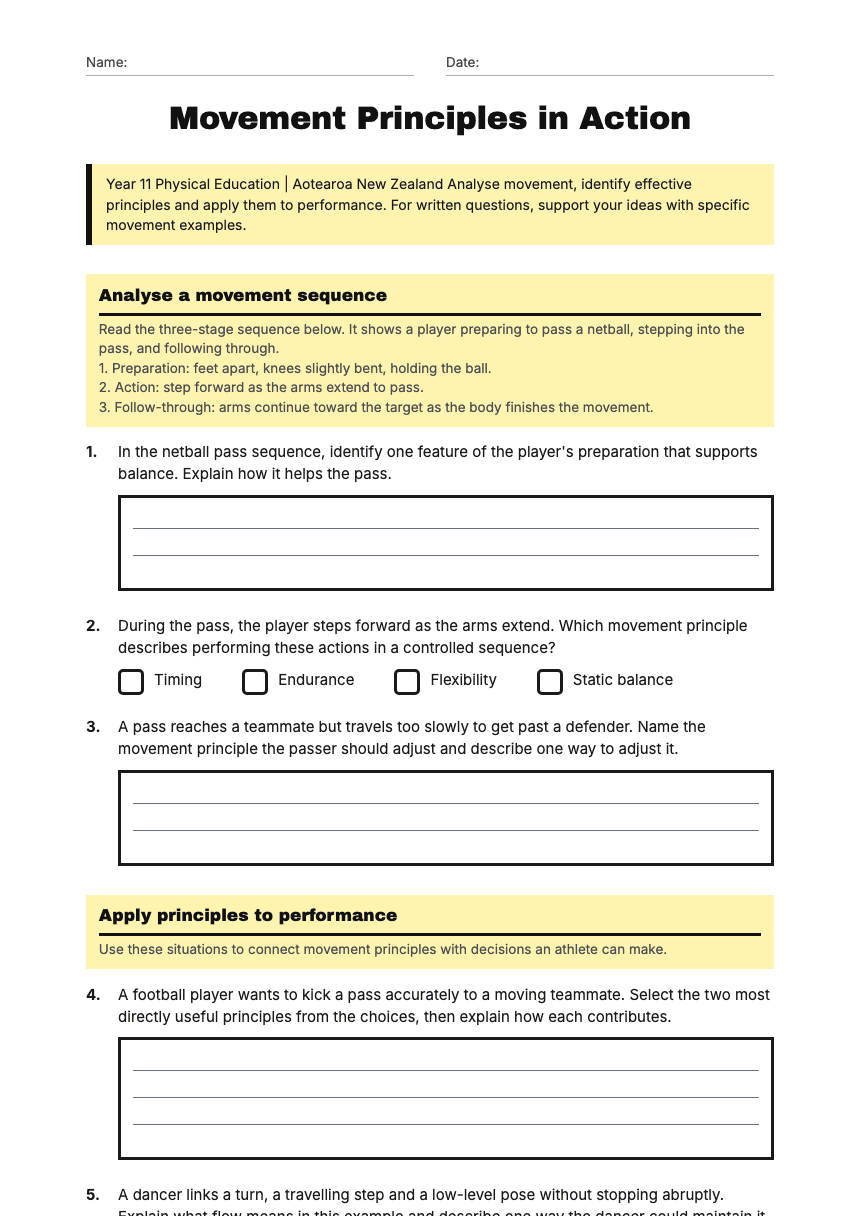
Movement Principles in Action

Year 11 Physical Education | Aotearoa New Zealand Analyse movement, identify effective principles and apply them to performance. For written questions, support your ideas with specific movement examples.

Analyse a movement sequence

Read the three-stage sequence below. It shows a player preparing to pass a netball, stepping into the pass, and following through. 1. Preparation: feet apart, knees slightly bent, holding the ball. 2. Action: step forward as the arms extend to pass. 3. Follow-through: arms continue toward the target as the body finishes the movement.

1.In the netball pass sequence, identify one feature of the player's preparation that supports balance. Explain how it helps the pass.
2.During the pass, the player steps forward as the arms extend. Which movement principle describes performing these actions in a controlled sequence?
  • Timing
  • Endurance
  • Flexibility
  • Static balance
3.A pass reaches a teammate but travels too slowly to get past a defender. Name the movement principle the passer should adjust and describe one way to adjust it.

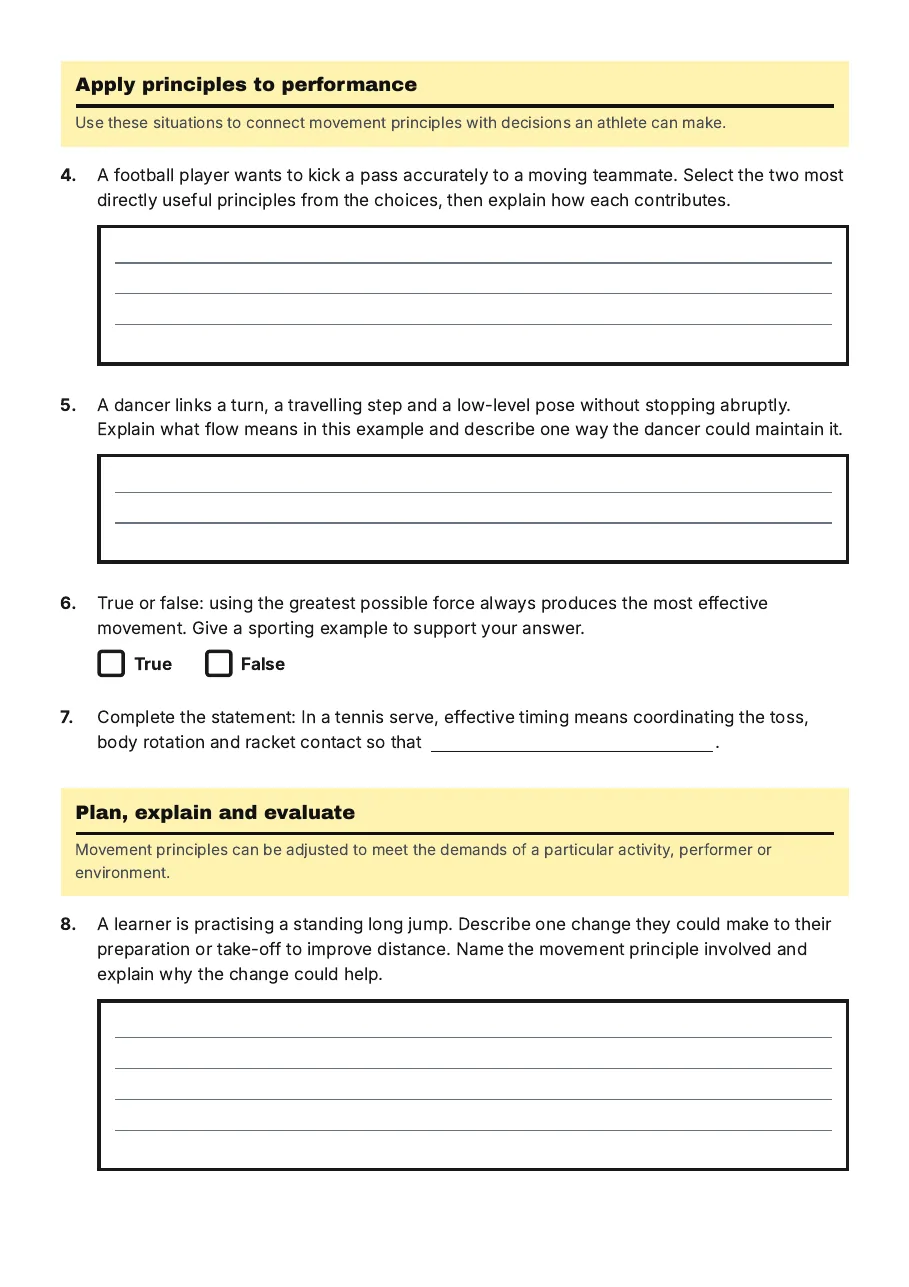
Apply principles to performance

Use these situations to connect movement principles with decisions an athlete can make.

4.A football player wants to kick a pass accurately to a moving teammate. Select the two most directly useful principles from the choices, then explain how each contributes.
5.A dancer links a turn, a travelling step and a low-level pose without stopping abruptly. Explain what flow means in this example and describe one way the dancer could maintain it.
6.True or false: using the greatest possible force always produces the most effective movement. Give a sporting example to support your answer.
TrueFalse
7.Complete the statement: In a tennis serve, effective timing means coordinating the toss, body rotation and racket contact so that .

Plan, explain and evaluate

Movement principles can be adjusted to meet the demands of a particular activity, performer or environment.

8.A learner is practising a standing long jump. Describe one change they could make to their preparation or take-off to improve distance. Name the movement principle involved and explain why the change could help.
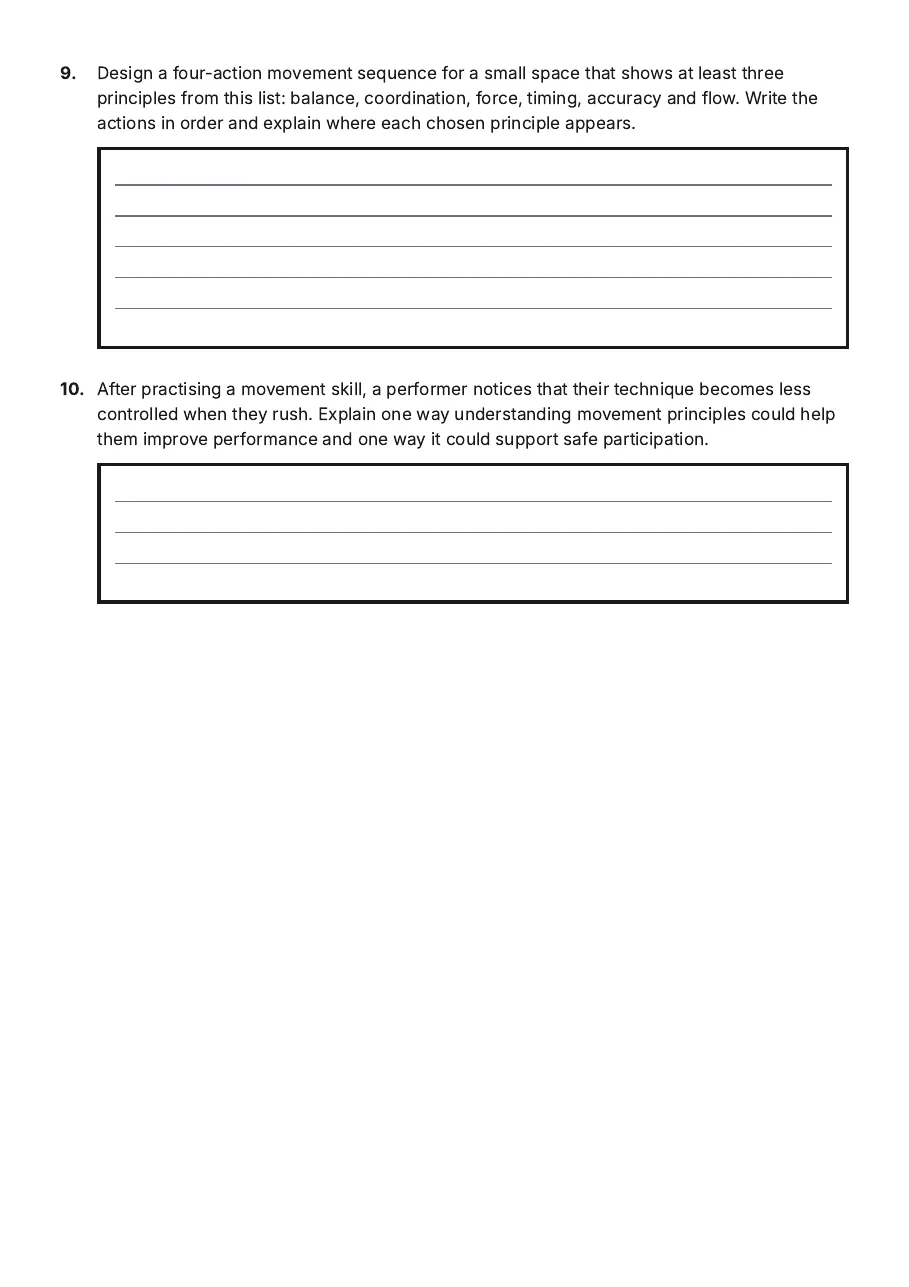
9.Design a four-action movement sequence for a small space that shows at least three principles from this list: balance, coordination, force, timing, accuracy and flow. Write the actions in order and explain where each chosen principle appears.
10.After practising a movement skill, a performer notices that their technique becomes less controlled when they rush. Explain one way understanding movement principles could help them improve performance and one way it could support safe participation.

3 printable pages

  • Movement Principles in Action, page 1 of 3: Analyse a movement sequence

    Page 1

  • Movement Principles in Action, page 2 of 3: Apply principles to performance, Plan, explain and evaluate

    Page 2

  • Movement Principles in Action, page 3 of 3: 9. Design a four-action movement sequence for a small space that shows at least three

    Page 3

About This Worksheet

Free in Kuraplan

Sign up free, grab the PDF, and customize it for your class.

Print-Ready

Formatted for standard paper. Clean layout, easy to read.

AI-Generated

Created with Kuraplan's AI, designed for real classroom use.

For Teachers & Parents

Use in classrooms, for homework, tutoring, or homeschool.

Need a custom version of this worksheet?

Kuraplan's AI generates custom worksheets in seconds — differentiated for every learner, aligned to your curriculum.

Generate Custom Worksheets — Free
No credit card Curriculum-aligned Under 60 seconds

Explore more free resources