MathsFreePrintable

Multivariate Data Investigation

A free maths worksheet ready for your classroom. Open in Kuraplan to grab the print-ready PDF, customize it for your students, or generate a fresh version in seconds.
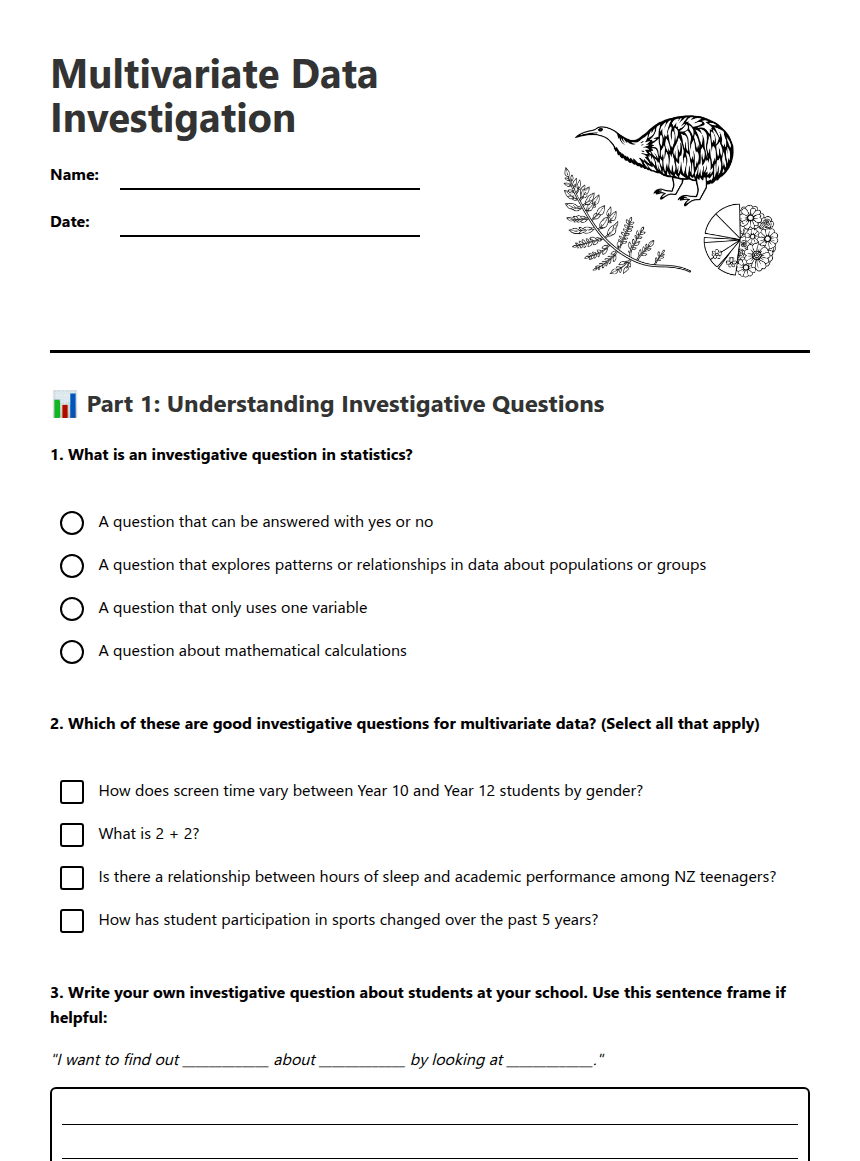
Multivariate Data Investigation worksheet preview

Multivariate Data Investigation

Data charts and graphs illustration

📊 Part 1: Understanding Investigative Questions

1. What is an investigative question in statistics?

A question that can be answered with yes or no

A question that explores patterns or relationships in data about populations or groups

A question that only uses one variable

A question about mathematical calculations

2. Which of these are good investigative questions for multivariate data? (Select all that apply)

How does screen time vary between Year 10 and Year 12 students by gender?

What is 2 + 2?

Is there a relationship between hours of sleep and academic performance among NZ teenagers?

How has student participation in sports changed over the past 5 years?

3. Write your own investigative question about students at your school. Use this sentence frame if helpful:

"I want to find out _____________ about _____________ by looking at _____________."

4. What conjecture (educated guess) would you make about your question above? What do you think the data might show?

📈 Part 2: Data Context and Ethics

5. A dataset shows information about students' ethnicity, academic results, and family income. Which ethical considerations should we keep in mind? (Select all that apply)

Treat the data as taonga (treasure) - something valuable that represents real people

Share individual students' personal information publicly

Respect privacy and confidentiality

Consider how findings might affect different cultural groups

6. Look at this scenario: You want to investigate "How do study habits differ between Māori and Pākehā students at different year levels?"

a) Identify the variables in this investigation:

Variable 1: ____________________

Variable 2: ____________________

Variable 3: ____________________

b) What population or group are you investigating?

7. Why is it important to consider Treaty of Waitangi principles when collecting and using data about New Zealand students?

🔍 Part 3: Reflection and Planning

8. Imagine you found that your conjecture from Question 4 was completely wrong. What would this tell you about the importance of data investigation?
9. What type of graph or visualisation would be most useful for showing:

a) Changes in student stress levels throughout the school year? ____________________

b) Comparing favourite subjects between different ethnic groups? ____________________

c) The relationship between hours of homework and test scores? ____________________

10. Extension Challenge: Design a plan for collecting data to answer your investigative question from Question 3. What ethical steps would you need to take?

About This Worksheet

Free in Kuraplan

Sign up free, grab the PDF, and customize it for your class.

Print-Ready

Formatted for standard paper. Clean layout, easy to read.

AI-Generated

Created with Kuraplan's AI, designed for real classroom use.

For Teachers & Parents

Use in classrooms, for homework, tutoring, or homeschool.

Need a custom version of this worksheet?

Kuraplan's AI generates custom worksheets in seconds — differentiated for every learner, aligned to your curriculum.

Generate Custom Worksheets — Free
No credit card Curriculum-aligned Under 60 seconds