Narrative Arc Analysis Worksheet
A free english worksheet ready for your classroom. Open in Kuraplan to grab the print-ready PDF, customize it for your students, or generate a fresh version in seconds.
Narrative Arc Analysis Worksheet
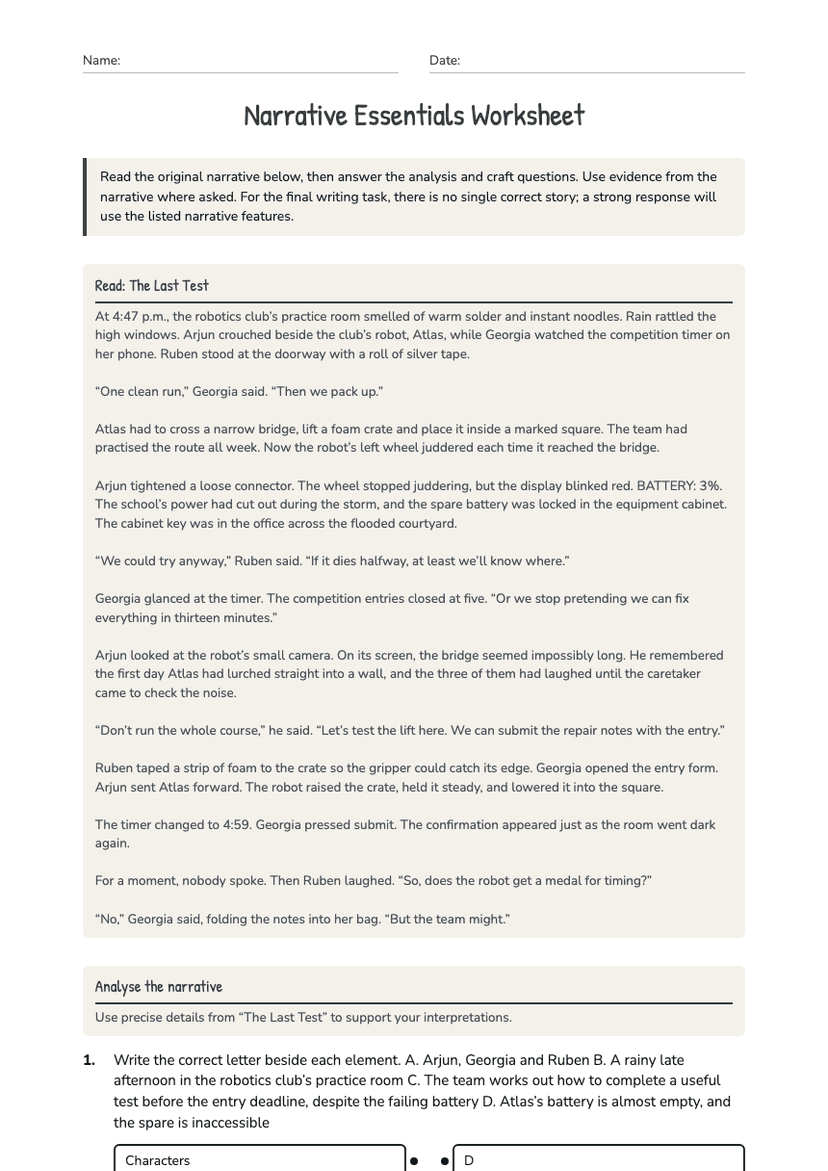
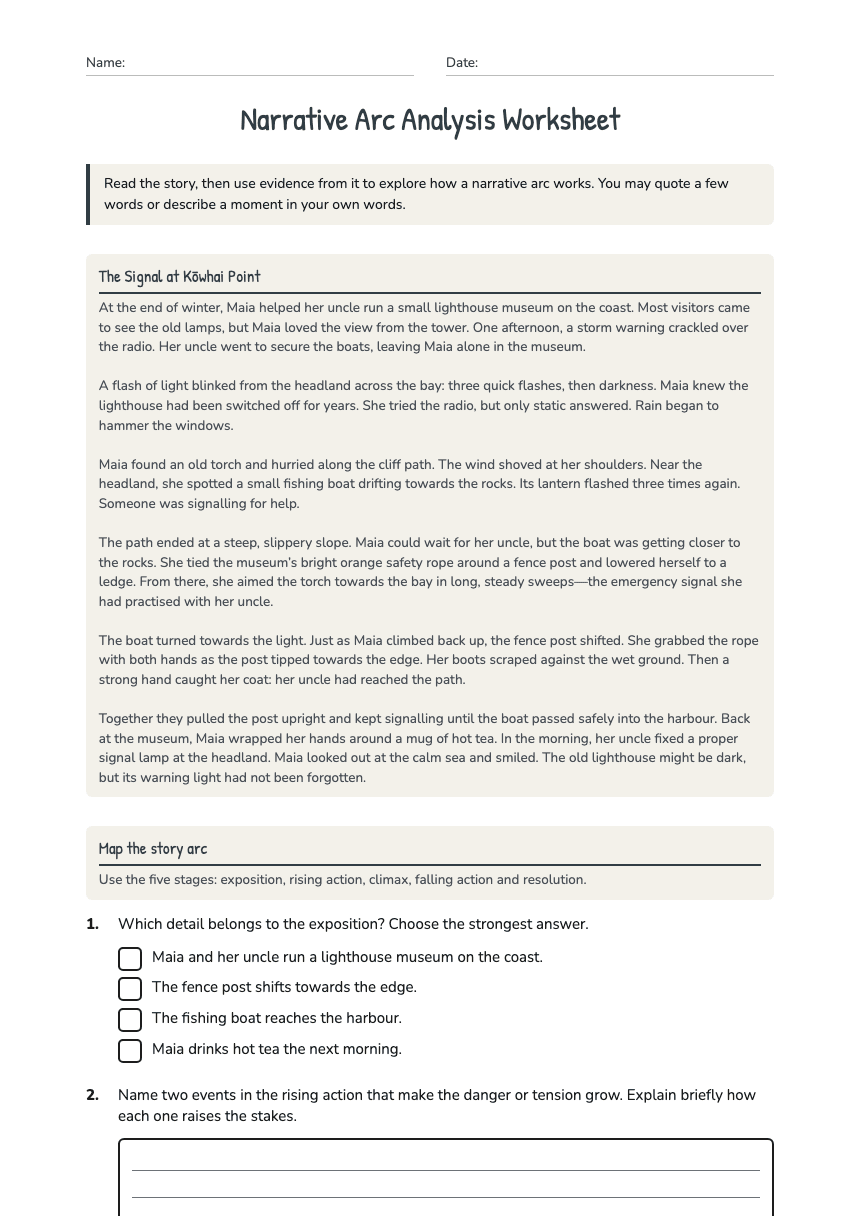
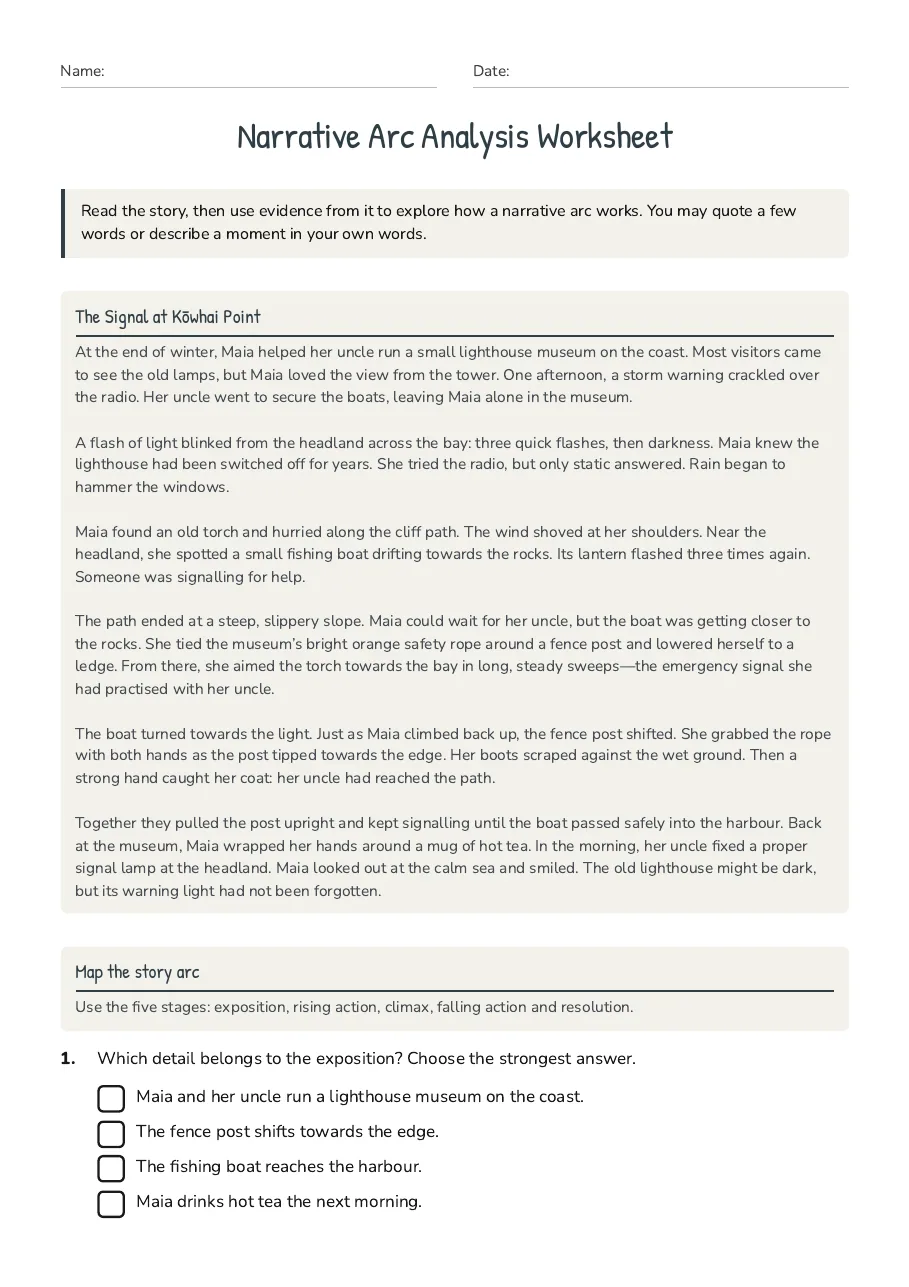
The Signal at Kōwhai Point
At the end of winter, Maia helped her uncle run a small lighthouse museum on the coast. Most visitors came to see the old lamps, but Maia loved the view from the tower. One afternoon, a storm warning crackled over the radio. Her uncle went to secure the boats, leaving Maia alone in the museum. A flash of light blinked from the headland across the bay: three quick flashes, then darkness. Maia knew the lighthouse had been switched off for years. She tried the radio, but only static answered. Rain began to hammer the windows. Maia found an old torch and hurried along the cliff path. The wind shoved at her shoulders. Near the headland, she spotted a small fishing boat drifting towards the rocks. Its lantern flashed three times again. Someone was signalling for help. The path ended at a steep, slippery slope. Maia could wait for her uncle, but the boat was getting closer to the rocks. She tied the museum’s bright orange safety rope around a fence post and lowered herself to a ledge. From there, she aimed the torch towards the bay in long, steady sweeps—the emergency signal she had practised with her uncle. The boat turned towards the light. Just as Maia climbed back up, the fence post shifted. She grabbed the rope with both hands as the post tipped towards the edge. Her boots scraped against the wet ground. Then a strong hand caught her coat: her uncle had reached the path. Together they pulled the post upright and kept signalling until the boat passed safely into the harbour. Back at the museum, Maia wrapped her hands around a mug of hot tea. In the morning, her uncle fixed a proper signal lamp at the headland. Maia looked out at the calm sea and smiled. The old lighthouse might be dark, but its warning light had not been forgotten.
Map the story arc
Use the five stages: exposition, rising action, climax, falling action and resolution.
- Maia and her uncle run a lighthouse museum on the coast.
- The fence post shifts towards the edge.
- The fishing boat reaches the harbour.
- Maia drinks hot tea the next morning.
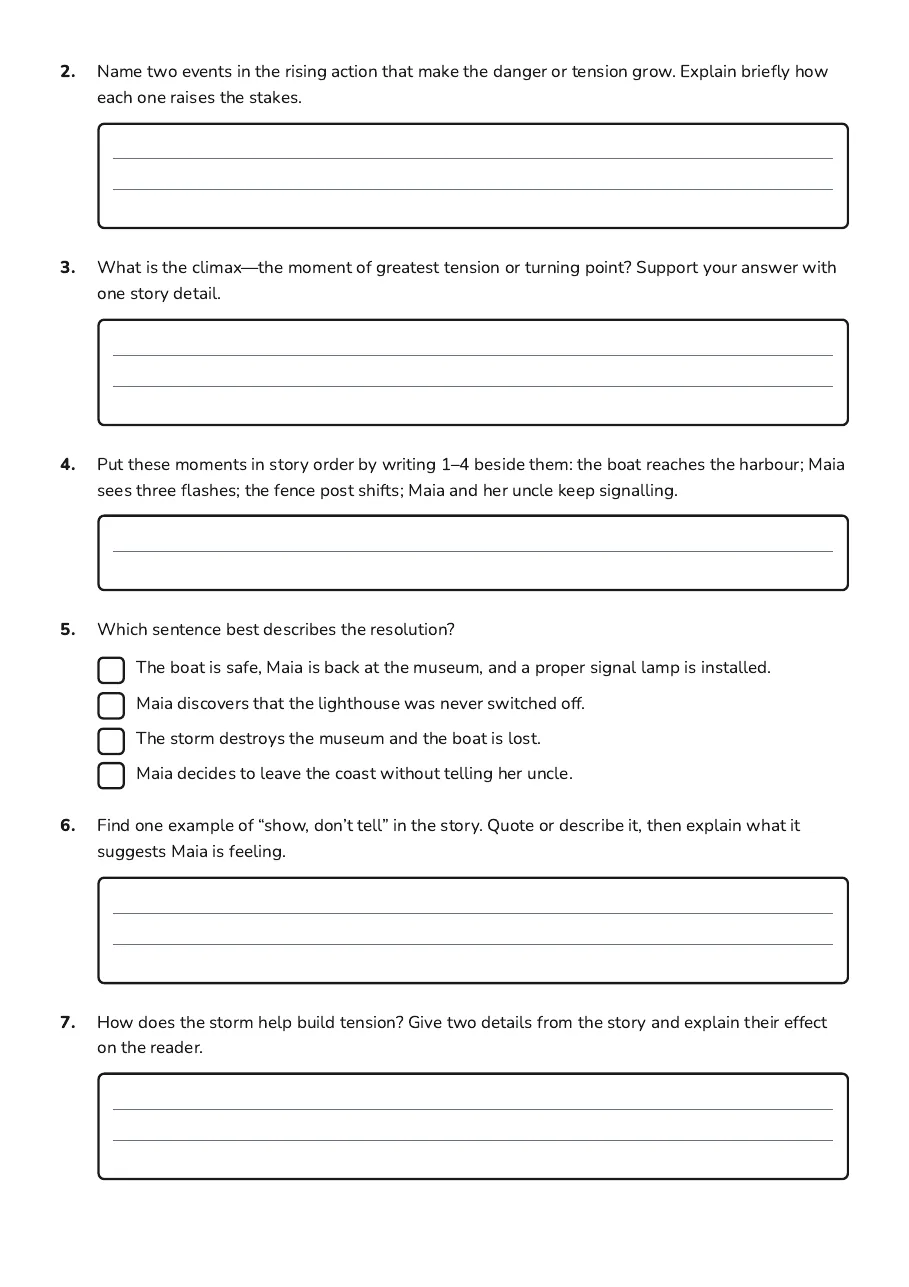
- The boat is safe, Maia is back at the museum, and a proper signal lamp is installed.
- Maia discovers that the lighthouse was never switched off.
- The storm destroys the museum and the boat is lost.
- Maia decides to leave the coast without telling her uncle.
3 printable pages
Page 1
Page 2
Page 3
About This Worksheet
Free in Kuraplan
Sign up free, grab the PDF, and customize it for your class.
Print-Ready
Formatted for standard paper. Clean layout, easy to read.
AI-Generated
Created with Kuraplan's AI, designed for real classroom use.
For Teachers & Parents
Use in classrooms, for homework, tutoring, or homeschool.
Need a custom version of this worksheet?
Kuraplan's AI generates custom worksheets in seconds — differentiated for every learner, aligned to your curriculum.
Generate Custom Worksheets — Free