EnglishFreePrintable
Narrative Introduction Planning
A free english worksheet ready for your classroom. Open in Kuraplan to grab the print-ready PDF, customize it for your students, or generate a fresh version in seconds.
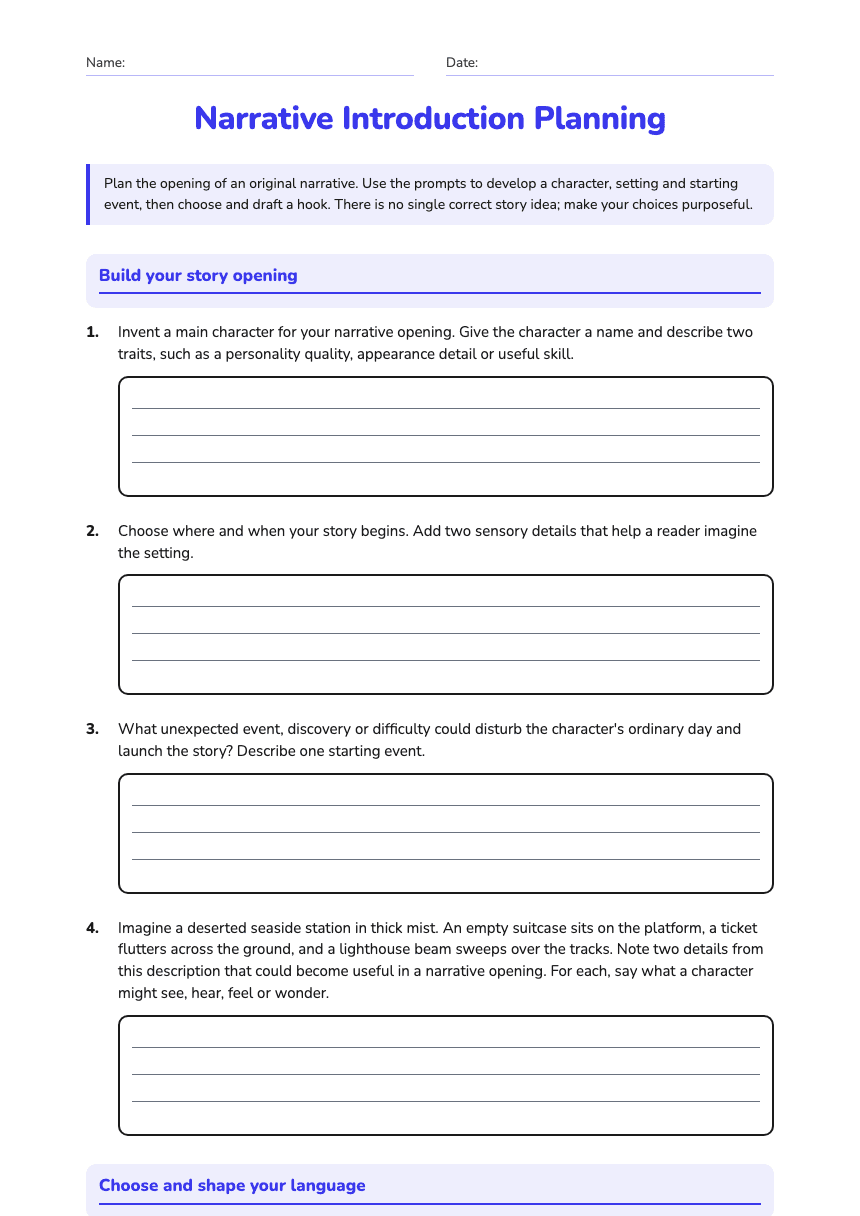
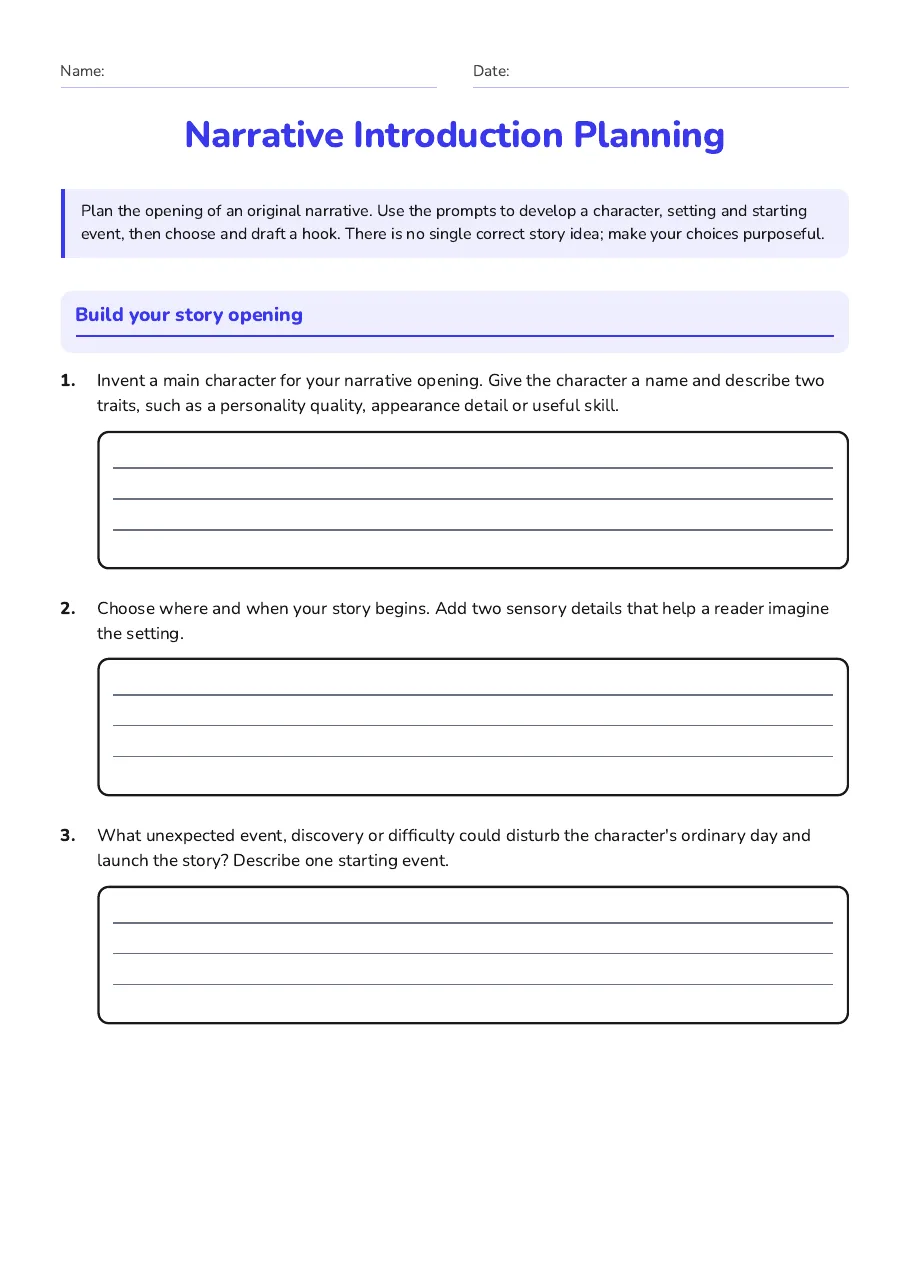
Name:Date:
Narrative Introduction Planning
Plan the opening of an original narrative. Use the prompts to develop a character, setting and starting event, then choose and draft a hook. There is no single correct story idea; make your choices purposeful.
Build your story opening
1.Invent a main character for your narrative opening. Give the character a name and describe two traits, such as a personality quality, appearance detail or useful skill.
2.Choose where and when your story begins. Add two sensory details that help a reader imagine the setting.
3.What unexpected event, discovery or difficulty could disturb the character's ordinary day and launch the story? Describe one starting event.
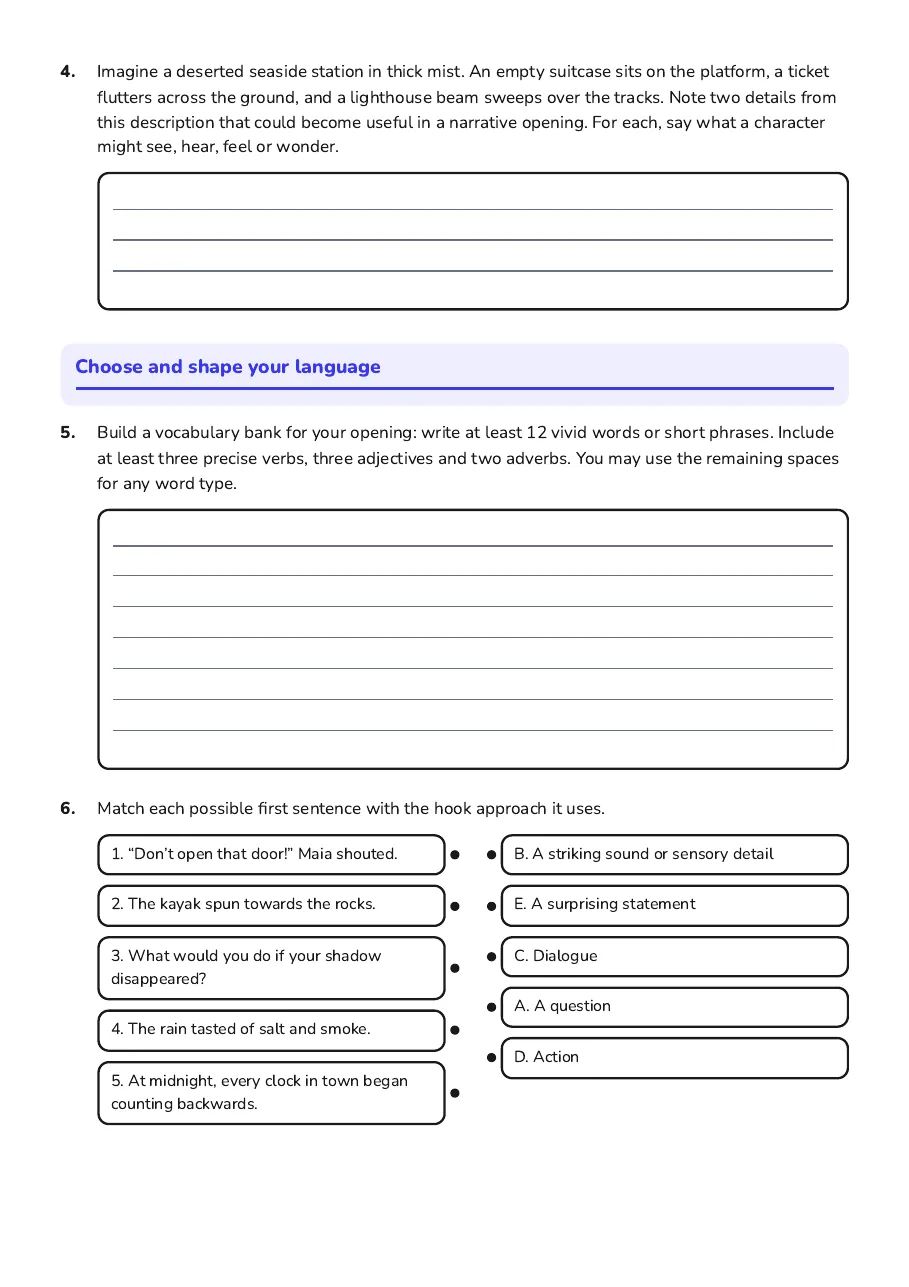
4.Imagine a deserted seaside station in thick mist. An empty suitcase sits on the platform, a ticket flutters across the ground, and a lighthouse beam sweeps over the tracks. Note two details from this description that could become useful in a narrative opening. For each, say what a character might see, hear, feel or wonder.
Choose and shape your language
5.Build a vocabulary bank for your opening: write at least 12 vivid words or short phrases. Include at least three precise verbs, three adjectives and two adverbs. You may use the remaining spaces for any word type.
6.Match each possible first sentence with the hook approach it uses.
- 1. “Don’t open that door!” Maia shouted.
- 2. The kayak spun towards the rocks.
- 3. What would you do if your shadow disappeared?
- 4. The rain tasted of salt and smoke.
- 5. At midnight, every clock in town began counting backwards.
- B. A striking sound or sensory detail
- E. A surprising statement
- C. Dialogue
- A. A question
- D. Action
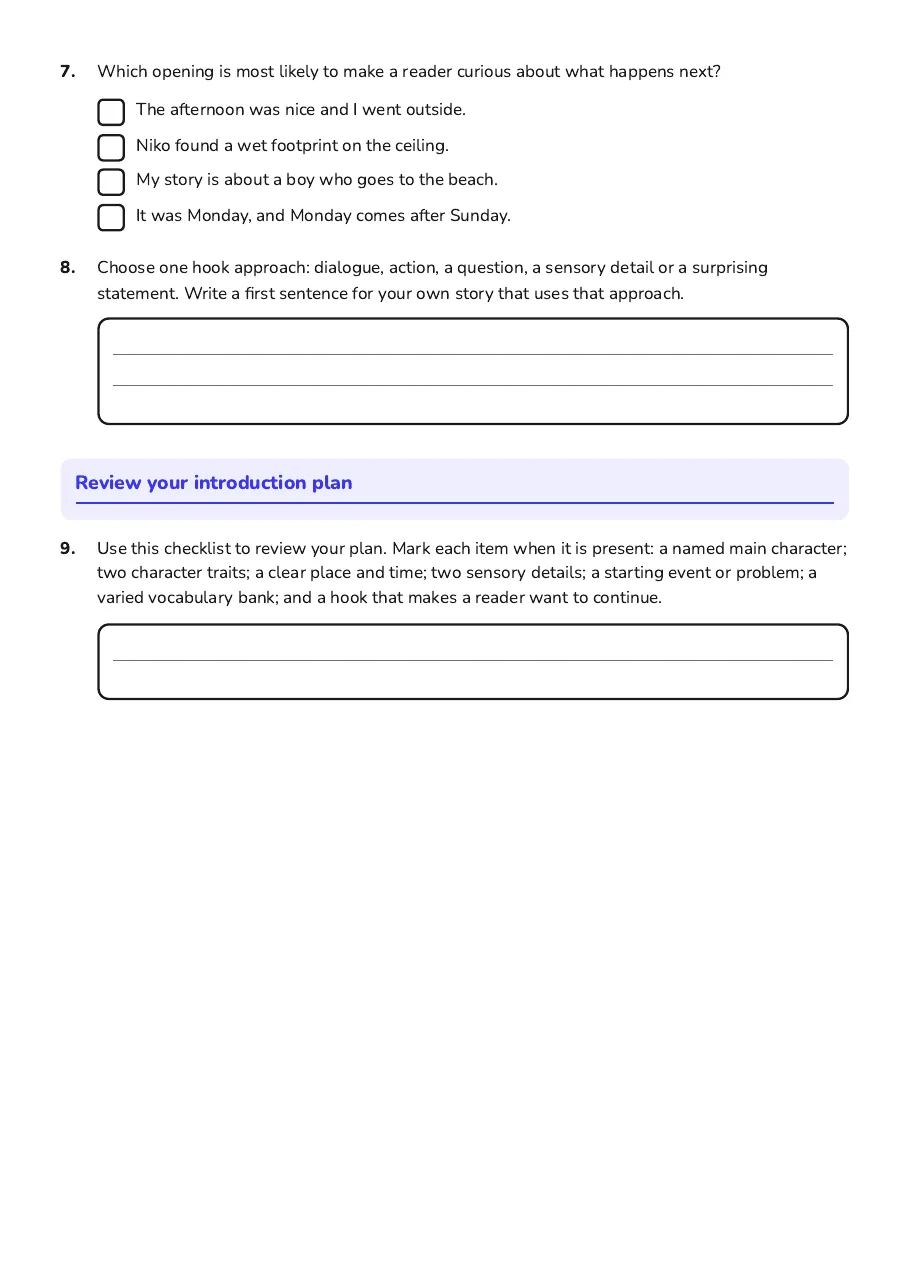
7.Which opening is most likely to make a reader curious about what happens next?
- The afternoon was nice and I went outside.
- Niko found a wet footprint on the ceiling.
- My story is about a boy who goes to the beach.
- It was Monday, and Monday comes after Sunday.
8.Choose one hook approach: dialogue, action, a question, a sensory detail or a surprising statement. Write a first sentence for your own story that uses that approach.
Review your introduction plan
9.Use this checklist to review your plan. Mark each item when it is present: a named main character; two character traits; a clear place and time; two sensory details; a starting event or problem; a varied vocabulary bank; and a hook that makes a reader want to continue.
3 printable pages
Page 1
Page 2
Page 3
About This Worksheet
Free in Kuraplan
Sign up free, grab the PDF, and customize it for your class.
Print-Ready
Formatted for standard paper. Clean layout, easy to read.
AI-Generated
Created with Kuraplan's AI, designed for real classroom use.
For Teachers & Parents
Use in classrooms, for homework, tutoring, or homeschool.
Need a custom version of this worksheet?
Kuraplan's AI generates custom worksheets in seconds — differentiated for every learner, aligned to your curriculum.
Generate Custom Worksheets — Free No credit card Curriculum-aligned Under 60 seconds