BusinessFreePrintable

Personal Finance Management Basics

A free business worksheet ready for your classroom. Open in Kuraplan to grab the print-ready PDF, customize it for your students, or generate a fresh version in seconds.
Personal Finance Management Basics worksheet preview
Name:Date:

Personal Finance Management Basics

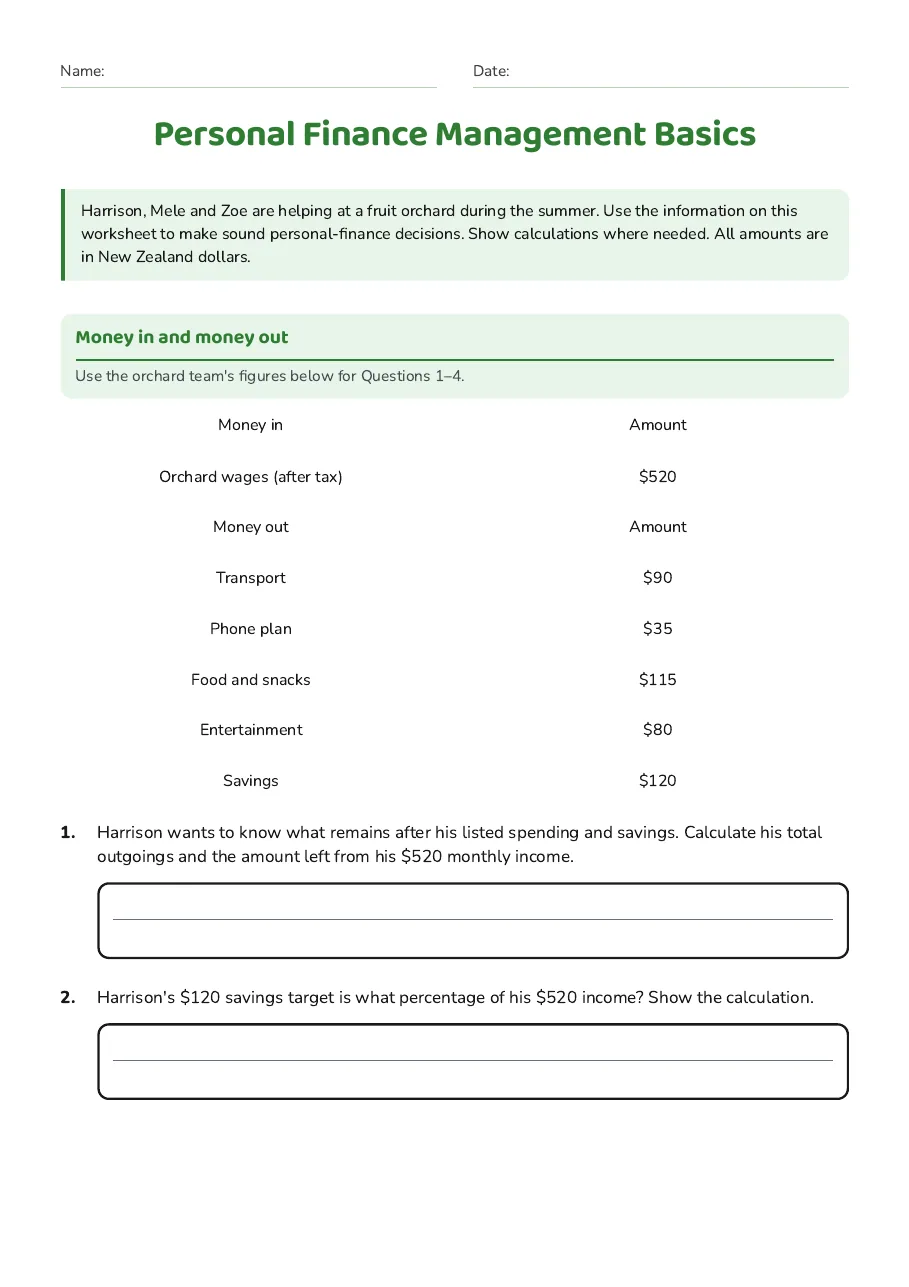
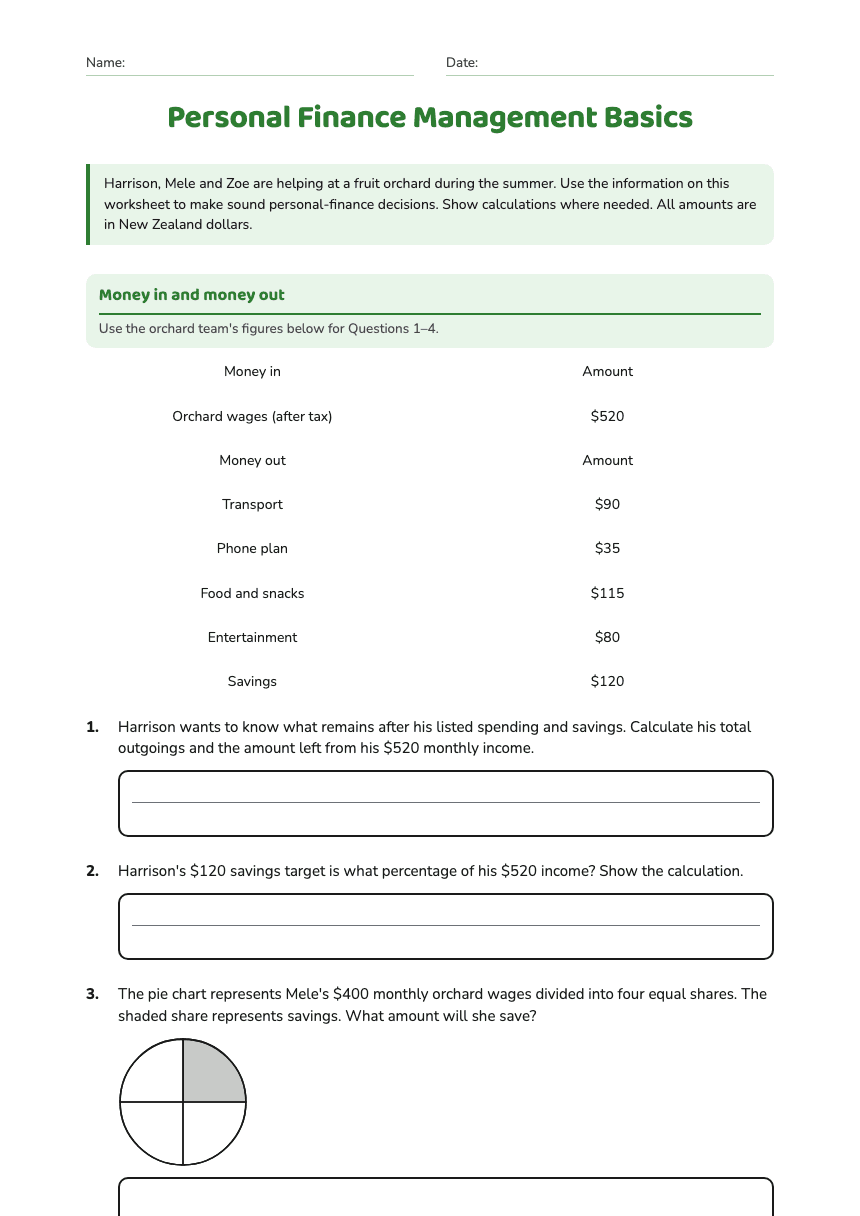
Harrison, Mele and Zoe are helping at a fruit orchard during the summer. Use the information on this worksheet to make sound personal-finance decisions. Show calculations where needed. All amounts are in New Zealand dollars.

Money in and money out

Use the orchard team's figures below for Questions 1–4.

Money in

Amount

Orchard wages (after tax)

$520

Money out

Amount

Transport

$90

Phone plan

$35

Food and snacks

$115

Entertainment

$80

Savings

$120

1.Harrison wants to know what remains after his listed spending and savings. Calculate his total outgoings and the amount left from his $520 monthly income.
2.Harrison's $120 savings target is what percentage of his $520 income? Show the calculation.
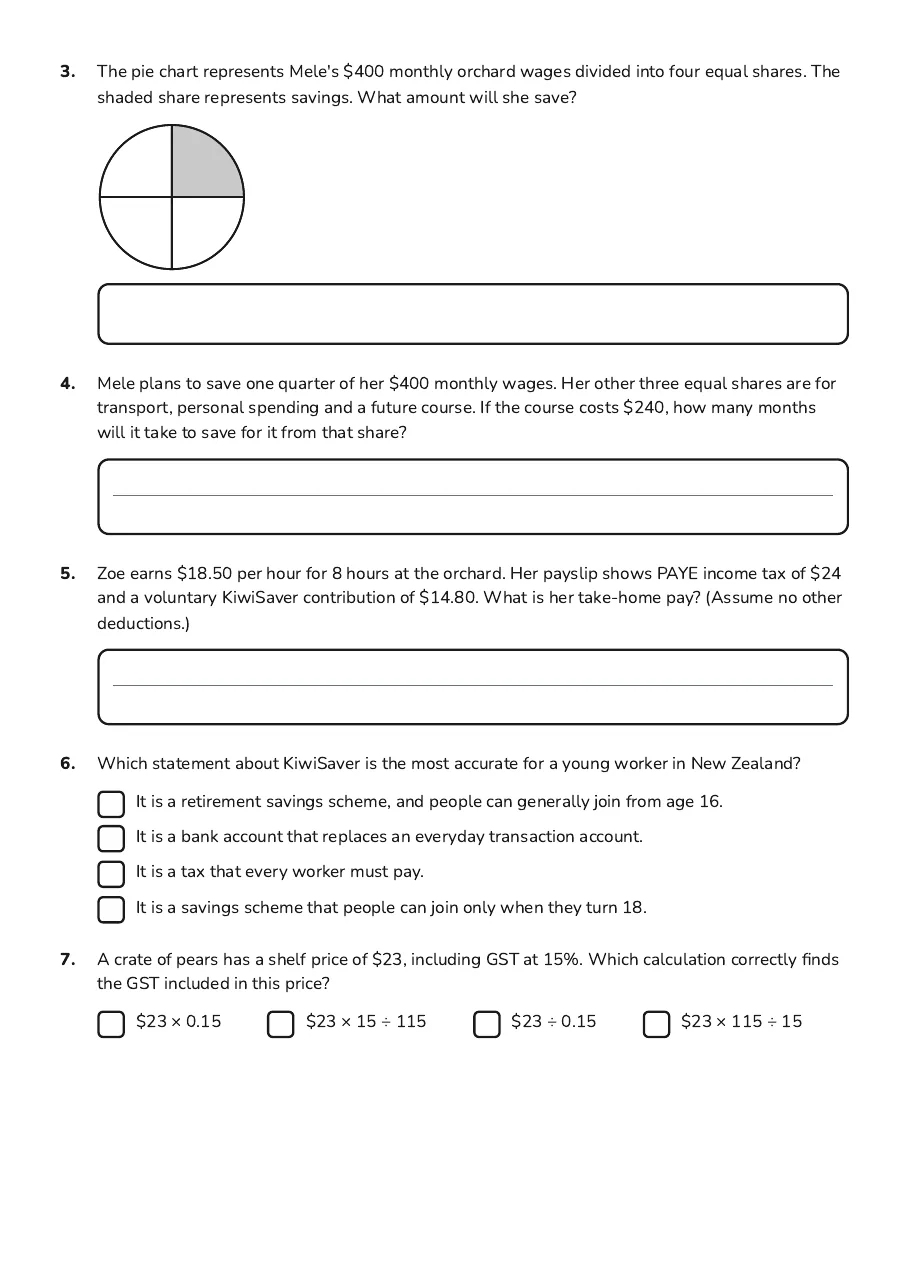
3.The pie chart represents Mele's $400 monthly orchard wages divided into four equal shares. The shaded share represents savings. What amount will she save?
4.Mele plans to save one quarter of her $400 monthly wages. Her other three equal shares are for transport, personal spending and a future course. If the course costs $240, how many months will it take to save for it from that share?
5.Zoe earns $18.50 per hour for 8 hours at the orchard. Her payslip shows PAYE income tax of $24 and a voluntary KiwiSaver contribution of $14.80. What is her take-home pay? (Assume no other deductions.)
6.Which statement about KiwiSaver is the most accurate for a young worker in New Zealand?
  • It is a retirement savings scheme, and people can generally join from age 16.
  • It is a bank account that replaces an everyday transaction account.
  • It is a tax that every worker must pay.
  • It is a savings scheme that people can join only when they turn 18.
7.A crate of pears has a shelf price of $23, including GST at 15%. Which calculation correctly finds the GST included in this price?
  • $23 × 0.15
  • $23 × 15 ÷ 115
  • $23 ÷ 0.15
  • $23 × 115 ÷ 15

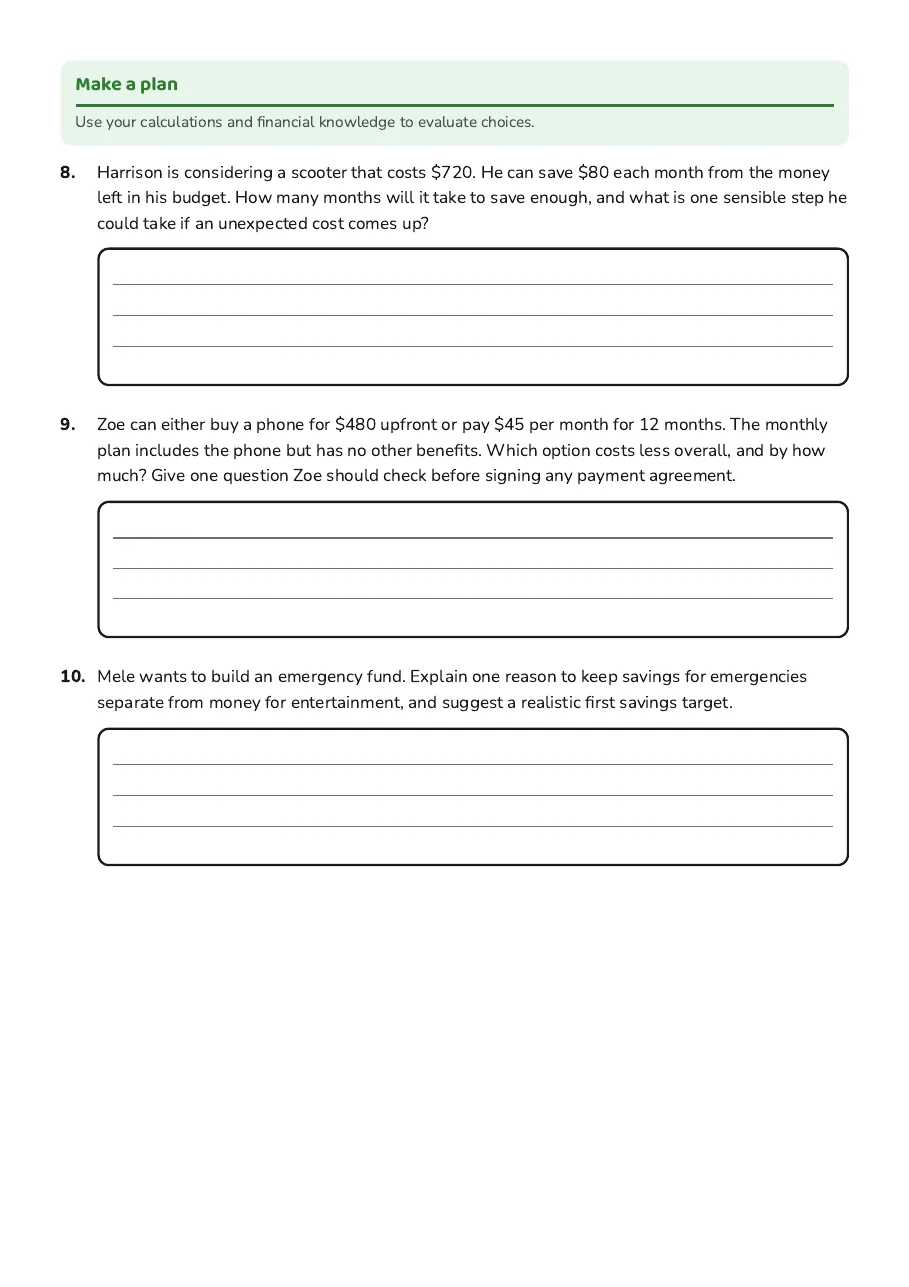
Make a plan

Use your calculations and financial knowledge to evaluate choices.

8.Harrison is considering a scooter that costs $720. He can save $80 each month from the money left in his budget. How many months will it take to save enough, and what is one sensible step he could take if an unexpected cost comes up?
9.Zoe can either buy a phone for $480 upfront or pay $45 per month for 12 months. The monthly plan includes the phone but has no other benefits. Which option costs less overall, and by how much? Give one question Zoe should check before signing any payment agreement.
10.Mele wants to build an emergency fund. Explain one reason to keep savings for emergencies separate from money for entertainment, and suggest a realistic first savings target.

3 printable pages

  • Personal Finance Management Basics, page 1 of 3: Money in and money out

    Page 1

  • Personal Finance Management Basics, page 2 of 3: 3. The pie chart represents Mele's $400 monthly orchard wages divided into four equal…

    Page 2

  • Personal Finance Management Basics, page 3 of 3: Make a plan

    Page 3

About This Worksheet

Free in Kuraplan

Sign up free, grab the PDF, and customize it for your class.

Print-Ready

Formatted for standard paper. Clean layout, easy to read.

AI-Generated

Created with Kuraplan's AI, designed for real classroom use.

For Teachers & Parents

Use in classrooms, for homework, tutoring, or homeschool.

Need a custom version of this worksheet?

Kuraplan's AI generates custom worksheets in seconds — differentiated for every learner, aligned to your curriculum.

Generate Custom Worksheets — Free
No credit card Curriculum-aligned Under 60 seconds

Explore more free resources