HealthFreePrintable

Personal Safety Risk Analysis

A free health worksheet ready for your classroom. Open in Kuraplan to grab the print-ready PDF, customize it for your students, or generate a fresh version in seconds.
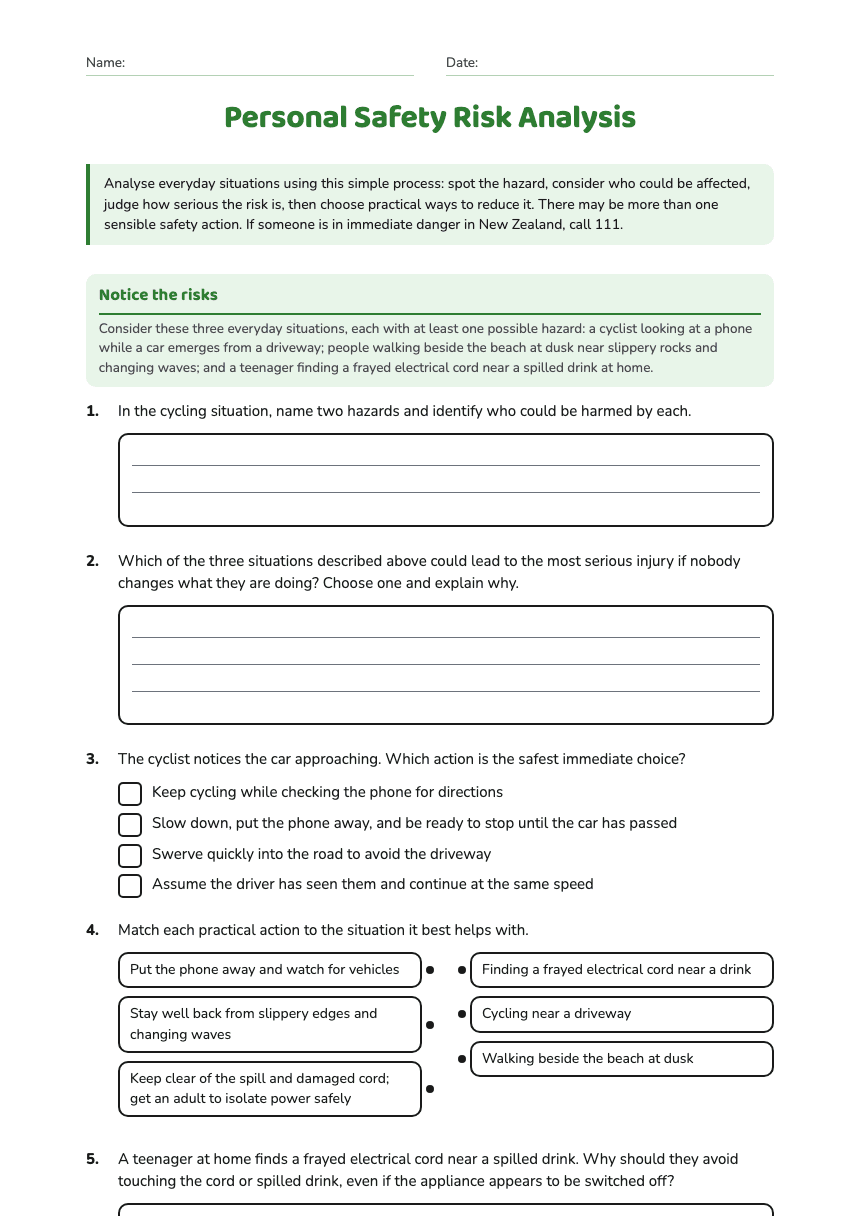
Personal Safety Risk Analysis worksheet preview
Name:Date:

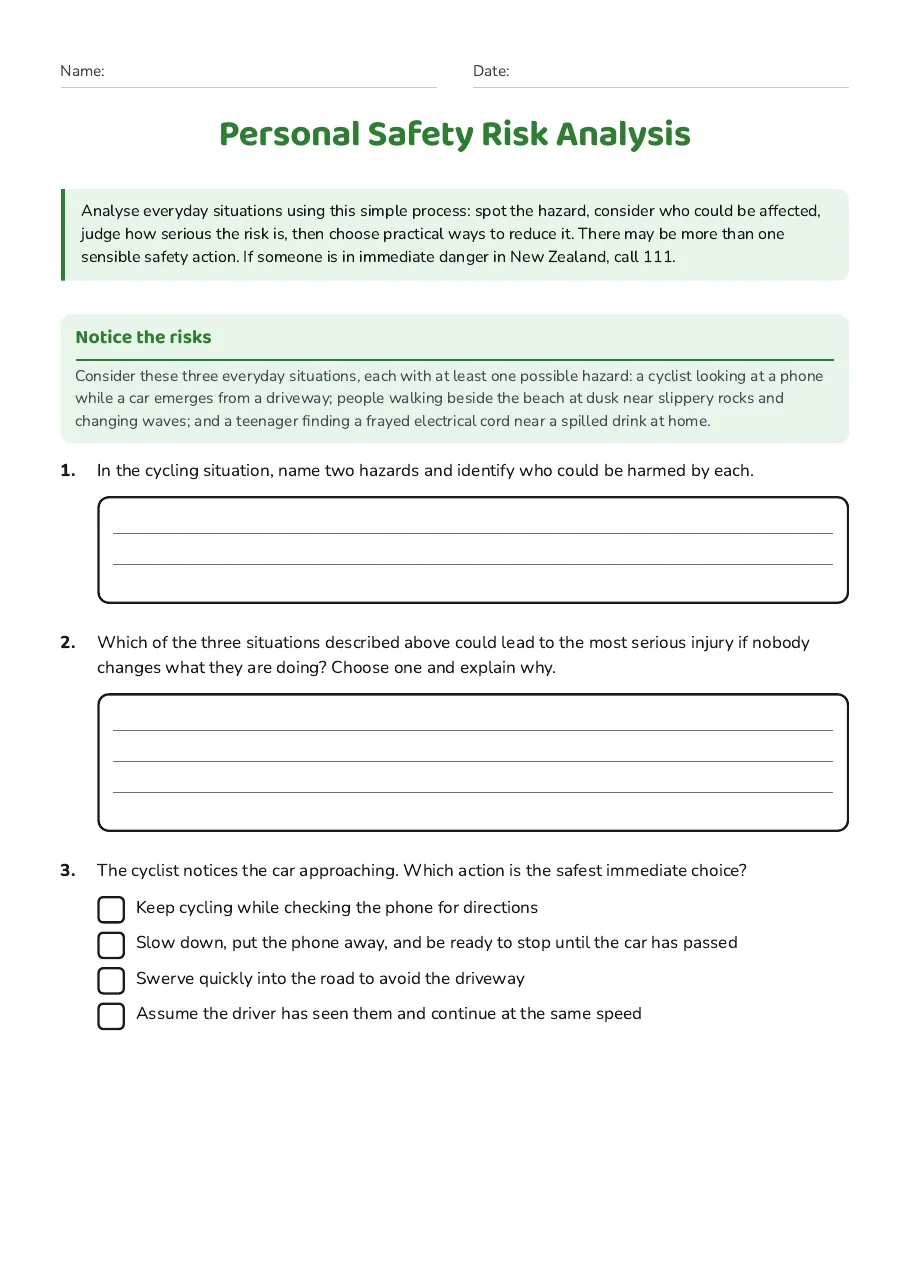
Personal Safety Risk Analysis

Analyse everyday situations using this simple process: spot the hazard, consider who could be affected, judge how serious the risk is, then choose practical ways to reduce it. There may be more than one sensible safety action. If someone is in immediate danger in New Zealand, call 111.

Notice the risks

Consider these three everyday situations, each with at least one possible hazard: a cyclist looking at a phone while a car emerges from a driveway; people walking beside the beach at dusk near slippery rocks and changing waves; and a teenager finding a frayed electrical cord near a spilled drink at home.

1.In the cycling situation, name two hazards and identify who could be harmed by each.
2.Which of the three situations described above could lead to the most serious injury if nobody changes what they are doing? Choose one and explain why.
3.The cyclist notices the car approaching. Which action is the safest immediate choice?
  • Keep cycling while checking the phone for directions
  • Slow down, put the phone away, and be ready to stop until the car has passed
  • Swerve quickly into the road to avoid the driveway
  • Assume the driver has seen them and continue at the same speed
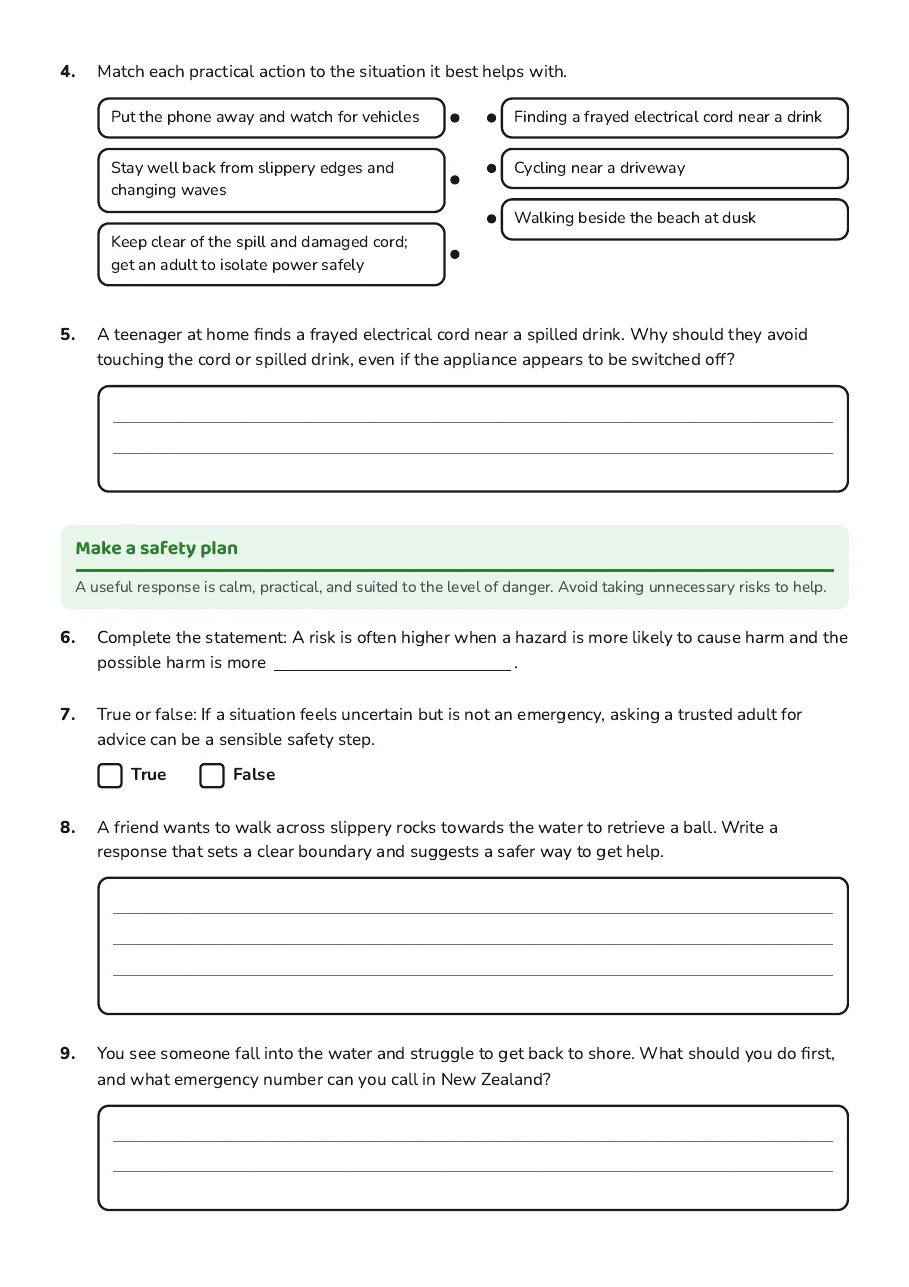
4.Match each practical action to the situation it best helps with.
  • Put the phone away and watch for vehicles
  • Stay well back from slippery edges and changing waves
  • Keep clear of the spill and damaged cord; get an adult to isolate power safely
  • Finding a frayed electrical cord near a drink
  • Cycling near a driveway
  • Walking beside the beach at dusk
5.A teenager at home finds a frayed electrical cord near a spilled drink. Why should they avoid touching the cord or spilled drink, even if the appliance appears to be switched off?

Make a safety plan

A useful response is calm, practical, and suited to the level of danger. Avoid taking unnecessary risks to help.

6.Complete the statement: A risk is often higher when a hazard is more likely to cause harm and the possible harm is more .
7.True or false: If a situation feels uncertain but is not an emergency, asking a trusted adult for advice can be a sensible safety step.
TrueFalse
8.A friend wants to walk across slippery rocks towards the water to retrieve a ball. Write a response that sets a clear boundary and suggests a safer way to get help.
9.You see someone fall into the water and struggle to get back to shore. What should you do first, and what emergency number can you call in New Zealand?
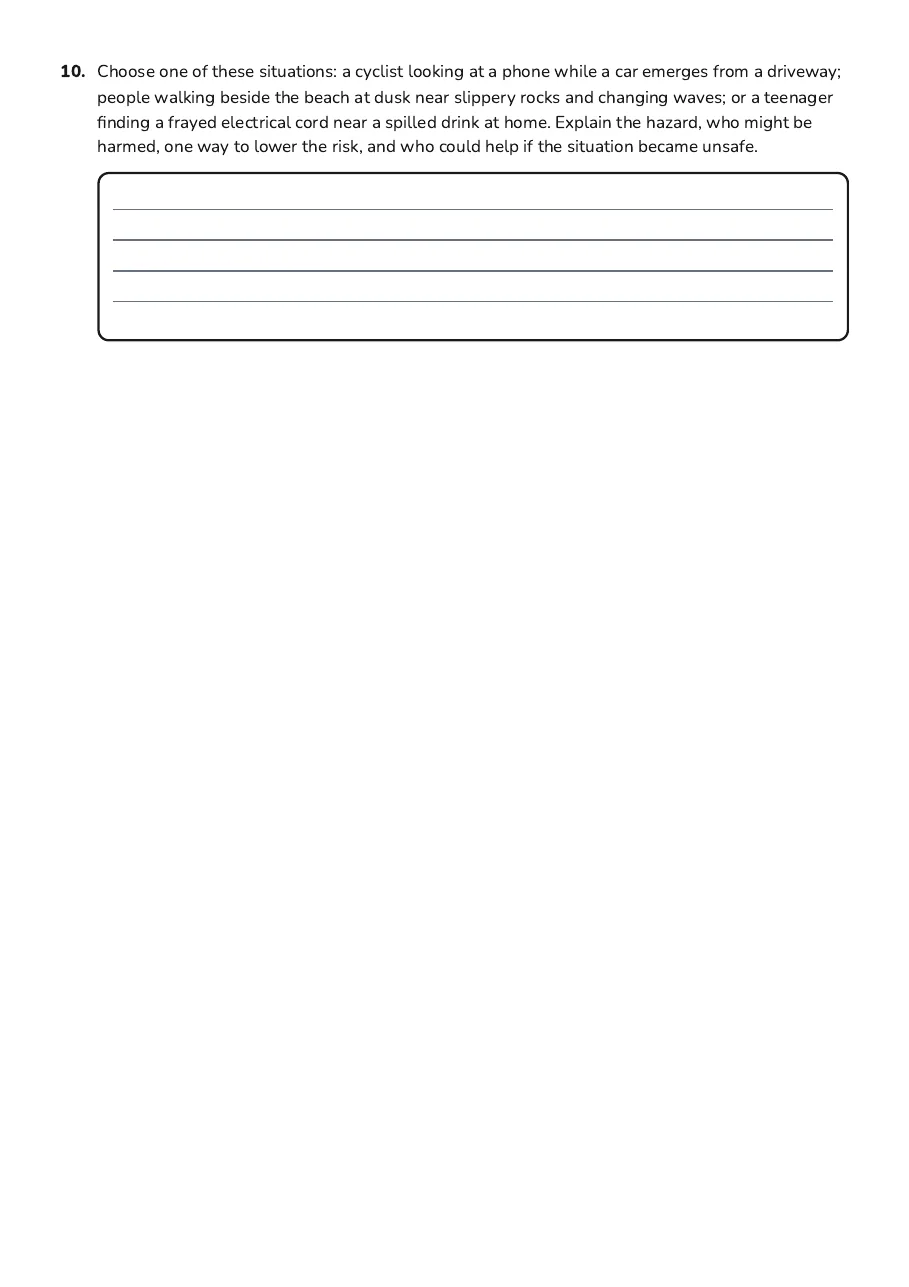
10.Choose one of these situations: a cyclist looking at a phone while a car emerges from a driveway; people walking beside the beach at dusk near slippery rocks and changing waves; or a teenager finding a frayed electrical cord near a spilled drink at home. Explain the hazard, who might be harmed, one way to lower the risk, and who could help if the situation became unsafe.

3 printable pages

  • Personal Safety Risk Analysis, page 1 of 3: Notice the risks

    Page 1

  • Personal Safety Risk Analysis, page 2 of 3: Make a safety plan

    Page 2

  • Personal Safety Risk Analysis, page 3 of 3: 10. Choose one of these situations: a cyclist looking at a phone while a car emerges from…

    Page 3

About This Worksheet

Free in Kuraplan

Sign up free, grab the PDF, and customize it for your class.

Print-Ready

Formatted for standard paper. Clean layout, easy to read.

AI-Generated

Created with Kuraplan's AI, designed for real classroom use.

For Teachers & Parents

Use in classrooms, for homework, tutoring, or homeschool.

Need a custom version of this worksheet?

Kuraplan's AI generates custom worksheets in seconds — differentiated for every learner, aligned to your curriculum.

Generate Custom Worksheets — Free
No credit card Curriculum-aligned Under 60 seconds