ScienceFreePrintable

Planet Earth Synthesis Grid

A free science worksheet ready for your classroom. Open in Kuraplan to grab the print-ready PDF, customize it for your students, or generate a fresh version in seconds.
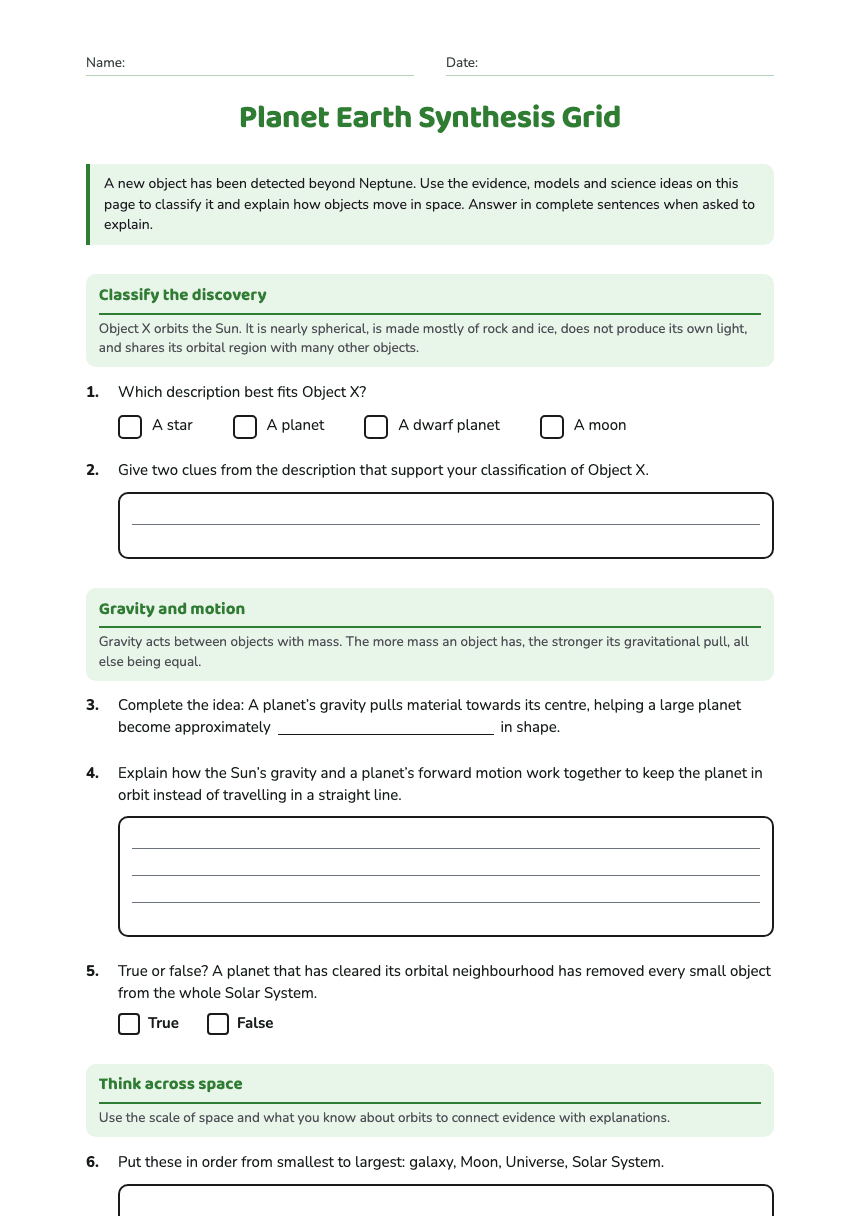
Planet Earth Synthesis Grid worksheet preview
Name:Date:

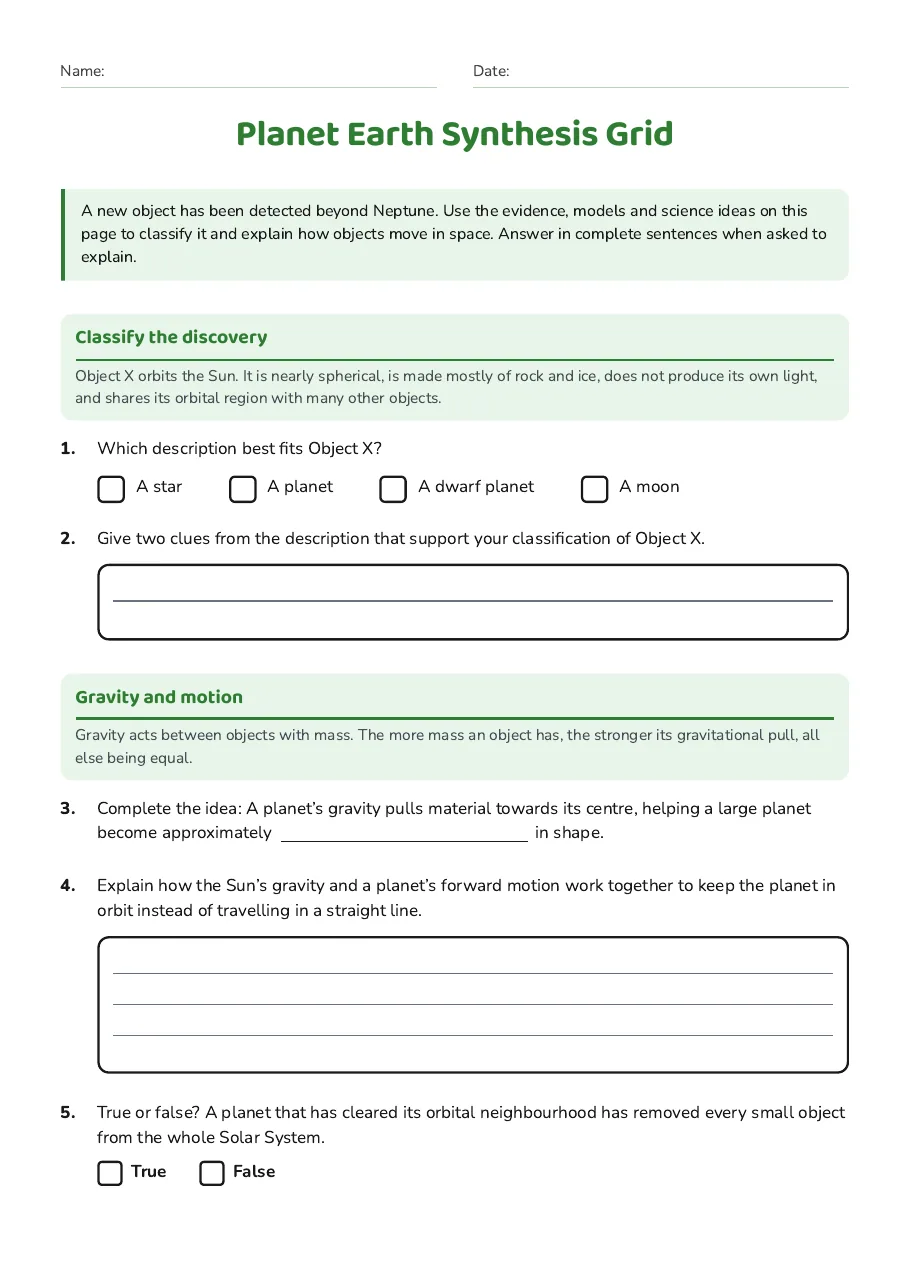
Planet Earth Synthesis Grid

A new object has been detected beyond Neptune. Use the evidence, models and science ideas on this page to classify it and explain how objects move in space. Answer in complete sentences when asked to explain.

Classify the discovery

Object X orbits the Sun. It is nearly spherical, is made mostly of rock and ice, does not produce its own light, and shares its orbital region with many other objects.

1.Which description best fits Object X?
  • A star
  • A planet
  • A dwarf planet
  • A moon
2.Give two clues from the description that support your classification of Object X.

Gravity and motion

Gravity acts between objects with mass. The more mass an object has, the stronger its gravitational pull, all else being equal.

3.Complete the idea: A planet’s gravity pulls material towards its centre, helping a large planet become approximately in shape.
4.Explain how the Sun’s gravity and a planet’s forward motion work together to keep the planet in orbit instead of travelling in a straight line.
5.True or false? A planet that has cleared its orbital neighbourhood has removed every small object from the whole Solar System.
TrueFalse

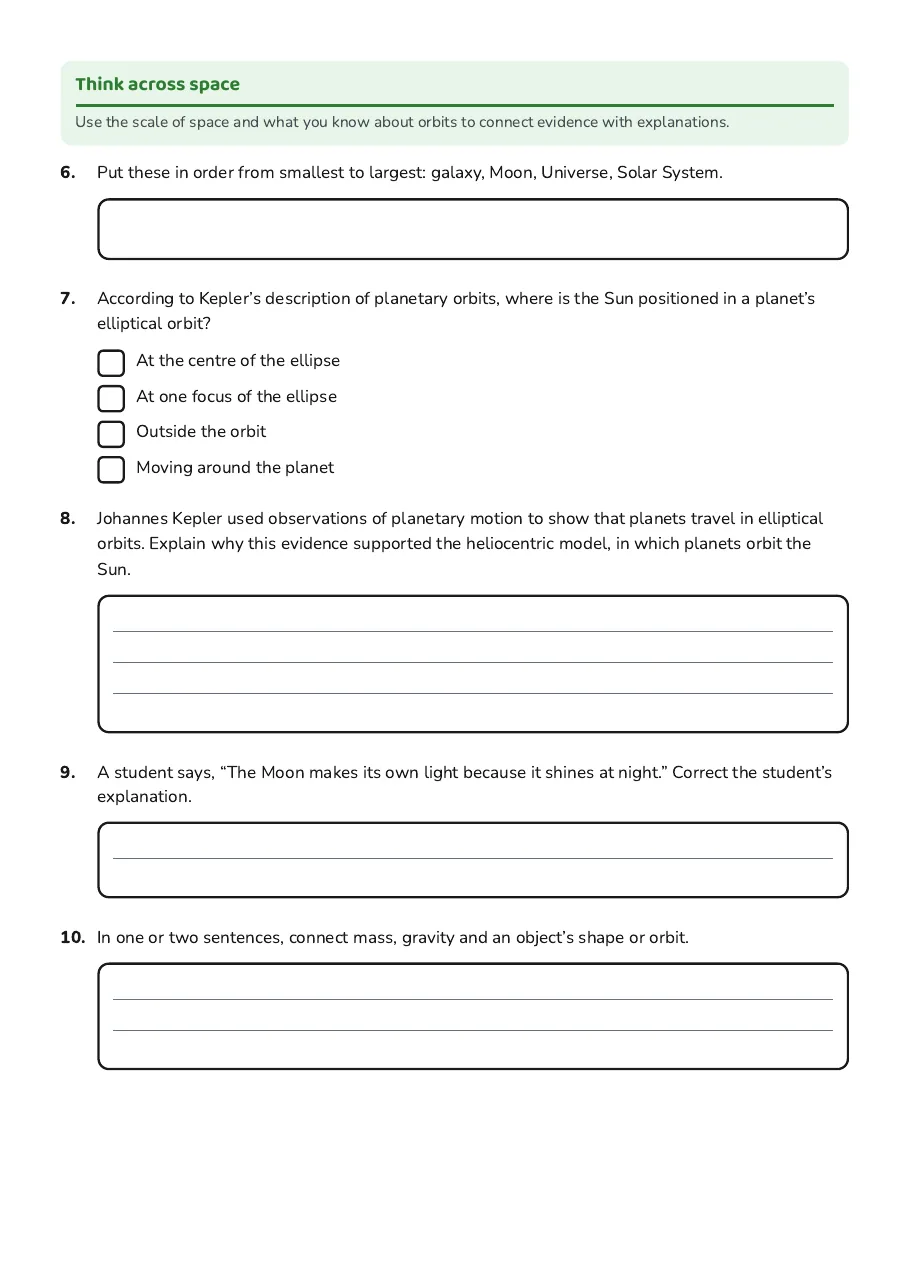
Think across space

Use the scale of space and what you know about orbits to connect evidence with explanations.

6.Put these in order from smallest to largest: galaxy, Moon, Universe, Solar System.
7.According to Kepler’s description of planetary orbits, where is the Sun positioned in a planet’s elliptical orbit?
  • At the centre of the ellipse
  • At one focus of the ellipse
  • Outside the orbit
  • Moving around the planet
8.Johannes Kepler used observations of planetary motion to show that planets travel in elliptical orbits. Explain why this evidence supported the heliocentric model, in which planets orbit the Sun.
9.A student says, “The Moon makes its own light because it shines at night.” Correct the student’s explanation.
10.In one or two sentences, connect mass, gravity and an object’s shape or orbit.

2 printable pages

  • Planet Earth Synthesis Grid, page 1 of 2: Classify the discovery, Gravity and motion

    Page 1

  • Planet Earth Synthesis Grid, page 2 of 2: Think across space

    Page 2

About This Worksheet

Free in Kuraplan

Sign up free, grab the PDF, and customize it for your class.

Print-Ready

Formatted for standard paper. Clean layout, easy to read.

AI-Generated

Created with Kuraplan's AI, designed for real classroom use.

For Teachers & Parents

Use in classrooms, for homework, tutoring, or homeschool.

Need a custom version of this worksheet?

Kuraplan's AI generates custom worksheets in seconds — differentiated for every learner, aligned to your curriculum.

Generate Custom Worksheets — Free
No credit card Curriculum-aligned Under 60 seconds