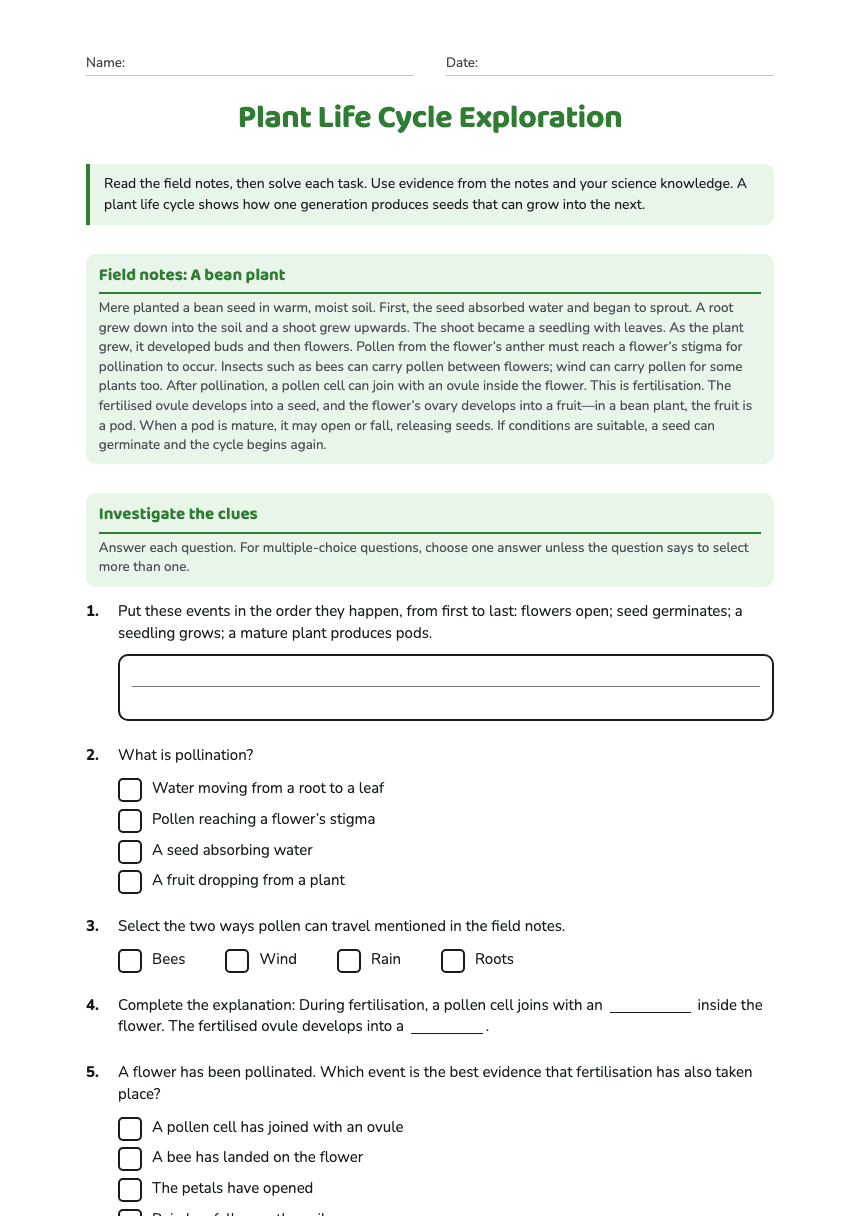
Plant Life Cycle Exploration
A free science worksheet ready for your classroom. Open in Kuraplan to grab the print-ready PDF, customize it for your students, or generate a fresh version in seconds.
Plant Life Cycle Exploration
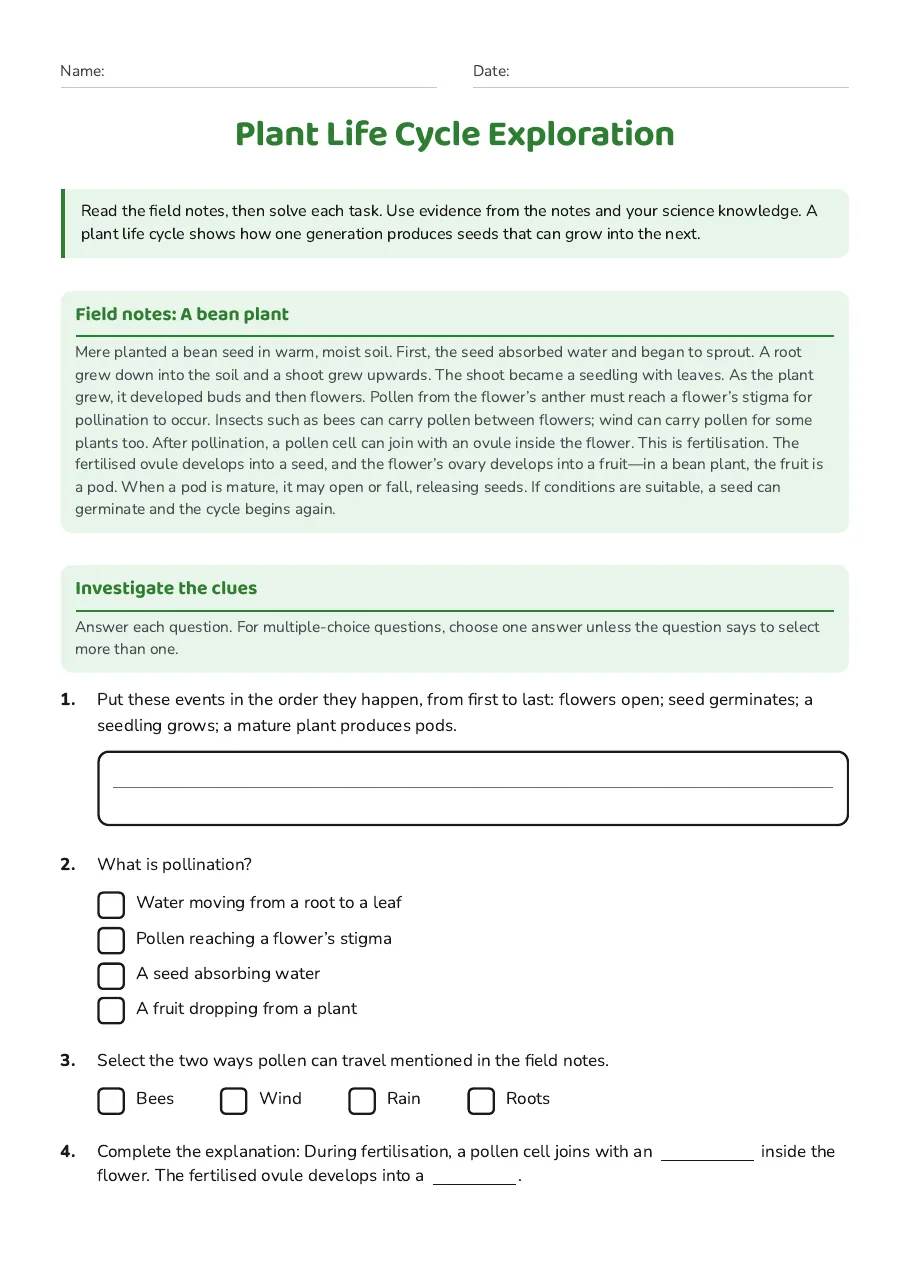
Field notes: A bean plant
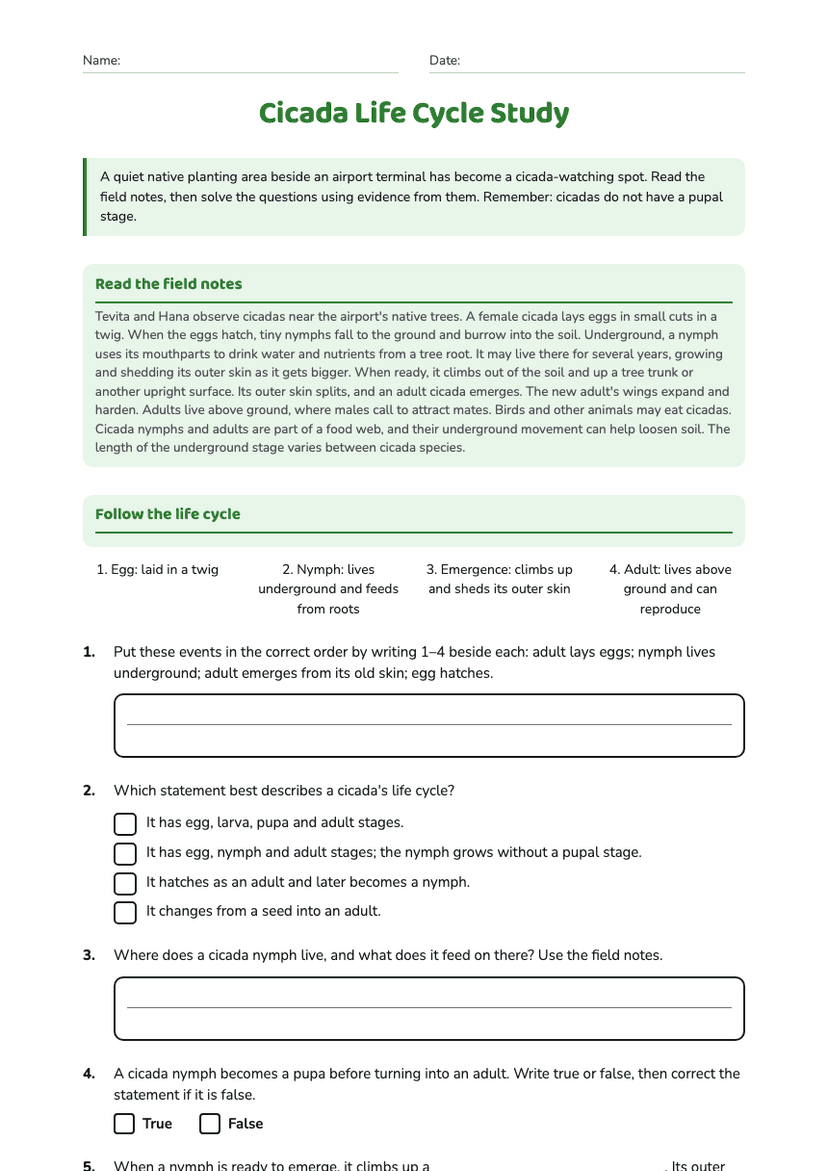
Mere planted a bean seed in warm, moist soil. First, the seed absorbed water and began to sprout. A root grew down into the soil and a shoot grew upwards. The shoot became a seedling with leaves. As the plant grew, it developed buds and then flowers. Pollen from the flower’s anther must reach a flower’s stigma for pollination to occur. Insects such as bees can carry pollen between flowers; wind can carry pollen for some plants too. After pollination, a pollen cell can join with an ovule inside the flower. This is fertilisation. The fertilised ovule develops into a seed, and the flower’s ovary develops into a fruit—in a bean plant, the fruit is a pod. When a pod is mature, it may open or fall, releasing seeds. If conditions are suitable, a seed can germinate and the cycle begins again.
Investigate the clues
Answer each question. For multiple-choice questions, choose one answer unless the question says to select more than one.
- Water moving from a root to a leaf
- Pollen reaching a flower’s stigma
- A seed absorbing water
- A fruit dropping from a plant
- Bees
- Wind
- Rain
- Roots
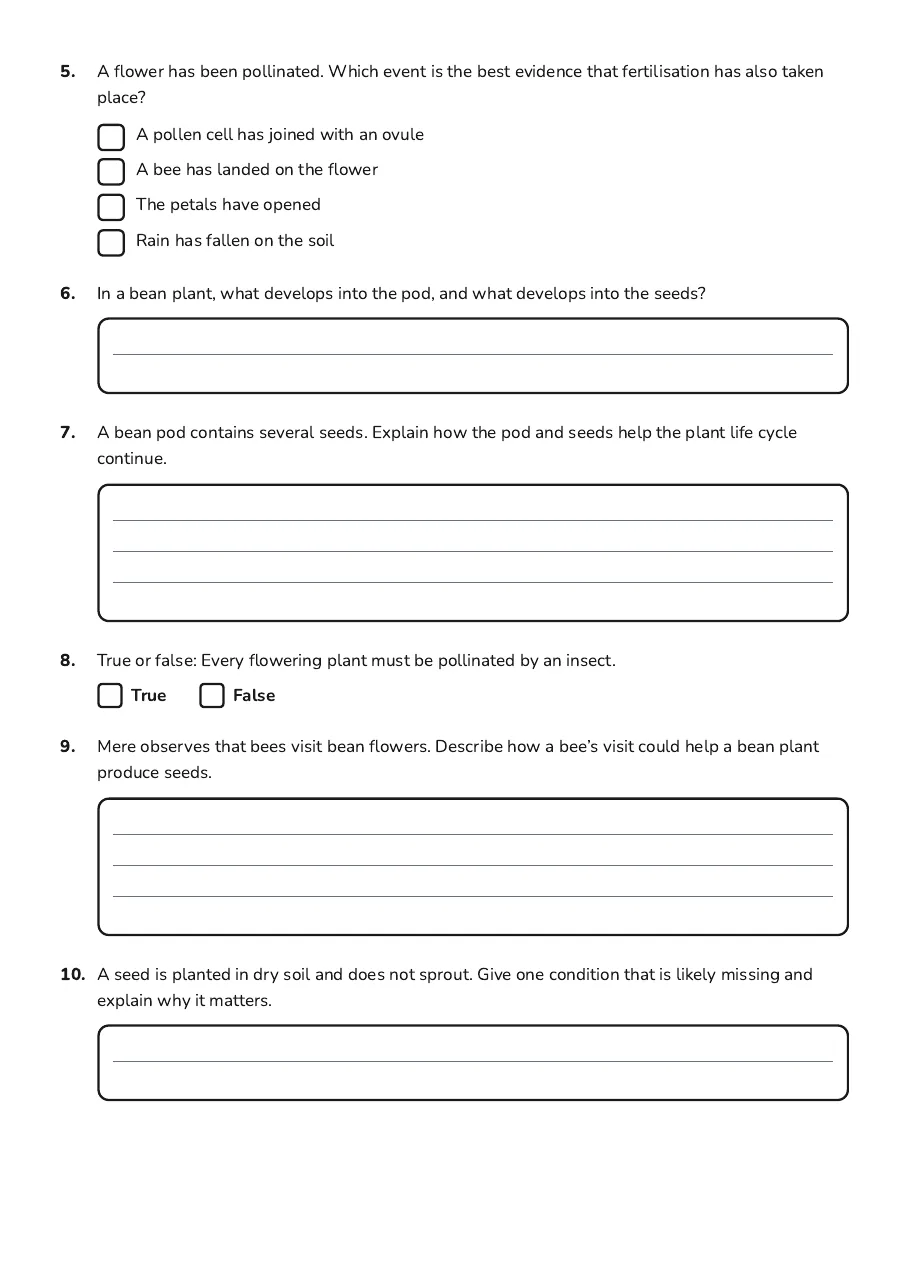
- A pollen cell has joined with an ovule
- A bee has landed on the flower
- The petals have opened
- Rain has fallen on the soil
3 printable pages
Page 1
Page 2

Page 3
About This Worksheet
Free in Kuraplan
Sign up free, grab the PDF, and customize it for your class.
Print-Ready
Formatted for standard paper. Clean layout, easy to read.
AI-Generated
Created with Kuraplan's AI, designed for real classroom use.
For Teachers & Parents
Use in classrooms, for homework, tutoring, or homeschool.
Need a custom version of this worksheet?
Kuraplan's AI generates custom worksheets in seconds — differentiated for every learner, aligned to your curriculum.
Generate Custom Worksheets — Free