Poetry Mentor Text Booklet
A free english worksheet ready for your classroom. Open in Kuraplan to grab the print-ready PDF, customize it for your students, or generate a fresh version in seconds.
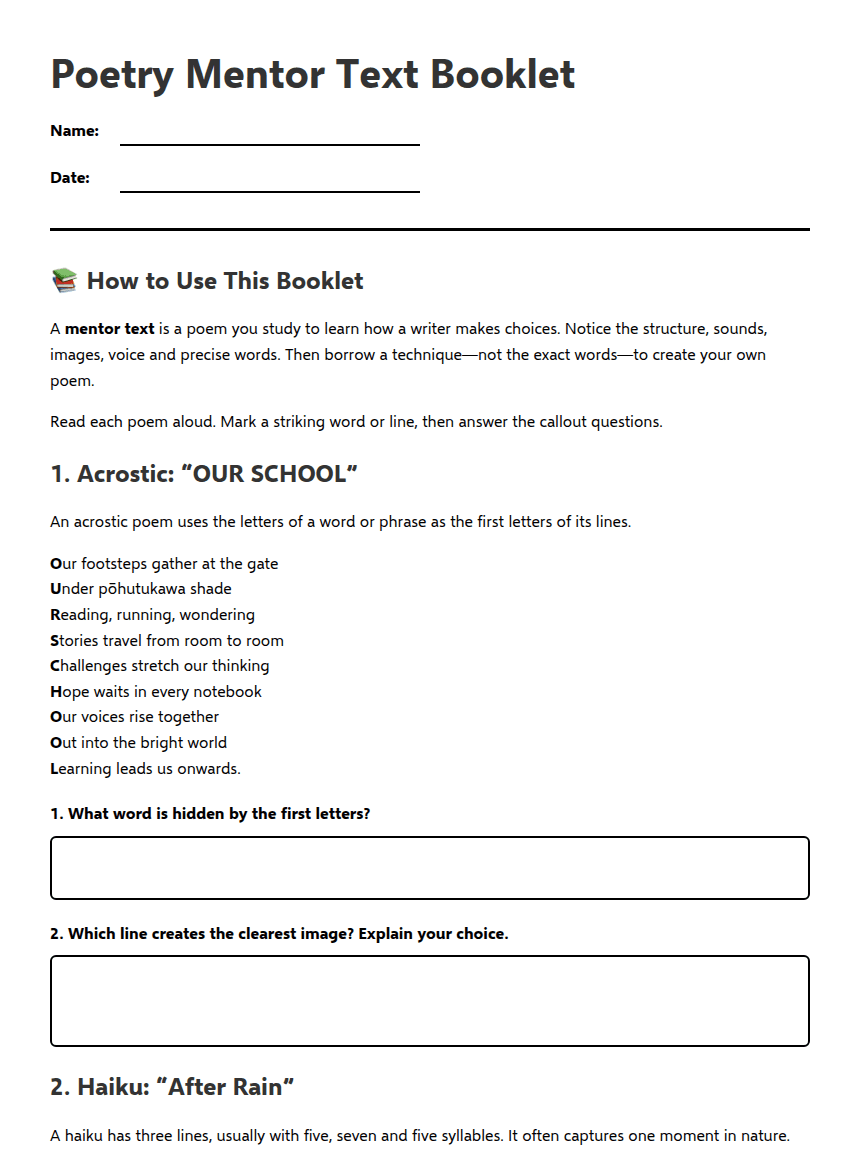
Poetry Mentor Text Booklet
📚 How to Use This Booklet
A mentor text is a poem you study to learn how a writer makes choices. Notice the structure, sounds, images, voice and precise words. Then borrow a technique—not the exact words—to create your own poem.
Read each poem aloud. Mark a striking word or line, then answer the callout questions.
1. Acrostic: “OUR SCHOOL”
An acrostic poem uses the letters of a word or phrase as the first letters of its lines.
Our footsteps gather at the gate
Under pōhutukawa shade
Reading, running, wondering
Stories travel from room to room
Challenges stretch our thinking
Hope waits in every notebook
Our voices rise together
Out into the bright world
Learning leads us onwards.
2. Haiku: “After Rain”
A haiku has three lines, usually with five, seven and five syllables. It often captures one moment in nature.
Silver puddles shine
A fantail flicks through wet leaves
Clouds loosen their grip
3. Cinquain: “Library”
A cinquain has five lines. A common pattern is one noun, two describing words, three action words, a four-word phrase and one final noun.
Library
Quiet, waiting
Shelving, whispering, opening
Worlds tucked between covers
Discovery
4. Concrete Poem: “Koru”
A concrete poem arranges words in a shape connected to its subject.
unfurl
new green
spiral of light
leaf by leaf opening
small beginning, wide promise
opening
light
green
5. Free Verse: “Between Bells”
Free verse does not follow a fixed rhyme or metre. The poet controls line breaks, spacing and rhythm.
Between bells
the corridor becomes a river—
shoes swish past,
a laugh breaks like a wave,
and someone carries
half a song
into the next lesson.
🌿 More Mentor Texts
6. Narrative Poem: “The Lost Lunchbox”
A narrative poem tells a story with characters, setting, events and often a problem or resolution.
At lunchtime Mia searched the court,
beneath the bench, beside the sport.
She found one note, a muddy shoe,
and crumbs that led where kererū flew.
Behind the shed, beneath a tree,
her lunchbox waited patiently.
“Next time,” she said, “I’ll write my name.”
The bell rang out; the lesson came.
7. Limerick: “The Fast Homework”
A limerick has five lines, a bouncy rhythm, an AABBA rhyme pattern and a humorous ending.
There once was a student named Jay,
Who finished his homework one day.
He danced with delight,
Till he noticed that night
He had written it backwards—hooray!
8. Sonnet-Style Poem: “The Science Room”
A sonnet-style poem often has fourteen lines, a thoughtful theme and a turn in thinking called a volta. This poem uses fourteen lines but not a strict traditional rhyme scheme.
Glass beakers catch the morning’s pale-blue flame,
and planets swing in quiet, painted space.
We test, record, repeat a result,
while questions gather speed around the place.
A seed beneath the microscope appears,
a tiny forest folded in its skin.
The smallest world can hold the largest thought;
a door is waiting where we thought walls stood.
So science is not answers lined in rows,
nor facts that sleep inside a heavy book.
It is the brave and curious “suppose”—
the pause before we take another look.
We leave with more unknowns than we began,
yet know the world is wider than we planned.
9. Ballad Stanza: “The Track Home”
A ballad stanza usually has four lines, a strong beat and an ABAB or ABCB rhyme pattern. It often tells a dramatic story.
The evening filled the track with gold,
the wind moved through the flax;
we heard the distant tui call
and hurried home with packs.
10. Spoken-Word Poem: “Say It”
A spoken-word poem is written for performance. It may use repetition, direct address, strong rhythm and a powerful personal voice.
Say it when the answer is hiding.
Say it when your hands are shaking.
Say it when the room feels too loud
and your idea is small but bright.
Say it—not to fill the silence,
but to give the silence a door.
Your voice is not a disturbance.
Your voice is what we are listening for.
📝 Compare the Forms
Record one structural feature, one sound or language feature, and one possible topic for each form.
Structure: ____________________
Craft feature: ____________________
Structure: ____________________
Craft feature: ____________________
Structure: ____________________
Craft feature: ____________________
Structure: ____________________
Craft feature: ____________________
Structure: ____________________
Craft feature: ____________________
Structure: ____________________
Craft feature: ____________________
Structure: ____________________
Craft feature: ____________________
Structure: ____________________
Craft feature: ____________________
Structure: ____________________
Craft feature: ____________________
Structure: ____________________
Craft feature: ____________________
✏️ Imitate the Mentor Text
Choose one form. Borrow its structure or technique, but create your own topic, images and voice.
👩🏫 Teacher Note and Answer Guide
Key features: Acrostic—first letters spell a word. Haiku—three short lines and a nature moment. Cinquain—five-line compressed description. Concrete poem—visual shape supports meaning. Free verse—controlled line breaks without a fixed pattern. Narrative poem—characters, events and resolution. Limerick—five lines, AABBA rhyme and humour. Sonnet-style—fourteen lines and a reflective turn. Ballad stanza—four-line story stanza with regular beat and rhyme. Spoken word—repetition, direct address and performance voice.
Suggested answers: 1 Our School. 3 “Silver”, “shine”, “flicks” and “wet” create visual and movement imagery. 7 A curved koru-like form. 11 Mia loses her lunchbox and finds it beneath a tree. 13 Lines 1, 2 and 5 rhyme; lines 3 and 4 rhyme: AABBA. 17 Lines 2 and 4 rhyme: ABCB. Other responses may vary if supported with evidence from the poem.
About This Worksheet
Free in Kuraplan
Sign up free, grab the PDF, and customize it for your class.
Print-Ready
Formatted for standard paper. Clean layout, easy to read.
AI-Generated
Created with Kuraplan's AI, designed for real classroom use.
For Teachers & Parents
Use in classrooms, for homework, tutoring, or homeschool.
Need a custom version of this worksheet?
Kuraplan's AI generates custom worksheets in seconds — differentiated for every learner, aligned to your curriculum.
Generate Custom Worksheets — Free