EnglishFreePrintable
Pātea Pools Story Structure
A free english worksheet ready for your classroom. Open in Kuraplan to grab the print-ready PDF, customize it for your students, or generate a fresh version in seconds.
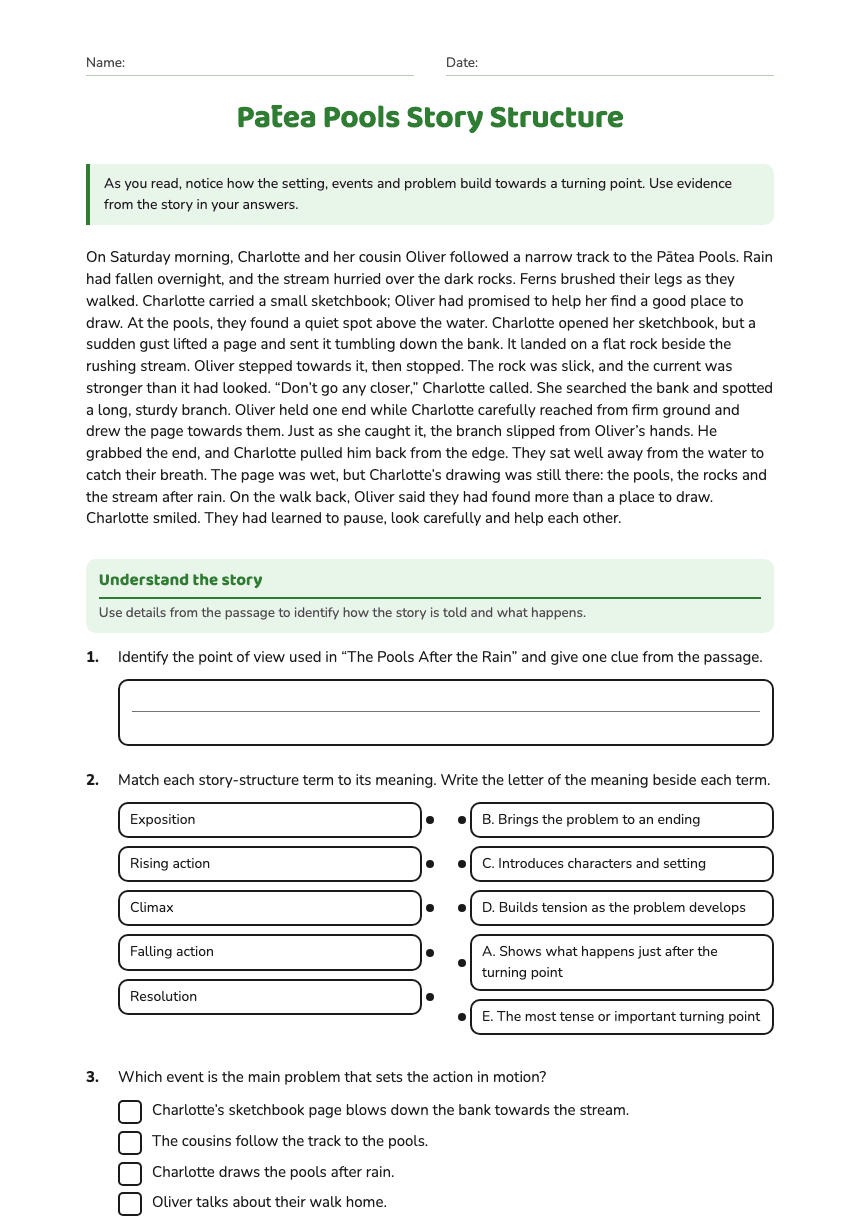
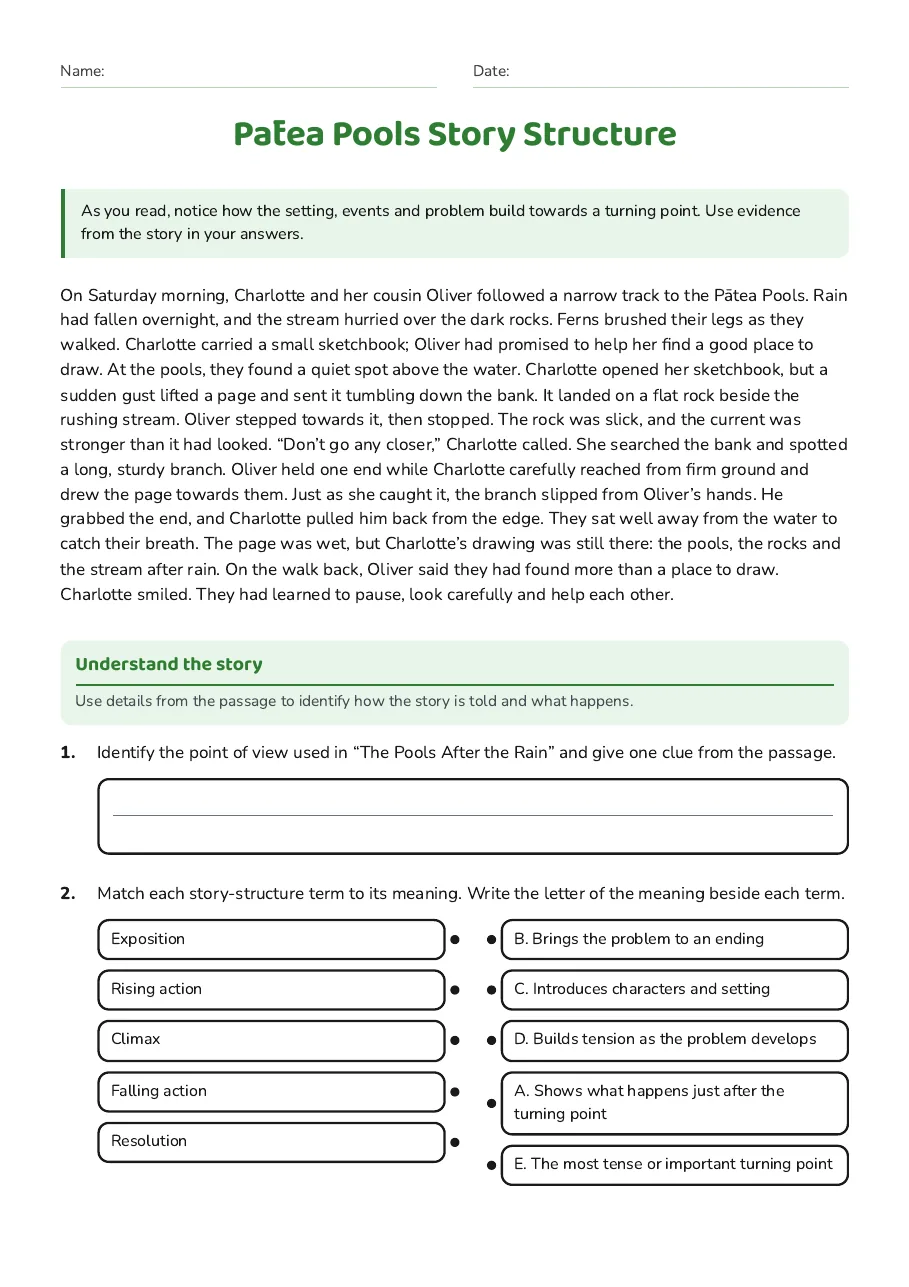
Name:Date:
Pātea Pools Story Structure
As you read, notice how the setting, events and problem build towards a turning point. Use evidence from the story in your answers.
On Saturday morning, Charlotte and her cousin Oliver followed a narrow track to the Pātea Pools. Rain had fallen overnight, and the stream hurried over the dark rocks. Ferns brushed their legs as they walked. Charlotte carried a small sketchbook; Oliver had promised to help her find a good place to draw.
At the pools, they found a quiet spot above the water. Charlotte opened her sketchbook, but a sudden gust lifted a page and sent it tumbling down the bank. It landed on a flat rock beside the rushing stream. Oliver stepped towards it, then stopped. The rock was slick, and the current was stronger than it had looked.
“Don’t go any closer,” Charlotte called. She searched the bank and spotted a long, sturdy branch. Oliver held one end while Charlotte carefully reached from firm ground and drew the page towards them. Just as she caught it, the branch slipped from Oliver’s hands. He grabbed the end, and Charlotte pulled him back from the edge.
They sat well away from the water to catch their breath. The page was wet, but Charlotte’s drawing was still there: the pools, the rocks and the stream after rain. On the walk back, Oliver said they had found more than a place to draw. Charlotte smiled. They had learned to pause, look carefully and help each other.
Understand the story
Use details from the passage to identify how the story is told and what happens.
1.Identify the point of view used in “The Pools After the Rain” and give one clue from the passage.
2.Match each story-structure term to its meaning. Write the letter of the meaning beside each term.
- Exposition
- Rising action
- Climax
- Falling action
- Resolution
- B. Brings the problem to an ending
- C. Introduces characters and setting
- D. Builds tension as the problem develops
- A. Shows what happens just after the turning point
- E. The most tense or important turning point
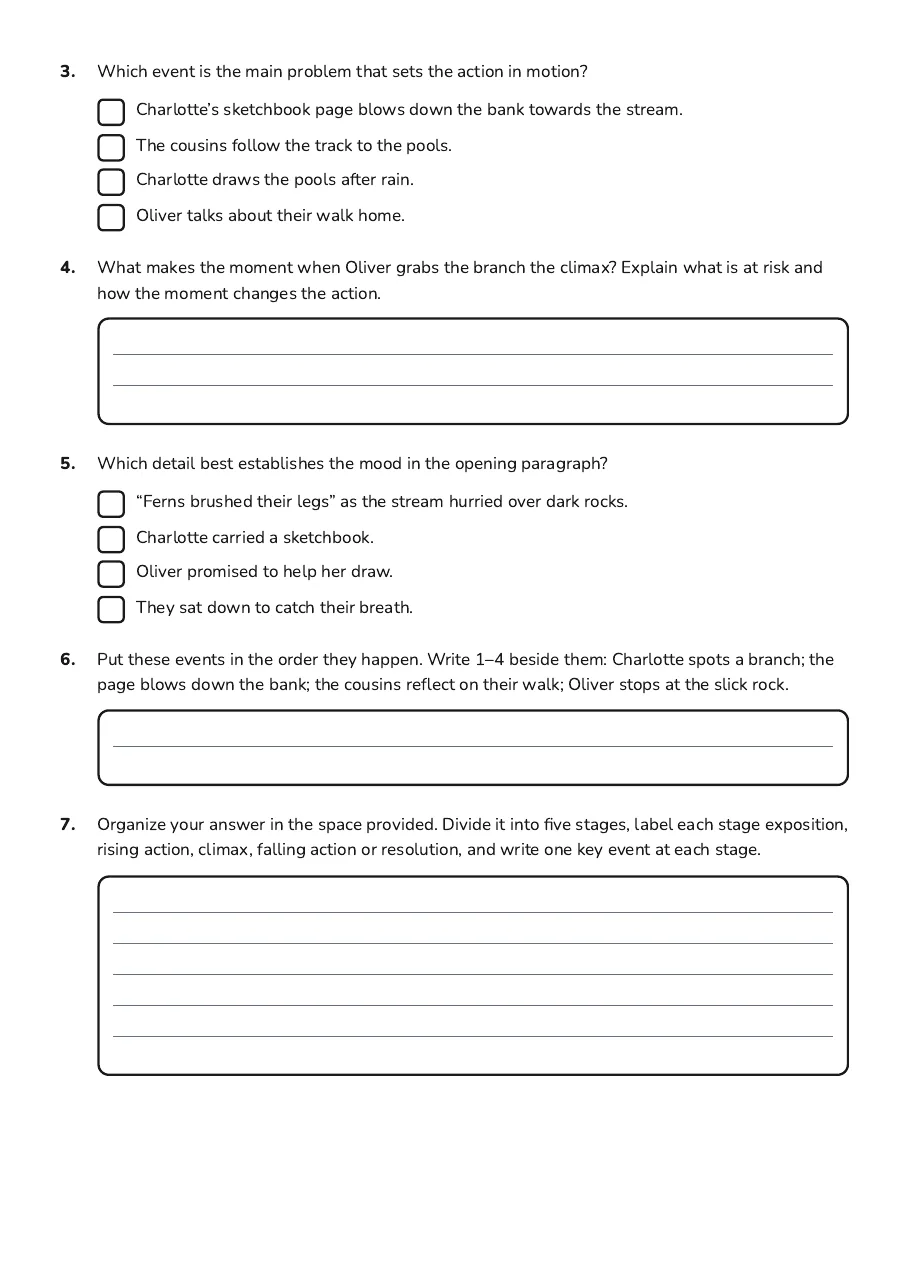
3.Which event is the main problem that sets the action in motion?
- Charlotte’s sketchbook page blows down the bank towards the stream.
- The cousins follow the track to the pools.
- Charlotte draws the pools after rain.
- Oliver talks about their walk home.
4.What makes the moment when Oliver grabs the branch the climax? Explain what is at risk and how the moment changes the action.
5.Which detail best establishes the mood in the opening paragraph?
- “Ferns brushed their legs” as the stream hurried over dark rocks.
- Charlotte carried a sketchbook.
- Oliver promised to help her draw.
- They sat down to catch their breath.
6.Put these events in the order they happen. Write 1–4 beside them: Charlotte spots a branch; the page blows down the bank; the cousins reflect on their walk; Oliver stops at the slick rock.
7.Organize your answer in the space provided. Divide it into five stages, label each stage exposition, rising action, climax, falling action or resolution, and write one key event at each stage.
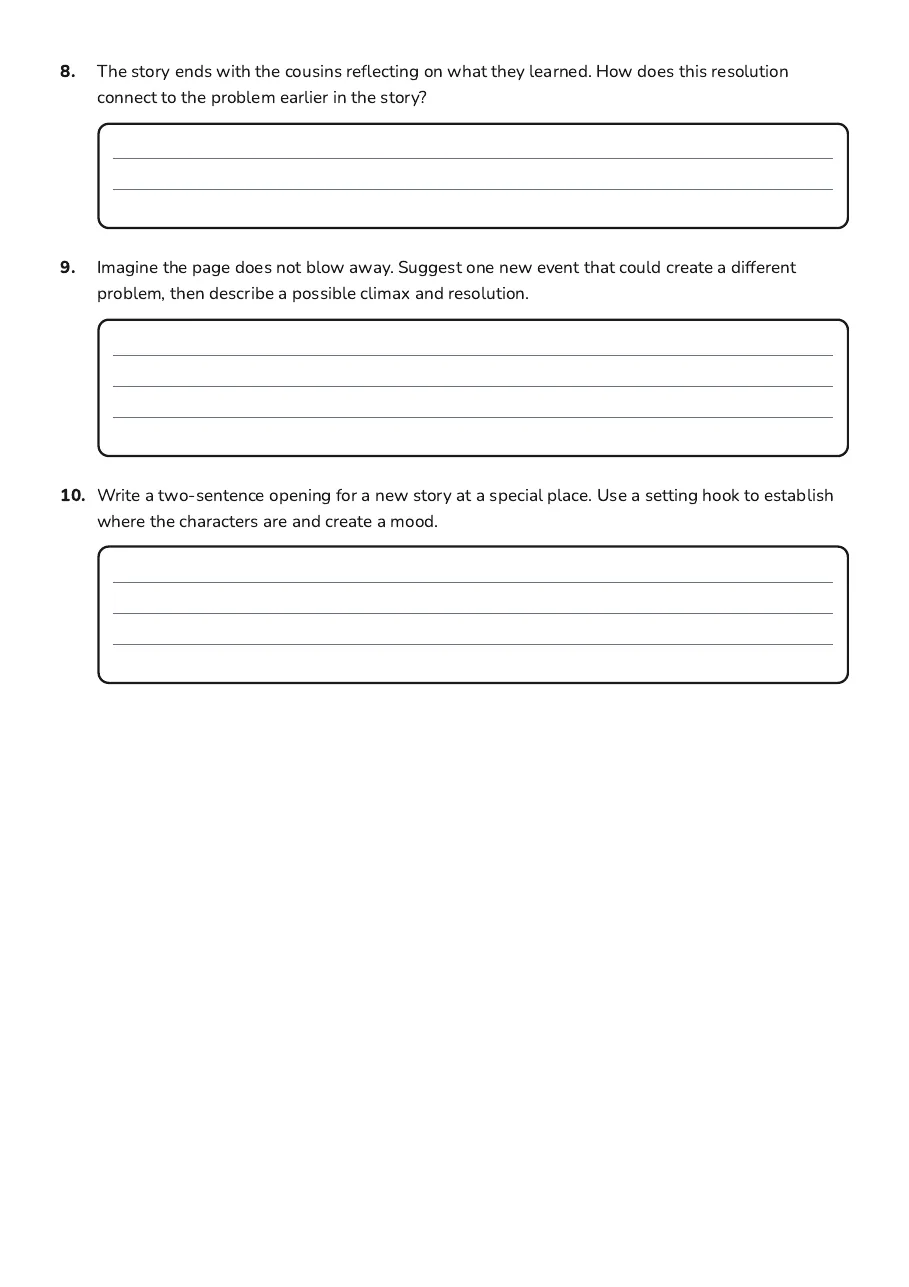
8.The story ends with the cousins reflecting on what they learned. How does this resolution connect to the problem earlier in the story?
9.Imagine the page does not blow away. Suggest one new event that could create a different problem, then describe a possible climax and resolution.
10.Write a two-sentence opening for a new story at a special place. Use a setting hook to establish where the characters are and create a mood.
3 printable pages
Page 1
Page 2
Page 3
About This Worksheet
Free in Kuraplan
Sign up free, grab the PDF, and customize it for your class.
Print-Ready
Formatted for standard paper. Clean layout, easy to read.
AI-Generated
Created with Kuraplan's AI, designed for real classroom use.
For Teachers & Parents
Use in classrooms, for homework, tutoring, or homeschool.
Need a custom version of this worksheet?
Kuraplan's AI generates custom worksheets in seconds — differentiated for every learner, aligned to your curriculum.
Generate Custom Worksheets — Free No credit card Curriculum-aligned Under 60 seconds