Reciprocal Reading Comprehension
A free english worksheet ready for your classroom. Open in Kuraplan to grab the print-ready PDF, customize it for your students, or generate a fresh version in seconds.
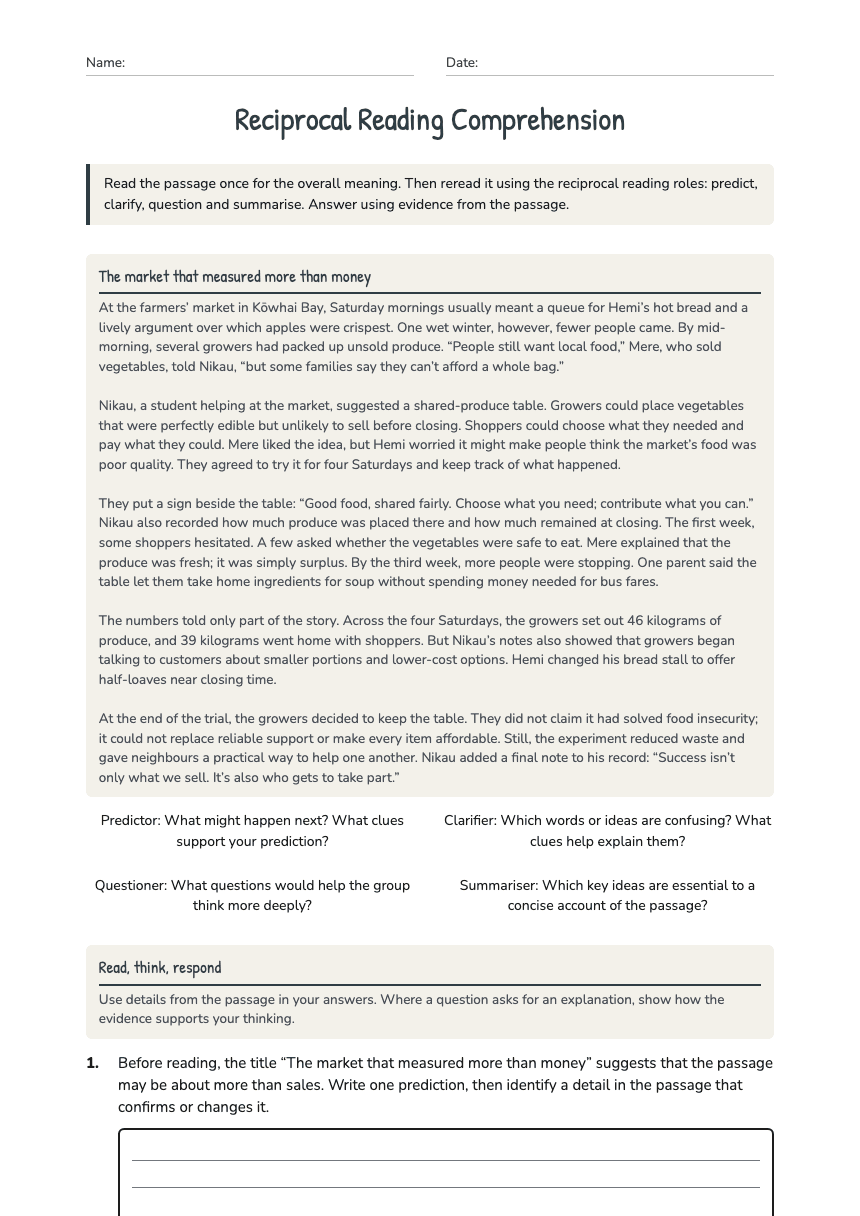
Reciprocal Reading Comprehension
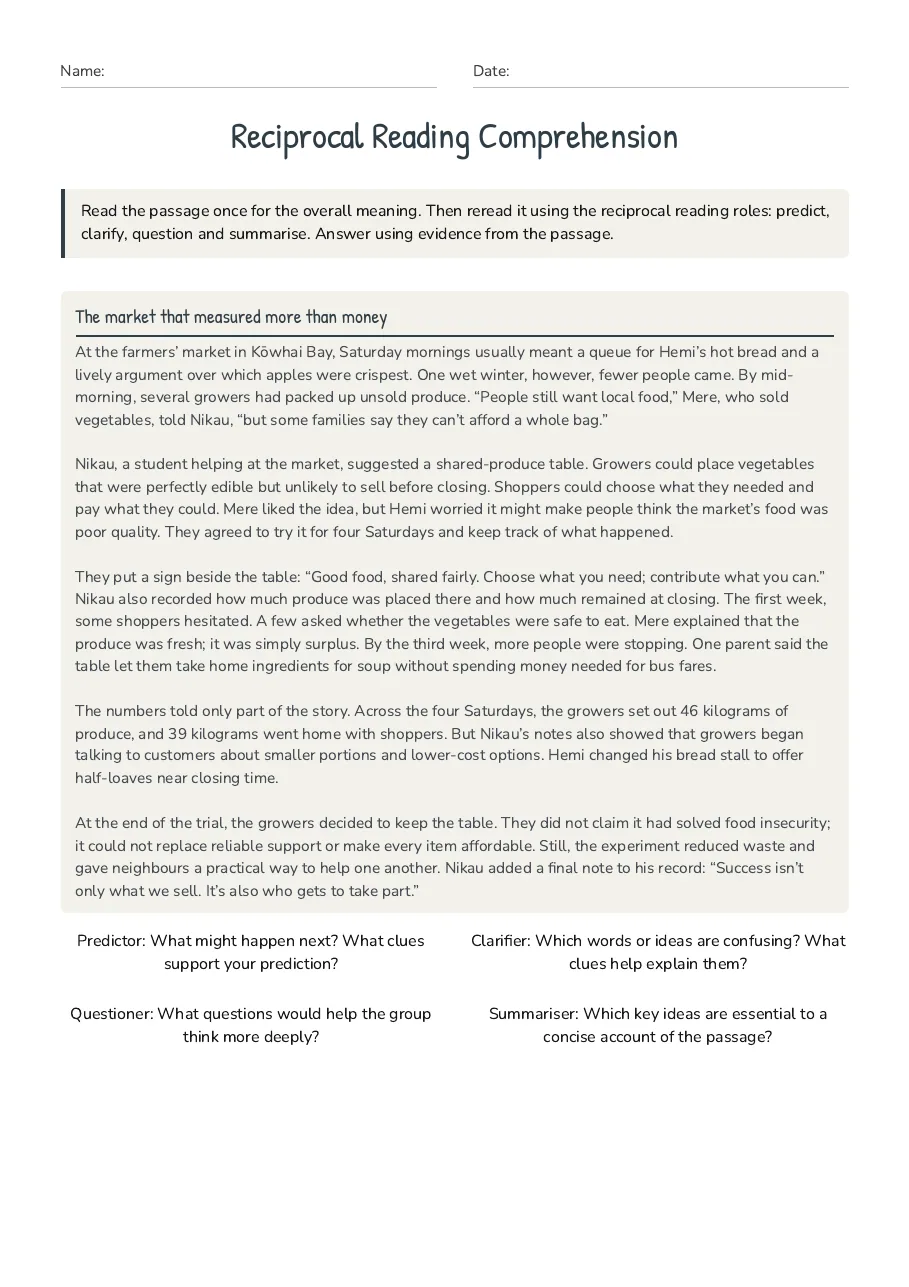
The market that measured more than money
At the farmers’ market in Kōwhai Bay, Saturday mornings usually meant a queue for Hemi’s hot bread and a lively argument over which apples were crispest. One wet winter, however, fewer people came. By mid-morning, several growers had packed up unsold produce. “People still want local food,” Mere, who sold vegetables, told Nikau, “but some families say they can’t afford a whole bag.” Nikau, a student helping at the market, suggested a shared-produce table. Growers could place vegetables that were perfectly edible but unlikely to sell before closing. Shoppers could choose what they needed and pay what they could. Mere liked the idea, but Hemi worried it might make people think the market’s food was poor quality. They agreed to try it for four Saturdays and keep track of what happened. They put a sign beside the table: “Good food, shared fairly. Choose what you need; contribute what you can.” Nikau also recorded how much produce was placed there and how much remained at closing. The first week, some shoppers hesitated. A few asked whether the vegetables were safe to eat. Mere explained that the produce was fresh; it was simply surplus. By the third week, more people were stopping. One parent said the table let them take home ingredients for soup without spending money needed for bus fares. The numbers told only part of the story. Across the four Saturdays, the growers set out 46 kilograms of produce, and 39 kilograms went home with shoppers. But Nikau’s notes also showed that growers began talking to customers about smaller portions and lower-cost options. Hemi changed his bread stall to offer half-loaves near closing time. At the end of the trial, the growers decided to keep the table. They did not claim it had solved food insecurity; it could not replace reliable support or make every item affordable. Still, the experiment reduced waste and gave neighbours a practical way to help one another. Nikau added a final note to his record: “Success isn’t only what we sell. It’s also who gets to take part.”
Predictor: What might happen next? What clues support your prediction?
Clarifier: Which words or ideas are confusing? What clues help explain them?
Questioner: What questions would help the group think more deeply?
Summariser: Which key ideas are essential to a concise account of the passage?
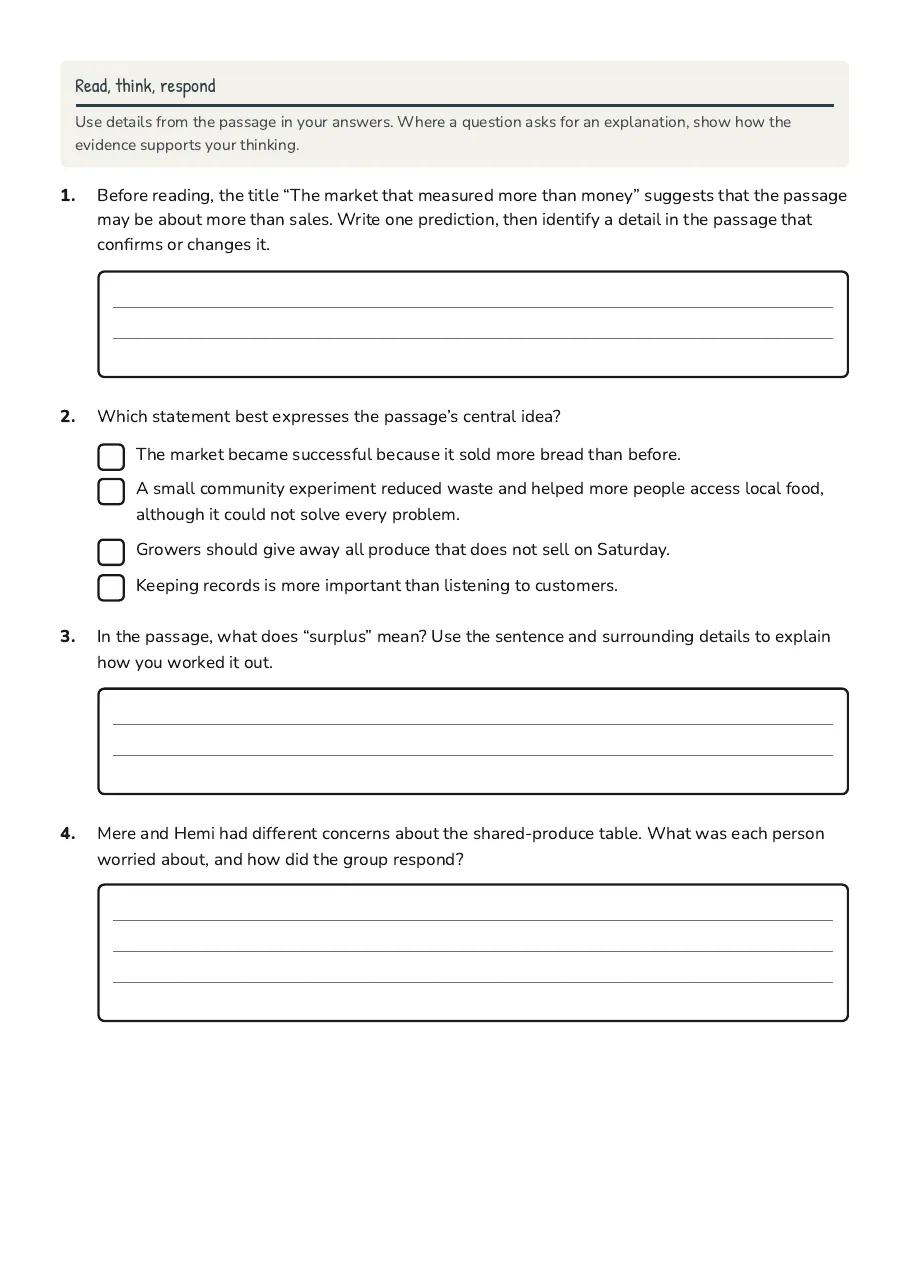
Read, think, respond
Use details from the passage in your answers. Where a question asks for an explanation, show how the evidence supports your thinking.
- The market became successful because it sold more bread than before.
- A small community experiment reduced waste and helped more people access local food, although it could not solve every problem.
- Growers should give away all produce that does not sell on Saturday.
- Keeping records is more important than listening to customers.
- Saturday mornings were usually busy.
- Nikau was a student helping at the market.
- Growers discussed smaller portions and lower-cost options, and Hemi began offering half-loaves near closing time.
- The trial lasted for four Saturdays.
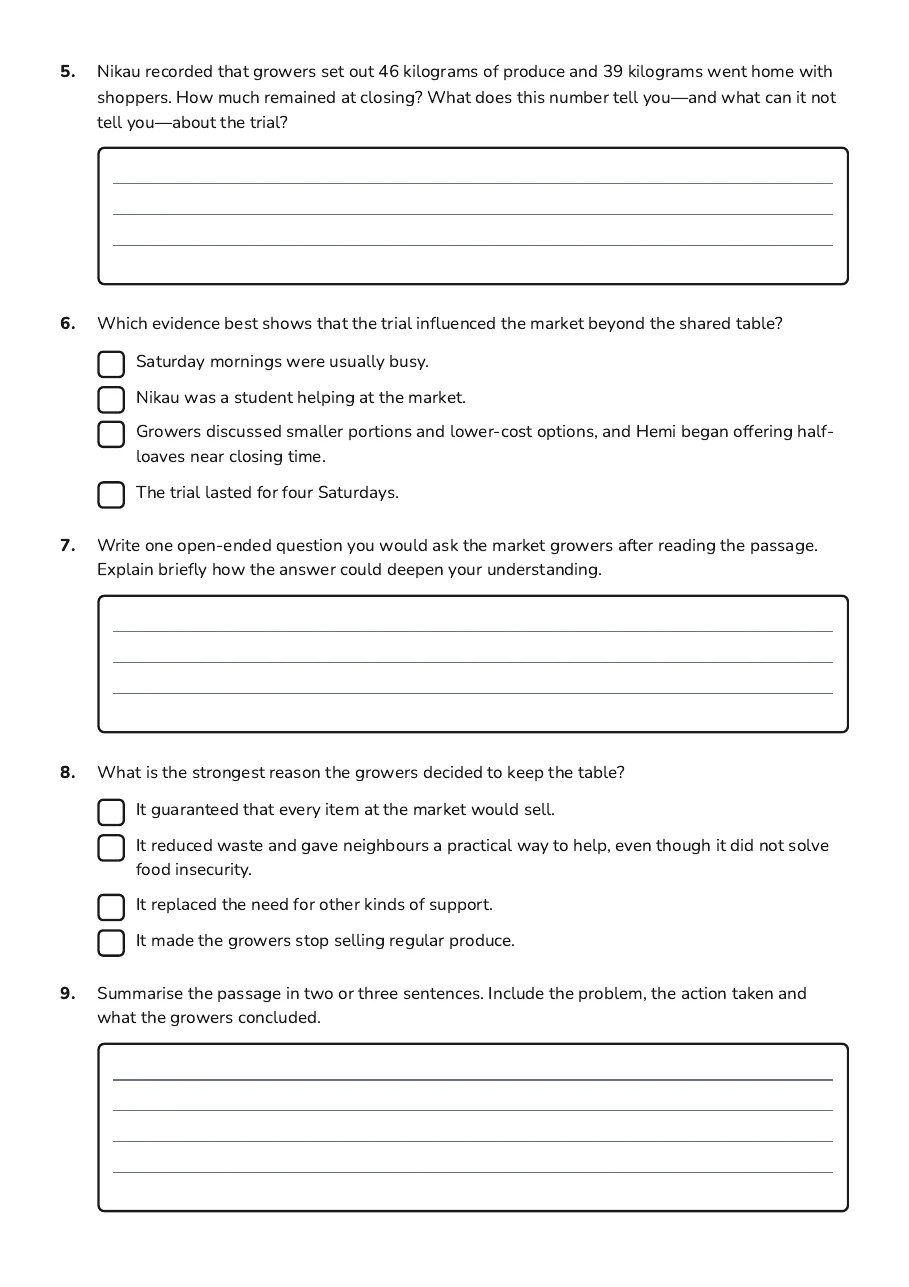
- It guaranteed that every item at the market would sell.
- It reduced waste and gave neighbours a practical way to help, even though it did not solve food insecurity.
- It replaced the need for other kinds of support.
- It made the growers stop selling regular produce.
4 printable pages
Page 1
Page 2
Page 3

Page 4
About This Worksheet
Free in Kuraplan
Sign up free, grab the PDF, and customize it for your class.
Print-Ready
Formatted for standard paper. Clean layout, easy to read.
AI-Generated
Created with Kuraplan's AI, designed for real classroom use.
For Teachers & Parents
Use in classrooms, for homework, tutoring, or homeschool.
Need a custom version of this worksheet?
Kuraplan's AI generates custom worksheets in seconds — differentiated for every learner, aligned to your curriculum.
Generate Custom Worksheets — Free