EnglishFreePrintable

Understanding Haiku Poetry

A free english worksheet ready for your classroom. Open in Kuraplan to grab the print-ready PDF, customize it for your students, or generate a fresh version in seconds.
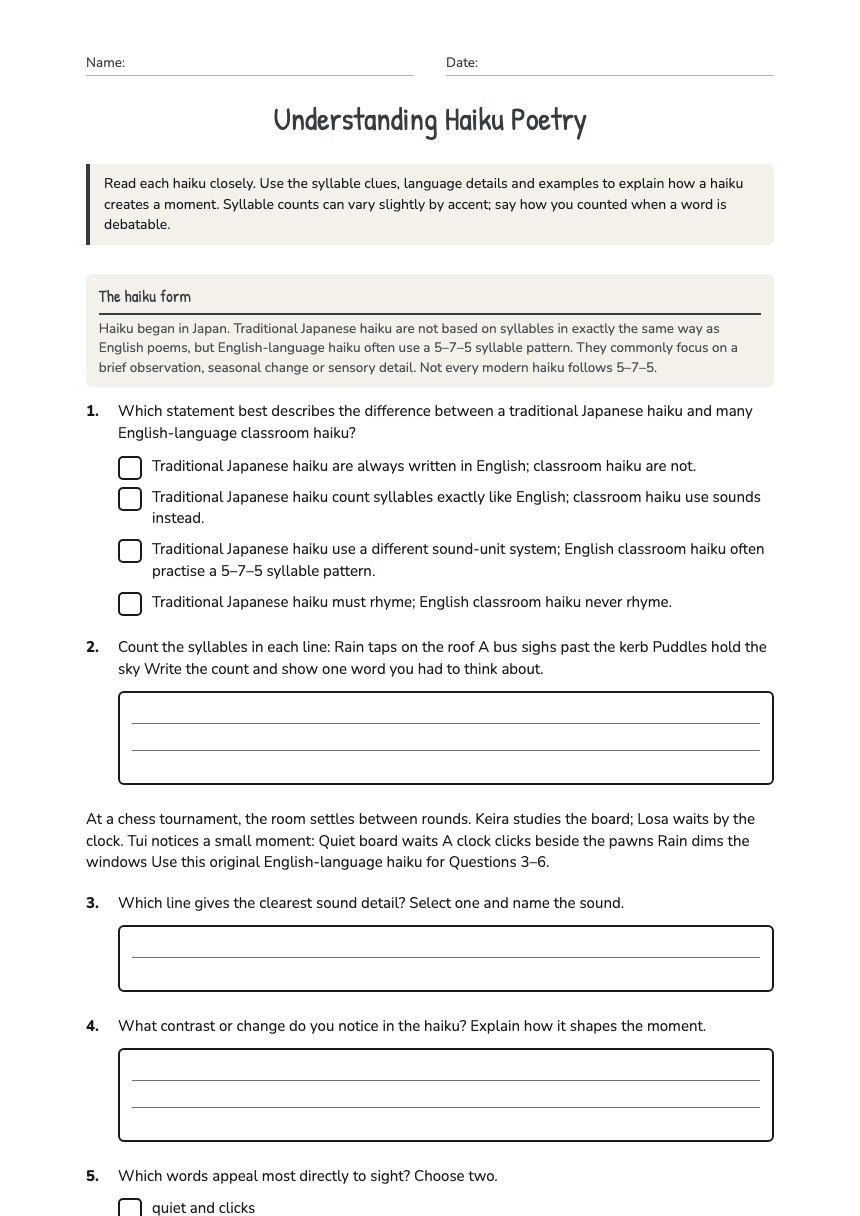
Understanding Haiku Poetry worksheet preview
Name:Date:

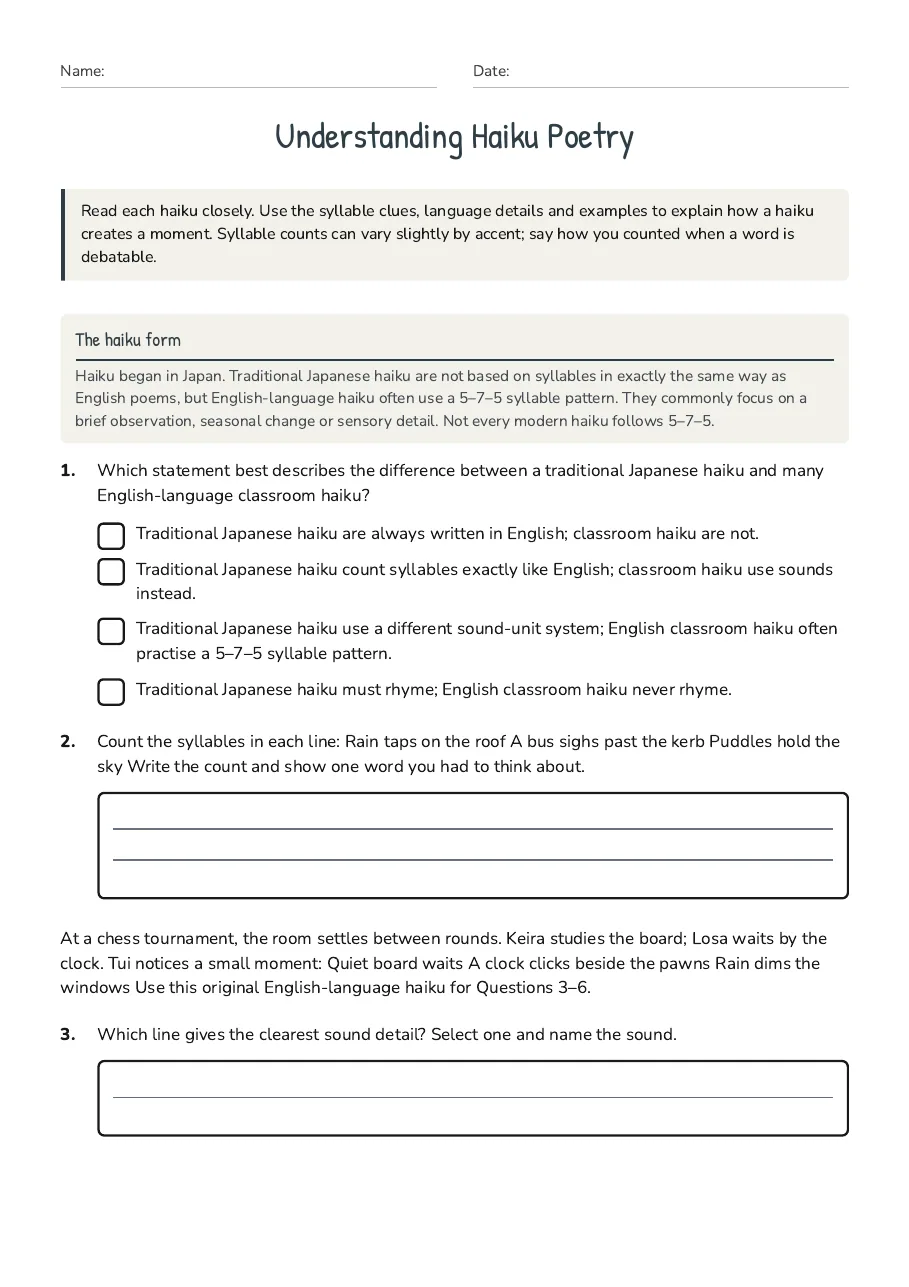
Understanding Haiku Poetry

Read each haiku closely. Use the syllable clues, language details and examples to explain how a haiku creates a moment. Syllable counts can vary slightly by accent; say how you counted when a word is debatable.

The haiku form

Haiku began in Japan. Traditional Japanese haiku are not based on syllables in exactly the same way as English poems, but English-language haiku often use a 5–7–5 syllable pattern. They commonly focus on a brief observation, seasonal change or sensory detail. Not every modern haiku follows 5–7–5.

1.Which statement best describes the difference between a traditional Japanese haiku and many English-language classroom haiku?
  • Traditional Japanese haiku are always written in English; classroom haiku are not.
  • Traditional Japanese haiku count syllables exactly like English; classroom haiku use sounds instead.
  • Traditional Japanese haiku use a different sound-unit system; English classroom haiku often practise a 5–7–5 syllable pattern.
  • Traditional Japanese haiku must rhyme; English classroom haiku never rhyme.
2.Count the syllables in each line: Rain taps on the roof A bus sighs past the kerb Puddles hold the sky Write the count and show one word you had to think about.
At a chess tournament, the room settles between rounds. Keira studies the board; Losa waits by the clock. Tui notices a small moment: Quiet board waits A clock clicks beside the pawns Rain dims the windows Use this original English-language haiku for Questions 3–6.
3.Which line gives the clearest sound detail? Select one and name the sound.
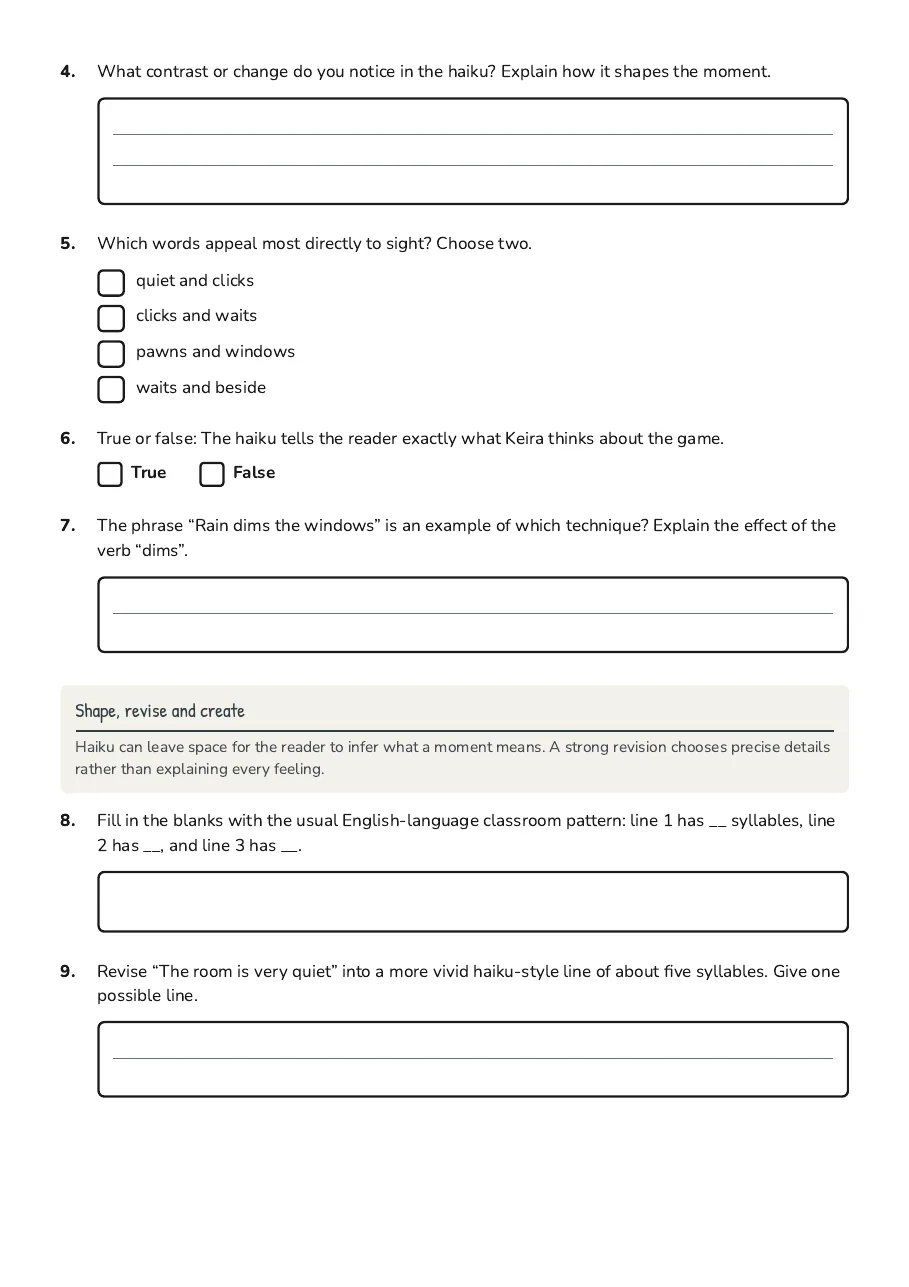
4.What contrast or change do you notice in the haiku? Explain how it shapes the moment.
5.Which words appeal most directly to sight? Choose two.
  • quiet and clicks
  • clicks and waits
  • pawns and windows
  • waits and beside
6.True or false: The haiku tells the reader exactly what Keira thinks about the game.
TrueFalse
7.The phrase “Rain dims the windows” is an example of which technique? Explain the effect of the verb “dims”.

Shape, revise and create

Haiku can leave space for the reader to infer what a moment means. A strong revision chooses precise details rather than explaining every feeling.

8.Fill in the blanks with the usual English-language classroom pattern: line 1 has __ syllables, line 2 has __, and line 3 has __.
9.Revise “The room is very quiet” into a more vivid haiku-style line of about five syllables. Give one possible line.
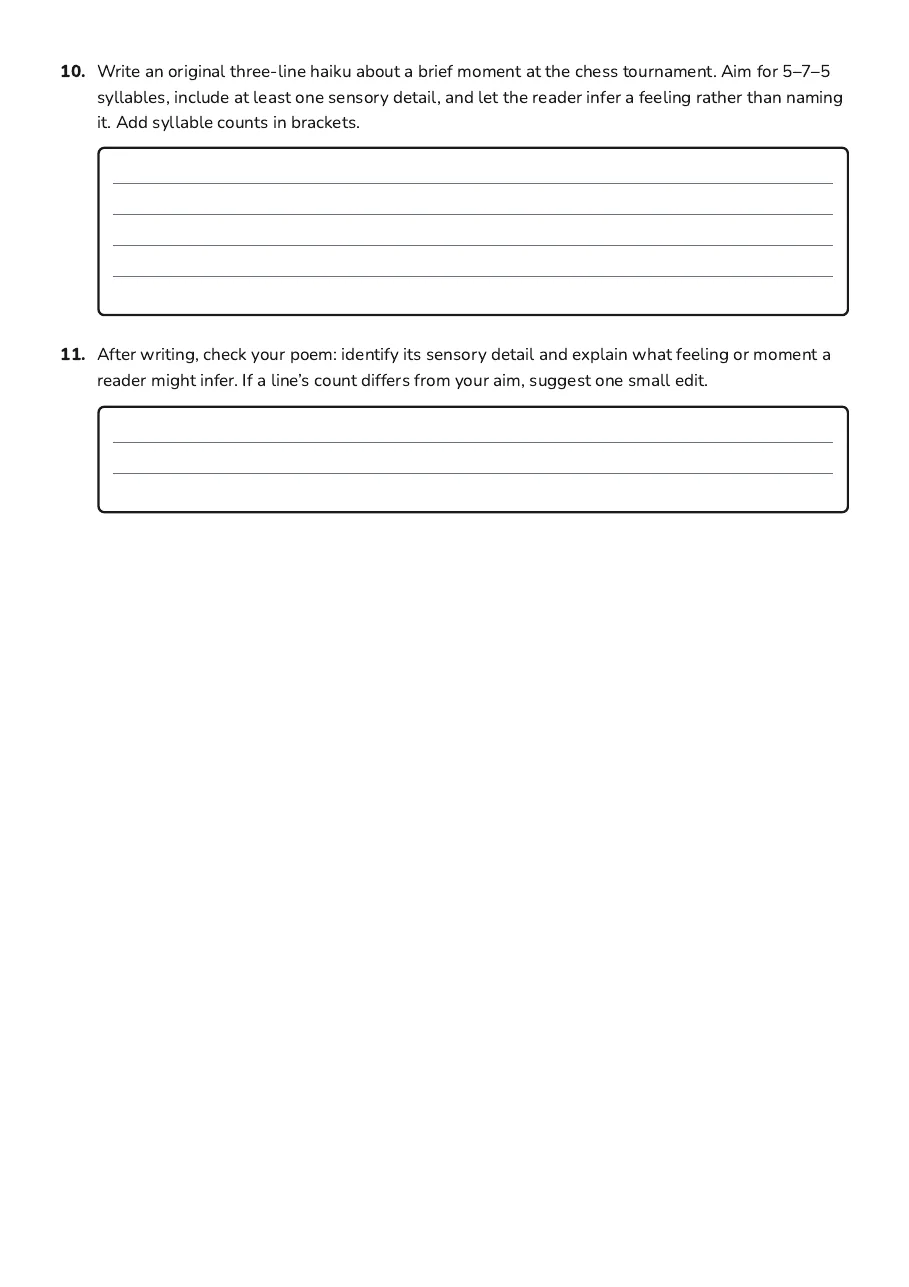
10.Write an original three-line haiku about a brief moment at the chess tournament. Aim for 5–7–5 syllables, include at least one sensory detail, and let the reader infer a feeling rather than naming it. Add syllable counts in brackets.
11.After writing, check your poem: identify its sensory detail and explain what feeling or moment a reader might infer. If a line’s count differs from your aim, suggest one small edit.

3 printable pages

  • Understanding Haiku Poetry, page 1 of 3: The haiku form

    Page 1

  • Understanding Haiku Poetry, page 2 of 3: Shape, revise and create

    Page 2

  • Understanding Haiku Poetry, page 3 of 3: 10. Write an original three-line haiku about a brief moment at the chess tournament. Aim…

    Page 3

About This Worksheet

Free in Kuraplan

Sign up free, grab the PDF, and customize it for your class.

Print-Ready

Formatted for standard paper. Clean layout, easy to read.

AI-Generated

Created with Kuraplan's AI, designed for real classroom use.

For Teachers & Parents

Use in classrooms, for homework, tutoring, or homeschool.

Need a custom version of this worksheet?

Kuraplan's AI generates custom worksheets in seconds — differentiated for every learner, aligned to your curriculum.

Generate Custom Worksheets — Free
No credit card Curriculum-aligned Under 60 seconds