EnglishFreePrintable

Red’s Narrative Map

A free english worksheet ready for your classroom. Open in Kuraplan to grab the print-ready PDF, customize it for your students, or generate a fresh version in seconds.
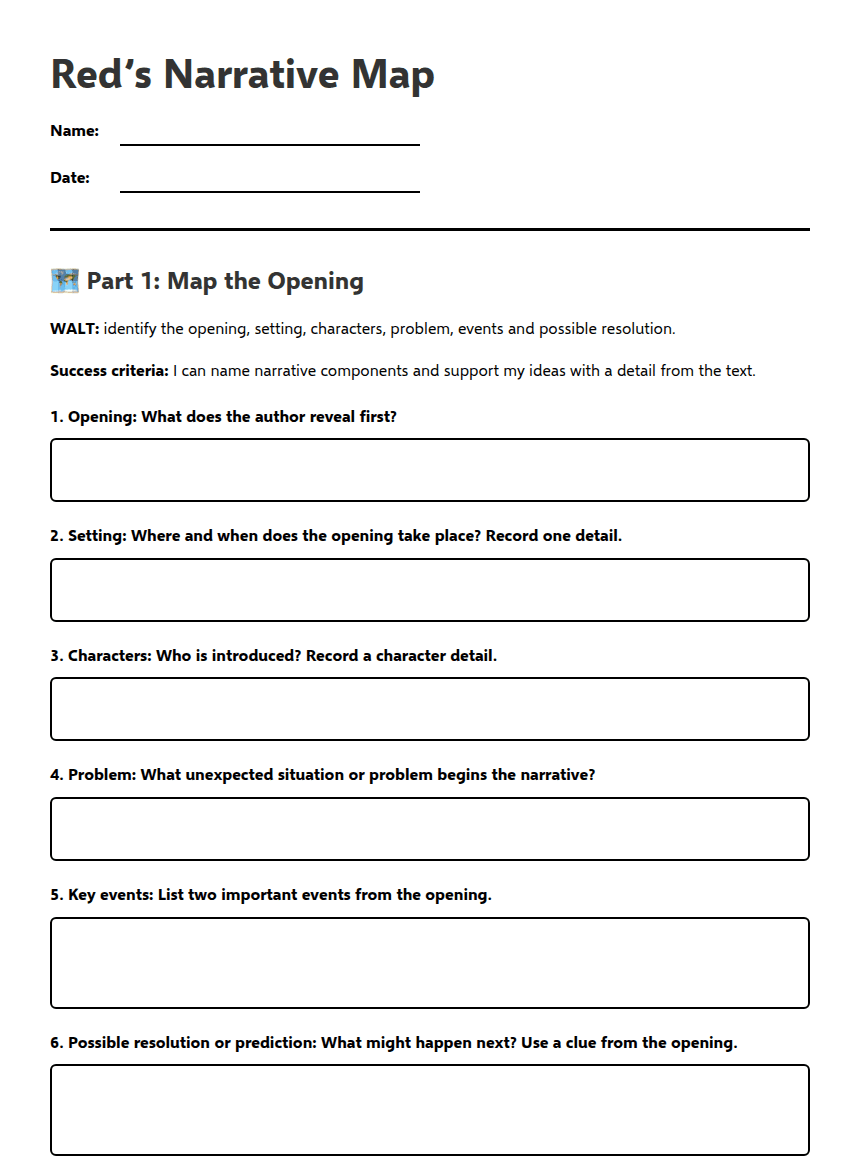
Red’s Narrative Map worksheet preview

Red’s Narrative Map

🗺️ Part 1: Map the Opening

WALT: identify the opening, setting, characters, problem, events and possible resolution.

Success criteria: I can name narrative components and support my ideas with a detail from the text.

1. Opening: What does the author reveal first?
2. Setting: Where and when does the opening take place? Record one detail.
3. Characters: Who is introduced? Record a character detail.
4. Problem: What unexpected situation or problem begins the narrative?
5. Key events: List two important events from the opening.
6. Possible resolution or prediction: What might happen next? Use a clue from the opening.

🔍 Part 2: Notice the Author’s Choices

WALT: notice how the author creates humour and curiosity.

Record a short detail or a few key words. You do not need to copy a long passage.

7. Humour: What detail, action or choice creates humour?
8. Curiosity: What detail makes you wonder what will happen next?

✏️ Part 3: Build a Writer’s Sentence

WALT: orally rehearse and write a clear sentence about an author’s choice.

Say your sentence to a partner first. Then complete the frame.

9. The author creates ____________________ by ________________________________.
10. Optional supporting detail: The text shows this when ____________________________________________.

Success criteria: My sentence names an author’s choice, explains its effect, and is complete.

🔑 Teacher Answer Key

Note: Accept equivalent answers that are supported by the class text. The responses below are concise model answers based on a typical opening in which Red begins a journey and encounters an unexpected danger.

1. Opening: The author first introduces Red and establishes what Red is about to do.
2. Setting: The opening takes place at Red’s home and on the route through the woods or forest. A supporting detail should identify the location or time, such as the path, trees, daylight or morning.
3. Characters: Red is introduced, along with another important character such as a parent, grandparent or the wolf. A character detail should describe Red’s task, appearance, personality or actions.
4. Problem: Red faces an unexpected danger or interruption during the journey, such as meeting the wolf or being tricked from the safe path.
5. Key events: Red begins the journey and encounters the problem. Other valid events include receiving instructions, meeting the wolf, sharing information or leaving the path.
6. Possible resolution or prediction: Red may discover the danger and reach safety, or another character may arrive to help. The prediction should refer to a clue such as the wolf’s behaviour, the warning Red receives or the growing danger.
7. Humour: Humour may come from the wolf’s exaggerated behaviour, an unexpected action, a disguise or the contrast between what a character believes and what the reader knows.
8. Curiosity: The danger, the wolf’s unusual behaviour or Red’s decision to continue the journey makes the reader wonder what will happen next.
9. Model sentence: The author creates curiosity by introducing the wolf before Red understands the danger.
10. Model supporting detail: The text shows this when the wolf appears, asks Red questions or secretly changes the plan.

About This Worksheet

Free in Kuraplan

Sign up free, grab the PDF, and customize it for your class.

Print-Ready

Formatted for standard paper. Clean layout, easy to read.

AI-Generated

Created with Kuraplan's AI, designed for real classroom use.

For Teachers & Parents

Use in classrooms, for homework, tutoring, or homeschool.

Need a custom version of this worksheet?

Kuraplan's AI generates custom worksheets in seconds — differentiated for every learner, aligned to your curriculum.

Generate Custom Worksheets — Free
No credit card Curriculum-aligned Under 60 seconds