ScienceFreePrintable

Solar System Timeline Activity

A free science worksheet ready for your classroom. Open in Kuraplan to grab the print-ready PDF, customize it for your students, or generate a fresh version in seconds.
Solar System Timeline Activity worksheet preview
Name:Date:

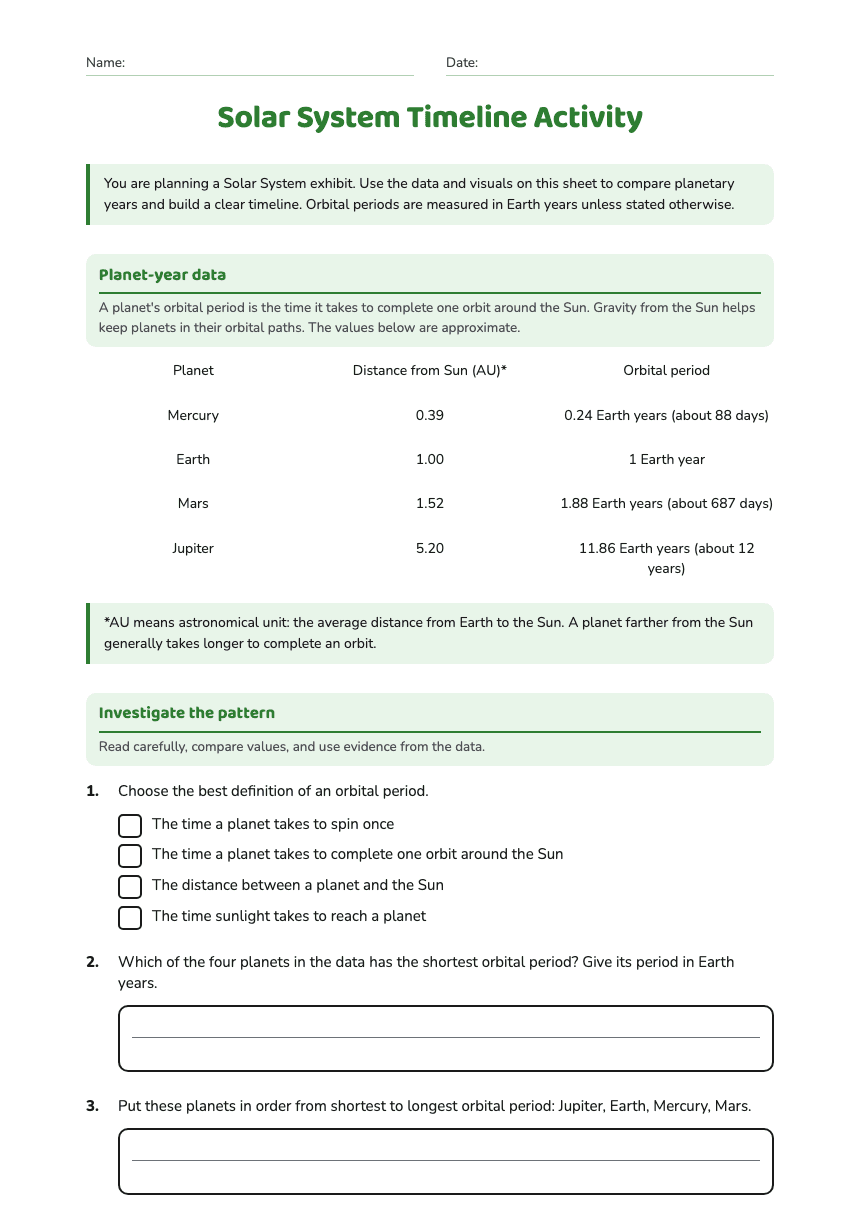
Solar System Timeline Activity

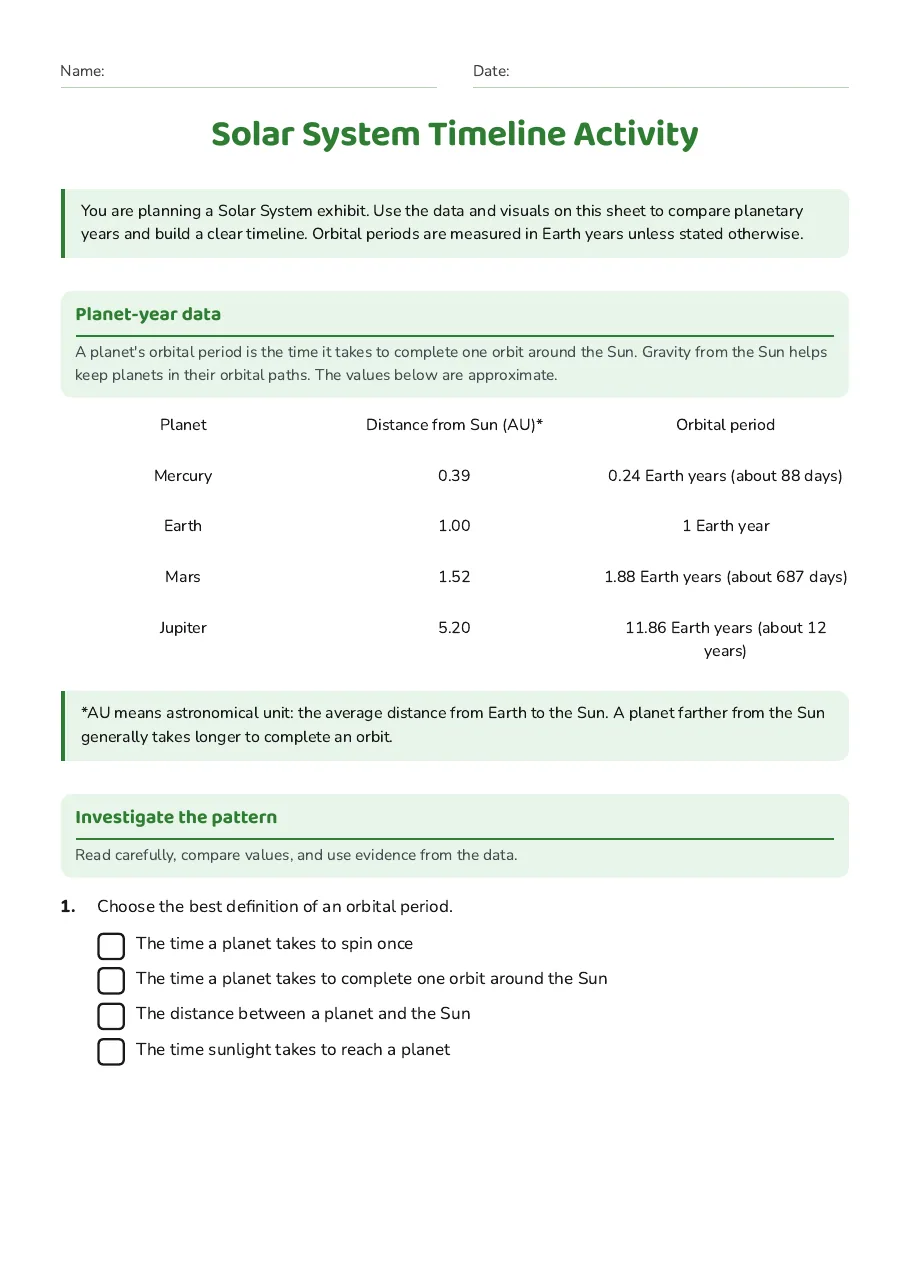
You are planning a Solar System exhibit. Use the data and visuals on this sheet to compare planetary years and build a clear timeline. Orbital periods are measured in Earth years unless stated otherwise.

Planet-year data

A planet's orbital period is the time it takes to complete one orbit around the Sun. Gravity from the Sun helps keep planets in their orbital paths. The values below are approximate.

Planet

Distance from Sun (AU)*

Orbital period

Mercury

0.39

0.24 Earth years (about 88 days)

Earth

1.00

1 Earth year

Mars

1.52

1.88 Earth years (about 687 days)

Jupiter

5.20

11.86 Earth years (about 12 years)

*AU means astronomical unit: the average distance from Earth to the Sun. A planet farther from the Sun generally takes longer to complete an orbit.

Investigate the pattern

Read carefully, compare values, and use evidence from the data.

1.Choose the best definition of an orbital period.
  • The time a planet takes to spin once
  • The time a planet takes to complete one orbit around the Sun
  • The distance between a planet and the Sun
  • The time sunlight takes to reach a planet
2.Which of the four planets in the data has the shortest orbital period? Give its period in Earth years.
3.Put these planets in order from shortest to longest orbital period: Jupiter, Earth, Mercury, Mars.
4.A planet travels around the Sun in an . The time for one complete orbit is its period.
5.The data show that Jupiter is farther from the Sun than Mars and has a longer orbital period.
6.Use two examples from the data to explain how distance from the Sun relates to orbital period. Include planet names and values.

Plot and use the timeline

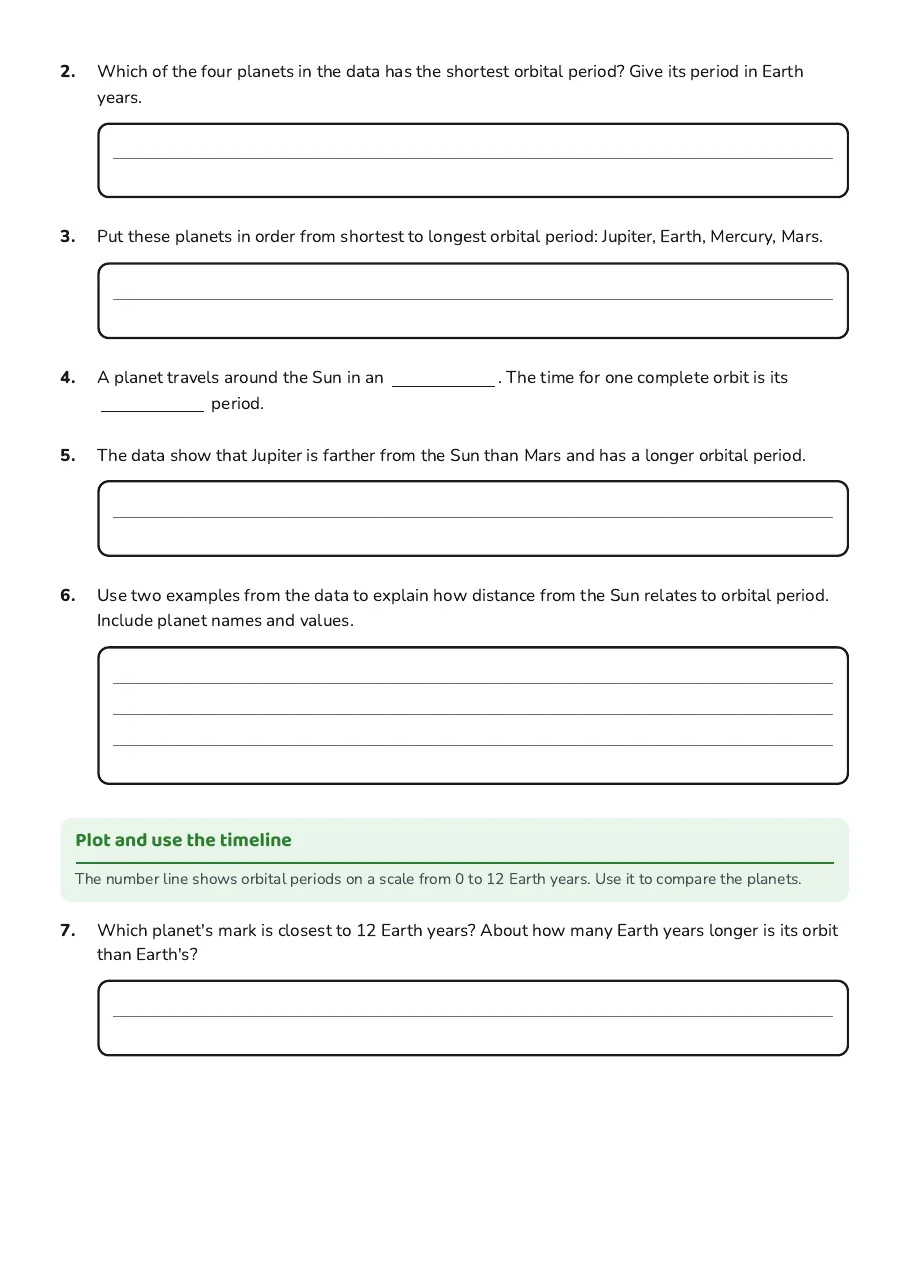
The number line shows orbital periods on a scale from 0 to 12 Earth years. Use it to compare the planets.

7.Which planet's mark is closest to 12 Earth years? About how many Earth years longer is its orbit than Earth's?
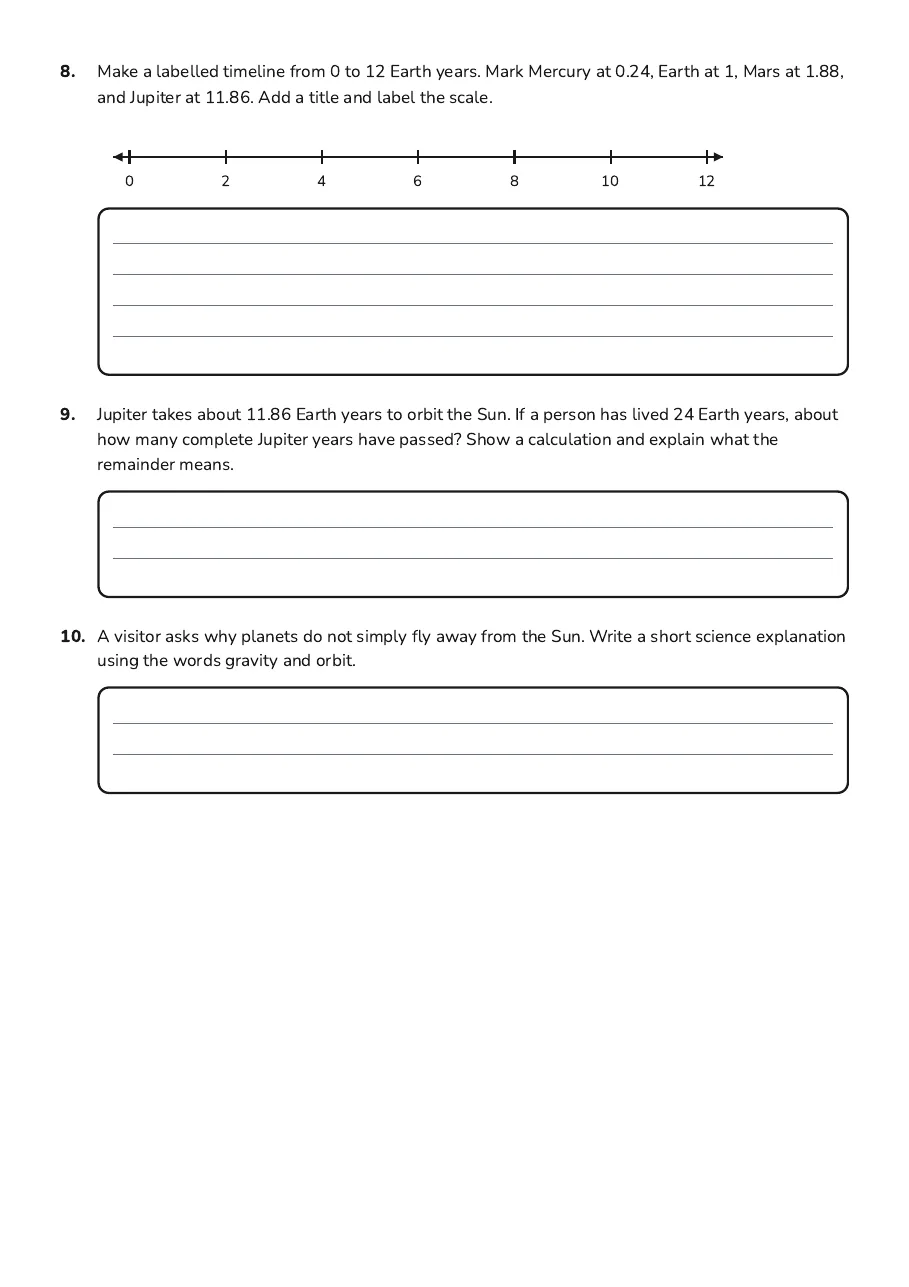
8.Make a labelled timeline from 0 to 12 Earth years. Mark Mercury at 0.24, Earth at 1, Mars at 1.88, and Jupiter at 11.86. Add a title and label the scale.
024681012
9.Jupiter takes about 11.86 Earth years to orbit the Sun. If a person has lived 24 Earth years, about how many complete Jupiter years have passed? Show a calculation and explain what the remainder means.
10.A visitor asks why planets do not simply fly away from the Sun. Write a short science explanation using the words gravity and orbit.

3 printable pages

  • Solar System Timeline Activity, page 1 of 3: Planet-year data, Investigate the pattern

    Page 1

  • Solar System Timeline Activity, page 2 of 3: Plot and use the timeline

    Page 2

  • Solar System Timeline Activity, page 3 of 3: 8. Make a labelled timeline from 0 to 12 Earth years. Mark Mercury at 0.24, Earth at 1,…

    Page 3

About This Worksheet

Free in Kuraplan

Sign up free, grab the PDF, and customize it for your class.

Print-Ready

Formatted for standard paper. Clean layout, easy to read.

AI-Generated

Created with Kuraplan's AI, designed for real classroom use.

For Teachers & Parents

Use in classrooms, for homework, tutoring, or homeschool.

Need a custom version of this worksheet?

Kuraplan's AI generates custom worksheets in seconds — differentiated for every learner, aligned to your curriculum.

Generate Custom Worksheets — Free
No credit card Curriculum-aligned Under 60 seconds