Sound Patterns in Poetry
A free english worksheet ready for your classroom. Open in Kuraplan to grab the print-ready PDF, customize it for your students, or generate a fresh version in seconds.
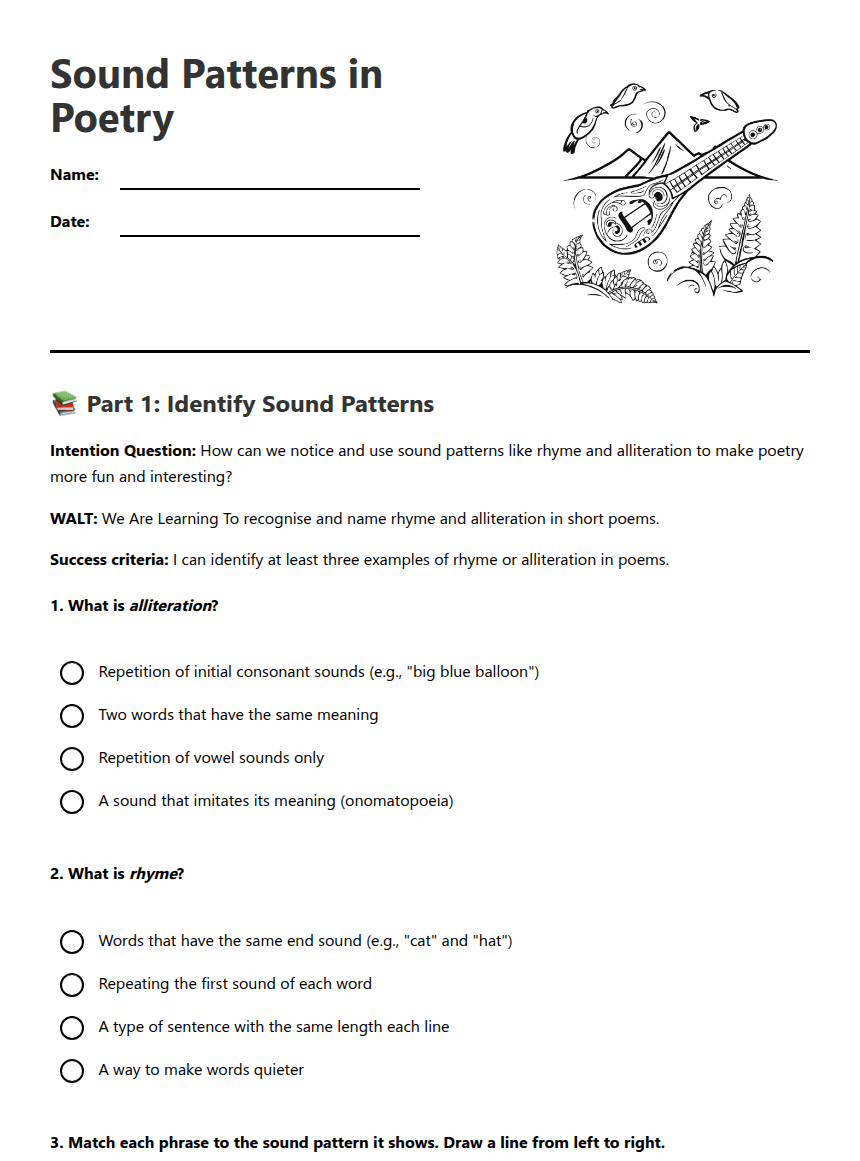
Sound Patterns in Poetry

📚 Part 1: Identify Sound Patterns
Intention Question: How can we notice and use sound patterns like rhyme and alliteration to make poetry more fun and interesting?
WALT: We Are Learning To recognise and name rhyme and alliteration in short poems.
Success criteria: I can identify at least three examples of rhyme or alliteration in poems.
✏️ Part 2: Create and Reflect
WALT: We Are Learning To create our own short examples of rhyme and alliteration and explain their effect.
Success criteria: I can create at least three alliteration examples, three rhyming pairs, and explain how sound patterns add to a poem.
Differentiation & Dyslexia-friendly options: Use the word bank, read examples aloud, or record your answers. Text is spaced for clarity; you may speak your answers first if writing is hard.
Additional extension: Try writing a 4–6 line poem that also uses onomatopoeia. Be ready to share or record it.
About This Worksheet
Free in Kuraplan
Sign up free, grab the PDF, and customize it for your class.
Print-Ready
Formatted for standard paper. Clean layout, easy to read.
AI-Generated
Created with Kuraplan's AI, designed for real classroom use.
For Teachers & Parents
Use in classrooms, for homework, tutoring, or homeschool.
Need a custom version of this worksheet?
Kuraplan's AI generates custom worksheets in seconds — differentiated for every learner, aligned to your curriculum.
Generate Custom Worksheets — FreeMore English Worksheets
Poetry Mentor Text Booklet
Free
Poem Viewpoint and Representation Analysis
Free
Poetry Detective Worksheet
Free
Winter Acrostic Planner and Draft
Free
Alliteration Adventure Worksheet
Free
Alliteration Exploration Worksheet
Free
Matariki Imagery Exploration
Free