"Engaging War History Posters"
A free english worksheet ready for your classroom. Open in Kuraplan to grab the print-ready PDF, customize it for your students, or generate a fresh version in seconds.
Engaging War History Posters
Year 6 English — Reading & Comprehension Activities
🌺 Poster 1: ANZAC — Lest We Forget
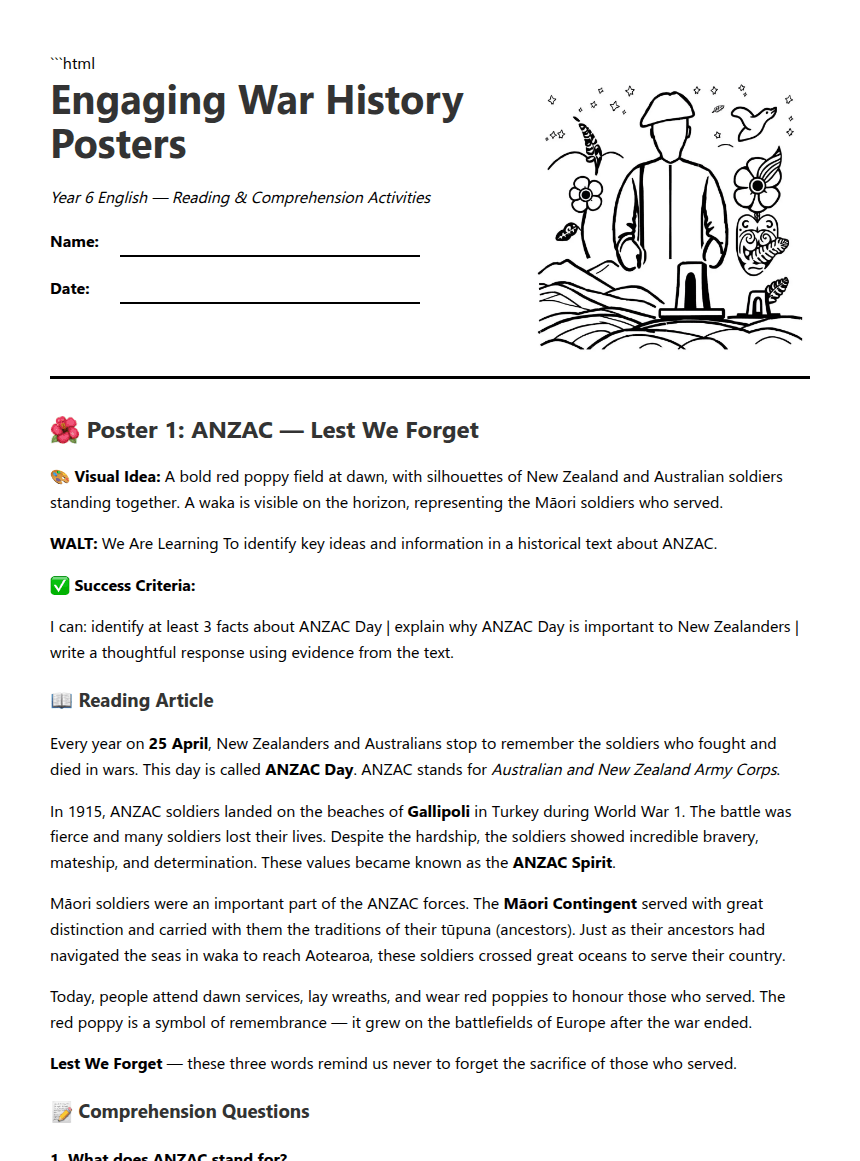
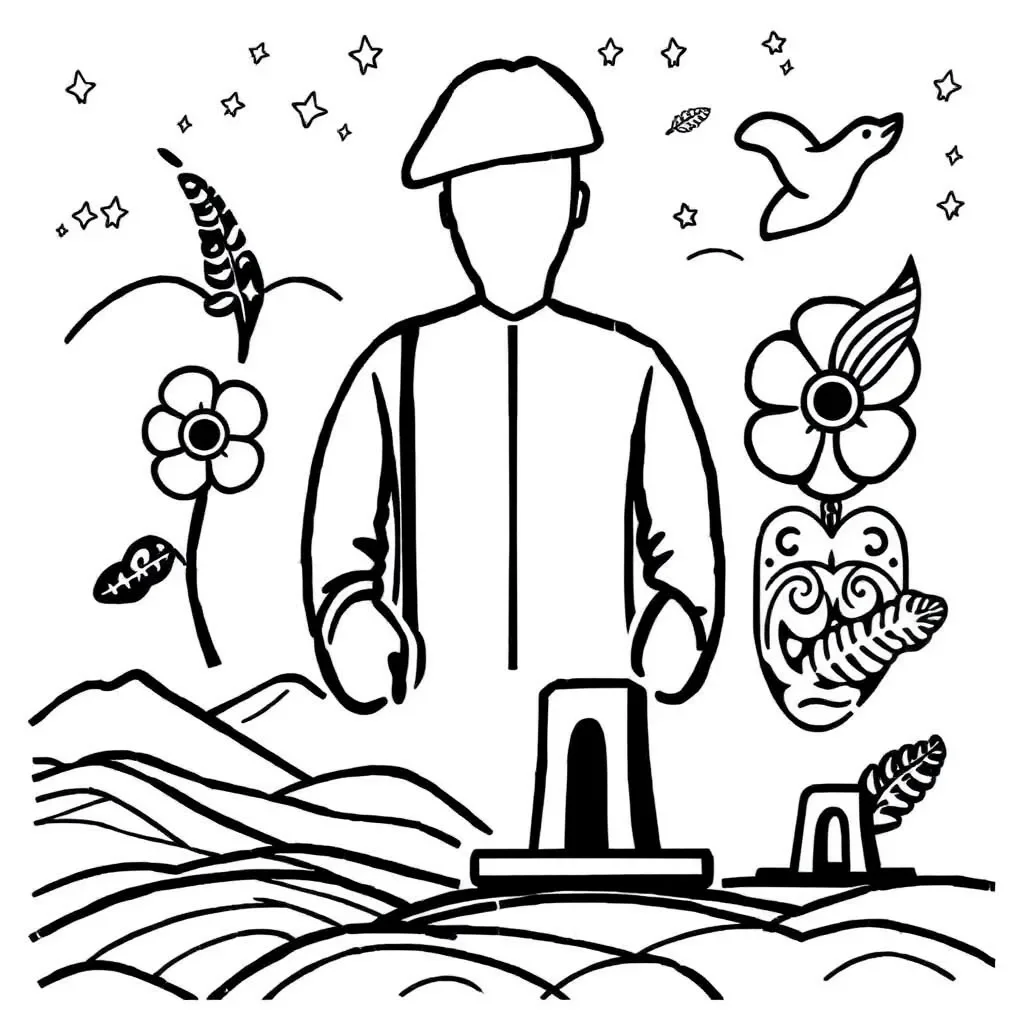
🎨 Visual Idea: A bold red poppy field at dawn, with silhouettes of New Zealand and Australian soldiers standing together. A waka is visible on the horizon, representing the Māori soldiers who served.
WALT: We Are Learning To identify key ideas and information in a historical text about ANZAC.
✅ Success Criteria:
I can: identify at least 3 facts about ANZAC Day | explain why ANZAC Day is important to New Zealanders | write a thoughtful response using evidence from the text.
📖 Reading Article
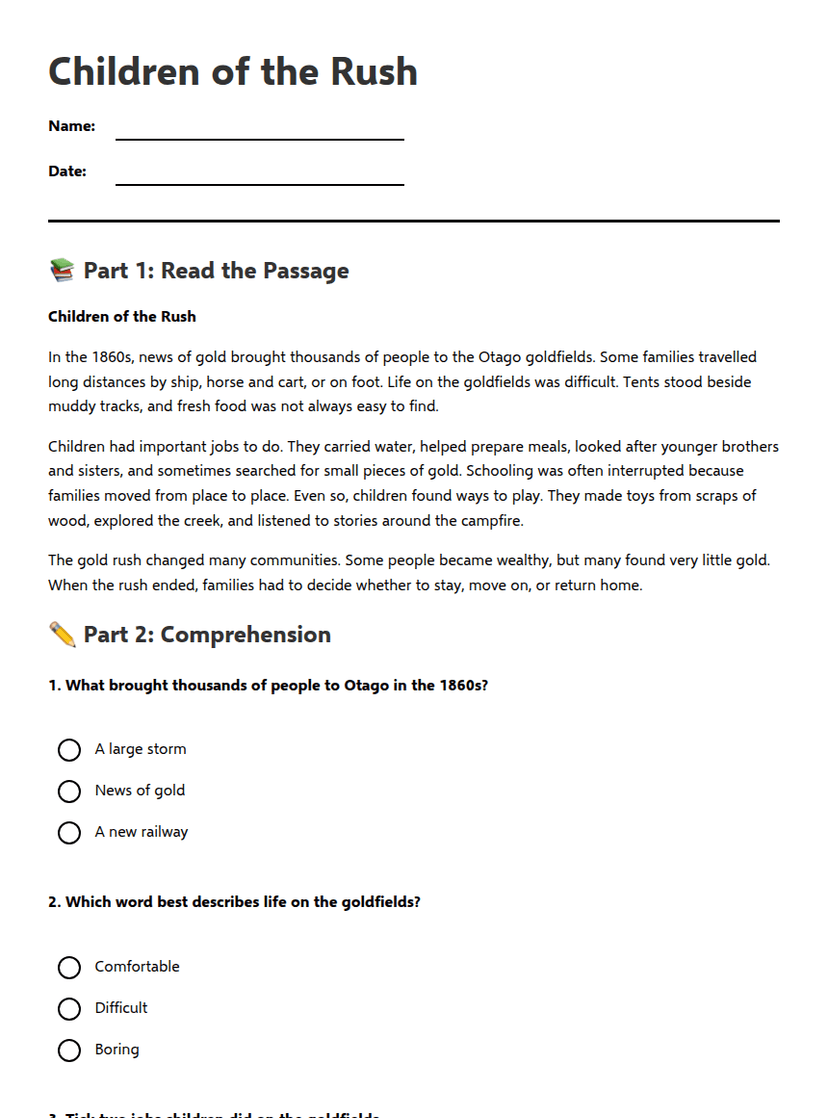
Every year on 25 April, New Zealanders and Australians stop to remember the soldiers who fought and died in wars. This day is called ANZAC Day. ANZAC stands for Australian and New Zealand Army Corps.
In 1915, ANZAC soldiers landed on the beaches of Gallipoli in Turkey during World War 1. The battle was fierce and many soldiers lost their lives. Despite the hardship, the soldiers showed incredible bravery, mateship, and determination. These values became known as the ANZAC Spirit.
Māori soldiers were an important part of the ANZAC forces. The Māori Contingent served with great distinction and carried with them the traditions of their tūpuna (ancestors). Just as their ancestors had navigated the seas in waka to reach Aotearoa, these soldiers crossed great oceans to serve their country.
Today, people attend dawn services, lay wreaths, and wear red poppies to honour those who served. The red poppy is a symbol of remembrance — it grew on the battlefields of Europe after the war ended.
Lest We Forget — these three words remind us never to forget the sacrifice of those who served.
📝 Comprehension Questions
🎯 Follow-Up Activities
🌟 Differentiation: Support: Provide a word bank for the acrostic poem. Extension: Research a specific Māori soldier who served at Gallipoli and write a short biography.
⚔️ Poster 2: World War 1 — The War to End All Wars
🎨 Visual Idea: A dramatic split image — one side shows a muddy trench with soldiers, the other shows a peaceful New Zealand farm. A waka paddle is illustrated in the corner, symbolising Māori connection to the war effort.
WALT: We Are Learning To understand the causes and impacts of World War 1 on New Zealand.
✅ Success Criteria:
I can: explain when and why WW1 started | describe what life was like for soldiers | connect New Zealand's involvement to our national identity.
📖 Reading Article
World War 1 (1914–1918) was one of the deadliest conflicts in human history. It was fought mainly in Europe between two groups: the Allied Powers (including New Zealand, Australia, Britain, and France) and the Central Powers (including Germany and Austria-Hungary).
The war began in 1914 after the assassination of Archduke Franz Ferdinand of Austria. Within weeks, countries across Europe were at war. New Zealand, as part of the British Empire, joined the fight.
Over 100,000 New Zealanders served in WW1 — a huge number for such a small country. Soldiers lived in muddy trenches, often cold, wet, and hungry. The fighting was brutal, and many never returned home.
The Māori Pioneer Battalion played a vital role in the war. These brave warriors carried their tīkanga (customs) with them, performing haka before battles to strengthen their spirits — much like ancient warriors who prepared for battle before setting out in their waka taua (war canoes).
By the time the war ended in 1918, over 18,000 New Zealanders had died. The war changed New Zealand forever — it shaped our national identity and showed the world who we were as a people.
📝 Comprehension Questions
🎯 Follow-Up Activities
🌟 Differentiation: Support: Provide sentence starters for the soldier's letter. Extension: Research the Battle of Passchendaele and write a detailed report on New Zealand's role.
✈️ Poster 3: World War 2 — A World on Fire
🎨 Visual Idea: A dramatic sky filled with aircraft, with a New Zealand flag flying proudly. Below, a waka sits on a calm harbour — a symbol of home and hope amid the chaos of war.
WALT: We Are Learning To analyse how World War 2 affected New Zealand and its people.
✅ Success Criteria:
I can: explain the key causes of WW2 | describe New Zealand's contribution | discuss the impact of war on everyday New Zealanders.
📖 Reading Article
World War 2 (1939–1945) was the largest and most destructive war in history. It involved countries from every corner of the globe and resulted in the deaths of over 70 million people.
The war began when Adolf Hitler and Nazi Germany invaded Poland in 1939. Britain and France declared war on Germany, and soon New Zealand followed. New Zealand sent soldiers, sailors, and airmen to fight in Europe, North Africa, and the Pacific.
At home, life changed dramatically. Women took on new roles in factories and on farms. Food and petrol were rationed — meaning people could only buy a small amount each week. Children collected scrap metal to help the war effort.
The 28th Māori Battalion became one of the most celebrated units in the New Zealand Army. Commanded by Māori officers, they fought bravely in Greece, North Africa, and Italy. Their fierce determination echoed the spirit of their tūpuna — warriors who once paddled waka across vast oceans to protect their people.
The war ended in 1945 when Germany surrendered in May and Japan surrendered in August after two atomic bombs were dropped on the Japanese cities of Hiroshima and Nagasaki. New Zealand celebrated VJ Day (Victory over Japan Day) with great relief and joy — but also deep sadness for the 11,900 New Zealanders who had died.
📝 Comprehension Questions
🎯 Follow-Up Activities
🌟 Differentiation: Support: Provide a template for the interview activity with sentence starters. Extension: Compare the roles of the 28th Māori Battalion in WW2 with Māori warriors in pre-European Aotearoa — what values did they share?
🌿 Poster 4: The Vietnam War — A Controversial Conflict
🎨 Visual Idea: A lush jungle scene with a New Zealand soldier looking thoughtful. In the background, protesters hold signs in Wellington. A small waka is carved into a nearby tree — a reminder of home and identity far from Aotearoa.
WALT: We Are Learning To evaluate different perspectives on New Zealand's involvement in the Vietnam War.
✅ Success Criteria:
I can: explain why the Vietnam War was controversial | describe New Zealand's role | identify at least two different perspectives on the war.
📖 Reading Article
The Vietnam War (1955–1975) was a conflict in Southeast Asia between North Vietnam (supported by communist countries like China and the Soviet Union) and South Vietnam (supported by the United States and its allies, including New Zealand).
New Zealand sent soldiers to Vietnam between 1964 and 1972. Unlike WW1 and WW2, this war was deeply controversial — meaning many people strongly disagreed about whether New Zealand should be involved at all.
At home, large protests erupted across New Zealand cities. Students marched through Wellington and Auckland, carrying signs that read "Stop the War!" Many New Zealanders believed the war was unjust and that young men should not be sent to fight in a foreign country.
The soldiers who returned from Vietnam were not always welcomed as heroes. Unlike WW2 veterans, many Vietnam veterans felt ignored or even blamed for the war. This caused lasting emotional pain for many of them.
Māori soldiers who served in Vietnam carried their cultural identity with them. Some carved small waka shapes into their gear — a quiet reminder of their whakapapa (genealogy) and connection to Aotearoa. When they returned, some found strength in reconnecting with their marae and community.
The Vietnam War ended in 1975 when North Vietnam captured the South Vietnamese capital, Saigon. It remains one of the most debated conflicts in New Zealand history.
📝 Comprehension Questions
🎯 Follow-Up Activities
🌟 Differentiation: Support: Provide sentence frames for the two perspectives activity (e.g., "I believe New Zealand should/should not have gone to Vietnam because..."). Extension: Research the New Zealand anti-Vietnam War movement and write a newspaper article from 1968 reporting on a protest march in Wellington.
🌏 Poster 5: Wars Today — Conflict in the Modern World
🎨 Visual Idea: A split globe — one half shows conflict zones with news headlines, the other half shows New Zealand peacekeepers in blue helmets helping communities rebuild. A waka navigates between the two halves, symbolising New Zealand's role as a peacemaker on the world stage.
WALT: We Are Learning To understand New Zealand's role in modern conflicts and peacekeeping missions.
✅ Success Criteria:
I can: identify at least two current or recent conflicts in the world | explain New Zealand's role as a peacekeeper | reflect on what peace means and how we can contribute to it.
📖 Reading Article
War did not end in the 20th century. Today, conflicts continue to affect millions of people around the world. In recent years, major conflicts have occurred in Ukraine, Gaza, Syria, Afghanistan, and South Sudan, among others. These wars cause enormous suffering — people lose their homes, their families, and their lives.
New Zealand's role in modern conflicts has changed significantly. Rather than sending large armies to fight, New Zealand now focuses on peacekeeping and humanitarian aid. New Zealand Defence Force (NZDF) personnel work with the United Nations to help protect civilians, rebuild communities, and support peace negotiations.
New Zealand has also been involved in disaster relief — sending military personnel and supplies to countries affected by earthquakes, floods, and other crises. This reflects New Zealand's values of compassion, fairness, and manaakitanga (caring for others).
The concept of waka hourua (double-hulled voyaging canoe) is a powerful metaphor for modern peacekeeping. Just as ancient navigators worked together to steer their waka safely across vast oceans, countries today must work together — sharing knowledge, resources, and responsibility — to navigate the challenges of conflict and build a more peaceful world.
As young New Zealanders, you are the next generation of navigators. The decisions made today about war, peace, and justice will shape the world you inherit. What kind of world do you want to help build?
📝 Comprehension Questions
🎯 Follow-Up Activities
🌟 Differentiation: Support: Provide a speech scaffold with sentence starters (e.g., "Throughout history, New Zealand has shown that..."). Extension: Research New Zealand's current peacekeeping missions and create an informational brochure about one mission, including maps, statistics, and personal stories.
About This Worksheet
Free in Kuraplan
Sign up free, grab the PDF, and customize it for your class.
Print-Ready
Formatted for standard paper. Clean layout, easy to read.
AI-Generated
Created with Kuraplan's AI, designed for real classroom use.
For Teachers & Parents
Use in classrooms, for homework, tutoring, or homeschool.
Need a custom version of this worksheet?
Kuraplan's AI generates custom worksheets in seconds — differentiated for every learner, aligned to your curriculum.
Generate Custom Worksheets — Free