ScienceFreePrintable

Standing Waves Answer Key

A free science worksheet ready for your classroom. Open in Kuraplan to grab the print-ready PDF, customize it for your students, or generate a fresh version in seconds.
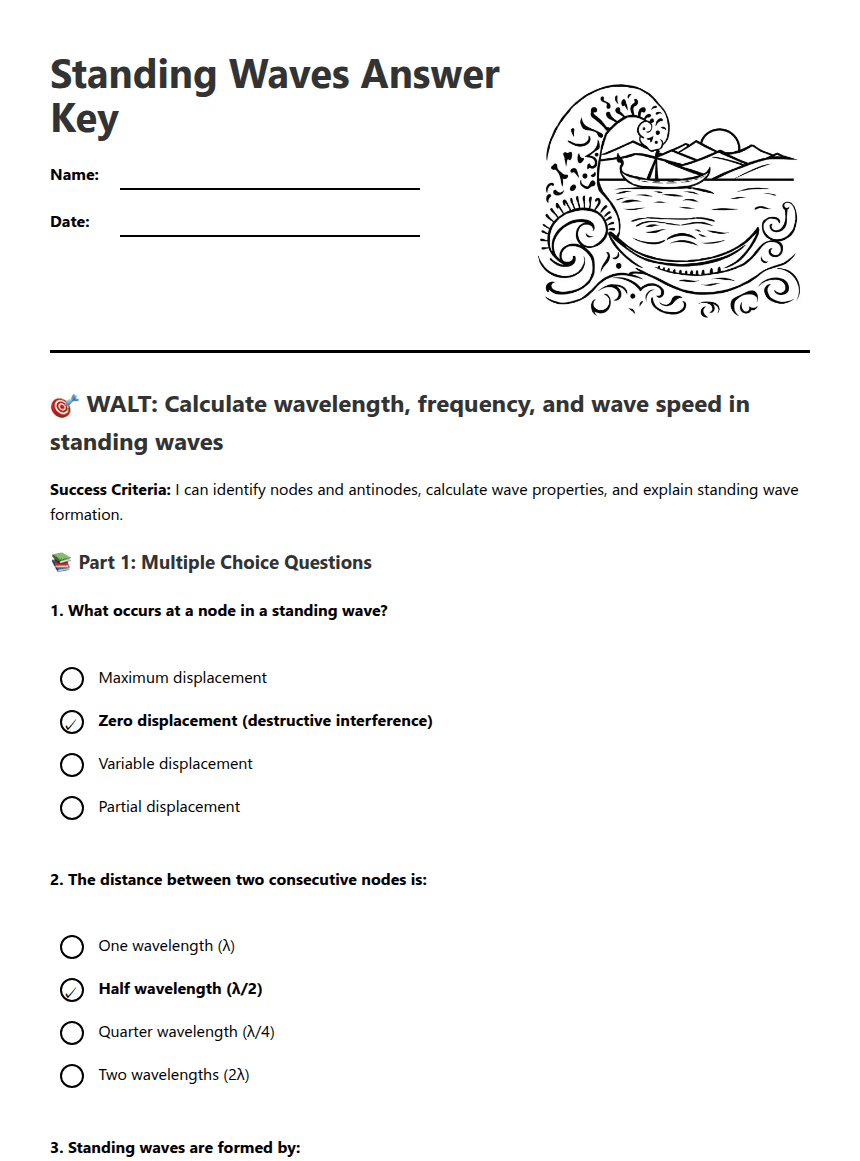
Standing Waves Answer Key worksheet preview

Standing Waves Answer Key

Standing wave diagram illustration

🎯 WALT: Calculate wavelength, frequency, and wave speed in standing waves

Success Criteria: I can identify nodes and antinodes, calculate wave properties, and explain standing wave formation.

📚 Part 1: Multiple Choice Questions

1. What occurs at a node in a standing wave?

Maximum displacement

Zero displacement (destructive interference)

Variable displacement

Partial displacement

2. The distance between two consecutive nodes is:

One wavelength (λ)

Half wavelength (λ/2)

Quarter wavelength (λ/4)

Two wavelengths (2λ)

3. Standing waves are formed by:

Two waves of equal frequency travelling in opposite directions

A single wave reflecting off a barrier

Multiple waves of different frequencies

Waves travelling in the same direction

4. Which musical instruments primarily use standing waves? (Select all that apply)

Guitar strings

Organ pipes

Drums (primarily)

Violin strings

🔢 Part 2: Calculation Problems

5. A guitar string vibrates with a frequency of 440 Hz. If the wave speed is 352 m/s, calculate the wavelength.

Given: f = 440 Hz, v = 352 m/s

Formula: v = fλ, therefore λ = v/f

Calculation: λ = 352 m/s ÷ 440 Hz = 0.8 m

Answer: λ = 0.8 m or 80 cm

6. An organ pipe (closed at one end) has a length of 1.5 m and produces its fundamental frequency. If the speed of sound is 340 m/s, find the frequency.

Given: L = 1.5 m, v = 340 m/s (closed pipe fundamental)

Formula: For closed pipe fundamental: L = λ/4, so λ = 4L

Calculation: λ = 4 × 1.5 m = 6 m

f = v/λ = 340 m/s ÷ 6 m = 56.7 Hz

Answer: f = 56.7 Hz

7. A standing wave pattern shows 4 complete wavelengths in a 2.4 m string. Calculate the wavelength and the distance between nodes.

Given: 4 wavelengths in 2.4 m

Calculation: λ = 2.4 m ÷ 4 = 0.6 m

Distance between nodes = λ/2 = 0.6 m ÷ 2 = 0.3 m

Answer: λ = 0.6 m, node separation = 0.3 m or 30 cm

🧠 Part 3: Analysis & Extension

8. Explain why standing waves have both nodes and antinodes. Use the concept of interference in your answer.
Model Answer: Standing waves form when two waves of equal frequency and amplitude travel in opposite directions and interfere. At nodes, the waves meet completely out of phase (180° phase difference), causing destructive interference and zero displacement. At antinodes, the waves meet in phase, causing constructive interference and maximum displacement. This creates the characteristic pattern of stationary points (nodes) and maximum vibration points (antinodes).
9. Extension Activity: A violin string is 32 cm long and vibrates at 660 Hz. Calculate the wave speed and explain how pressing the string at the 8 cm mark would affect the frequency.
Part 1: For fundamental frequency, L = λ/2, so λ = 2L = 2 × 0.32 m = 0.64 m
Wave speed: v = fλ = 660 Hz × 0.64 m = 422.4 m/s
Part 2: Pressing at 8 cm creates new effective length of 24 cm (32-8). New wavelength = 2 × 0.24 m = 0.48 m
New frequency = v/λ = 422.4 m/s ÷ 0.48 m = 880 Hz (higher pitch)
10. Differentiation Support: Complete this sentence: When the frequency of a standing wave increases, the wavelength __________ and the number of nodes __________.

Answer: When the frequency of a standing wave increases, the wavelength decreases and the number of nodes increases.

🌟 Dyslexia-Friendly Summary:

Node = No movement (zero point)

Antinode = Maximum movement

Key Formula: v = fλ (speed = frequency × wavelength)

Node spacing = λ/2

Higher frequency = shorter wavelength = more nodes

About This Worksheet

Free in Kuraplan

Sign up free, grab the PDF, and customize it for your class.

Print-Ready

Formatted for standard paper. Clean layout, easy to read.

AI-Generated

Created with Kuraplan's AI, designed for real classroom use.

For Teachers & Parents

Use in classrooms, for homework, tutoring, or homeschool.

Need a custom version of this worksheet?

Kuraplan's AI generates custom worksheets in seconds — differentiated for every learner, aligned to your curriculum.

Generate Custom Worksheets — Free
No credit card Curriculum-aligned Under 60 seconds