ScienceFreePrintable
Sound Waves Fact Cards
A free science worksheet ready for your classroom. Open in Kuraplan to grab the print-ready PDF, customize it for your students, or generate a fresh version in seconds.
Name:Date:
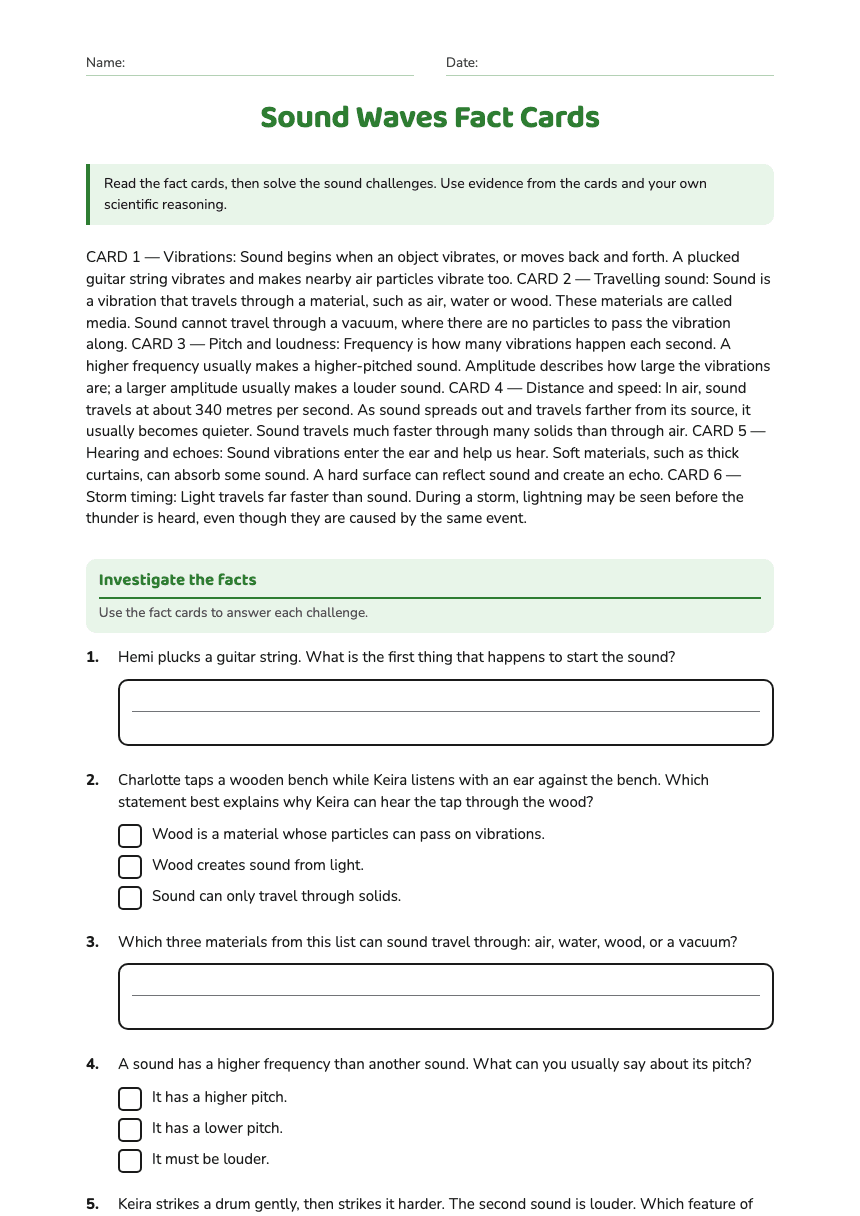
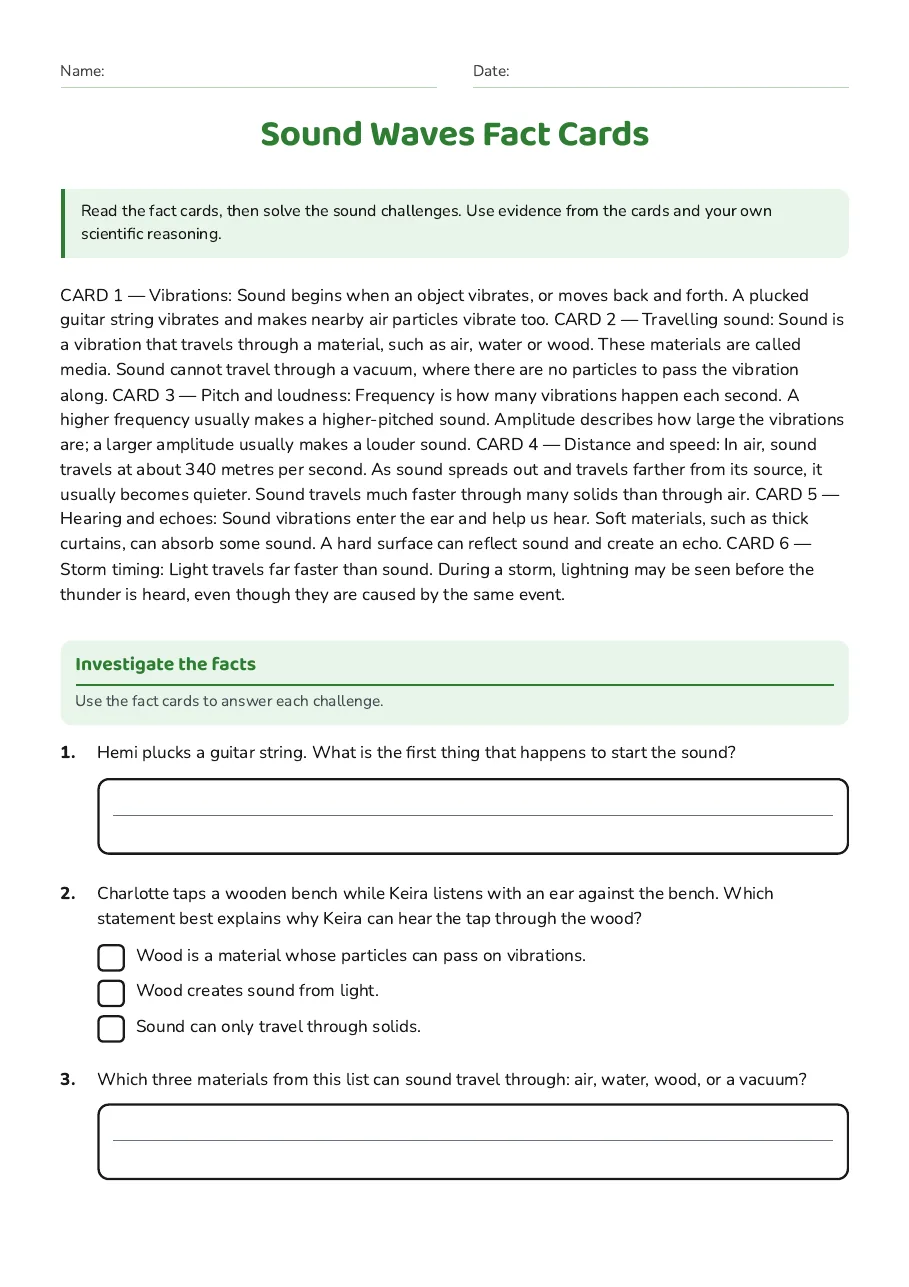
Sound Waves Fact Cards
Read the fact cards, then solve the sound challenges. Use evidence from the cards and your own scientific reasoning.
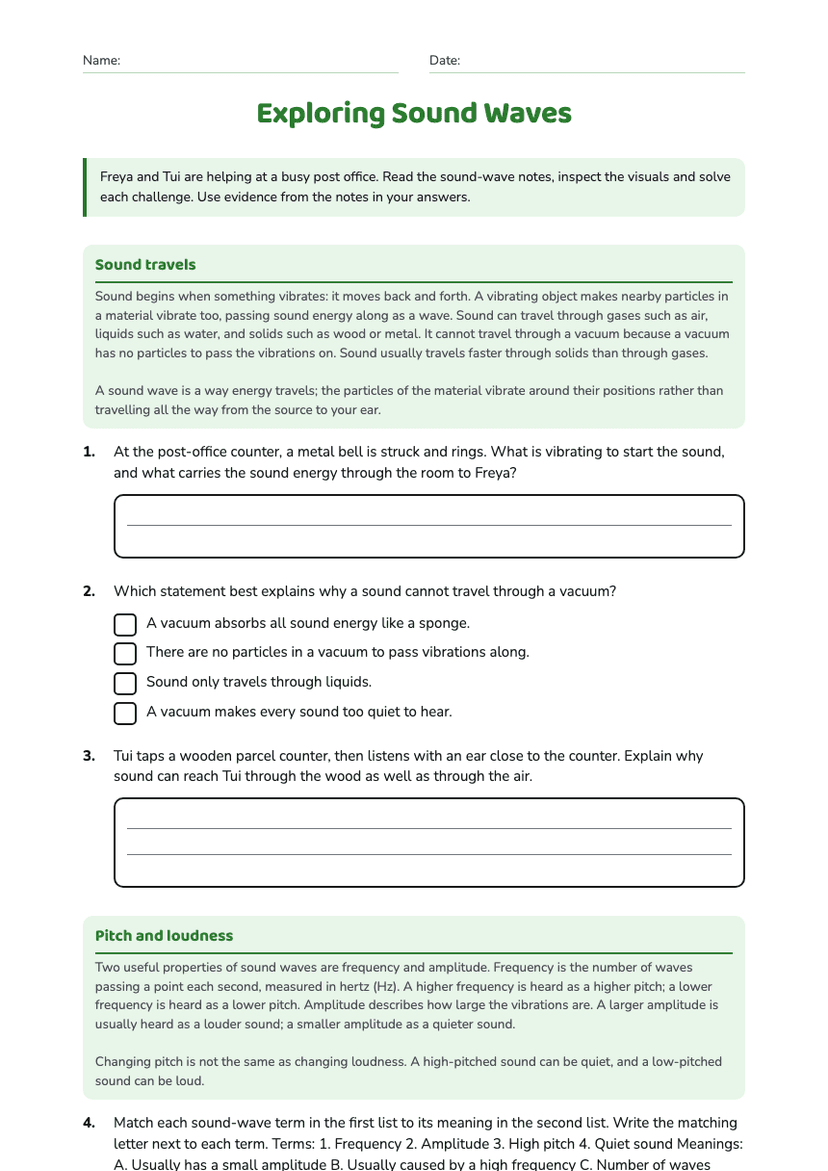
CARD 1 — Vibrations: Sound begins when an object vibrates, or moves back and forth. A plucked guitar string vibrates and makes nearby air particles vibrate too.
CARD 2 — Travelling sound: Sound is a vibration that travels through a material, such as air, water or wood. These materials are called media. Sound cannot travel through a vacuum, where there are no particles to pass the vibration along.
CARD 3 — Pitch and loudness: Frequency is how many vibrations happen each second. A higher frequency usually makes a higher-pitched sound. Amplitude describes how large the vibrations are; a larger amplitude usually makes a louder sound.
CARD 4 — Distance and speed: In air, sound travels at about 340 metres per second. As sound spreads out and travels farther from its source, it usually becomes quieter. Sound travels much faster through many solids than through air.
CARD 5 — Hearing and echoes: Sound vibrations enter the ear and help us hear. Soft materials, such as thick curtains, can absorb some sound. A hard surface can reflect sound and create an echo.
CARD 6 — Storm timing: Light travels far faster than sound. During a storm, lightning may be seen before the thunder is heard, even though they are caused by the same event.
Investigate the facts
Use the fact cards to answer each challenge.
1.Hemi plucks a guitar string. What is the first thing that happens to start the sound?
2.Charlotte taps a wooden bench while Keira listens with an ear against the bench. Which statement best explains why Keira can hear the tap through the wood?
- Wood is a material whose particles can pass on vibrations.
- Wood creates sound from light.
- Sound can only travel through solids.
3.Which three materials from this list can sound travel through: air, water, wood, or a vacuum?
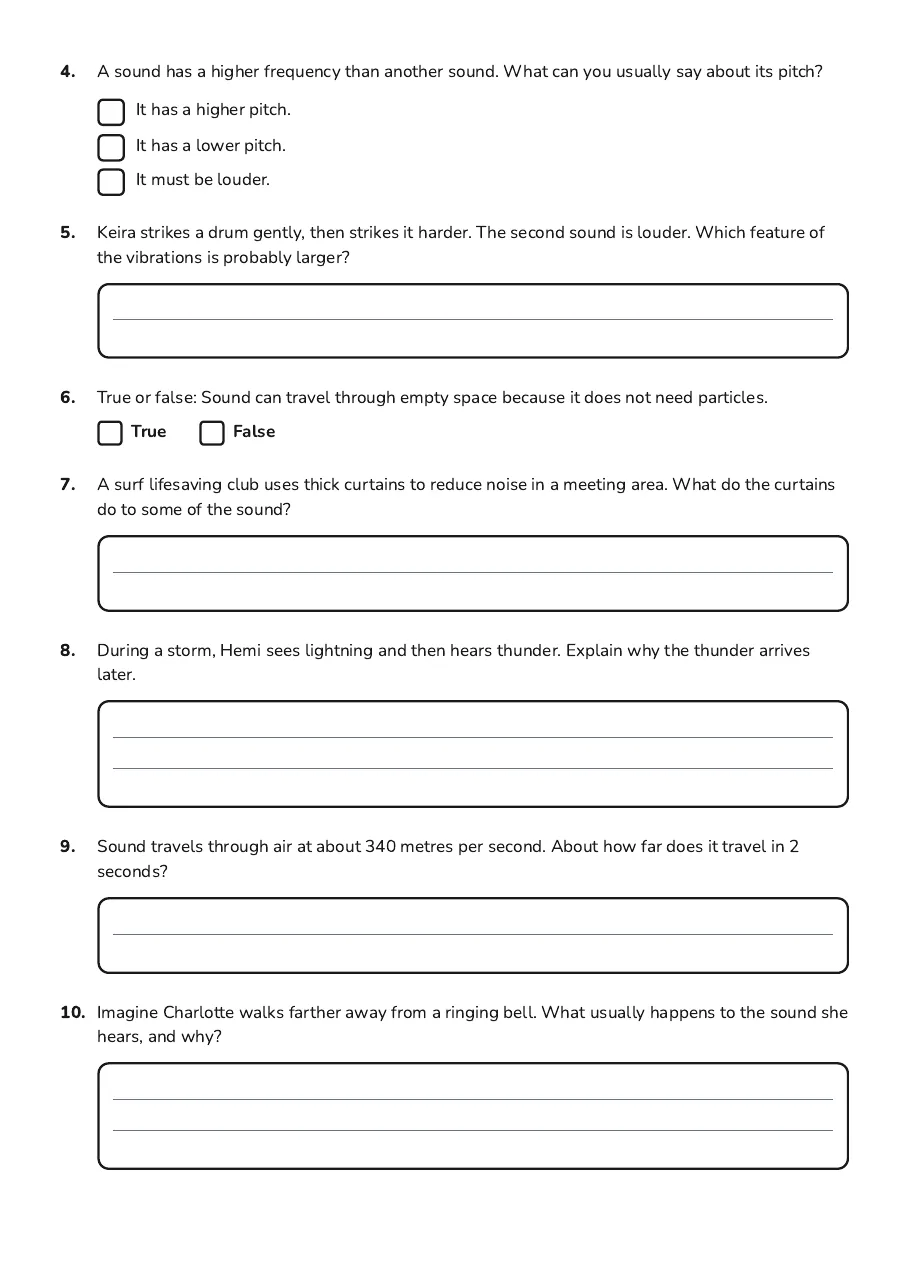
4.A sound has a higher frequency than another sound. What can you usually say about its pitch?
- It has a higher pitch.
- It has a lower pitch.
- It must be louder.
5.Keira strikes a drum gently, then strikes it harder. The second sound is louder. Which feature of the vibrations is probably larger?
6.True or false: Sound can travel through empty space because it does not need particles.
TrueFalse
7.A surf lifesaving club uses thick curtains to reduce noise in a meeting area. What do the curtains do to some of the sound?
8.During a storm, Hemi sees lightning and then hears thunder. Explain why the thunder arrives later.
9.Sound travels through air at about 340 metres per second. About how far does it travel in 2 seconds?
10.Imagine Charlotte walks farther away from a ringing bell. What usually happens to the sound she hears, and why?
11.Complete the science sentence: A hard surface can sound and cause an .
3 printable pages
Page 1
Page 2

Page 3
About This Worksheet
Free in Kuraplan
Sign up free, grab the PDF, and customize it for your class.
Print-Ready
Formatted for standard paper. Clean layout, easy to read.
AI-Generated
Created with Kuraplan's AI, designed for real classroom use.
For Teachers & Parents
Use in classrooms, for homework, tutoring, or homeschool.
Need a custom version of this worksheet?
Kuraplan's AI generates custom worksheets in seconds — differentiated for every learner, aligned to your curriculum.
Generate Custom Worksheets — Free No credit card Curriculum-aligned Under 60 seconds