Te Reo MāoriFreePrintable

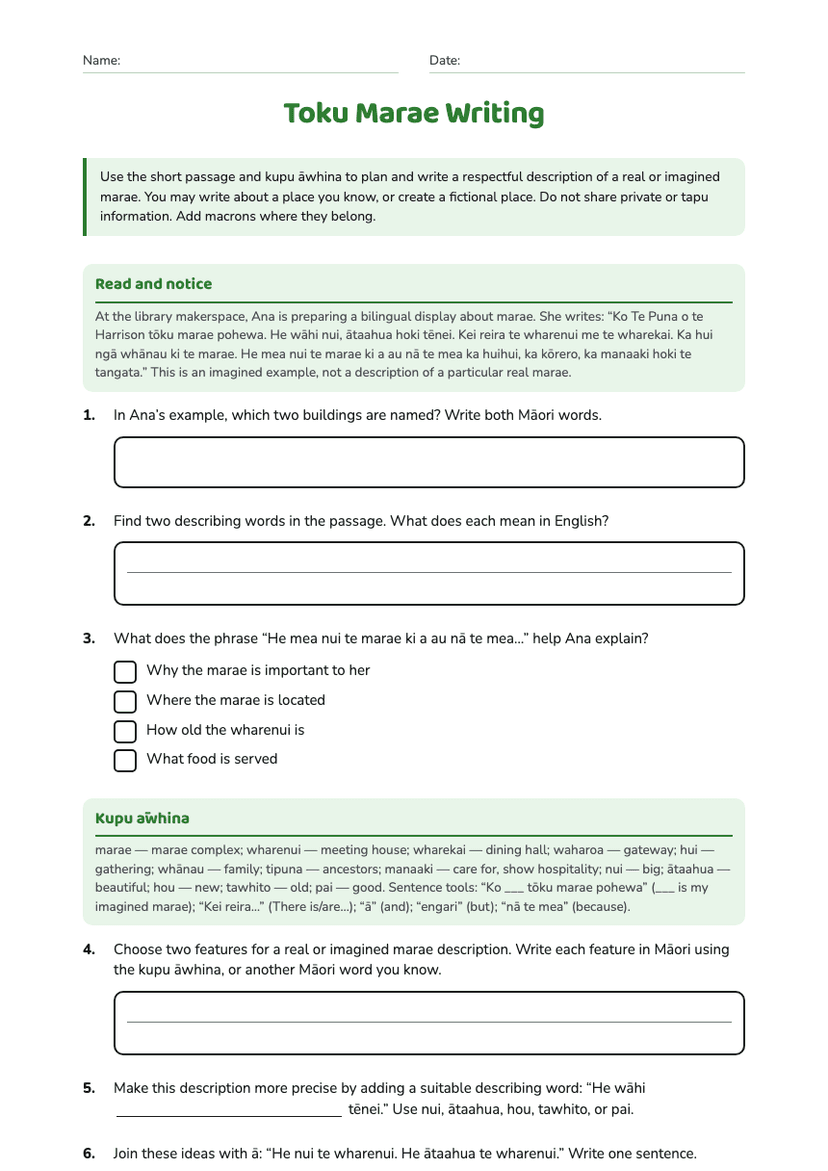
Tōku Marae Writing

A free te reo māori worksheet ready for your classroom. Open in Kuraplan to grab the print-ready PDF, customize it for your students, or generate a fresh version in seconds.
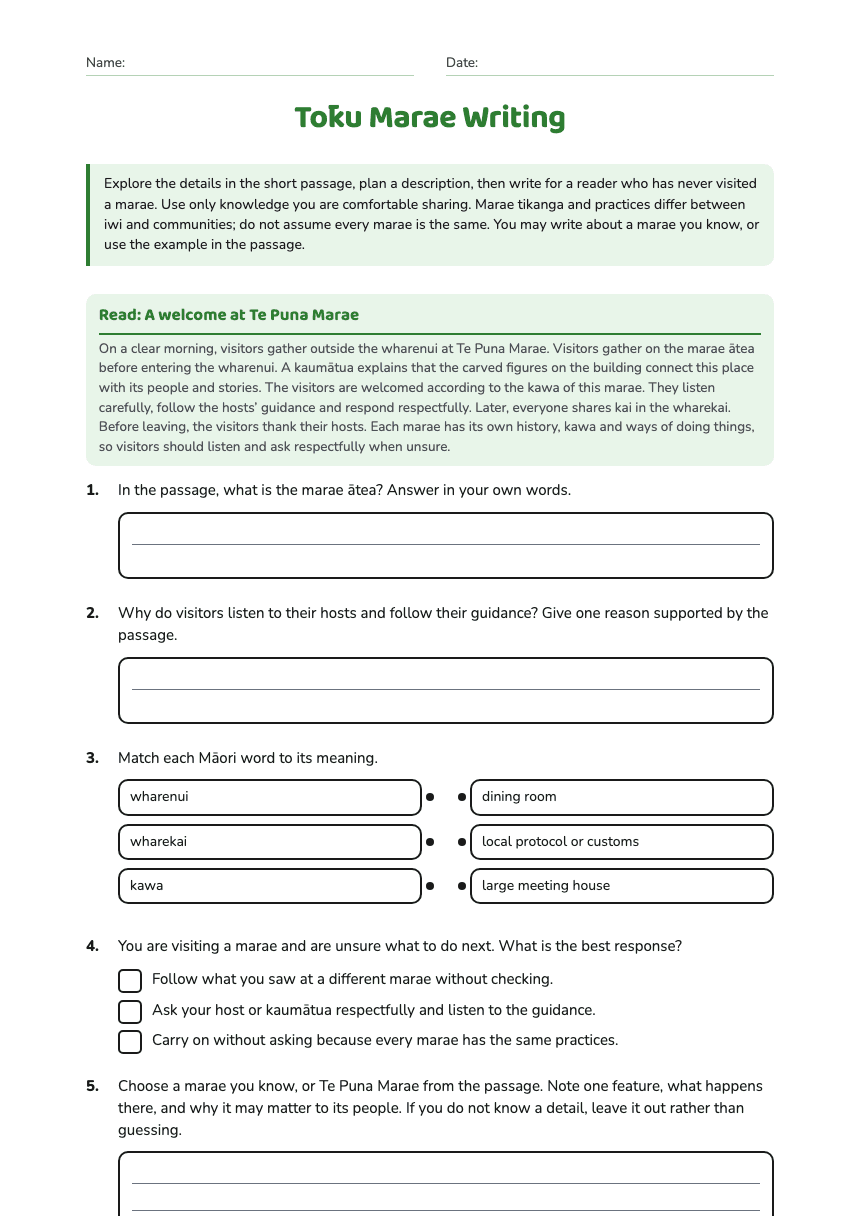
Tōku Marae Writing worksheet preview
Name:Date:

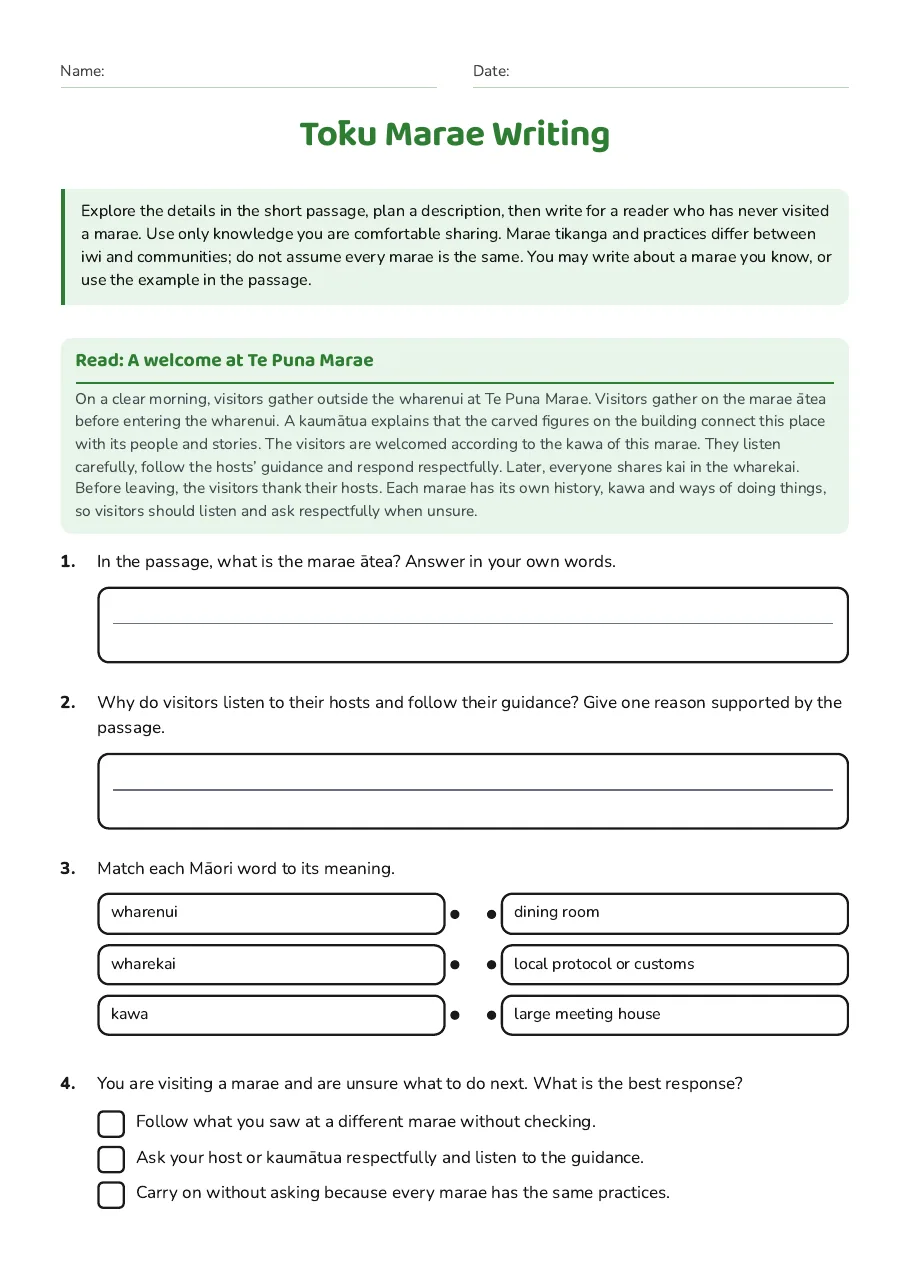
Tōku Marae Writing

Explore the details in the short passage, plan a description, then write for a reader who has never visited a marae. Use only knowledge you are comfortable sharing. Marae tikanga and practices differ between iwi and communities; do not assume every marae is the same. You may write about a marae you know, or use the example in the passage.

Read: A welcome at Te Puna Marae

On a clear morning, visitors gather outside the wharenui at Te Puna Marae. Visitors gather on the marae ātea before entering the wharenui. A kaumātua explains that the carved figures on the building connect this place with its people and stories. The visitors are welcomed according to the kawa of this marae. They listen carefully, follow the hosts’ guidance and respond respectfully. Later, everyone shares kai in the wharekai. Before leaving, the visitors thank their hosts. Each marae has its own history, kawa and ways of doing things, so visitors should listen and ask respectfully when unsure.

1.In the passage, what is the marae ātea? Answer in your own words.
2.Why do visitors listen to their hosts and follow their guidance? Give one reason supported by the passage.
3.Match each Māori word to its meaning.
  • wharenui
  • wharekai
  • kawa
  • dining room
  • local protocol or customs
  • large meeting house
4.You are visiting a marae and are unsure what to do next. What is the best response?
  • Follow what you saw at a different marae without checking.
  • Ask your host or kaumātua respectfully and listen to the guidance.
  • Carry on without asking because every marae has the same practices.
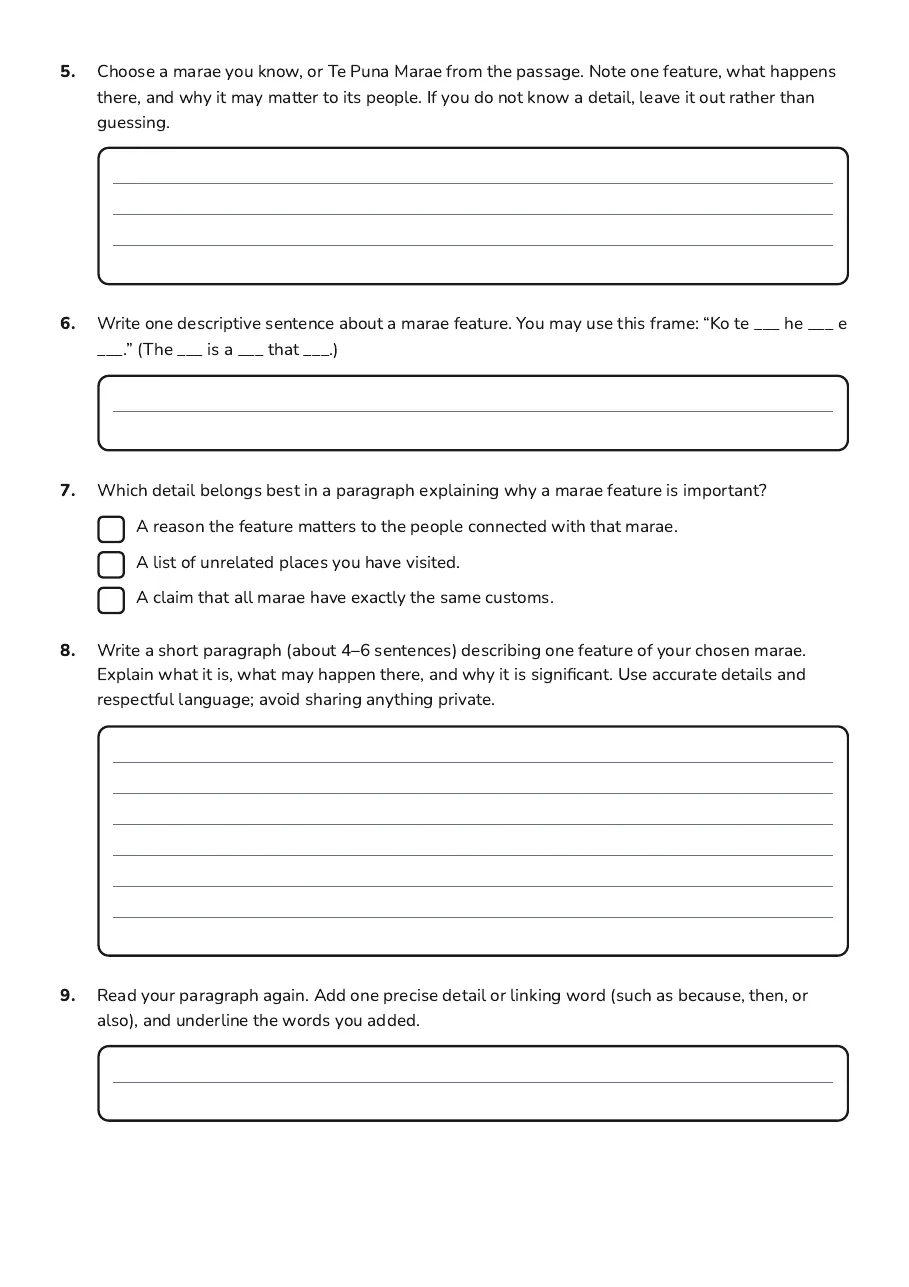
5.Choose a marae you know, or Te Puna Marae from the passage. Note one feature, what happens there, and why it may matter to its people. If you do not know a detail, leave it out rather than guessing.
6.Write one descriptive sentence about a marae feature. You may use this frame: “Ko te ___ he ___ e ___.” (The ___ is a ___ that ___.)
7.Which detail belongs best in a paragraph explaining why a marae feature is important?
  • A reason the feature matters to the people connected with that marae.
  • A list of unrelated places you have visited.
  • A claim that all marae have exactly the same customs.
8.Write a short paragraph (about 4–6 sentences) describing one feature of your chosen marae. Explain what it is, what may happen there, and why it is significant. Use accurate details and respectful language; avoid sharing anything private.
9.Read your paragraph again. Add one precise detail or linking word (such as because, then, or also), and underline the words you added.
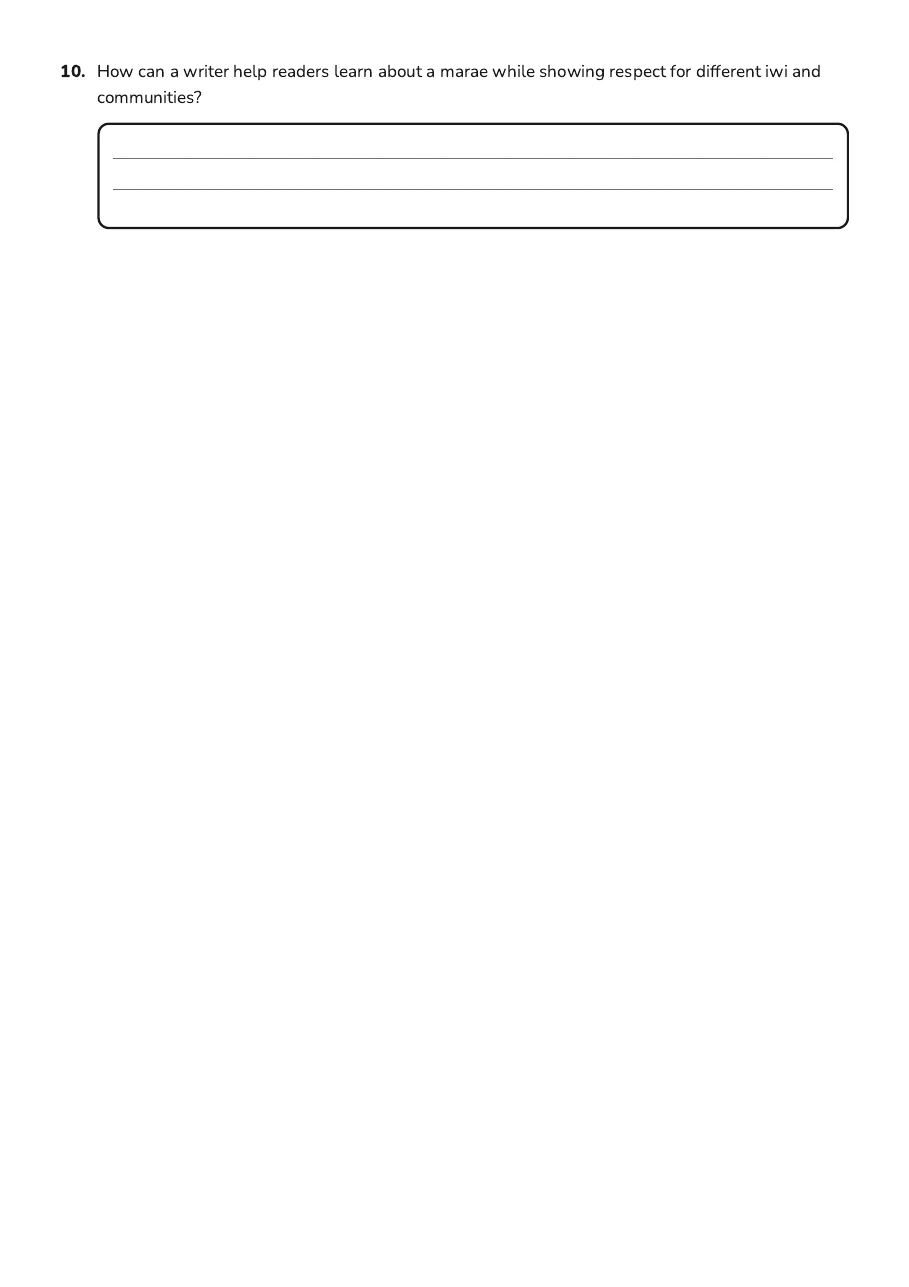
10.How can a writer help readers learn about a marae while showing respect for different iwi and communities?

3 printable pages

  • Tōku Marae Writing, page 1 of 3: Read: A welcome at Te Puna Marae

    Page 1

  • Tōku Marae Writing, page 2 of 3: 5. Choose a marae you know, or Te Puna Marae from the passage. Note one feature, what…

    Page 2

  • Tōku Marae Writing, page 3 of 3: 10. How can a writer help readers learn about a marae while showing respect for different…

    Page 3

About This Worksheet

Free in Kuraplan

Sign up free, grab the PDF, and customize it for your class.

Print-Ready

Formatted for standard paper. Clean layout, easy to read.

AI-Generated

Created with Kuraplan's AI, designed for real classroom use.

For Teachers & Parents

Use in classrooms, for homework, tutoring, or homeschool.

Need a custom version of this worksheet?

Kuraplan's AI generates custom worksheets in seconds — differentiated for every learner, aligned to your curriculum.

Generate Custom Worksheets — Free
No credit card Curriculum-aligned Under 60 seconds