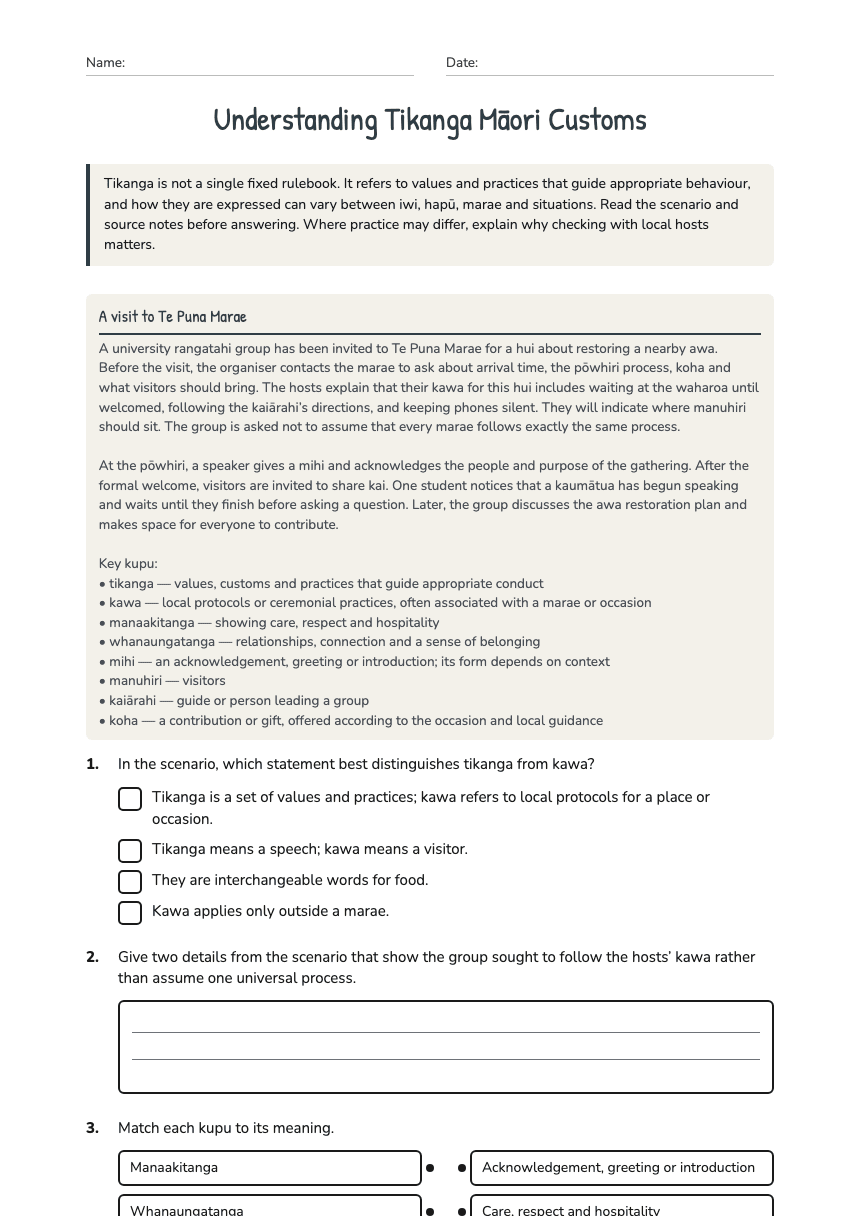
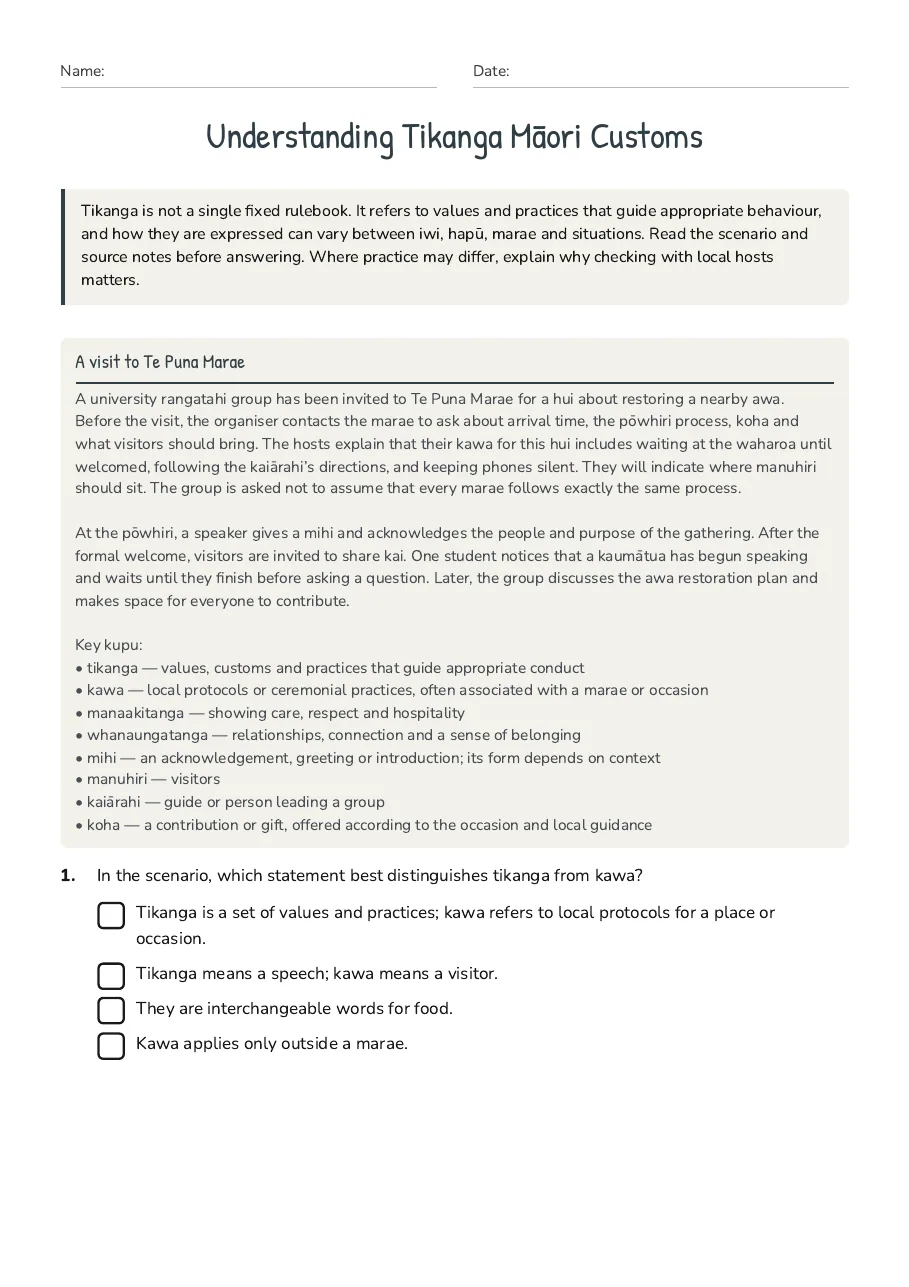
Understanding Tikanga Māori Customs
A free te reo māori worksheet ready for your classroom. Open in Kuraplan to grab the print-ready PDF, customize it for your students, or generate a fresh version in seconds.
Understanding Tikanga Māori Customs
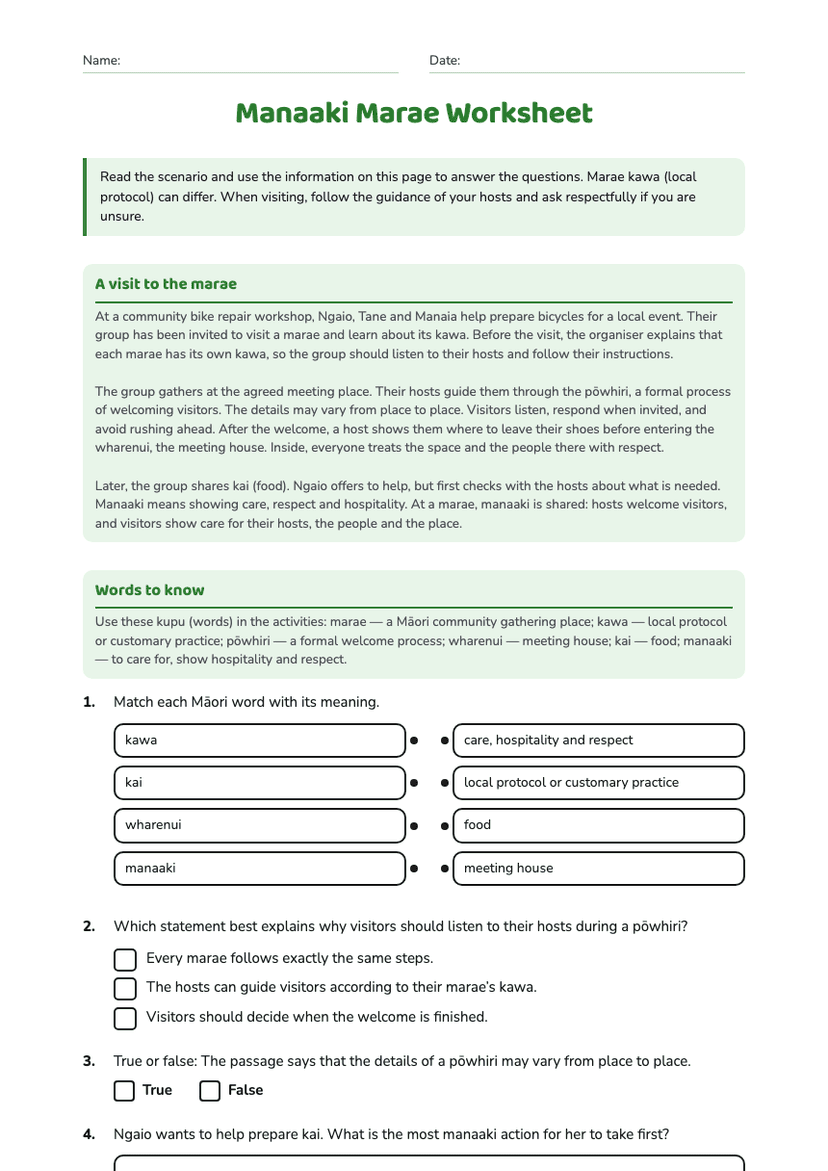
A visit to Te Puna Marae
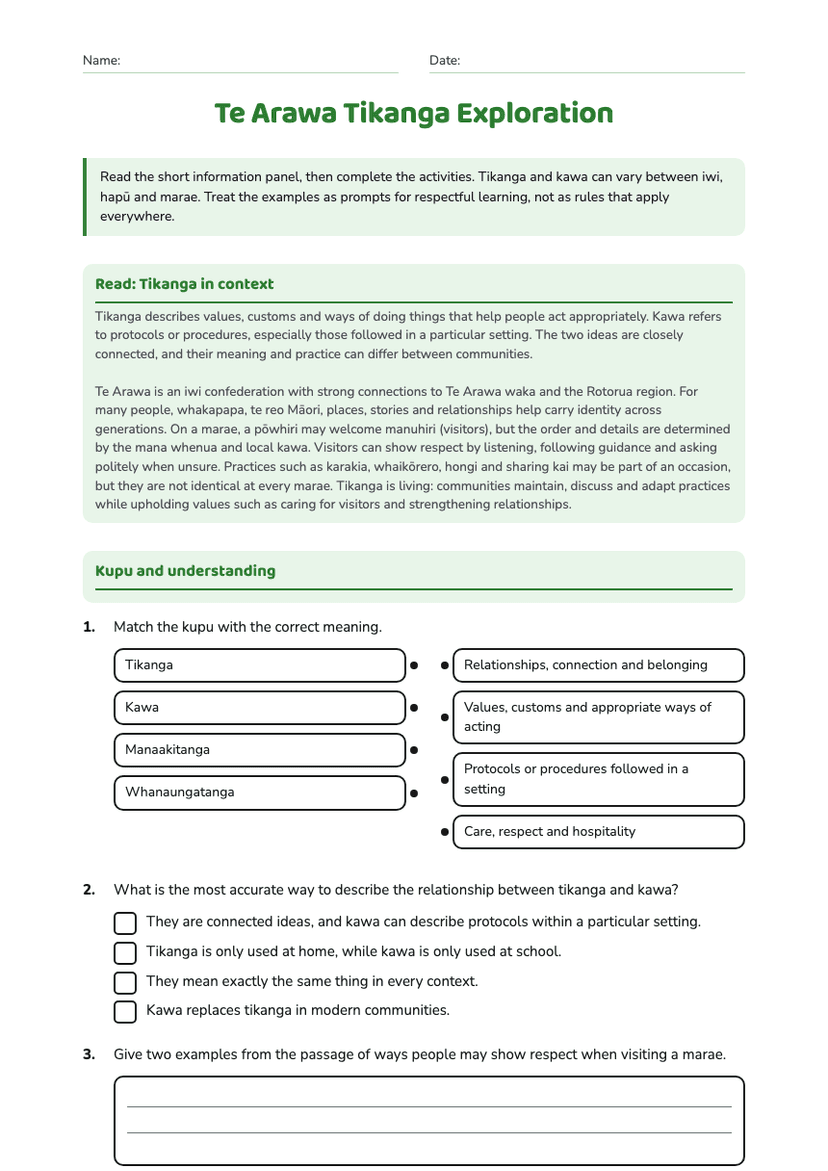
A university rangatahi group has been invited to Te Puna Marae for a hui about restoring a nearby awa. Before the visit, the organiser contacts the marae to ask about arrival time, the pōwhiri process, koha and what visitors should bring. The hosts explain that their kawa for this hui includes waiting at the waharoa until welcomed, following the kaiārahi’s directions, and keeping phones silent. They will indicate where manuhiri should sit. The group is asked not to assume that every marae follows exactly the same process. At the pōwhiri, a speaker gives a mihi and acknowledges the people and purpose of the gathering. After the formal welcome, visitors are invited to share kai. One student notices that a kaumātua has begun speaking and waits until they finish before asking a question. Later, the group discusses the awa restoration plan and makes space for everyone to contribute. Key kupu: • tikanga — values, customs and practices that guide appropriate conduct • kawa — local protocols or ceremonial practices, often associated with a marae or occasion • manaakitanga — showing care, respect and hospitality • whanaungatanga — relationships, connection and a sense of belonging • mihi — an acknowledgement, greeting or introduction; its form depends on context • manuhiri — visitors • kaiārahi — guide or person leading a group • koha — a contribution or gift, offered according to the occasion and local guidance
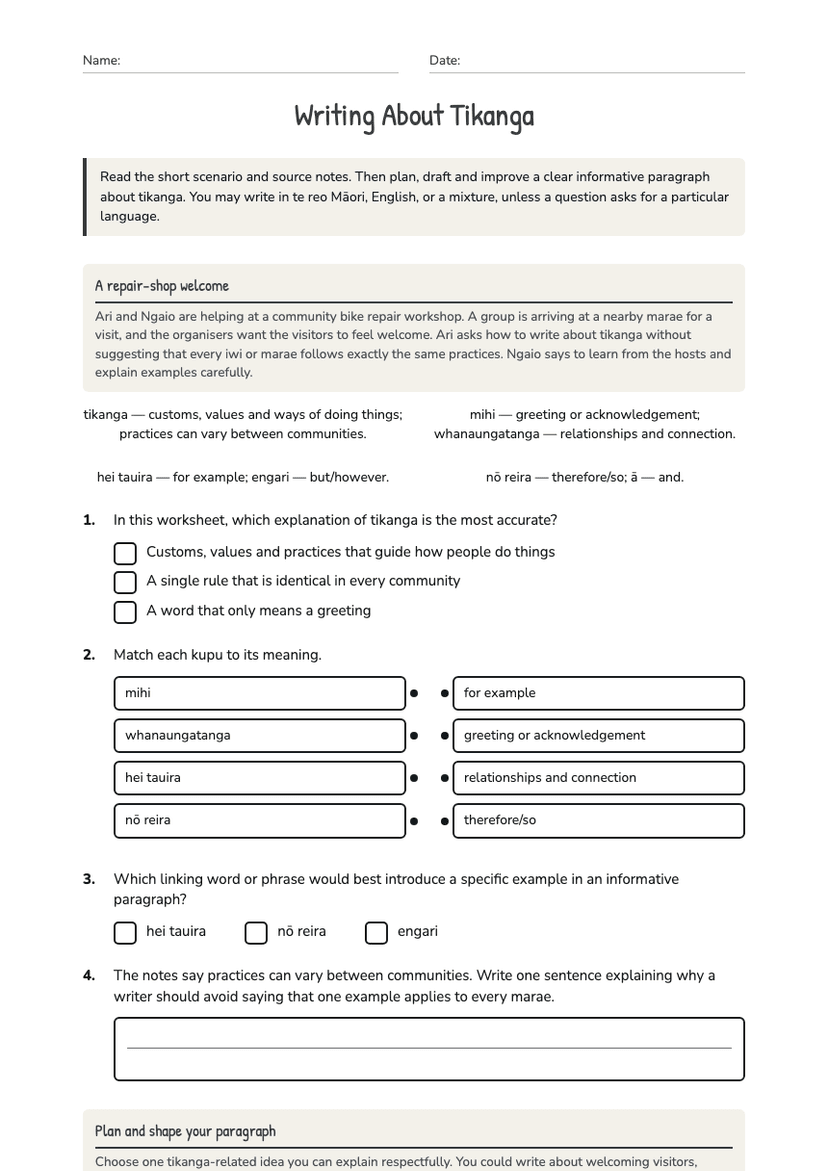
- Tikanga is a set of values and practices; kawa refers to local protocols for a place or occasion.
- Tikanga means a speech; kawa means a visitor.
- They are interchangeable words for food.
- Kawa applies only outside a marae.
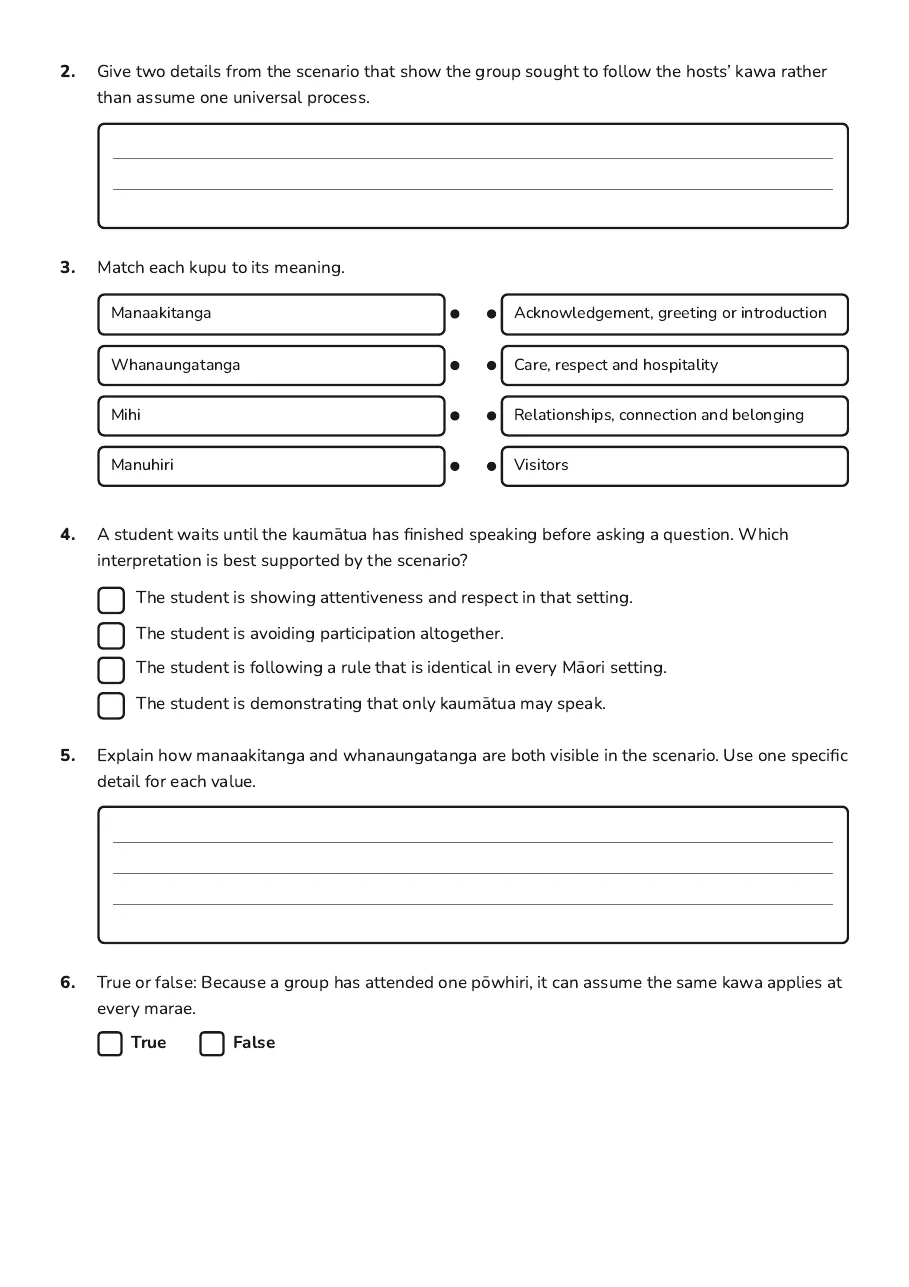
- Manaakitanga
- Whanaungatanga
- Mihi
- Manuhiri
- Acknowledgement, greeting or introduction
- Care, respect and hospitality
- Relationships, connection and belonging
- Visitors
- The student is showing attentiveness and respect in that setting.
- The student is avoiding participation altogether.
- The student is following a rule that is identical in every Māori setting.
- The student is demonstrating that only kaumātua may speak.
3 printable pages
Page 1
Page 2
Page 3
About This Worksheet
Free in Kuraplan
Sign up free, grab the PDF, and customize it for your class.
Print-Ready
Formatted for standard paper. Clean layout, easy to read.
AI-Generated
Created with Kuraplan's AI, designed for real classroom use.
For Teachers & Parents
Use in classrooms, for homework, tutoring, or homeschool.
Need a custom version of this worksheet?
Kuraplan's AI generates custom worksheets in seconds — differentiated for every learner, aligned to your curriculum.
Generate Custom Worksheets — Free