Te Reo MāoriFreePrintable

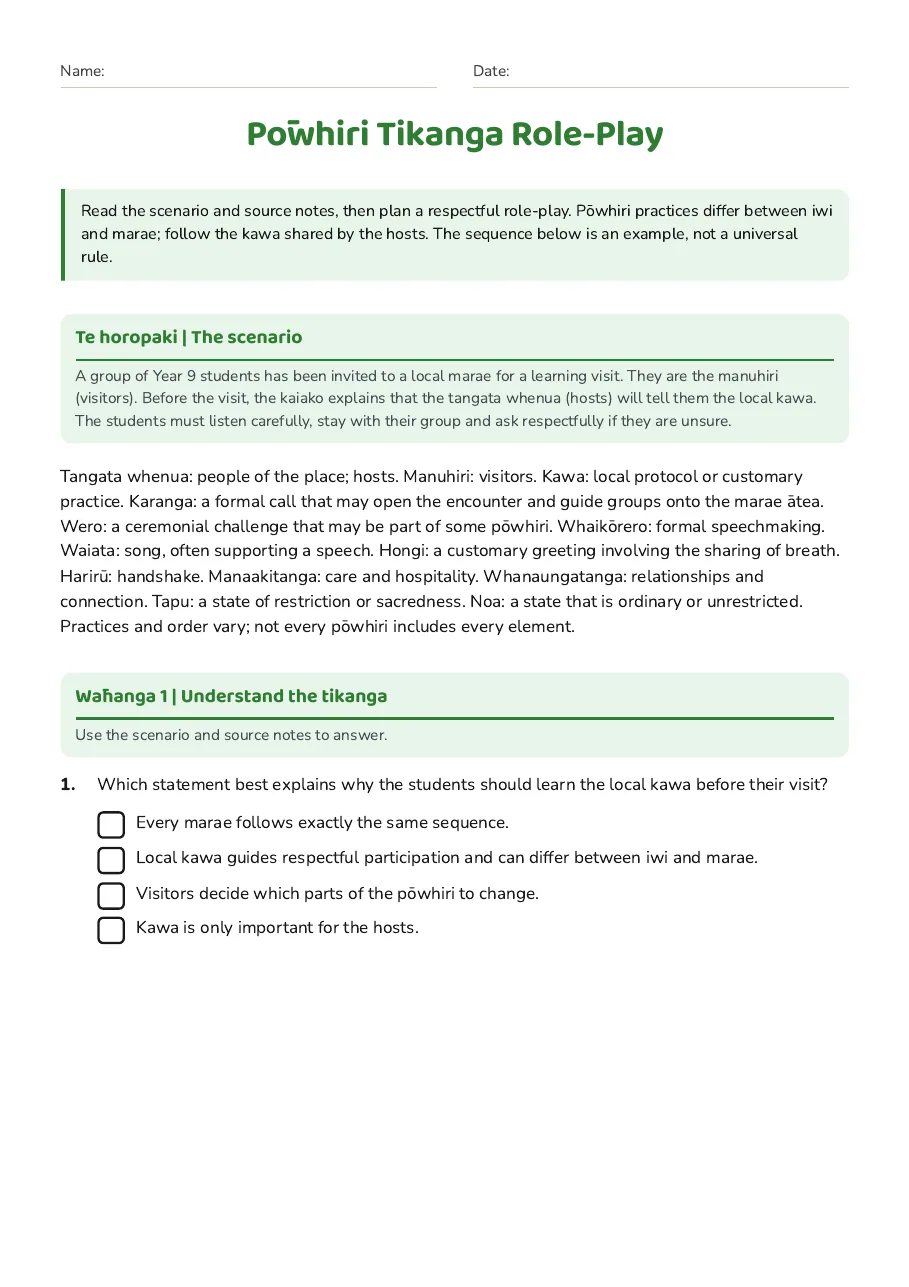
Pōwhiri Tikanga Role-Play

A free te reo māori worksheet ready for your classroom. Open in Kuraplan to grab the print-ready PDF, customize it for your students, or generate a fresh version in seconds.
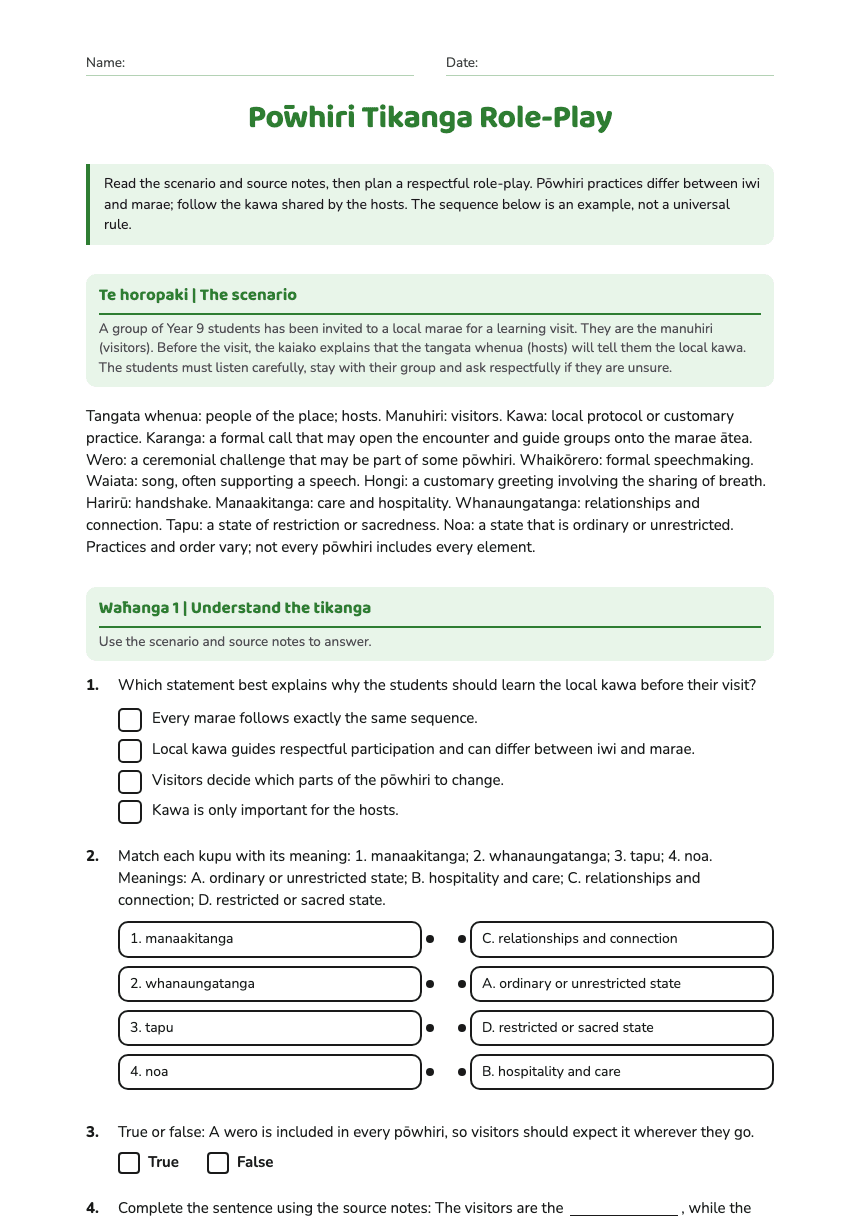
Pōwhiri Tikanga Role-Play worksheet preview
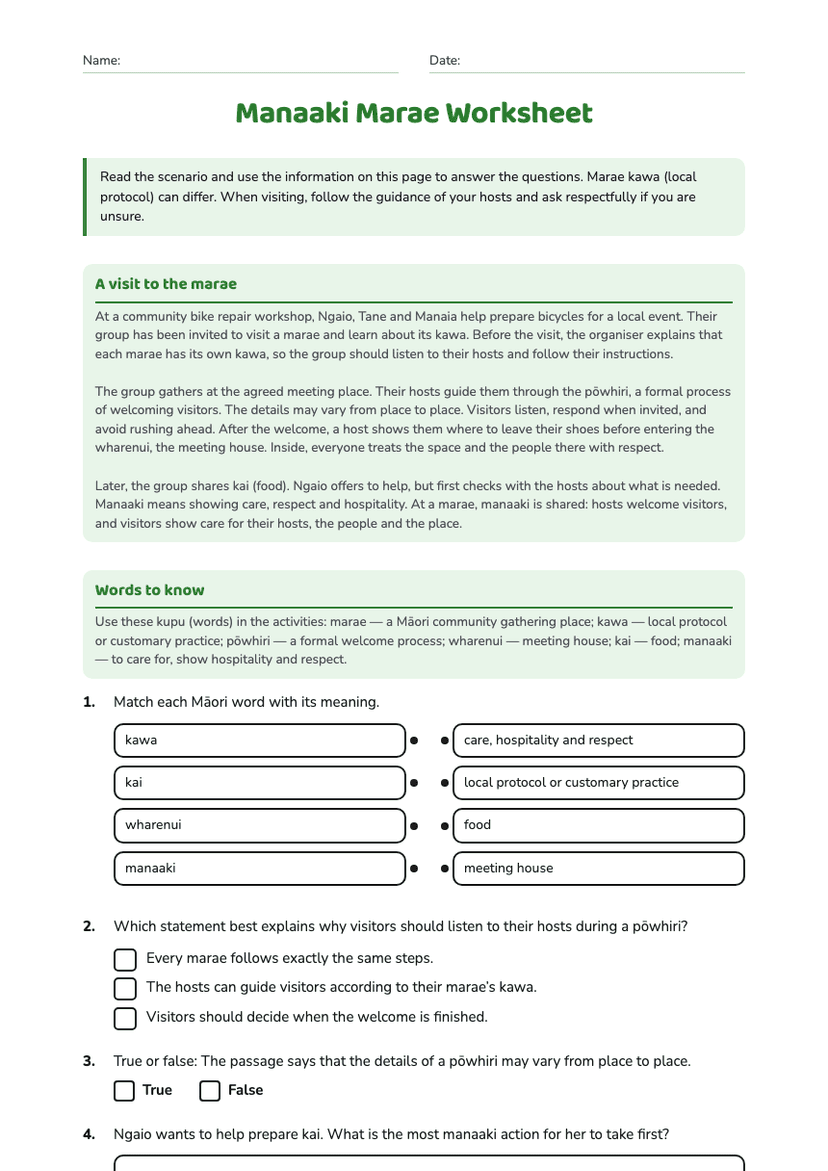
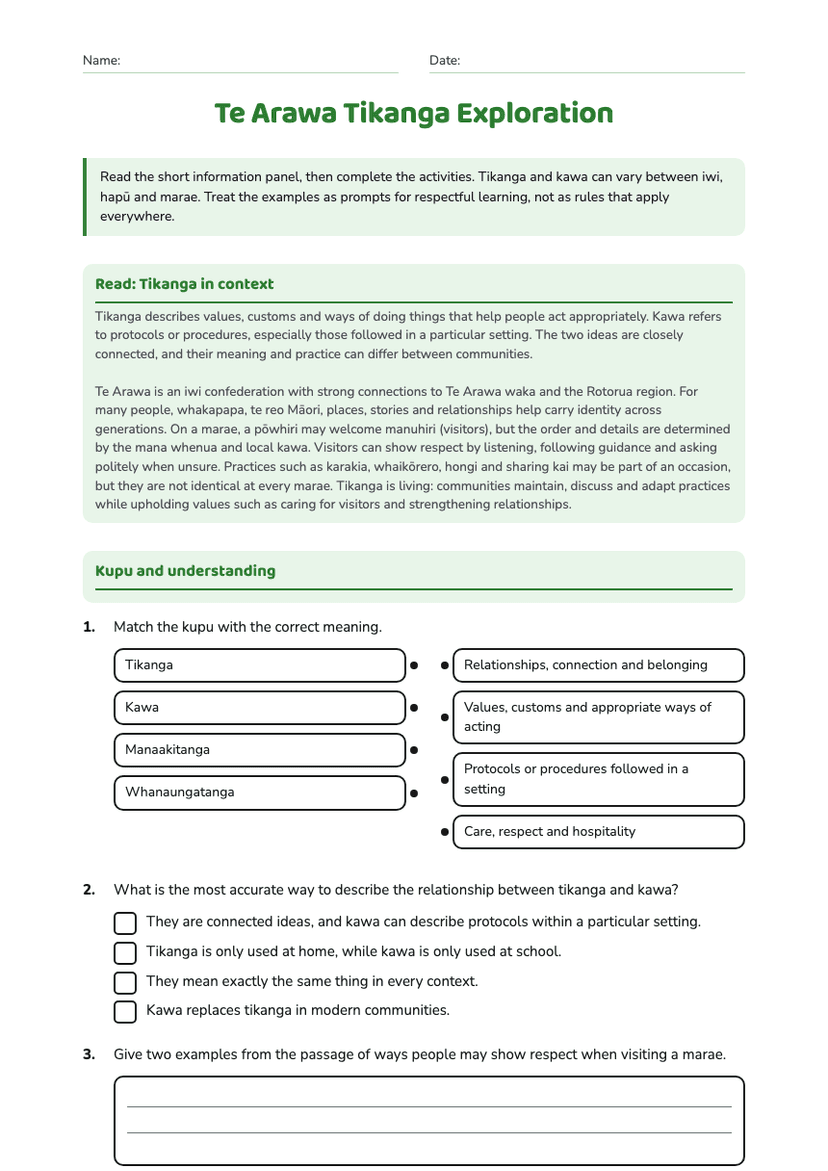
Name:Date:

Pōwhiri Tikanga Role-Play

Read the scenario and source notes, then plan a respectful role-play. Pōwhiri practices differ between iwi and marae; follow the kawa shared by the hosts. The sequence below is an example, not a universal rule.

Te horopaki | The scenario

A group of Year 9 students has been invited to a local marae for a learning visit. They are the manuhiri (visitors). Before the visit, the kaiako explains that the tangata whenua (hosts) will tell them the local kawa. The students must listen carefully, stay with their group and ask respectfully if they are unsure.

Tangata whenua: people of the place; hosts. Manuhiri: visitors. Kawa: local protocol or customary practice. Karanga: a formal call that may open the encounter and guide groups onto the marae ātea. Wero: a ceremonial challenge that may be part of some pōwhiri. Whaikōrero: formal speechmaking. Waiata: song, often supporting a speech. Hongi: a customary greeting involving the sharing of breath. Harirū: handshake. Manaakitanga: care and hospitality. Whanaungatanga: relationships and connection. Tapu: a state of restriction or sacredness. Noa: a state that is ordinary or unrestricted. Practices and order vary; not every pōwhiri includes every element.

Wāhanga 1 | Understand the tikanga

Use the scenario and source notes to answer.

1.Which statement best explains why the students should learn the local kawa before their visit?
  • Every marae follows exactly the same sequence.
  • Local kawa guides respectful participation and can differ between iwi and marae.
  • Visitors decide which parts of the pōwhiri to change.
  • Kawa is only important for the hosts.
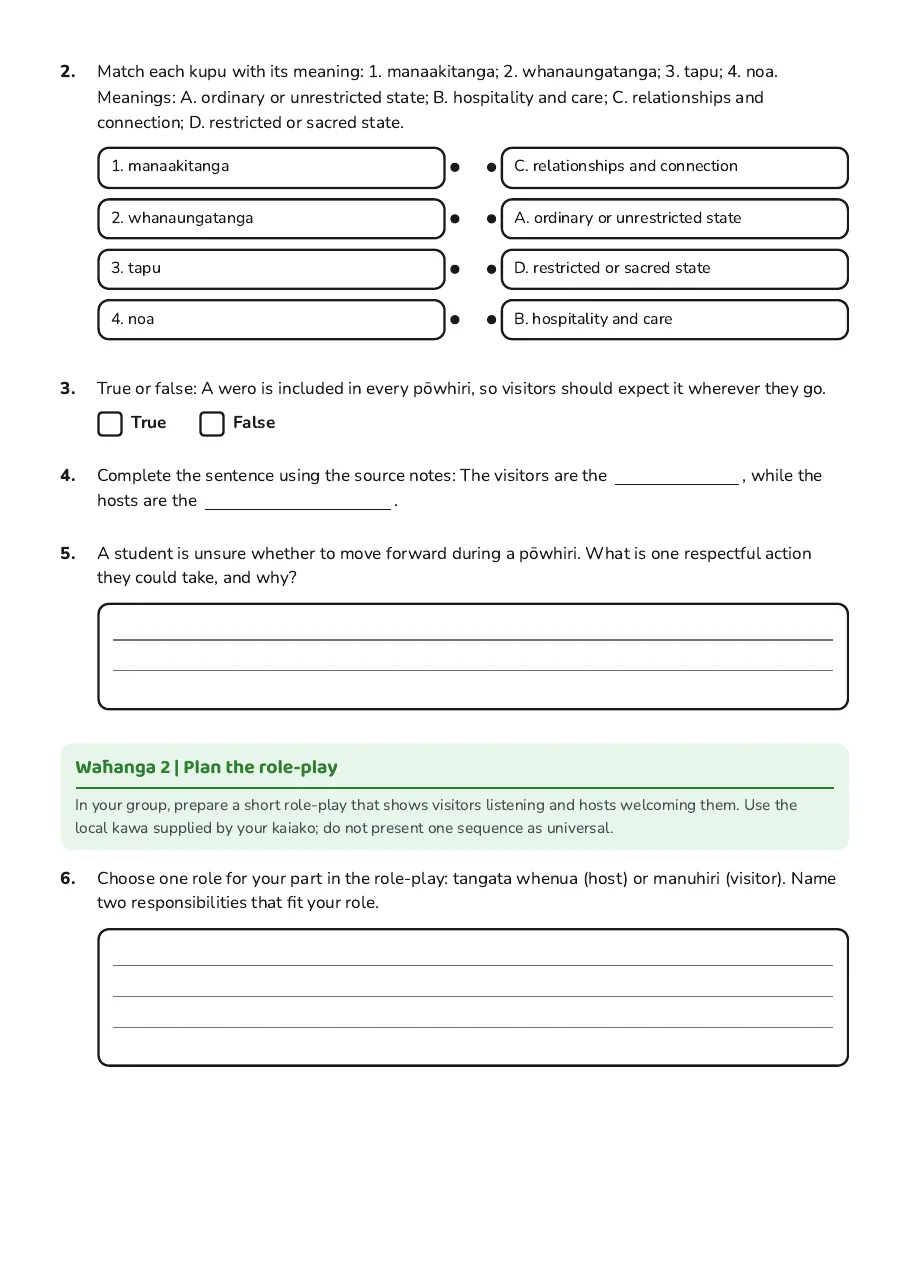
2.Match each kupu with its meaning: 1. manaakitanga; 2. whanaungatanga; 3. tapu; 4. noa. Meanings: A. ordinary or unrestricted state; B. hospitality and care; C. relationships and connection; D. restricted or sacred state.
  • 1. manaakitanga
  • 2. whanaungatanga
  • 3. tapu
  • 4. noa
  • C. relationships and connection
  • A. ordinary or unrestricted state
  • D. restricted or sacred state
  • B. hospitality and care
3.True or false: A wero is included in every pōwhiri, so visitors should expect it wherever they go.
TrueFalse
4.Complete the sentence using the source notes: The visitors are the , while the hosts are the .
5.A student is unsure whether to move forward during a pōwhiri. What is one respectful action they could take, and why?

Wāhanga 2 | Plan the role-play

In your group, prepare a short role-play that shows visitors listening and hosts welcoming them. Use the local kawa supplied by your kaiako; do not present one sequence as universal.

6.Choose one role for your part in the role-play: tangata whenua (host) or manuhiri (visitor). Name two responsibilities that fit your role.
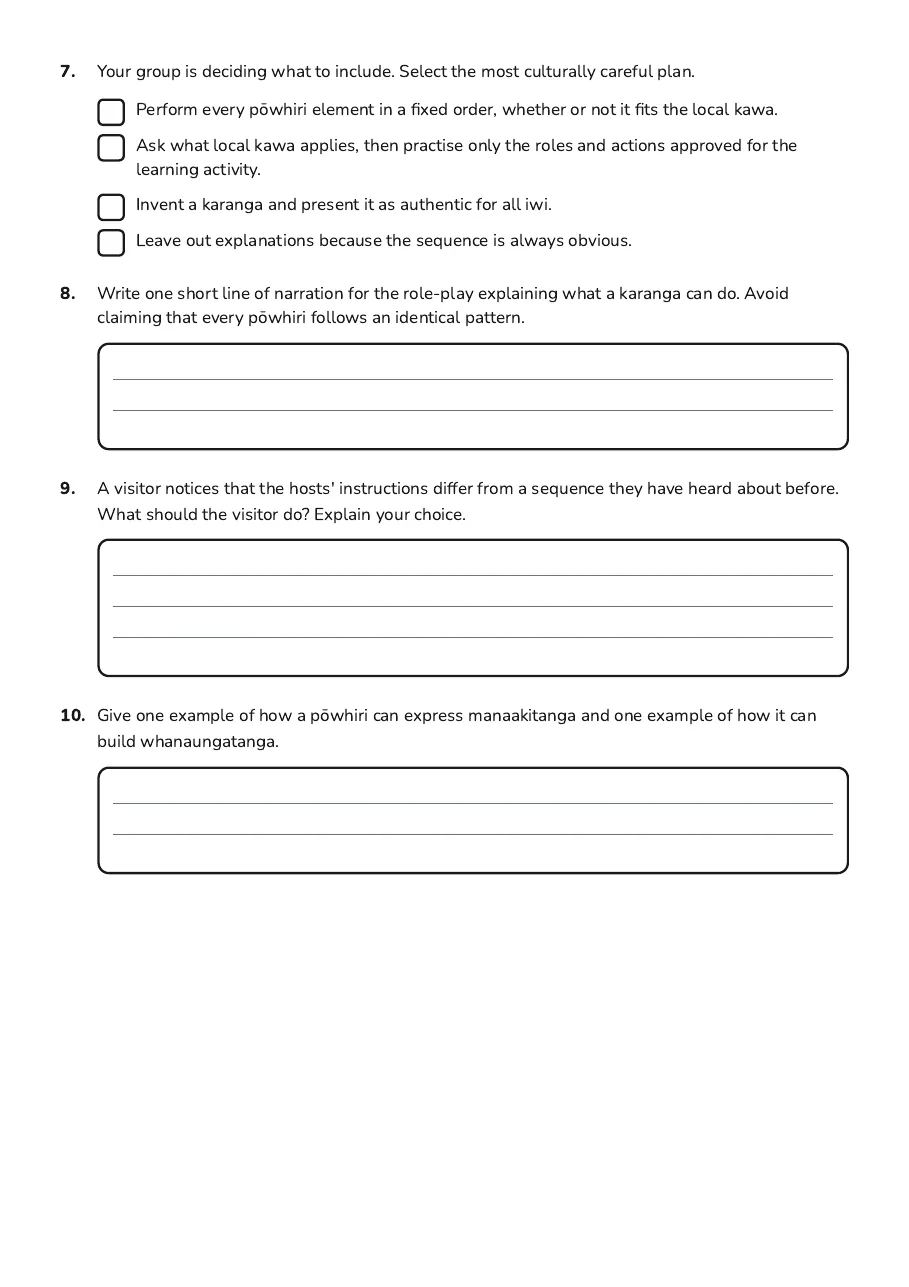
7.Your group is deciding what to include. Select the most culturally careful plan.
  • Perform every pōwhiri element in a fixed order, whether or not it fits the local kawa.
  • Ask what local kawa applies, then practise only the roles and actions approved for the learning activity.
  • Invent a karanga and present it as authentic for all iwi.
  • Leave out explanations because the sequence is always obvious.
8.Write one short line of narration for the role-play explaining what a karanga can do. Avoid claiming that every pōwhiri follows an identical pattern.
9.A visitor notices that the hosts' instructions differ from a sequence they have heard about before. What should the visitor do? Explain your choice.
10.Give one example of how a pōwhiri can express manaakitanga and one example of how it can build whanaungatanga.

3 printable pages

  • Pōwhiri Tikanga Role-Play, page 1 of 3: Te horopaki | The scenario, Wāhanga 1 | Understand the tikanga

    Page 1

  • Pōwhiri Tikanga Role-Play, page 2 of 3: Wāhanga 2 | Plan the role-play

    Page 2

  • Pōwhiri Tikanga Role-Play, page 3 of 3: 7. Your group is deciding what to include. Select the most culturally careful plan.

    Page 3

About This Worksheet

Free in Kuraplan

Sign up free, grab the PDF, and customize it for your class.

Print-Ready

Formatted for standard paper. Clean layout, easy to read.

AI-Generated

Created with Kuraplan's AI, designed for real classroom use.

For Teachers & Parents

Use in classrooms, for homework, tutoring, or homeschool.

Need a custom version of this worksheet?

Kuraplan's AI generates custom worksheets in seconds — differentiated for every learner, aligned to your curriculum.

Generate Custom Worksheets — Free
No credit card Curriculum-aligned Under 60 seconds

Explore more free resources