ScienceFreePrintable

Water Quality Investigation Lab

A free science worksheet ready for your classroom. Open in Kuraplan to grab the print-ready PDF, customize it for your students, or generate a fresh version in seconds.
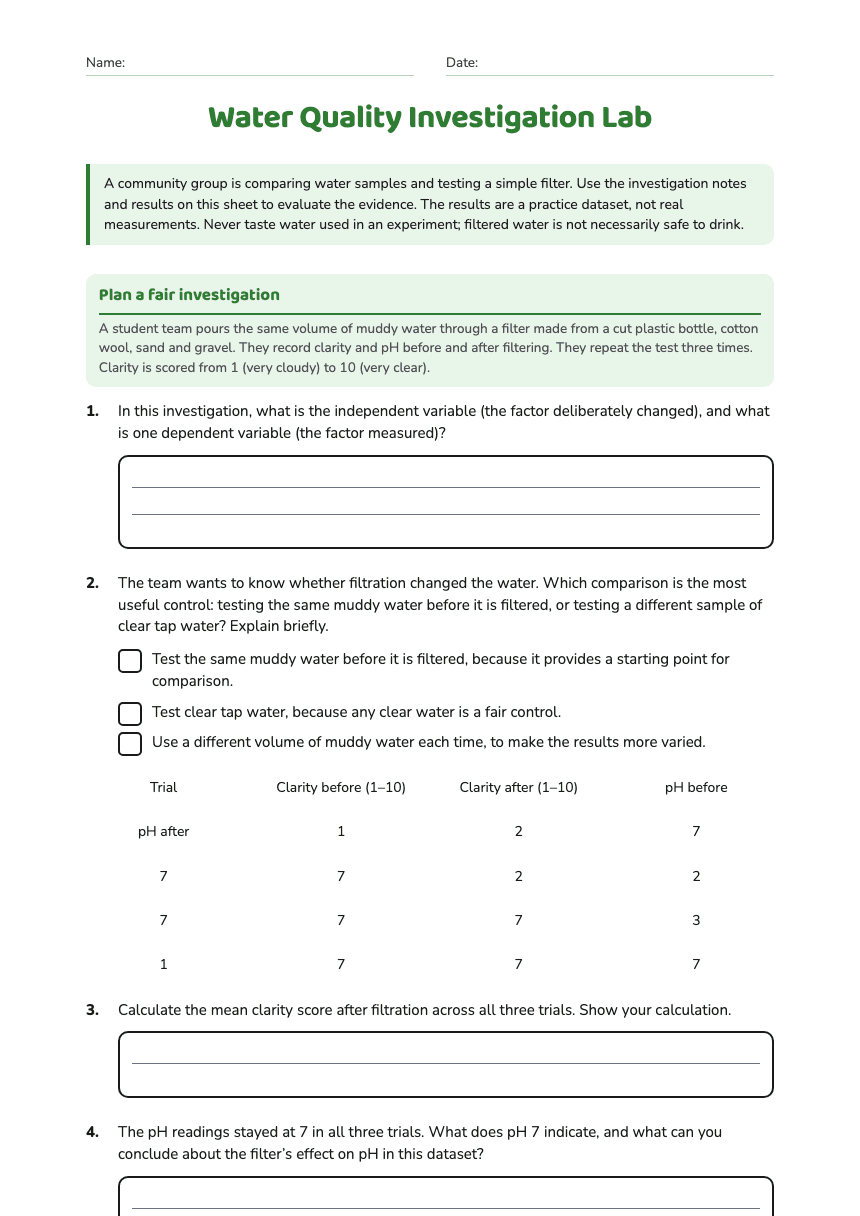
Water Quality Investigation Lab worksheet preview
Name:Date:

Water Quality Investigation Lab

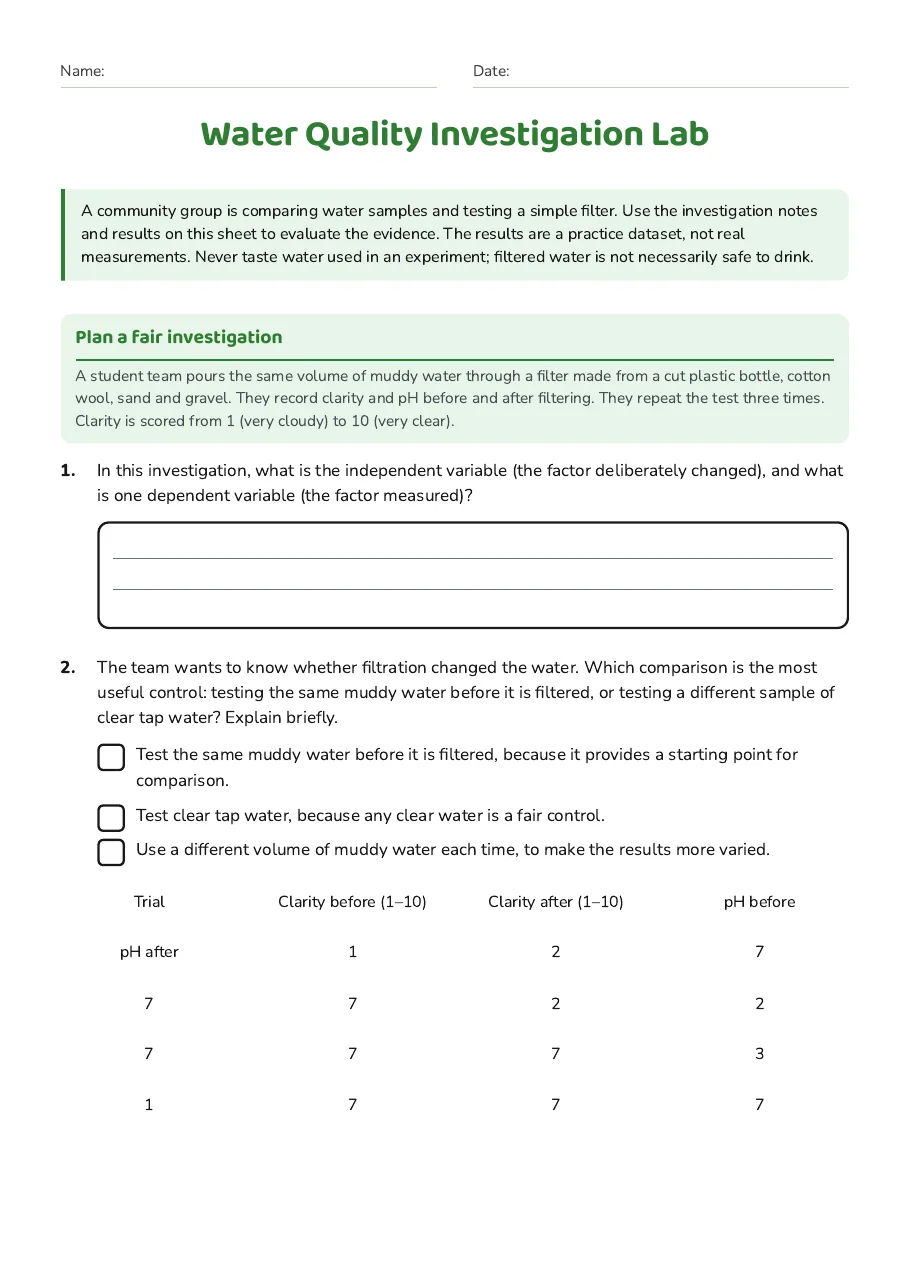
A community group is comparing water samples and testing a simple filter. Use the investigation notes and results on this sheet to evaluate the evidence. The results are a practice dataset, not real measurements. Never taste water used in an experiment; filtered water is not necessarily safe to drink.

Plan a fair investigation

A student team pours the same volume of muddy water through a filter made from a cut plastic bottle, cotton wool, sand and gravel. They record clarity and pH before and after filtering. They repeat the test three times. Clarity is scored from 1 (very cloudy) to 10 (very clear).

1.In this investigation, what is the independent variable (the factor deliberately changed), and what is one dependent variable (the factor measured)?
2.The team wants to know whether filtration changed the water. Which comparison is the most useful control: testing the same muddy water before it is filtered, or testing a different sample of clear tap water? Explain briefly.
  • Test the same muddy water before it is filtered, because it provides a starting point for comparison.
  • Test clear tap water, because any clear water is a fair control.
  • Use a different volume of muddy water each time, to make the results more varied.

Trial

Clarity before (1–10)

Clarity after (1–10)

pH before

pH after

1

2

7

7

7

2

2

7

7

7

3

1

7

7

7

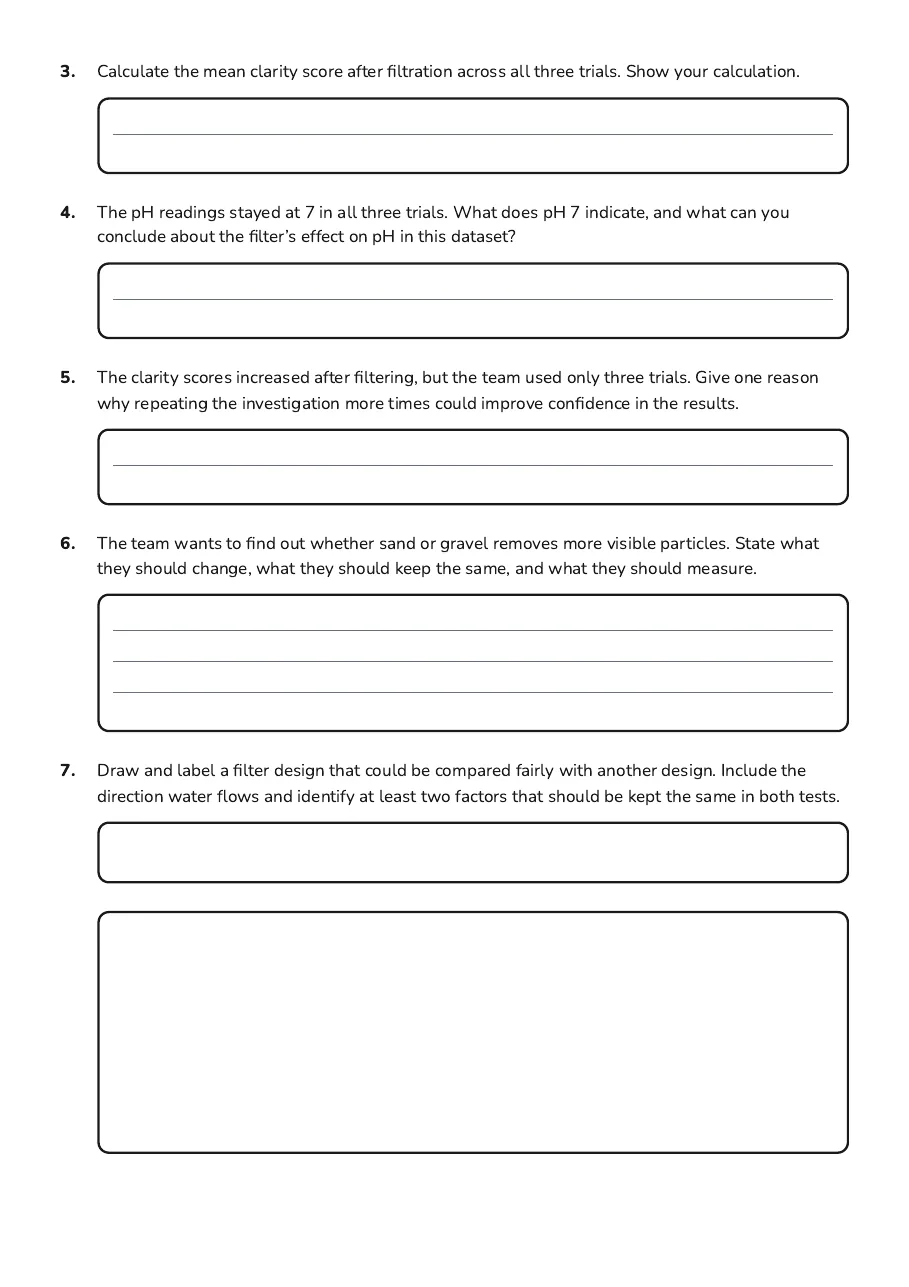
3.Calculate the mean clarity score after filtration across all three trials. Show your calculation.
4.The pH readings stayed at 7 in all three trials. What does pH 7 indicate, and what can you conclude about the filter’s effect on pH in this dataset?
5.The clarity scores increased after filtering, but the team used only three trials. Give one reason why repeating the investigation more times could improve confidence in the results.
6.The team wants to find out whether sand or gravel removes more visible particles. State what they should change, what they should keep the same, and what they should measure.
7.Draw and label a filter design that could be compared fairly with another design. Include the direction water flows and identify at least two factors that should be kept the same in both tests.
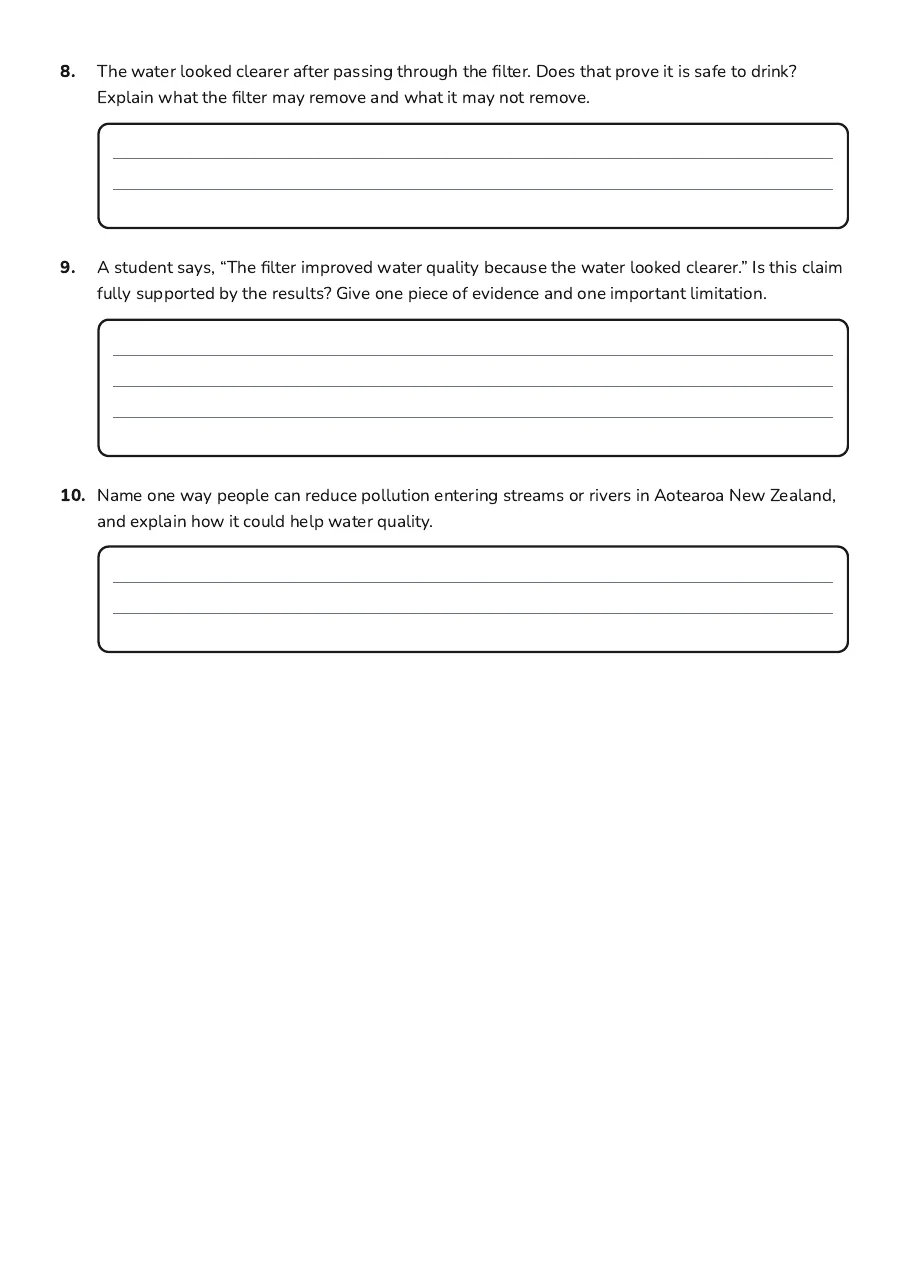
8.The water looked clearer after passing through the filter. Does that prove it is safe to drink? Explain what the filter may remove and what it may not remove.
9.A student says, “The filter improved water quality because the water looked clearer.” Is this claim fully supported by the results? Give one piece of evidence and one important limitation.
10.Name one way people can reduce pollution entering streams or rivers in Aotearoa New Zealand, and explain how it could help water quality.

3 printable pages

  • Water Quality Investigation Lab, page 1 of 3: Plan a fair investigation

    Page 1

  • Water Quality Investigation Lab, page 2 of 3: 3. Calculate the mean clarity score after filtration across all three trials. Show your…

    Page 2

  • Water Quality Investigation Lab, page 3 of 3: 8. The water looked clearer after passing through the filter. Does that prove it is safe…

    Page 3

About This Worksheet

Free in Kuraplan

Sign up free, grab the PDF, and customize it for your class.

Print-Ready

Formatted for standard paper. Clean layout, easy to read.

AI-Generated

Created with Kuraplan's AI, designed for real classroom use.

For Teachers & Parents

Use in classrooms, for homework, tutoring, or homeschool.

Need a custom version of this worksheet?

Kuraplan's AI generates custom worksheets in seconds — differentiated for every learner, aligned to your curriculum.

Generate Custom Worksheets — Free
No credit card Curriculum-aligned Under 60 seconds