ScienceFreePrintable
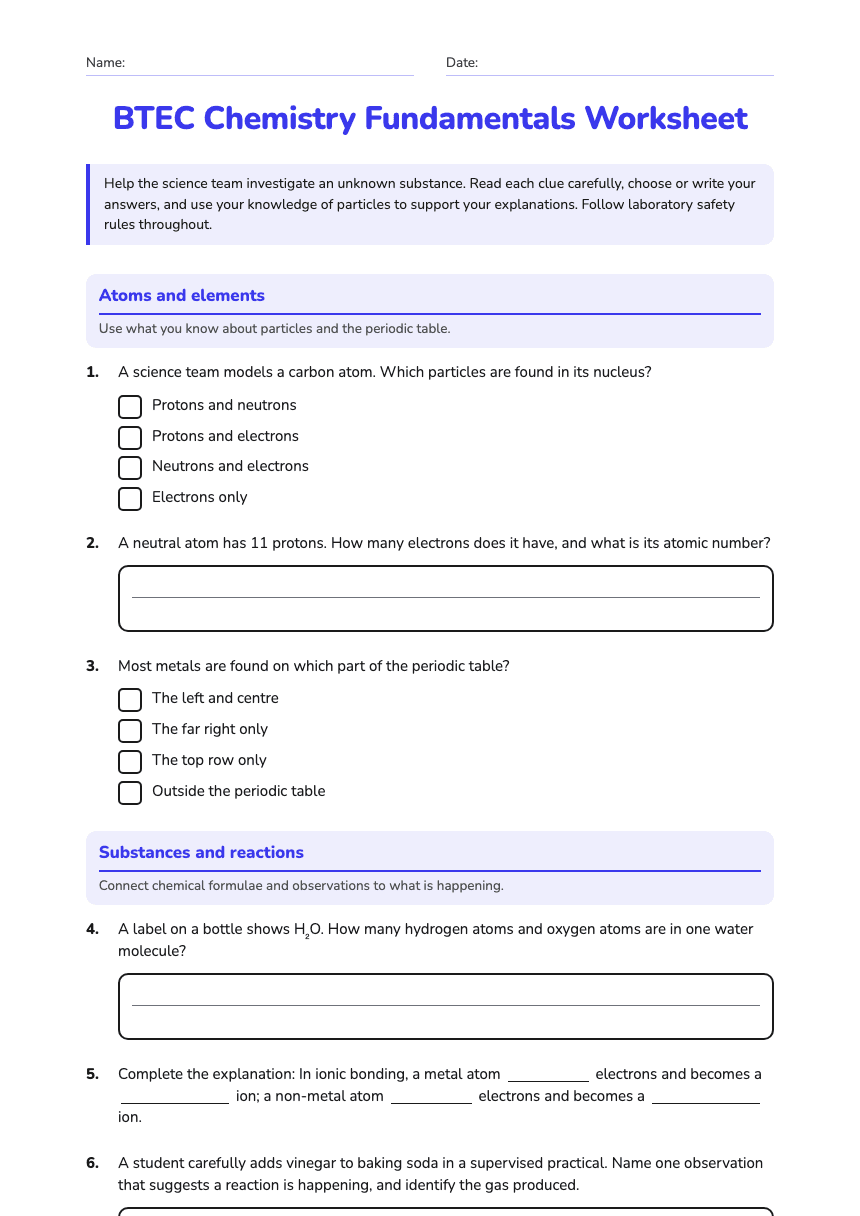
BTEC Chemistry Fundamentals Worksheet
A free science worksheet ready for your classroom. Open in Kuraplan to grab the print-ready PDF, customize it for your students, or generate a fresh version in seconds.
Name:Date:
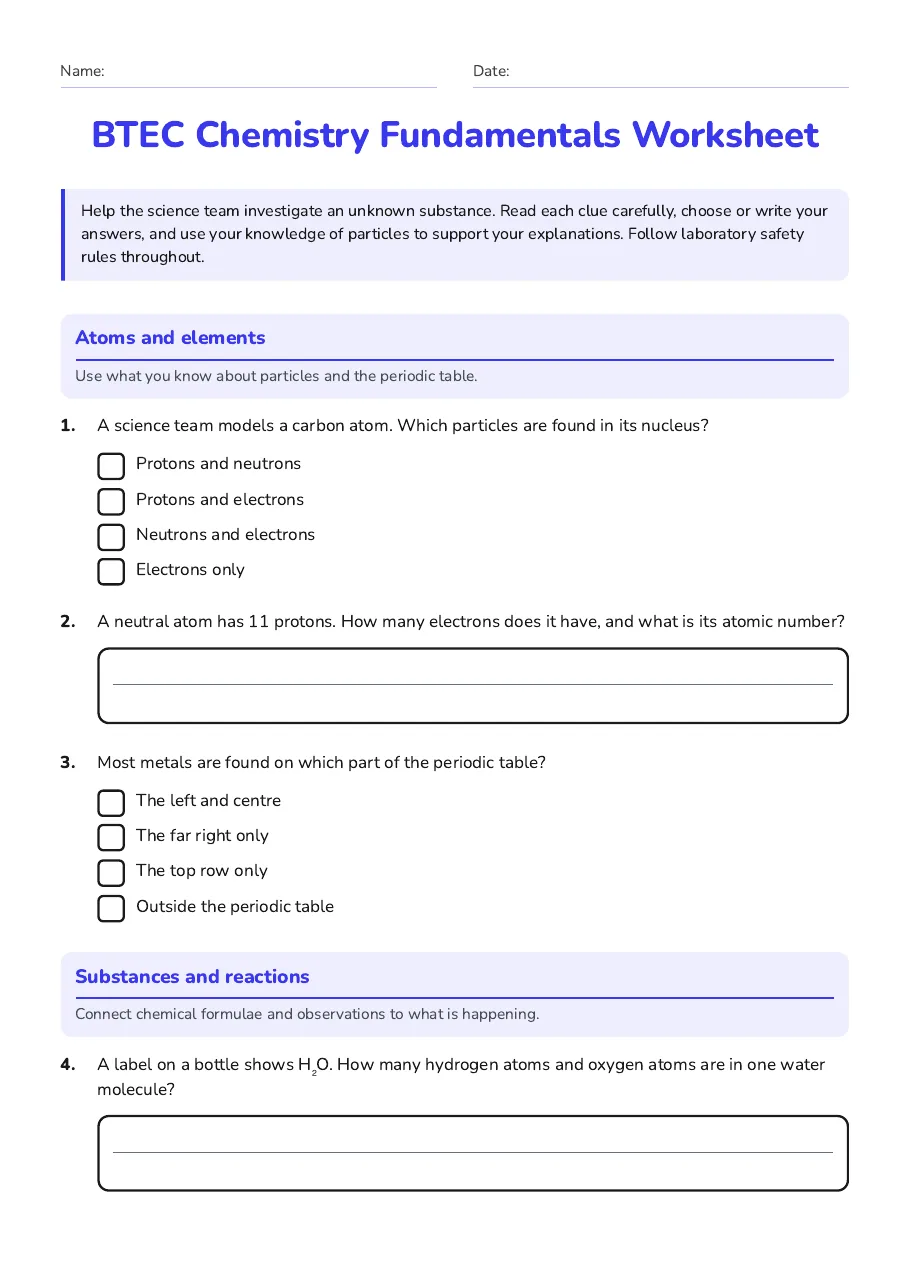
BTEC Chemistry Fundamentals Worksheet
Help the science team investigate an unknown substance. Read each clue carefully, choose or write your answers, and use your knowledge of particles to support your explanations. Follow laboratory safety rules throughout.
Atoms and elements
Use what you know about particles and the periodic table.
1.A science team models a carbon atom. Which particles are found in its nucleus?
- Protons and neutrons
- Protons and electrons
- Neutrons and electrons
- Electrons only
2.A neutral atom has 11 protons. How many electrons does it have, and what is its atomic number?
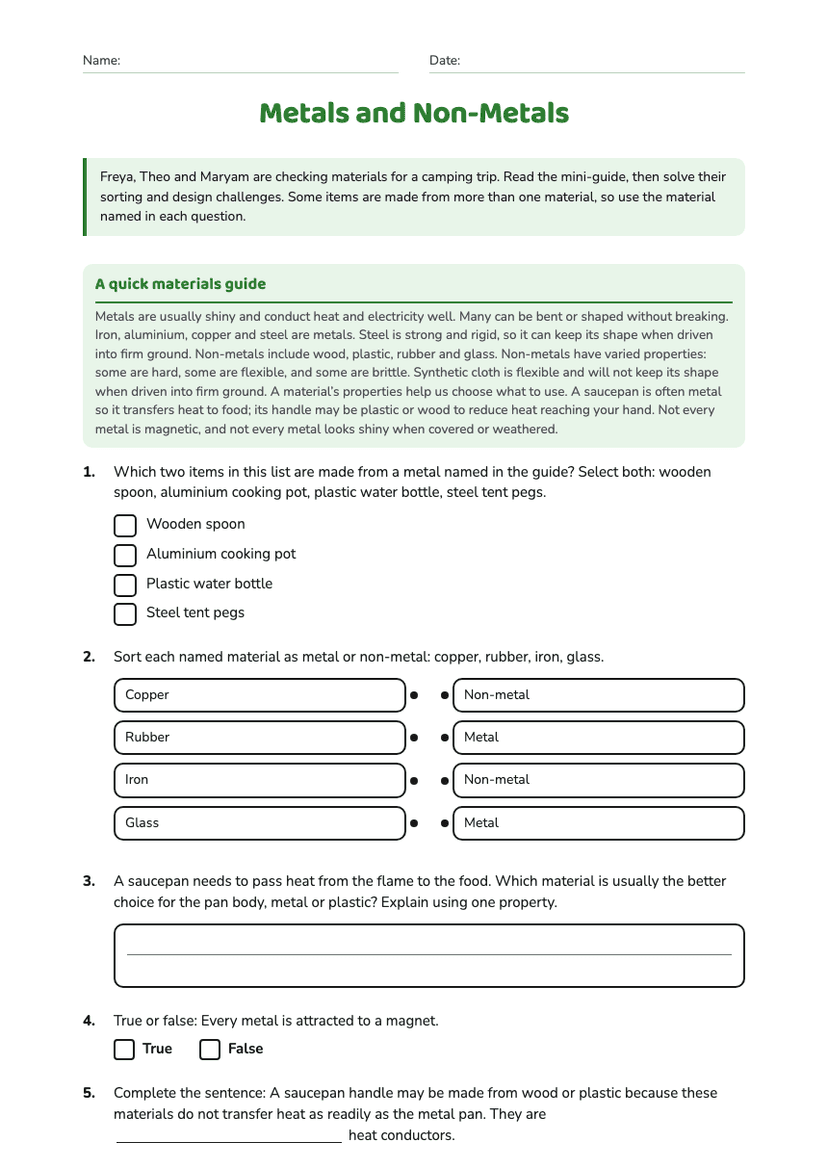
3.Most metals are found on which part of the periodic table?
- The left and centre
- The far right only
- The top row only
- Outside the periodic table
Substances and reactions
Connect chemical formulae and observations to what is happening.
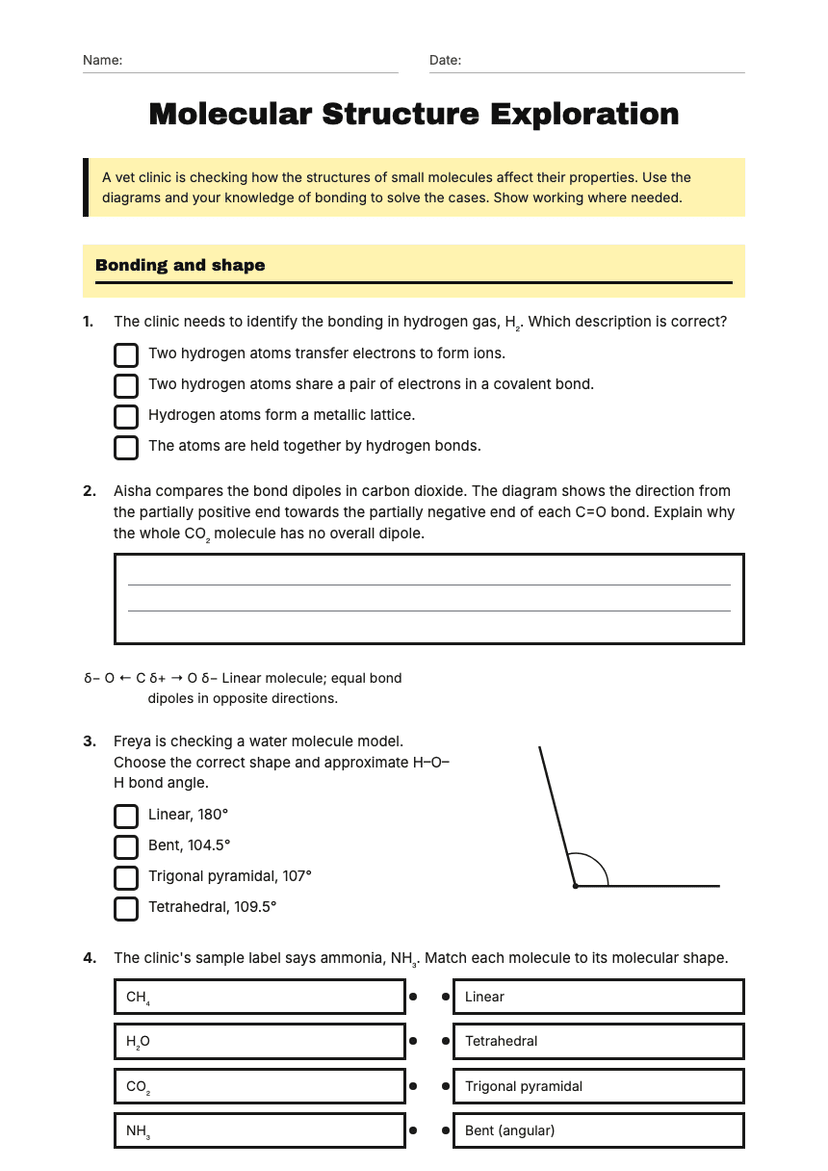
4.A label on a bottle shows H₂O. How many hydrogen atoms and oxygen atoms are in one water molecule?
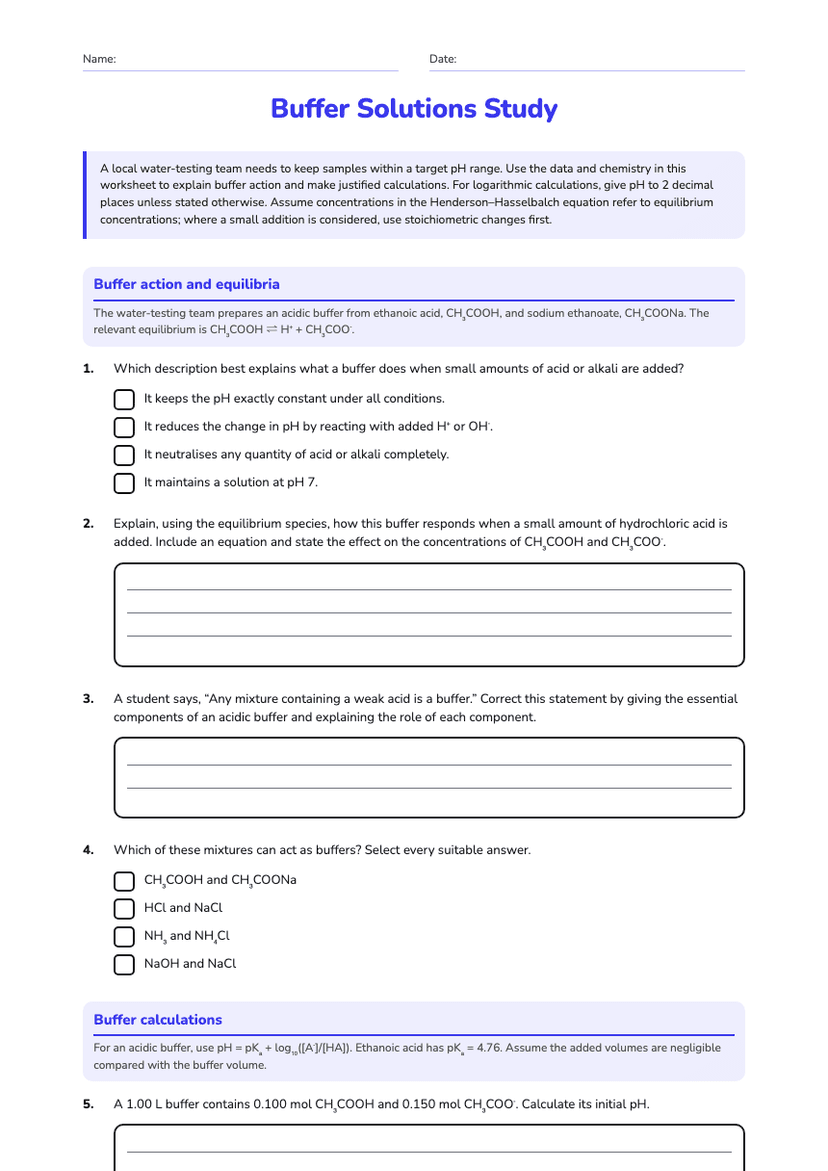
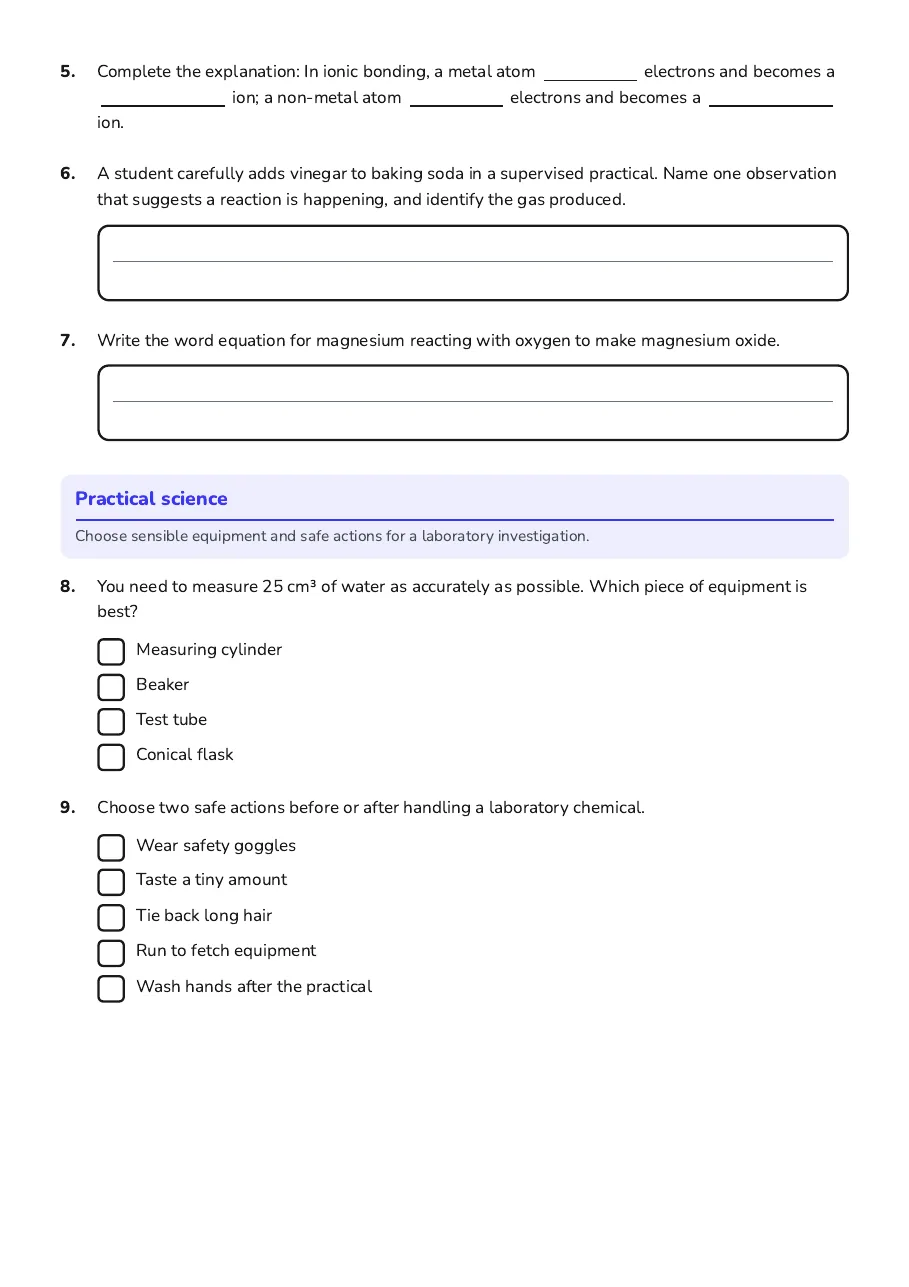
5.Complete the explanation: In ionic bonding, a metal atom electrons and becomes a ion; a non-metal atom electrons and becomes a ion.
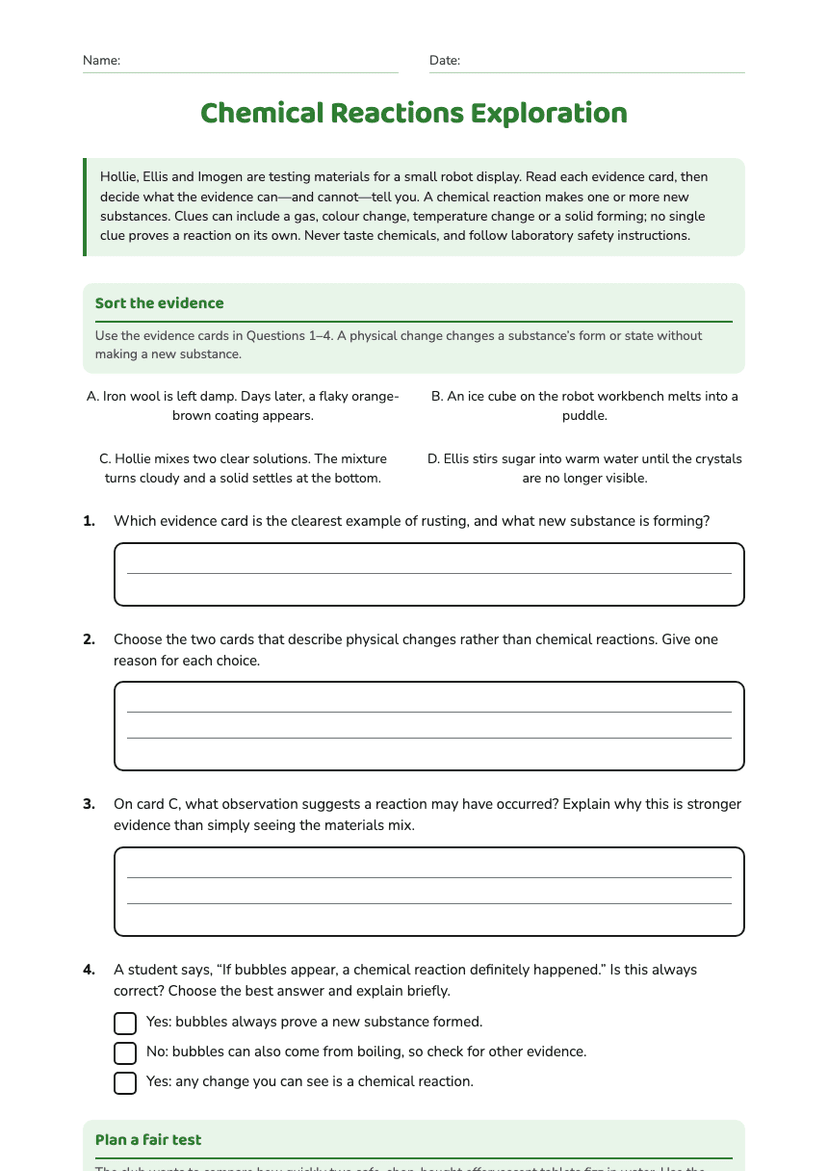
6.A student carefully adds vinegar to baking soda in a supervised practical. Name one observation that suggests a reaction is happening, and identify the gas produced.
7.Write the word equation for magnesium reacting with oxygen to make magnesium oxide.
Practical science
Choose sensible equipment and safe actions for a laboratory investigation.
8.You need to measure 25 cm³ of water as accurately as possible. Which piece of equipment is best?
- Measuring cylinder
- Beaker
- Test tube
- Conical flask
9.Choose two safe actions before or after handling a laboratory chemical.
- Wear safety goggles
- Taste a tiny amount
- Tie back long hair
- Run to fetch equipment
- Wash hands after the practical
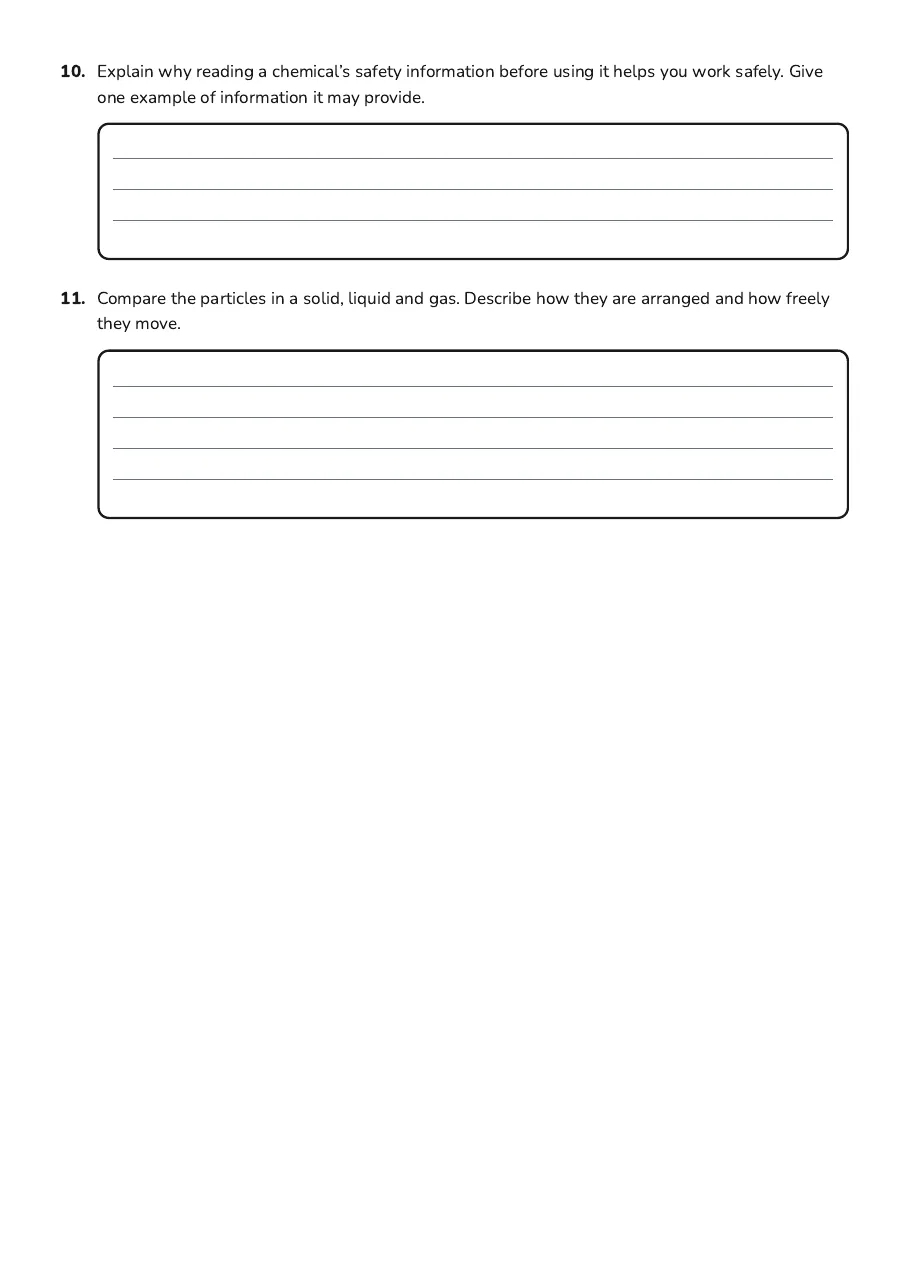
10.Explain why reading a chemical’s safety information before using it helps you work safely. Give one example of information it may provide.
11.Compare the particles in a solid, liquid and gas. Describe how they are arranged and how freely they move.
3 printable pages
Page 1
Page 2
Page 3
About This Worksheet
Free in Kuraplan
Sign up free, grab the PDF, and customize it for your class.
Print-Ready
Formatted for standard paper. Clean layout, easy to read.
AI-Generated
Created with Kuraplan's AI, designed for real classroom use.
For Teachers & Parents
Use in classrooms, for homework, tutoring, or homeschool.
Need a custom version of this worksheet?
Kuraplan's AI generates custom worksheets in seconds — differentiated for every learner, aligned to your curriculum.
Generate Custom Worksheets — Free No credit card Curriculum-aligned Under 60 seconds