GCSE Chemistry Diagnostic Assessment
A free science worksheet ready for your classroom. Open in Kuraplan to grab the print-ready PDF, customize it for your students, or generate a fresh version in seconds.
GCSE Chemistry Diagnostic Assessment
Section 1: Atoms, the Periodic Table and Bonding
WALT: We are learning to identify strengths and gaps in GCSE Chemistry knowledge.
Confidence before starting:
a) What is its mass number? _________
b) What is its atomic number? _________
c) Explain why the atom has no overall charge.
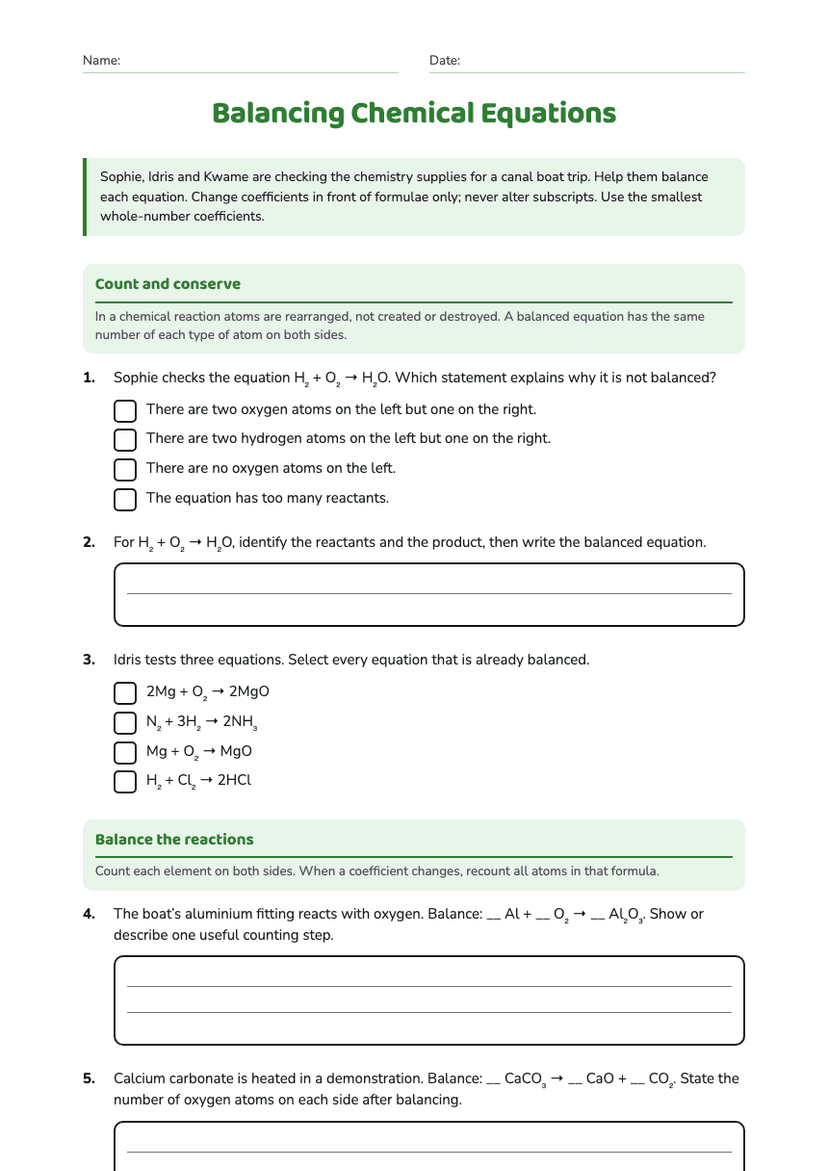
____ Mg + ____ O2 → ____ MgO
Section 2: Chemical Changes, Quantitative Chemistry, Energy and Rates
Confidence before starting:
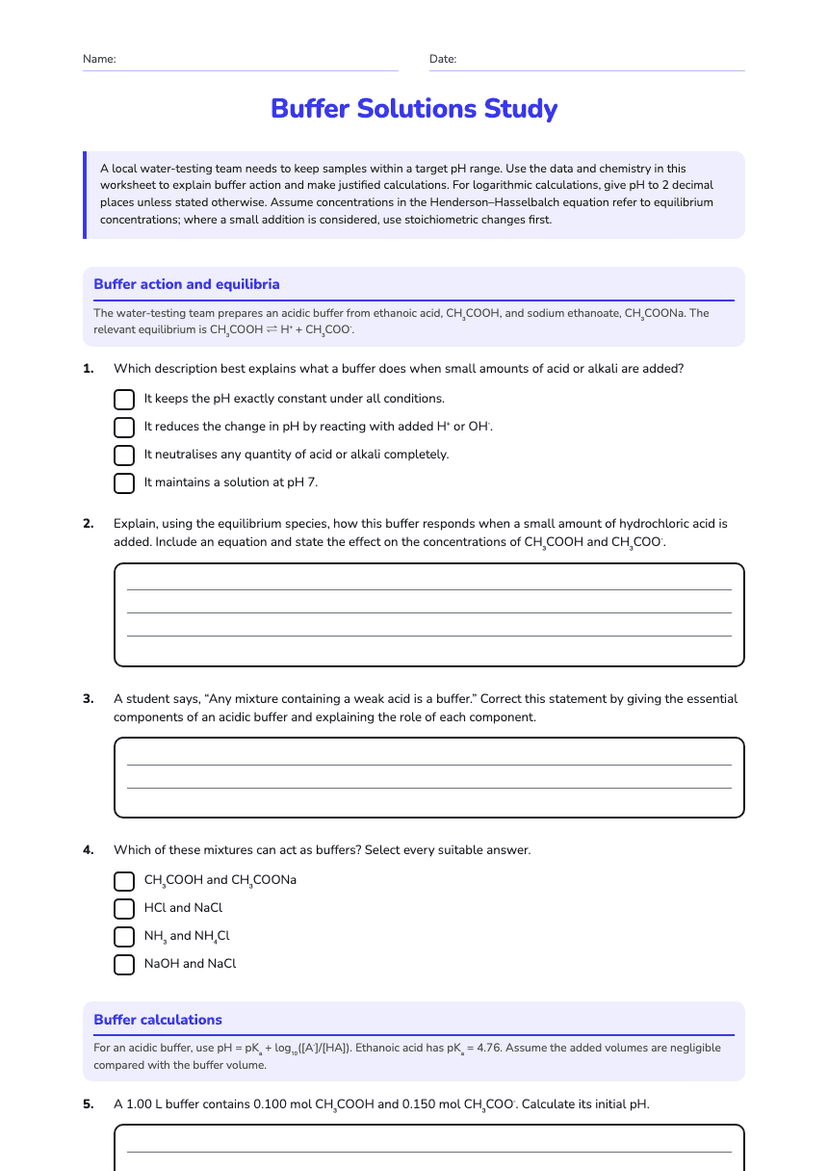
Use: amount = concentration × volume in dm3.
a) Name the gas produced. ____________________
b) Describe a test for this gas and the positive result.
c) Write the word equation.
magnesium + hydrochloric acid → ____________________ + ____________________
Section 3: Organic Chemistry, Analysis, Atmosphere and Resources
Confidence before starting:
Final student reflection
My strongest topic is: ________________________________________________
The topic I need to revisit is: _________________________________________
One question I still have is:
Teacher answer key and diagnostic notes
Section 1: 1. Neutrons have no charge. 2. a) 23 b) 11 c) Equal numbers of positive protons and negative electrons. 3. Metals contain delocalised electrons that can move; simple molecular substances do not have freely moving charged particles. 4. 2Mg + O2 → 2MgO.
Misconceptions to check: Confusing atomic number with mass number; thinking electrons are in the nucleus; believing all substances conduct electricity; incorrect balancing of formula equations.
Section 2: 5. 25.0 cm3 = 0.0250 dm3; amount = 0.20 × 0.0250 = 0.0050 mol. 6. a) Hydrogen b) A lit splint gives a squeaky pop c) magnesium + hydrochloric acid → magnesium chloride + hydrogen. 7. Endothermic; energy is taken in from the surroundings, causing the temperature to fall. 8. Rate = 60 ÷ 30 = 2 cm3/s; acceptable answers include increasing temperature or concentration, using a catalyst, or increasing surface area.
Misconceptions to check: Failure to convert cm3 to dm3; confusing hydrogen and oxygen tests; confusing exothermic and endothermic reactions; giving a factor that does not increase collision frequency or energy.
Section 3: 9. It is separated into fractions by fractional distillation. 10. Chloride ions; a cream precipitate forms with silver nitrate solution. Chromatography can separate and identify substances, often accurately and using small samples. 11. Burning fossil fuels; possible effects include global temperature rise, changing weather patterns or sea-level rise. 12. Recycling reduces mining and use of finite ores, usually uses less energy than extraction, and reduces waste and environmental damage.
Misconceptions to check: Confusing crude oil with a single compound; misidentifying halide precipitates; treating climate change and ozone depletion as the same issue; overlooking the energy and resource benefits of recycling.
Total score: ______ / 30
About This Worksheet
Free in Kuraplan
Sign up free, grab the PDF, and customize it for your class.
Print-Ready
Formatted for standard paper. Clean layout, easy to read.
AI-Generated
Created with Kuraplan's AI, designed for real classroom use.
For Teachers & Parents
Use in classrooms, for homework, tutoring, or homeschool.
Need a custom version of this worksheet?
Kuraplan's AI generates custom worksheets in seconds — differentiated for every learner, aligned to your curriculum.
Generate Custom Worksheets — Free