ScienceFreePrintable

Moles and Avogadro's Calculations

A free science worksheet ready for your classroom. Open in Kuraplan to grab the print-ready PDF, customize it for your students, or generate a fresh version in seconds.
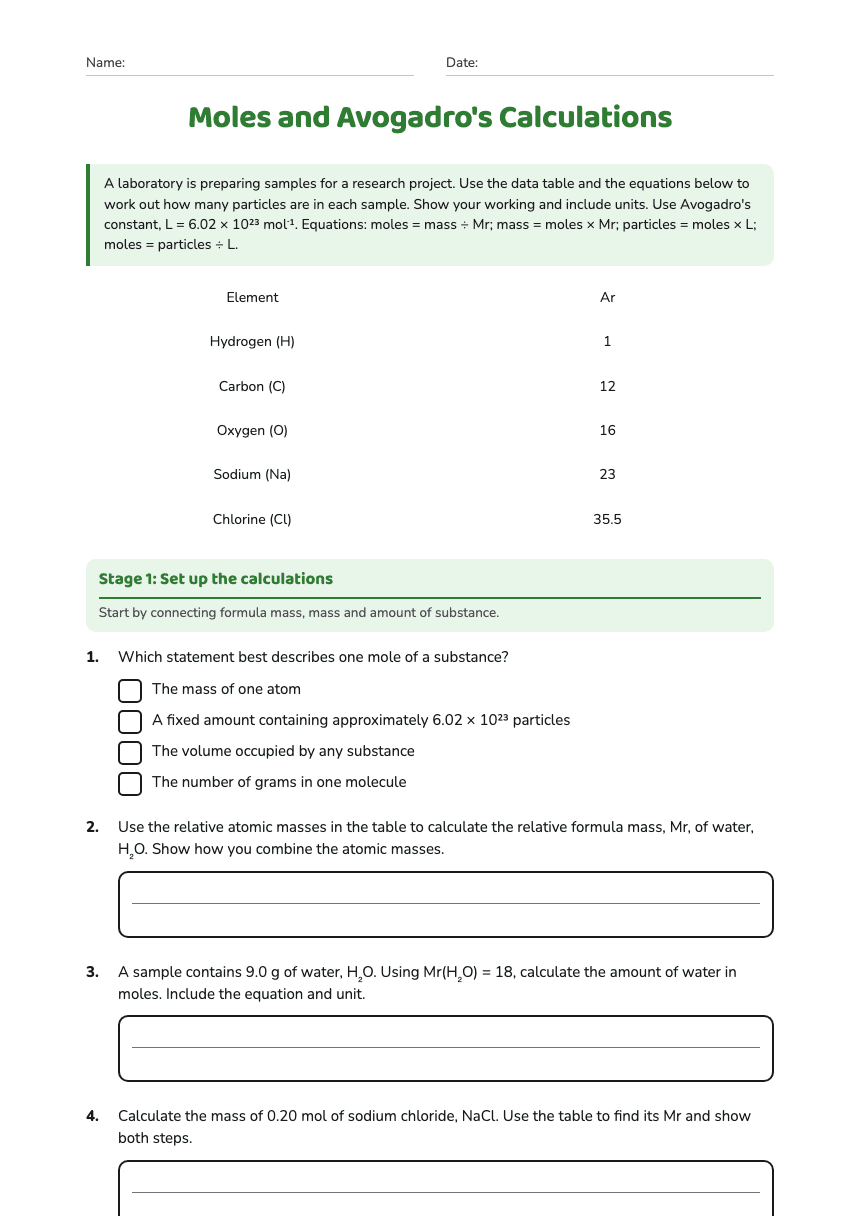
Moles and Avogadro's Calculations worksheet preview
Name:Date:

Moles and Avogadro's Calculations

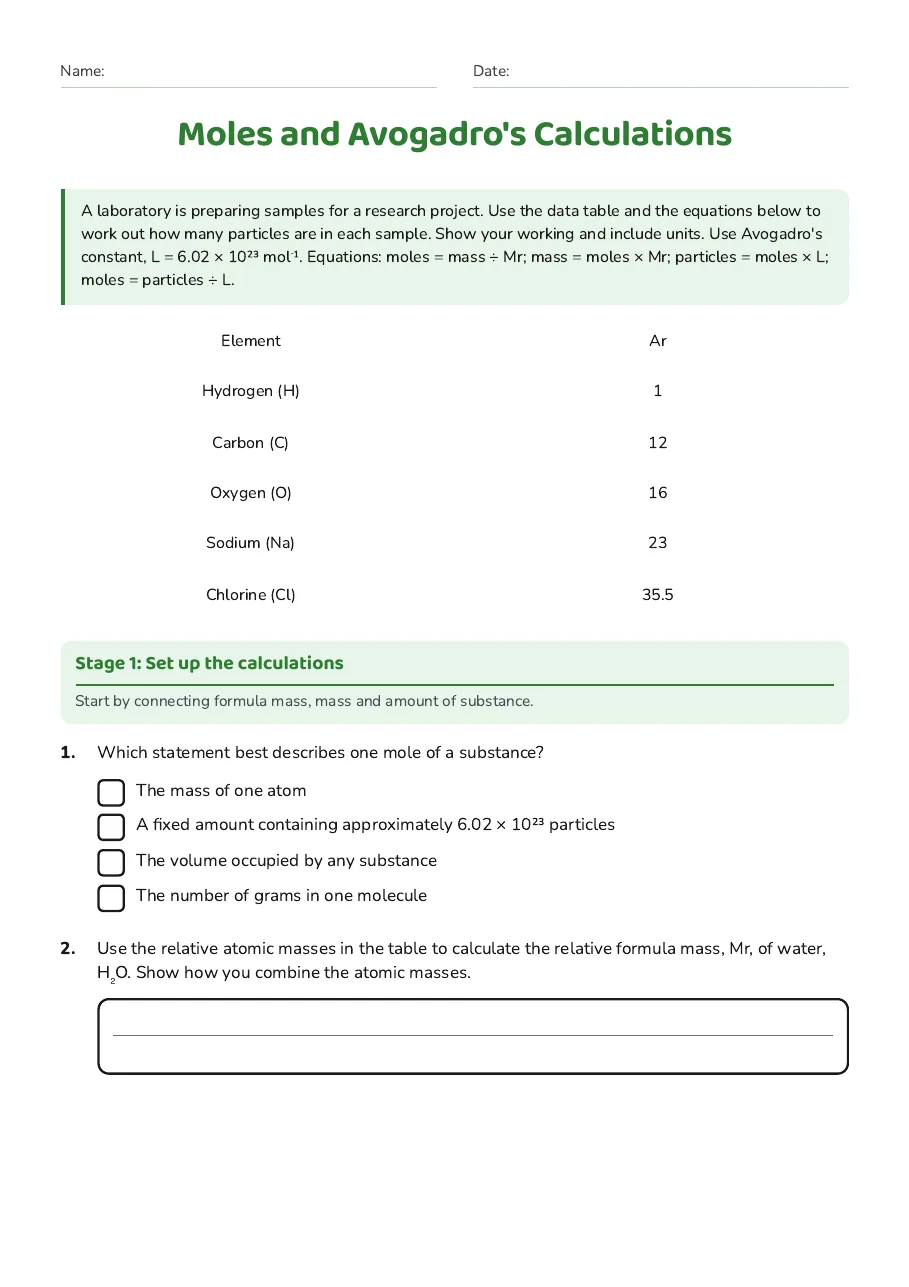
A laboratory is preparing samples for a research project. Use the data table and the equations below to work out how many particles are in each sample. Show your working and include units. Use Avogadro's constant, L = 6.02 × 10²³ mol⁻¹. Equations: moles = mass ÷ Mr; mass = moles × Mr; particles = moles × L; moles = particles ÷ L.

Element

Ar

Hydrogen (H)

1

Carbon (C)

12

Oxygen (O)

16

Sodium (Na)

23

Chlorine (Cl)

35.5

Stage 1: Set up the calculations

Start by connecting formula mass, mass and amount of substance.

1.Which statement best describes one mole of a substance?
  • The mass of one atom
  • A fixed amount containing approximately 6.02 × 10²³ particles
  • The volume occupied by any substance
  • The number of grams in one molecule
2.Use the relative atomic masses in the table to calculate the relative formula mass, Mr, of water, H₂O. Show how you combine the atomic masses.
3.A sample contains 9.0 g of water, H₂O. Using Mr(H₂O) = 18, calculate the amount of water in moles. Include the equation and unit.
4.Calculate the mass of 0.20 mol of sodium chloride, NaCl. Use the table to find its Mr and show both steps.

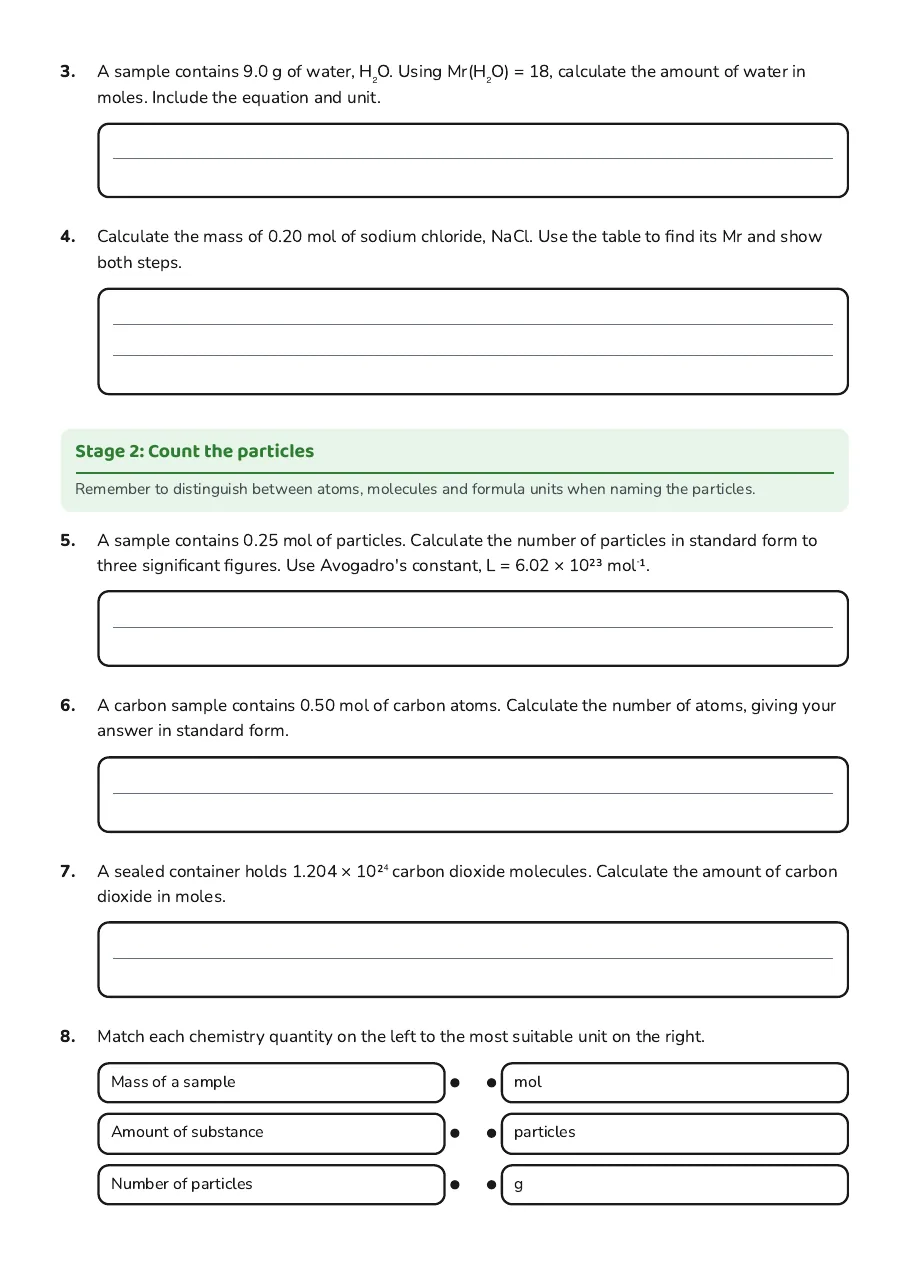
Stage 2: Count the particles

Remember to distinguish between atoms, molecules and formula units when naming the particles.

5.A sample contains 0.25 mol of particles. Calculate the number of particles in standard form to three significant figures. Use Avogadro's constant, L = 6.02 × 10²³ mol⁻¹.
6.A carbon sample contains 0.50 mol of carbon atoms. Calculate the number of atoms, giving your answer in standard form.
7.A sealed container holds 1.204 × 10²⁴ carbon dioxide molecules. Calculate the amount of carbon dioxide in moles.
8.Match each chemistry quantity on the left to the most suitable unit on the right.
  • Mass of a sample
  • Amount of substance
  • Number of particles
  • mol
  • particles
  • g

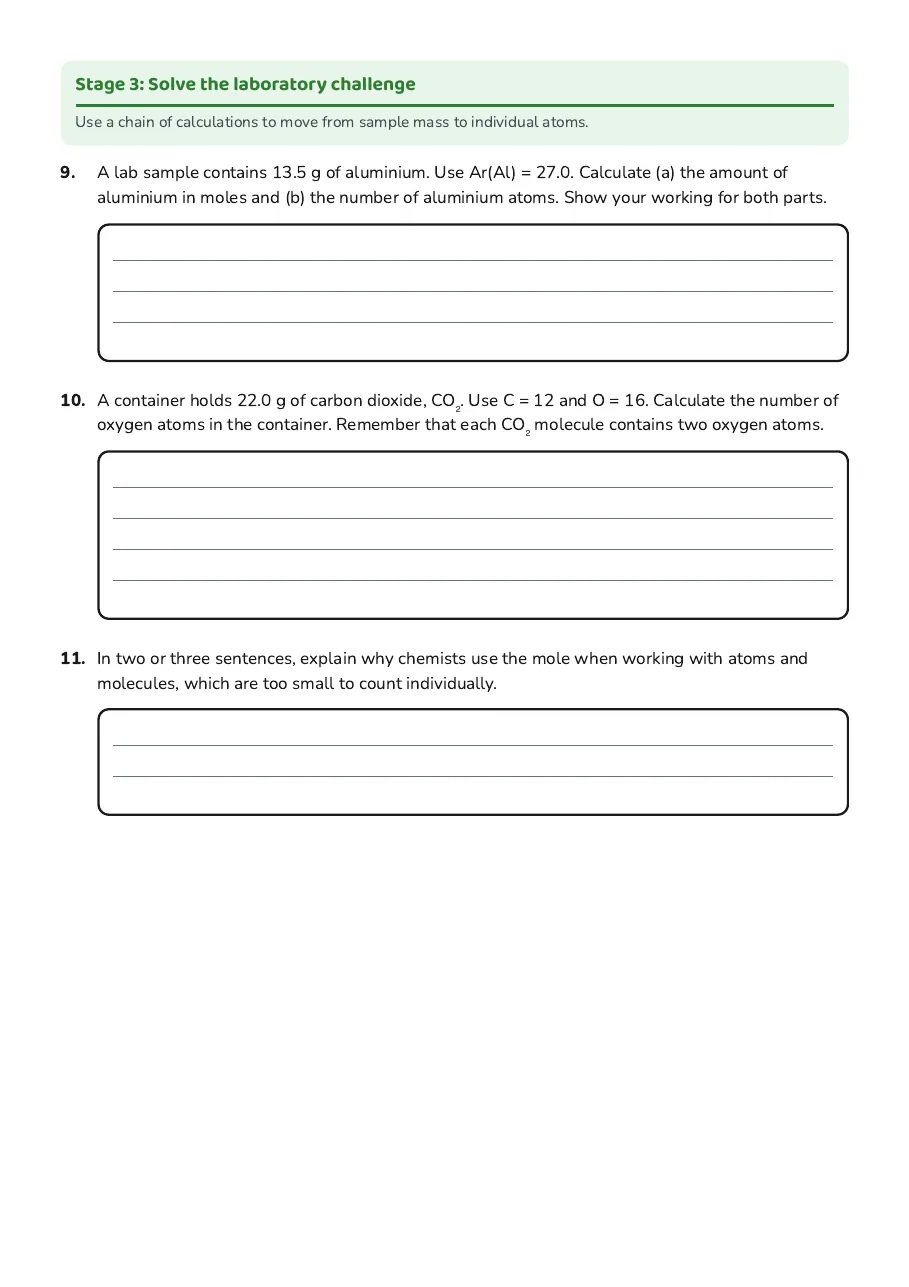
Stage 3: Solve the laboratory challenge

Use a chain of calculations to move from sample mass to individual atoms.

9.A lab sample contains 13.5 g of aluminium. Use Ar(Al) = 27.0. Calculate (a) the amount of aluminium in moles and (b) the number of aluminium atoms. Show your working for both parts.
10.A container holds 22.0 g of carbon dioxide, CO₂. Use C = 12 and O = 16. Calculate the number of oxygen atoms in the container. Remember that each CO₂ molecule contains two oxygen atoms.
11.In two or three sentences, explain why chemists use the mole when working with atoms and molecules, which are too small to count individually.

3 printable pages

  • Moles and Avogadro's Calculations, page 1 of 3: Stage 1: Set up the calculations

    Page 1

  • Moles and Avogadro's Calculations, page 2 of 3: Stage 2: Count the particles

    Page 2

  • Moles and Avogadro's Calculations, page 3 of 3: Stage 3: Solve the laboratory challenge

    Page 3

About This Worksheet

Free in Kuraplan

Sign up free, grab the PDF, and customize it for your class.

Print-Ready

Formatted for standard paper. Clean layout, easy to read.

AI-Generated

Created with Kuraplan's AI, designed for real classroom use.

For Teachers & Parents

Use in classrooms, for homework, tutoring, or homeschool.

Need a custom version of this worksheet?

Kuraplan's AI generates custom worksheets in seconds — differentiated for every learner, aligned to your curriculum.

Generate Custom Worksheets — Free
No credit card Curriculum-aligned Under 60 seconds