Student-centered learning can outperform traditional lectures, but only when “student-led” means more than handing out independent work. In a landmark meta-analysis of 225 undergraduate STEM studies, active learning improved examination and concept-inventory performance by 0.47 standard deviations, equivalent to about a 6% improvement in exam scores. Students in traditional lecture classes were also 1.95 times more likely to fail, according to the meta-analysis of active learning in STEM. The evidence points to a practical conclusion: students need opportunities to investigate, discuss, choose, reflect, and demonstrate mastery, while teachers still provide the objectives, scaffolds, feedback, assessment, and standards alignment.
The following nine strategies for student centered learning build agency in different ways. Some work best with younger learners or novices, while others require stronger self-management, reliable access to materials, or more classroom time. Adapt each approach to grade level, subject, readiness, inclusion needs, and local conditions. For more activity ideas, explore these practical classroom ideas, then begin with one routine you can observe and improve.
1. Problem- and Project-Based Learning
Problem- and project-based learning gives students a meaningful question, challenge, or product to pursue. A high school class might design water filtration systems for a community contamination problem. Middle school teams might create and pitch startup solutions for local needs. Elementary students could write children's books that teach science concepts to younger readers.
The teacher's work happens before and during the project. Define the standards, clarify the driving question, teach essential skills, and establish checkpoints before students begin making decisions. Start with a well-defined problem or a short project if learners are new to this approach. More open-ended investigations can come later, once students understand how to plan, research, revise, and explain their choices.
Practical rule: Student ownership needs visible boundaries. Let learners choose the solution, but make the learning target and evidence requirements non-negotiable.
Make the process assessable
Give groups clear roles, such as researcher, designer, project manager, and presenter. Rotate responsibilities where appropriate, and require individual reflections so a polished group product doesn't hide uneven learning. Assess the final product, the process, the content knowledge, and each student's explanation of their contribution. Peer and self-assessment should supplement teacher judgment, not replace it.
Build iteration into the calendar. Students should receive feedback while they can still improve their work, rather than hearing comments only after the final presentation. A public audience, community screening, exhibition, or pitch can make the work more authentic, but the audience should serve the learning objective rather than become a distraction.
Use Kuraplan's unit planning tools to organize milestones, connect project tasks to standards, and prepare scaffolds or rubrics before launch.
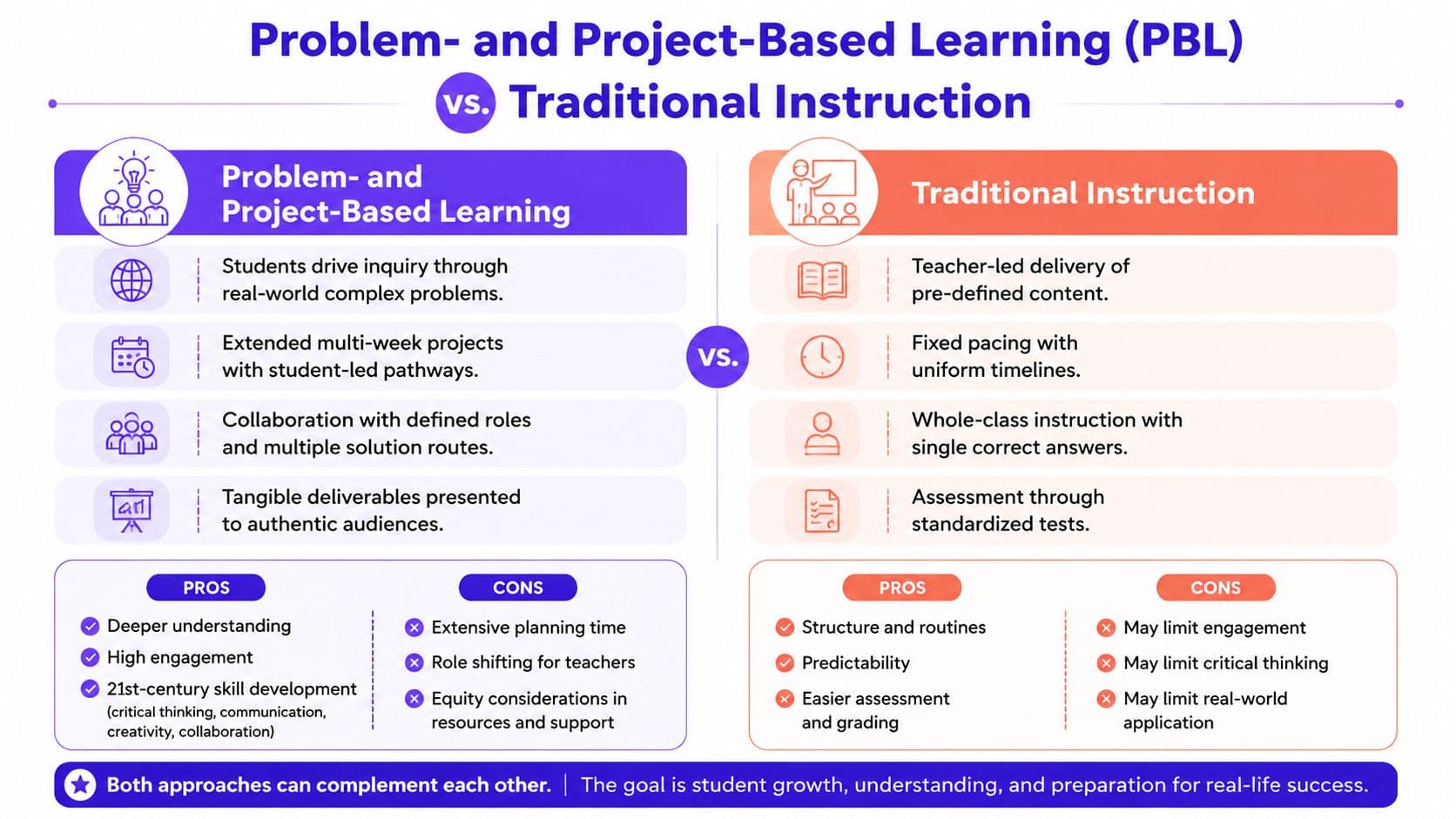
This video can help teachers visualize how problem-driven instruction differs from a lecture-first lesson.
2. Peer Teaching and Collaborative Learning
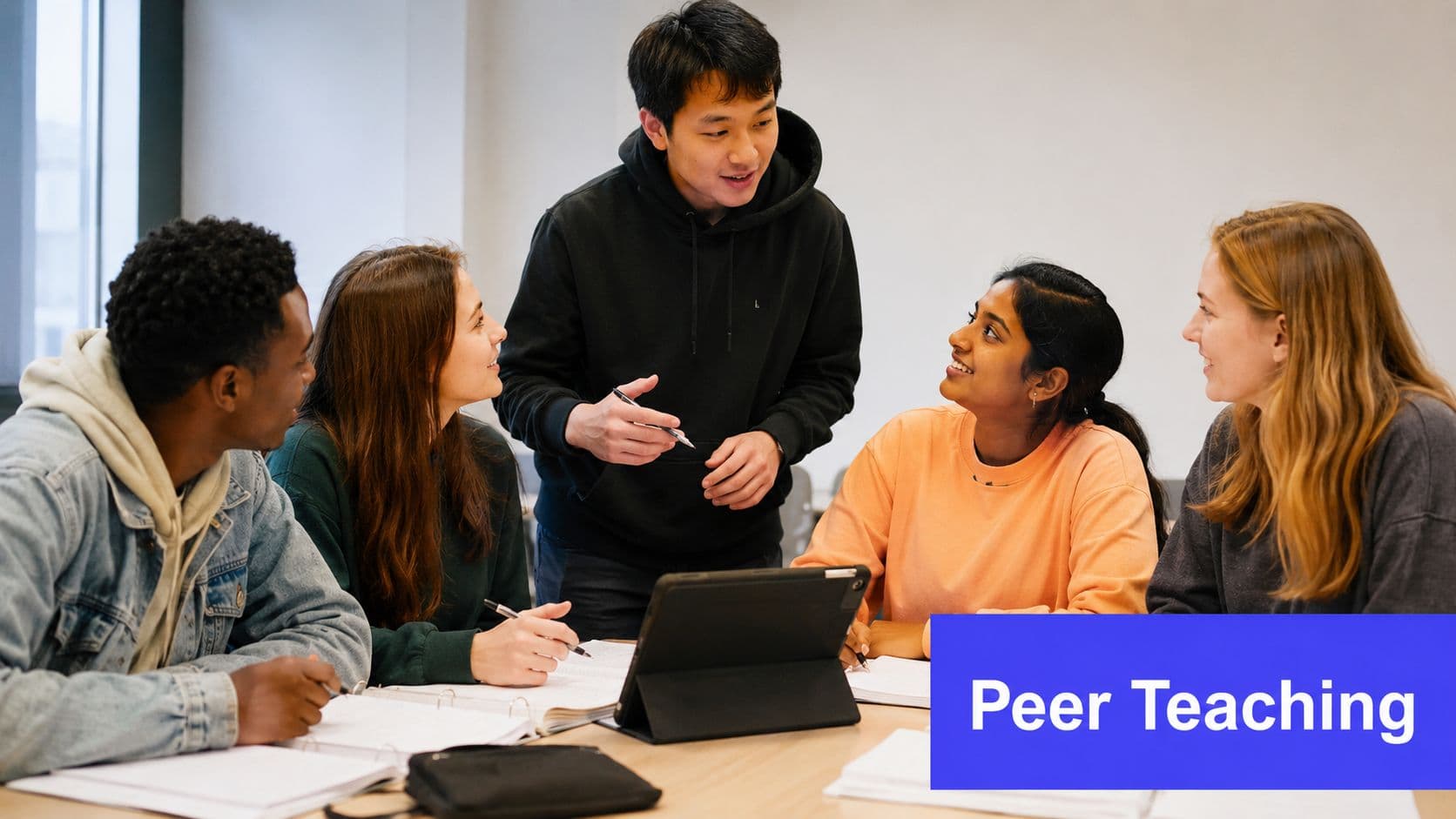
Students often reveal their understanding more clearly when they explain an idea to a classmate. In a math lesson, one learner might demonstrate a problem-solving strategy while another asks questions and checks the reasoning. In a jigsaw activity, students first become responsible for one part of a topic, then teach that part to their home group.
Peer teaching works when collaboration is explicitly taught. Model how to ask for clarification, disagree respectfully, and respond to an incorrect answer without embarrassing the speaker. Give students sentence frames such as “I agree because…,” “Can you explain…?” and “I used a different strategy because…”. These structures are especially useful for multilingual learners and students who need support entering academic conversations.
Prevent group work from becoming free time
Assign roles such as facilitator, recorder, timekeeper, and evidence checker. Rotate groups regularly, but don't change them so often that students lose the chance to develop productive routines. Watch and listen for misconceptions. Peer explanations can expose gaps in understanding, but students can also reinforce misinformation if the teacher never checks the discussion.
Use peer teaching as formative assessment. Ask each student to submit a brief explanation, solve a parallel problem independently, or complete an exit response after the group activity. That evidence tells you whether students learned the concept or merely followed a confident peer.
Kuraplan's group generator can reduce the administrative work of creating flexible groups and planning differentiated prompts. The instructional decision remains yours: group students by readiness, language support, interests, or a deliberate mix depending on the task.
3. Inquiry-Based Learning
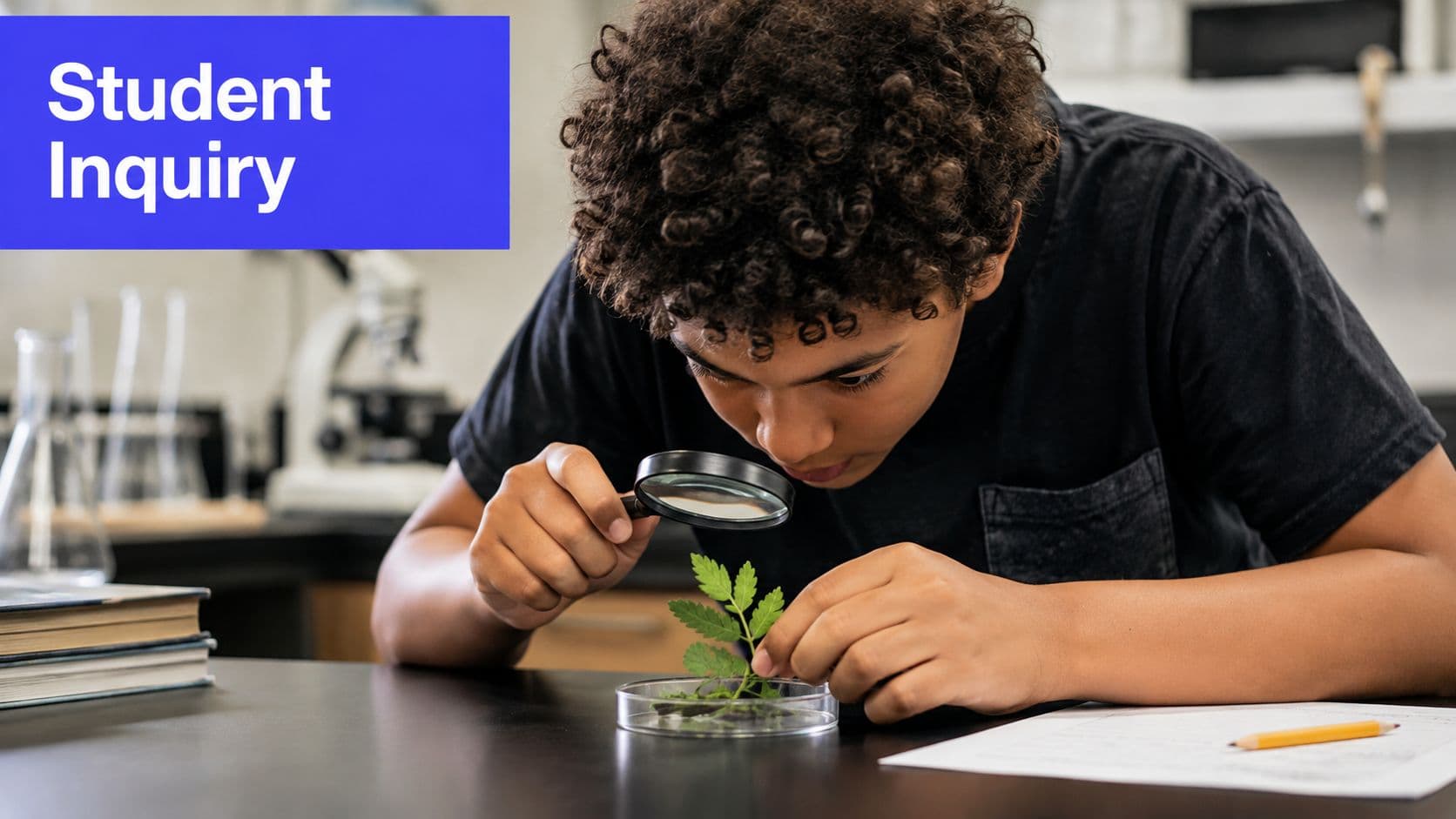
Inquiry-based learning starts with questions rather than immediate answers. Elementary students might observe plant growth under different conditions and use their observations to investigate photosynthesis. Middle school students could sample local water and analyze evidence. History students might compare primary sources to understand how different people experienced the same event.
The level of openness matters. Structured inquiry gives students a question, materials, and a method. Guided inquiry gives them more responsibility for choosing procedures or evidence. Open inquiry asks learners to frame the question themselves. Moving straight to open inquiry can overwhelm students who haven't learned how to ask investigable questions or distinguish evidence from opinion.
Build an evidence trail
Create an inquiry question bank with stems such as:
- What changes when…: Students identify variables and patterns.
- What evidence supports…: Students connect claims to sources or observations.
- How could we test…: Students plan an investigation.
- What else might explain…: Students consider alternative interpretations.
Students can keep reflection journals that record their questions, evidence, conclusions, and unresolved ideas. A classroom “wonder wall” gives questions a visible place and helps you decide which ones can guide future lessons. Offer multiple ways to record findings, including diagrams, oral explanations, annotated photographs, models, and written reports.
Assess both the conclusion and the reasoning that produced it. A student who reaches the expected answer through weak evidence needs different feedback from a student whose conclusion differs but whose method is sound. Use short conferences, evidence organizers, and claim-evidence-reasoning responses to make the process visible.
Kuraplan can help prepare inquiry scaffolds, standards-aligned question sets, investigation organizers, and assessment checkpoints. Keep the scaffold responsive. Remove prompts as students become more capable, but restore them when a new subject or complex task demands additional structure.
4. Differentiated Instruction
Differentiated instruction makes student-centered learning workable in a mixed-readiness classroom. Students can pursue a shared objective through different texts, representations, levels of prompting, or products. A reading class might use several texts on the same theme at different complexity levels. A math class might run stations where students practice different strategies based on formative evidence.
Differentiation shouldn't mean preparing an unrelated lesson for every student. Start with a common learning target, then adjust the entry point, process, or demonstration of learning. Pre-assessment, observation, conferences, and quick checks help you decide who needs explicit modeling, who needs guided practice, and who is ready for extension.
Differentiate without labeling
Use flexible groups that change according to the task. Explain that groups are temporary supports, not fixed judgments about ability. A student may need intensive vocabulary support in science but work independently in mathematics. Choice also matters. Offer tiered project options, varied modalities, and more than one way to show understanding while keeping the success criteria clear.
Plan an anchor activity for students who finish early. It should extend thinking, not function as filler. Students might revise an explanation for a younger audience, create a new example, compare methods, or apply the concept to a different context.
Kuraplan can make differentiation easier by helping you prepare lesson and worksheet variations at different complexity levels, connect them to standards, and attach assessment rubrics. A useful planning workflow is to create the shared core task first, then generate targeted supports and extensions. Teachers looking for an additional personalized planning example can review this customized Gaeilge study plan.
5. Socratic Seminars and Structured Discussions
A Socratic seminar turns discussion into an evidence-based learning task. Students might debate interpretations of a novel, examine historical perspectives through primary documents, discuss experimental design in science, or explore an ethical dilemma connected to current events. The teacher sets the conditions, but students carry the intellectual conversation.
Preparation determines the quality of the seminar. Students need close-reading notes, source annotations, vocabulary, and time to formulate questions before they sit in the discussion circle. Provide a small set of text-dependent prompts at first, then invite students to write and select their own questions as they gain confidence.
Teach the talk moves
Post and practice discussion moves such as:
- Build on: Connect your idea to a classmate's point.
- Challenge: Identify a different interpretation and support it with evidence.
- Clarify: Ask what a speaker means before responding.
- Return to the text: Point to the sentence, detail, or data that supports the claim.
Rotate facilitator, evidence tracker, and summarizer roles. Use written reflections before and after the seminar to assess how student thinking changed. A rubric can measure evidence use, listening, relevance, questioning, and response to others, not just how often a student speaks.
Quieter students need deliberate access points. Give them rehearsal time with a partner, allow written questions to enter the discussion, and use wait time after asking a question. Sentence starters such as “The text suggests…” and “I respectfully disagree because…” help students participate without reducing the complexity of their thinking.
Kuraplan can support preparation by generating comprehension questions and discussion prompts aligned with the intended standards. Review every prompt before using it. A question that sounds deep but cannot be answered from the text or evidence will produce opinion-sharing rather than disciplined dialogue.
6. Student Choice and Voice
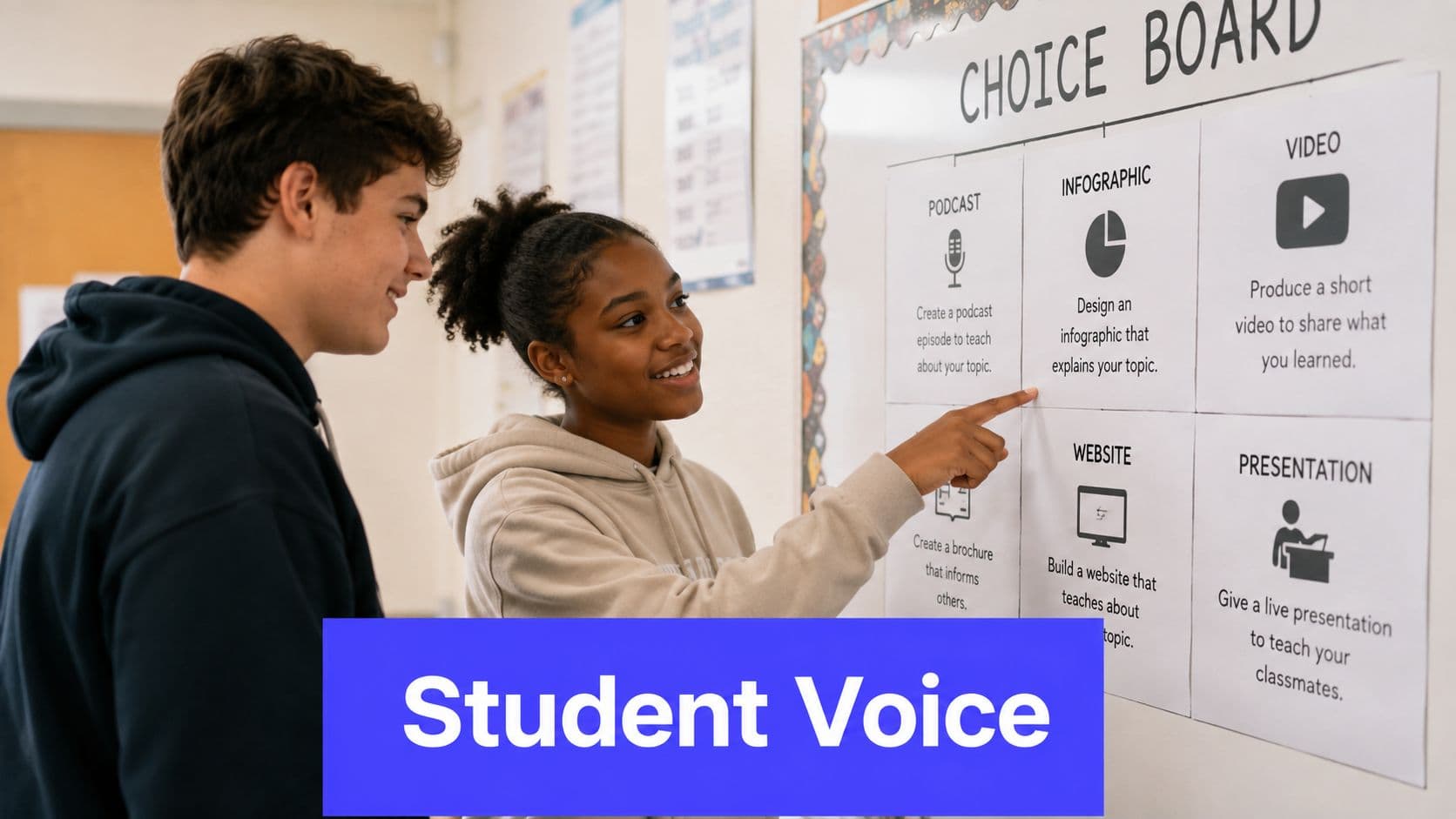
Student choice builds agency when students choose how to meet a meaningful objective. They might select a novel within a genre, choose between a podcast and an essay, set a personal reading goal, or pursue a passion project within a defined content framework. Choice doesn't mean students choose whether to learn the standard. It means they have a legitimate say in the route, topic, format, or pace.
Start with bounded options. A choice board with three or four pathways is easier to manage than a completely open assignment. For example, students could demonstrate understanding of an ecosystem through a labeled model, an explanatory article, or a recorded presentation, while every option must include the same scientific concepts and evidence.
Make choices academically useful
Share the rubric before students choose. If formats differ, assess the common knowledge and skills rather than presentation polish or access to expensive materials. Ask students to explain why their selection fits their strengths or learning goal. That reflection turns preference into metacognition.
Voice can also shape the learning process. Invite students to suggest inquiry questions, recommend texts, identify confusing instructions, or propose a real audience for their work. Not every suggestion can be adopted, so explain the boundaries and show where student input changed a decision.
Use Kuraplan to create choice menus with shared standards, differentiated pathways, and consistent rubrics. This reduces planning repetition while preserving teacher control over the essential learning. The framework can be as simple as: “You can choose the format, but you must demonstrate these three skills.”
7. Metacognition and Self-Regulated Learning
Student autonomy becomes fragile when learners don't know how to plan, monitor, or adjust their work. Metacognition makes those actions explicit. A student might set a goal, select a strategy, check progress, decide that the strategy isn't working, and try another approach.
Teach the process through modeling. During a reading lesson, say, “I'm confused, so I'll reread the paragraph and look for a definition.” In mathematics, model how you check whether an answer is reasonable. Students need to see that proficient learners also notice confusion and change tactics.
Turn reflection into a routine
Learning logs, self-assessment rubrics, goal-setting conferences, and exit tickets can make thinking visible. Keep prompts specific:
- Strategy: What did you try?
- Evidence: What tells you whether it worked?
- Adjustment: What will you change next?
- Transfer: Where else could you use this strategy?
A 2024 meta-analysis of student-centered, problem-driven learning found a positive moderate effect on self-regulated learning and self-directed learning readiness, with an overall effect size of d = 0.551 across 58 papers and 69 subsamples. The review of student-centered learning and learner autonomy also emphasizes that self-regulation should be an explicit instructional target, not an assumed result of participation.
Build reflection into ordinary lessons rather than reserving it for the end of a unit. Learning intentions and success criteria can help anchor students' self-assessments to the intended learning instead of vague statements such as “I did well.”
8. Flipped Classroom Model
The flipped classroom moves some direct instruction outside class so face-to-face time can focus on practice, discussion, investigation, and support. A history teacher might provide primary-source reading before class, then use the lesson for an evidence-based debate. A science teacher could share a phenomenon video before students conduct an investigation together.
Flipping isn't just assigning a video for homework. Students need a reliable way to access the content, a reason to engage with it, and a classroom task that depends on preparation. Start with one lesson type or one unit. Keep pre-class materials concise, and offer text, audio, or printed alternatives when home internet access isn't dependable.
Protect the in-class advantage
Use low-stakes quizzes, short response forms, or entry tickets to check preparation. Don't spend the entire lesson reteaching content to students who didn't engage, but don't punish students for access barriers either. Provide a quick catch-up pathway, then monitor whether the student can participate in the central task.
Use class time for work that benefits from teacher presence: solving unfamiliar problems, debating interpretations, conducting experiments, conferencing, or revising writing. If students watch a recording at home and complete a worksheet alone in class, the model has preserved passive learning rather than improving it.
Kuraplan can support the in-class design by organizing practice activities, discussion prompts, scaffolds, and differentiated materials around the pre-class content. A clear family explanation also matters, especially when students are young or the flipped routine is new. For planning routines that coordinate lessons and schedules, teachers may find this guide to smarter planning useful.
9. Competency-Based Progression and Mastery Learning
Competency-based progression asks students to demonstrate defined knowledge and skills rather than complete the same work at the same pace. A portfolio might show evidence of reading, writing, and mathematics competencies. In music or physical education, students can demonstrate performance benchmarks. Professional certification follows the same basic logic, competency matters more than time spent in a course.
The model depends on precise definitions. “Understand fractions” is too broad to assess consistently. Define what students must do, what proficient work looks like, and what evidence will count. Provide exemplars, transparent rubrics, and regular progress conversations so students know whether they're approaching, meeting, or extending the competency.
Offer more than one proof
Students can demonstrate mastery through a written response, oral explanation, performance, model, project, or portfolio entry when the format doesn't undermine the standard. A student who explains a mathematical method verbally may show the same reasoning as a student who writes it, provided the assessment measures the intended competency.
Use formative checks before formal judgments. If a student hasn't mastered a prerequisite, provide targeted instruction and another opportunity to demonstrate learning. During a transition, schools may need to explain how competency evidence relates to traditional grades, reporting, and promotion decisions.
Kuraplan can help organize competency-aligned lessons, formative assessments, differentiated practice, and rubrics. Progress dashboards or shared tracking systems can help teams identify patterns, but data shouldn't make the instructional decision by itself. Teachers still need to examine student work, speak with learners, and consider language, disability, access, and prior opportunity.
Student-Centered Strategies: 9-Point Comparison
| Approach | Implementation complexity 🔄 | Resource requirements ⚡ | Expected outcomes ⭐📊 | Ideal use cases 💡 | Key advantages ⭐ |
|---|---|---|---|---|---|
| Problem- and Project-Based Learning (PBL) | High 🔄, multi-week planning, curriculum redesign | High ⚡, materials, partner coordination, extended teacher facilitation | ⭐⭐⭐⭐⭐ 📊 Deep conceptual understanding, problem-solving, authentic products | Interdisciplinary capstones, community problem-solving, portfolio development | Authentic relevance, engagement, collaboration, transferable products |
| Peer Teaching and Collaborative Learning | Medium 🔄, structured protocols and role management | Low–Medium ⚡, small-group materials, teacher monitoring time | ⭐⭐⭐ 📊 Improved comprehension, communication, formative insight | Skill practice, peer review, jigsaw activities, review sessions | Peer explanation, leadership development, efficient formative assessment |
| Inquiry-Based Learning | Medium–High 🔄, scaffolding from guided to open inquiry | Medium ⚡, hands-on materials, data collection, teacher expertise | ⭐⭐⭐⭐ 📊 Strong curiosity, scientific thinking, evidence-based reasoning | Science investigations, student-led research, cross-disciplinary inquiry | Student-driven questions, deeper investigation, data literacy |
| Differentiated Instruction | High 🔄, ongoing assessment and multiple pathways planning | Medium ⚡, varied resources, assessment data, planning time | ⭐⭐⭐⭐ 📊 Greater access and growth across ability levels | Mixed-ability classrooms, tiered tasks, literacy/math centers | Personalized access, reduced boredom, tailored challenge |
| Socratic Seminars & Structured Discussions | Medium 🔄, prep, norms, and facilitation practice | Low ⚡, texts, prep time, facilitation skills | ⭐⭐⭐⭐ 📊 Enhanced argumentation, critical reading, oral discourse | Literature, history, ethics, primary-source analysis | Higher-order thinking, democratic participation, multiple perspectives |
| Student Choice & Voice | Medium 🔄, boundary-setting and gradual scaffolding | Low–Medium ⚡, choice menus, rubrics, monitoring | ⭐⭐⭐⭐ 📊 Increased motivation, autonomy, sustained engagement | Passion projects, choice boards, student-led goals | Agency, intrinsic motivation, personalized relevance |
| Metacognition & Self-Regulated Learning | Medium 🔄, sustained modeling and habit-building | Low ⚡, reflection tools, time for coaching and feedback | ⭐⭐⭐⭐ 📊 Improved independent learning, strategy transfer, self-monitoring | Study skills units, goal-setting conferences, reflective journals | Self-awareness, strategy transfer, long-term academic resilience |
| Flipped Classroom Model | Medium 🔄, content creation and class-time redesign | Medium–High ⚡, video/LMS production, reliable student access | ⭐⭐⭐ 📊 More active in-class practice, targeted support when prep occurs | Skill workshops, blended lessons, practice-focused units | Maximizes teacher coaching time, supports varied pacing |
| Competency-Based Progression & Mastery Learning | High 🔄, curriculum & assessment restructuring | High ⚡, frequent formative checks, data systems, training | ⭐⭐⭐⭐⭐ 📊 Demonstrated mastery, reduced gaps, clear progress data | Competency schools, certification programs, personalized pathways | Ensures mastery, flexible pacing, transparent success criteria |
Build Agency One Routine at a Time
Student-centered learning isn't a contest to see who can remove the most teacher talk. Clear explanations and guided practice remain valuable, especially when students are novices, the concept is unfamiliar, or the classroom lacks the time and materials needed for a complex investigation. A 2026 STEM review emphasizes that the right approach depends on the instructional goal, student readiness, preparation time, in-class time, and access to materials or digital infrastructure. Another 2026 evidence summary notes that implementation can be constrained by teacher preparation, curriculum pressure, limited technology, and assessment misalignment. The same evidence base raises an important equity concern: teacher-led instruction with clear explanations and guided practice was more strongly associated with mathematics gains for lower-SES students, while student-centered approaches did not close the achievement gap. Read the evidence on context, readiness, and equity in student-centered STEM instruction before treating any strategy as universally superior.
The strongest classroom design usually combines approaches. A teacher might explain a difficult concept, let students practice with a partner, offer a choice of application tasks, and close with a reflection. That sequence still centers learning on students, but it doesn't abandon the teacher's responsibility to make the content accessible.
Start with one manageable routine. Try a structured choice board, a peer explanation protocol, one inquiry question, or an exit ticket that asks students to name the strategy they used and judge its effectiveness. Select a standards-aligned objective, define what students must demonstrate, add the scaffold students need, and plan a formative check before increasing student choice.
Measure agency through learning evidence
Participation alone isn't proof that student-centered learning is working. Track the evidence that matters for the objective: the quality of student explanations, the accuracy of claims, the transfer of a skill, the revision between drafts, or the ability to select and justify a strategy. Ask students whether the options, feedback, and supports helped them learn, but connect their responses to work samples and assessment results.
This measurement gap deserves attention. A 2025 ERIC-indexed study found little to no direct language in existing guidance documents about using student voice in assessment design and implementation, while a separate 2025 validation study created new scales for student voice practices. The research on student voice and assessment highlights why schools need more than broad claims about engagement. Teachers and leaders need usable evidence that can be disaggregated, discussed with students, and connected to assessment decisions.
Kuraplan can support the planning workflow by organizing sequential lessons, mapping objectives to standards, creating differentiated materials, and building assessment rubrics. Use those features to reduce preparation time, not to outsource professional judgment. The teacher should remain the decision-maker who adapts every plan to the learners in the room.
Agency grows through repeated, supported decisions. Students learn to choose well when teachers make the objective clear, provide models, teach the necessary strategies, and give feedback while there is still time to improve. The practical aim isn't a classroom where the teacher disappears. It's a classroom where students increasingly understand what they're learning, why it matters, how they'll show it, and what they can do next.
Kuraplan helps K–12 teachers create standards-aligned lesson and unit plans, differentiated worksheets, visuals, learning sequences, and assessment rubrics for student-centered instruction. Visit Kuraplan to organize your next agency-building routine and prepare the scaffolds that will help every learner participate meaningfully.