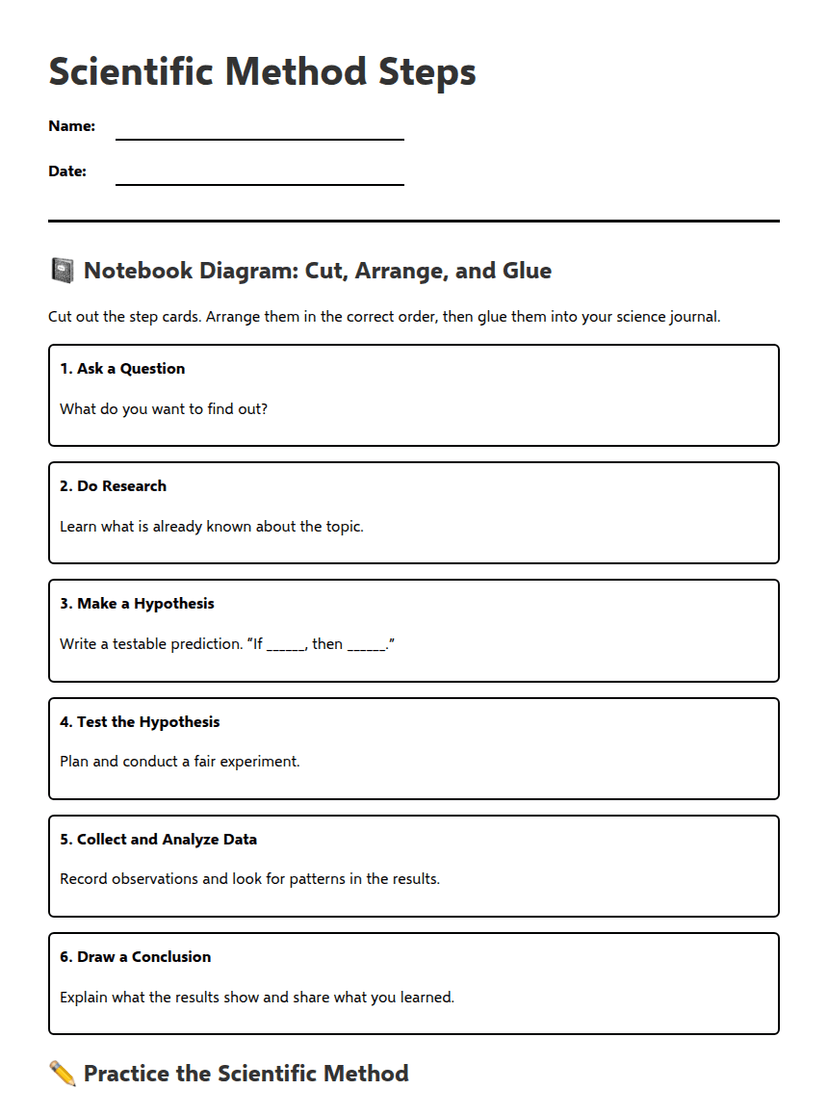
Exploring Scientific Skills
A free science worksheet ready for your classroom. Open in Kuraplan to grab the print-ready PDF, customize it for your students, or generate a fresh version in seconds.
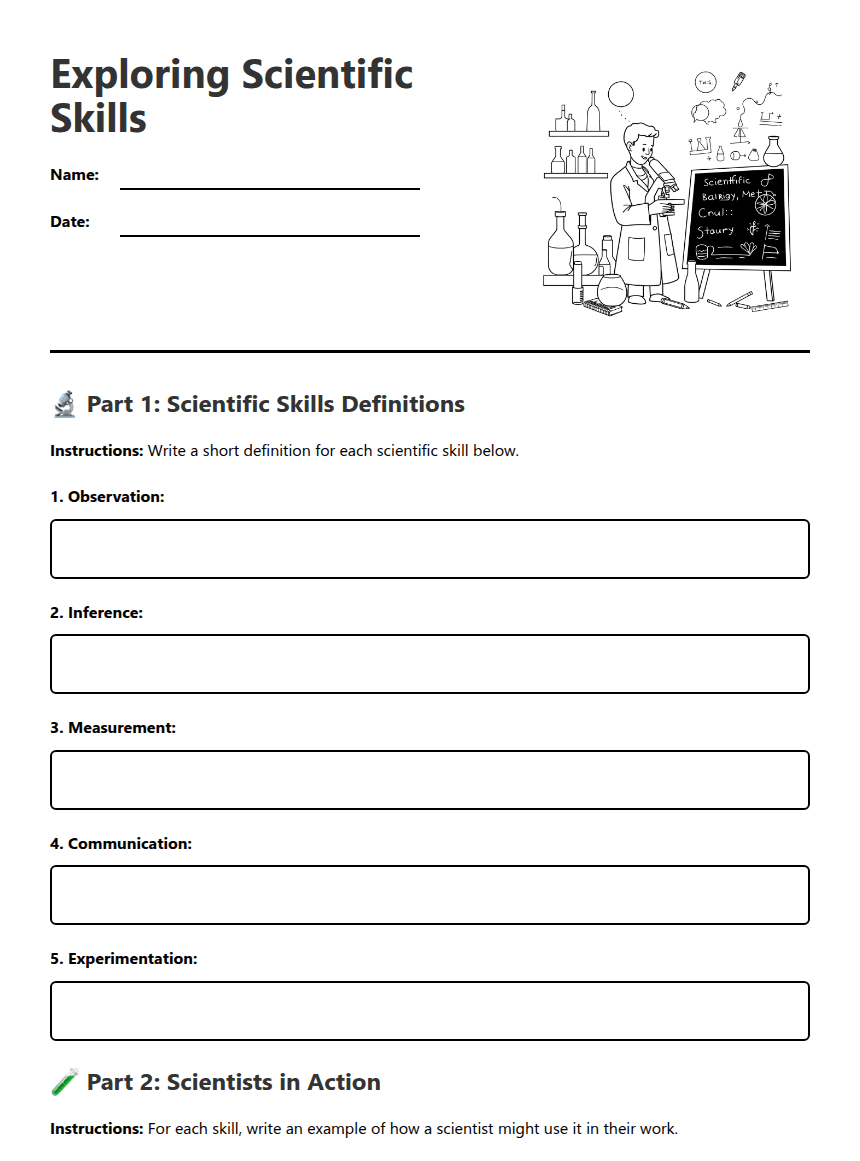
Exploring Scientific Skills
🔬 Part 1: Scientific Skills Definitions
Instructions: Write a short definition for each scientific skill below.
🧪 Part 2: Scientists in Action
Instructions: For each skill, write an example of how a scientist might use it in their work.
💭 Part 3: Reflection & Real-World Connections
📝 Answer Key
Part 1: Scientific Skills Definitions
Using your five senses to gather information about the world around you. Looking carefully at what happens and noticing details.
Making an educated guess or conclusion based on observations and prior knowledge. Drawing conclusions from what you observe.
Using tools and units to find the size, amount, or quantity of something. Getting exact numbers for length, weight, temperature, etc.
Sharing scientific information with others through writing, speaking, drawings, or charts. Explaining results and discoveries clearly.
Testing ideas by doing controlled tests to see what happens. Changing one thing at a time to see how it affects the results.
Part 2: Scientists in Action
Sample answers: Watching how animals behave in their natural habitat, noting what they eat, observing how they interact with other animals, recording their daily activities, or watching how they build nests.
Sample answers: If a scientist observes dark clouds and dropping air pressure, they might infer that a storm is coming. Or if they see ice rings in tree trunks, they might infer there were very cold winters in the past.
Sample answers: Ruler/measuring tape (length/distance), scale (weight/mass), thermometer (temperature), stopwatch (time), graduated cylinder (volume of liquids), or microscope (size of tiny objects).
Sample answers: Writing research papers, presenting at conferences, creating charts and graphs, making videos, writing books, posting on websites, or teaching others about their findings.
Sample answer: Plant seeds in identical pots with the same soil. Give some plants lots of light and others very little light, but water them the same amount. Measure and compare how tall they grow over several weeks to see if light affects plant growth.
Part 3: Reflection & Real-World Connections
Sample answer: Scientists need to share their discoveries so other scientists can learn from their work, check their results, and build on their ideas. Sharing with the public helps people understand the world better and can lead to new inventions or solutions to problems that help everyone.
Sample answer: This will vary by student. Example: "I use observation the most because I like to watch carefully during science experiments and notice all the details of what happens. For example, when we mixed baking soda and vinegar, I observed that it bubbled up, made a fizzing sound, and felt cool to touch."
About This Worksheet
Free in Kuraplan
Sign up free, grab the PDF, and customize it for your class.
Print-Ready
Formatted for standard paper. Clean layout, easy to read.
AI-Generated
Created with Kuraplan's AI, designed for real classroom use.
For Teachers & Parents
Use in classrooms, for homework, tutoring, or homeschool.
Need a custom version of this worksheet?
Kuraplan's AI generates custom worksheets in seconds — differentiated for every learner, aligned to your curriculum.
Generate Custom Worksheets — FreeMore Science Worksheets
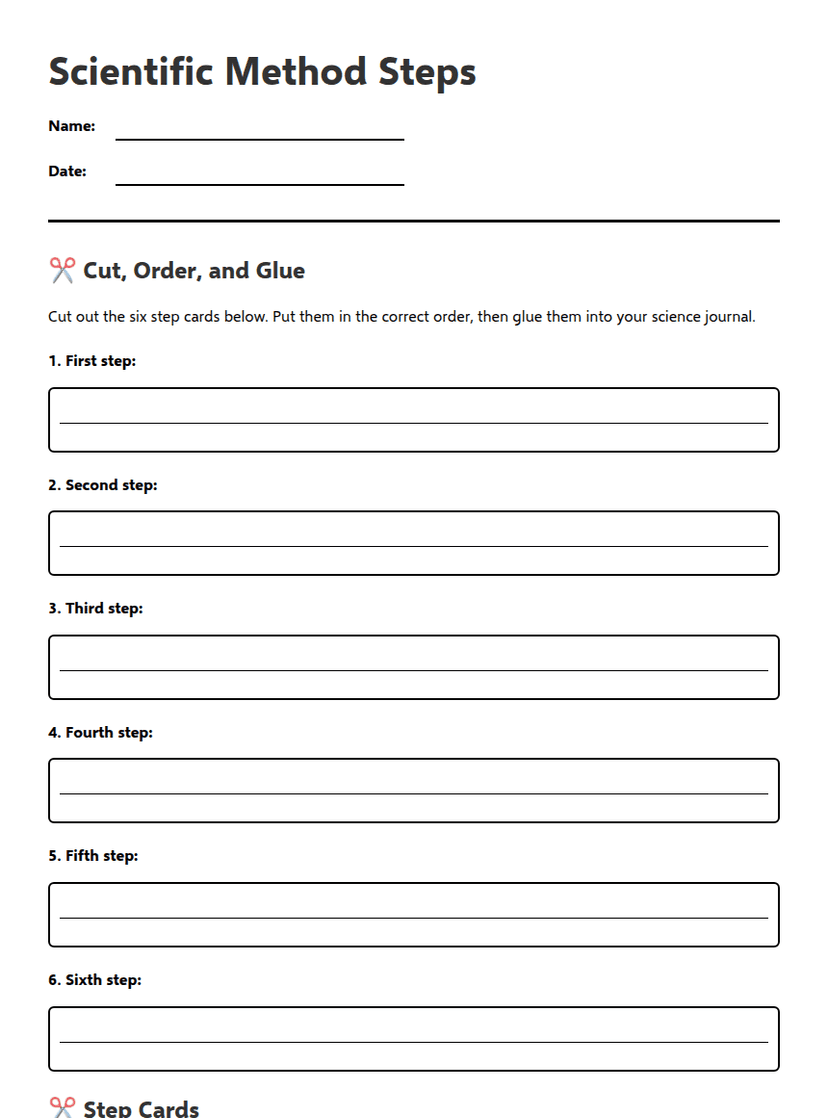
Scientific Method Steps
Free
Lab Safety Tools Search
Free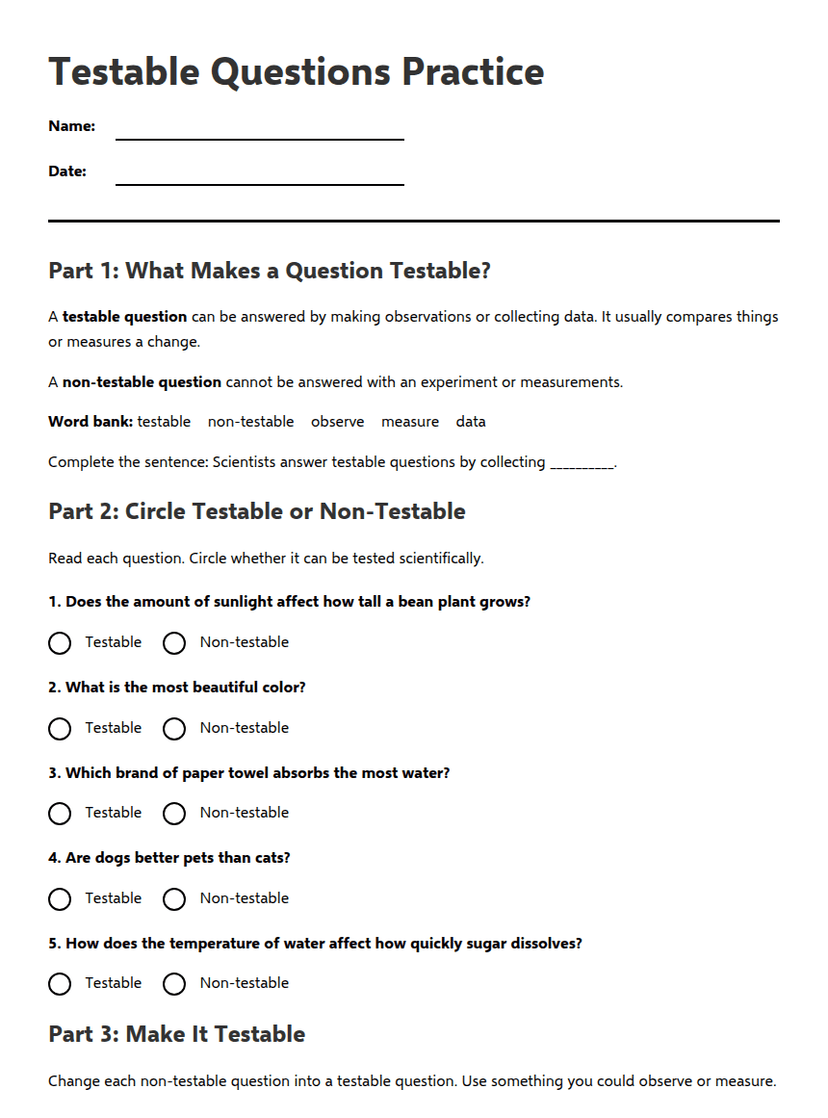
Testable Questions Practice
Free
Testable Questions Practice
Free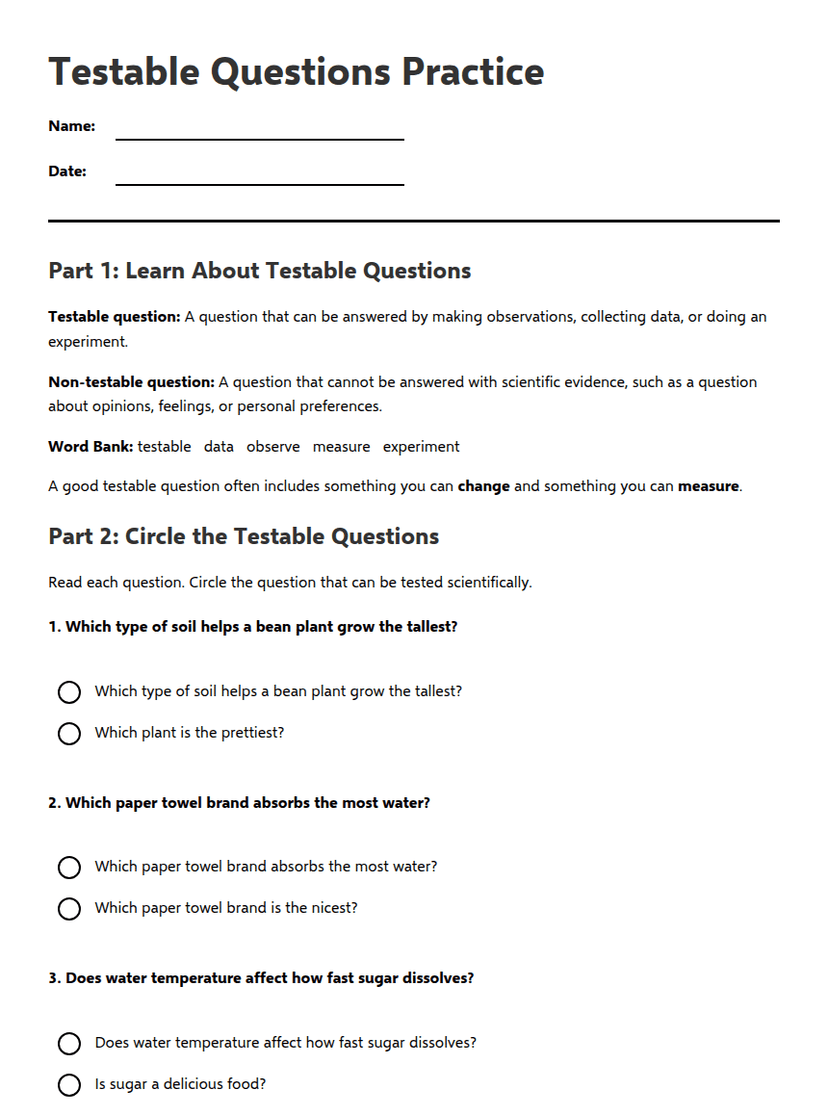
Testable Questions Practice
Free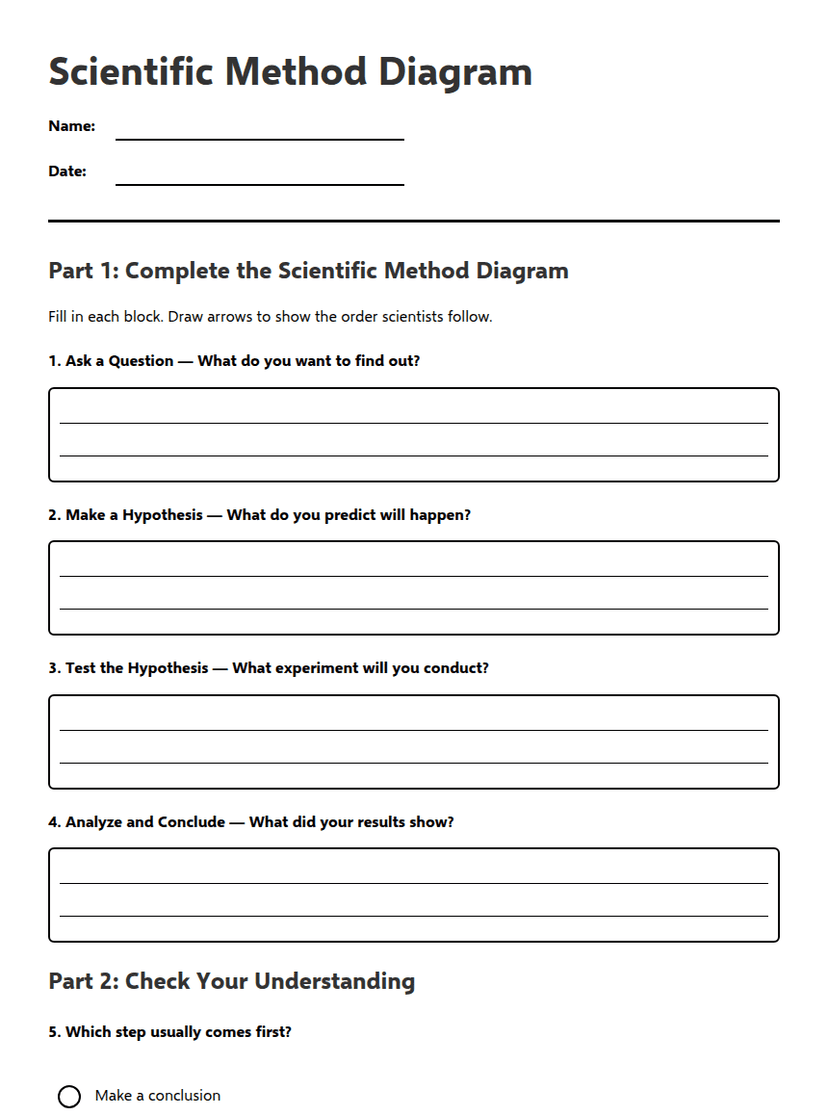
Scientific Method Diagram
Free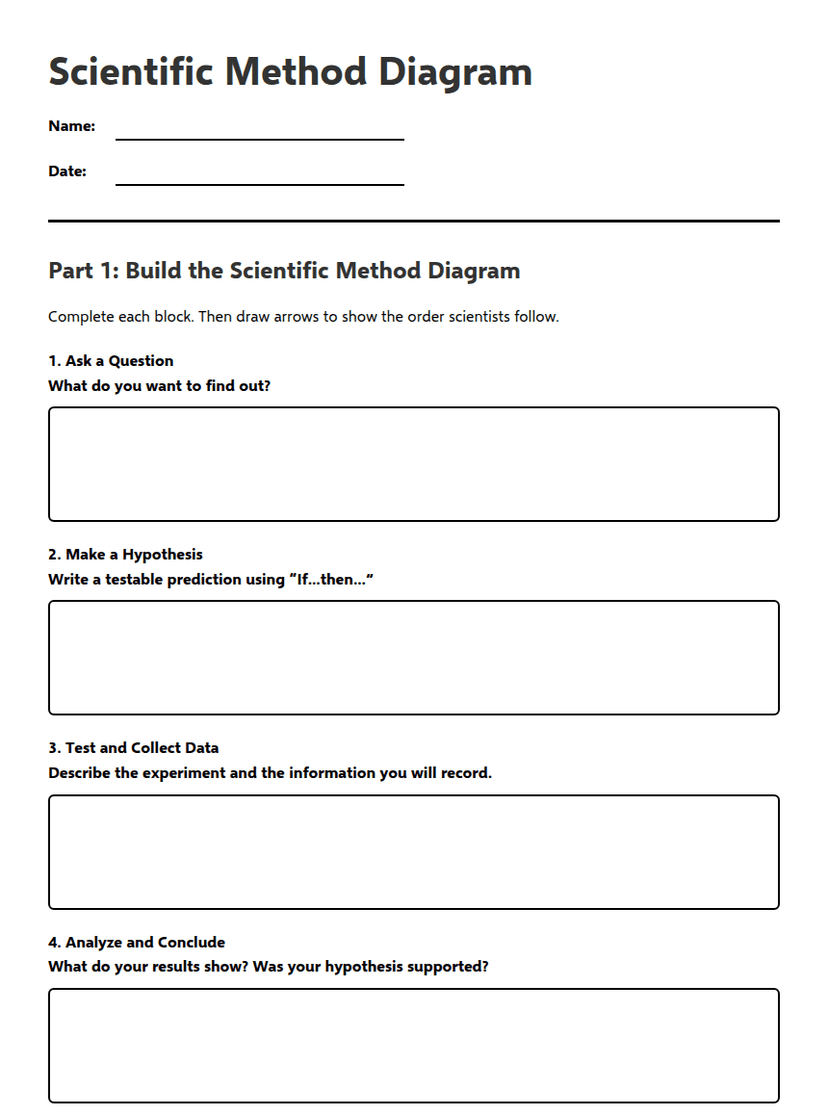
Scientific Method Diagram
Free