MathematicsFreePrintable

Similarity and Scale Factors

A free mathematics worksheet ready for your classroom. Open in Kuraplan to grab the print-ready PDF, customize it for your students, or generate a fresh version in seconds.
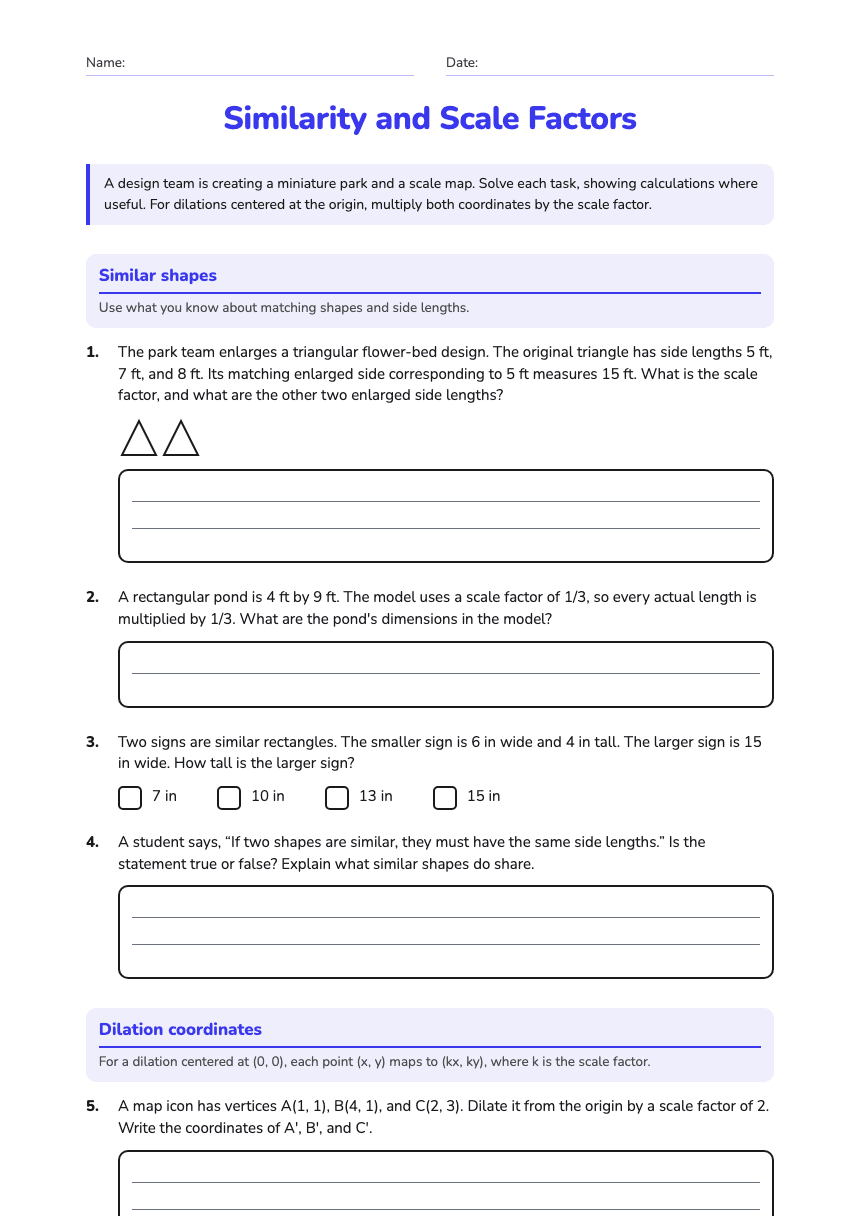
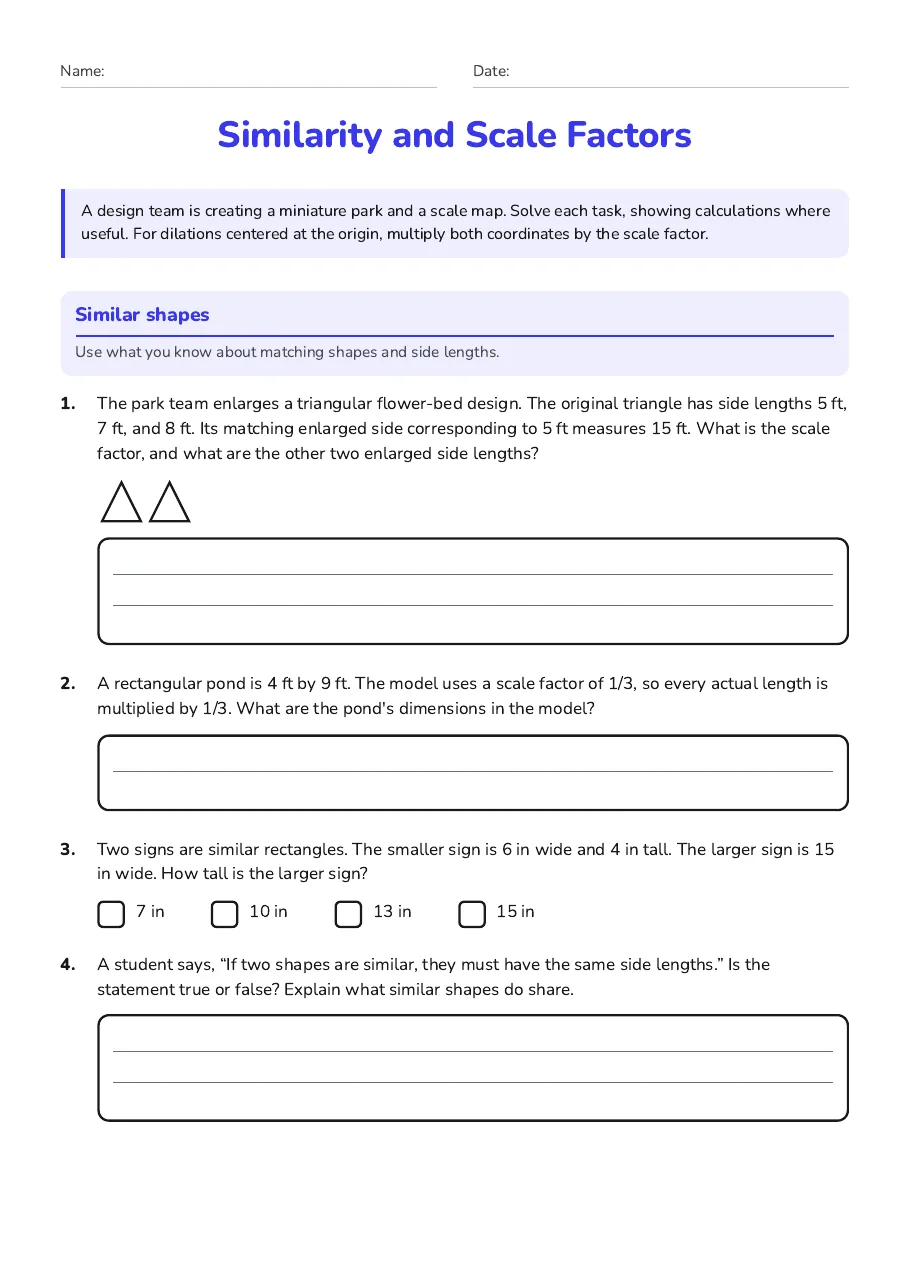
Similarity and Scale Factors worksheet preview
Name:Date:

Similarity and Scale Factors

A design team is creating a miniature park and a scale map. Solve each task, showing calculations where useful. For dilations centered at the origin, multiply both coordinates by the scale factor.

Similar shapes

Use what you know about matching shapes and side lengths.

1.The park team enlarges a triangular flower-bed design. The original triangle has side lengths 5 ft, 7 ft, and 8 ft. Its matching enlarged side corresponding to 5 ft measures 15 ft. What is the scale factor, and what are the other two enlarged side lengths?
2.A rectangular pond is 4 ft by 9 ft. The model uses a scale factor of 1/3, so every actual length is multiplied by 1/3. What are the pond's dimensions in the model?
3.Two signs are similar rectangles. The smaller sign is 6 in wide and 4 in tall. The larger sign is 15 in wide. How tall is the larger sign?
  • 7 in
  • 10 in
  • 13 in
  • 15 in
4.A student says, “If two shapes are similar, they must have the same side lengths.” Is the statement true or false? Explain what similar shapes do share.

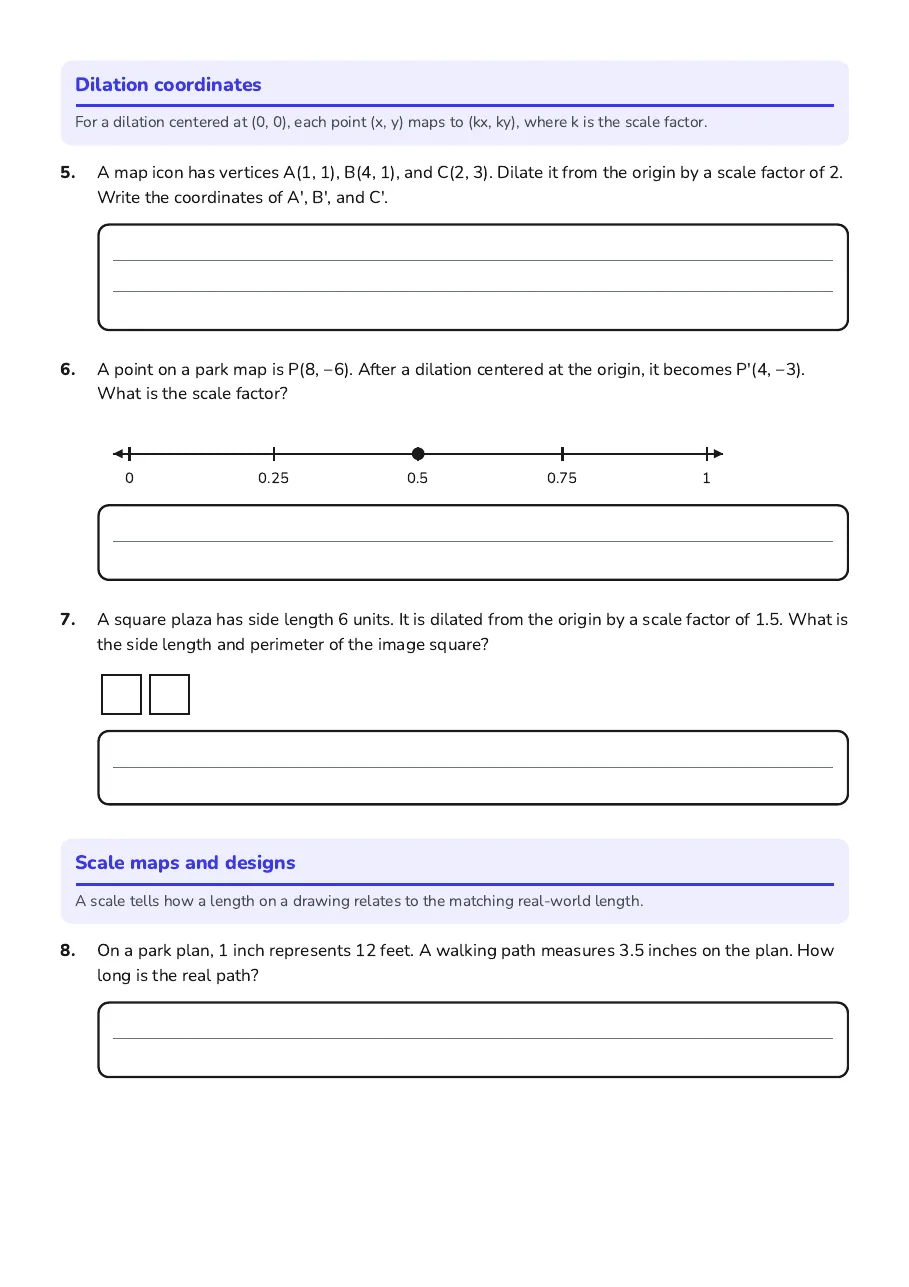
Dilation coordinates

For a dilation centered at (0, 0), each point (x, y) maps to (kx, ky), where k is the scale factor.

5.A map icon has vertices A(1, 1), B(4, 1), and C(2, 3). Dilate it from the origin by a scale factor of 2. Write the coordinates of A′, B′, and C′.
6.A point on a park map is P(8, −6). After a dilation centered at the origin, it becomes P′(4, −3). What is the scale factor?
00.250.50.751
7.A square plaza has side length 6 units. It is dilated from the origin by a scale factor of 1.5. What is the side length and perimeter of the image square?

Scale maps and designs

A scale tells how a length on a drawing relates to the matching real-world length.

8.On a park plan, 1 inch represents 12 feet. A walking path measures 3.5 inches on the plan. How long is the real path?
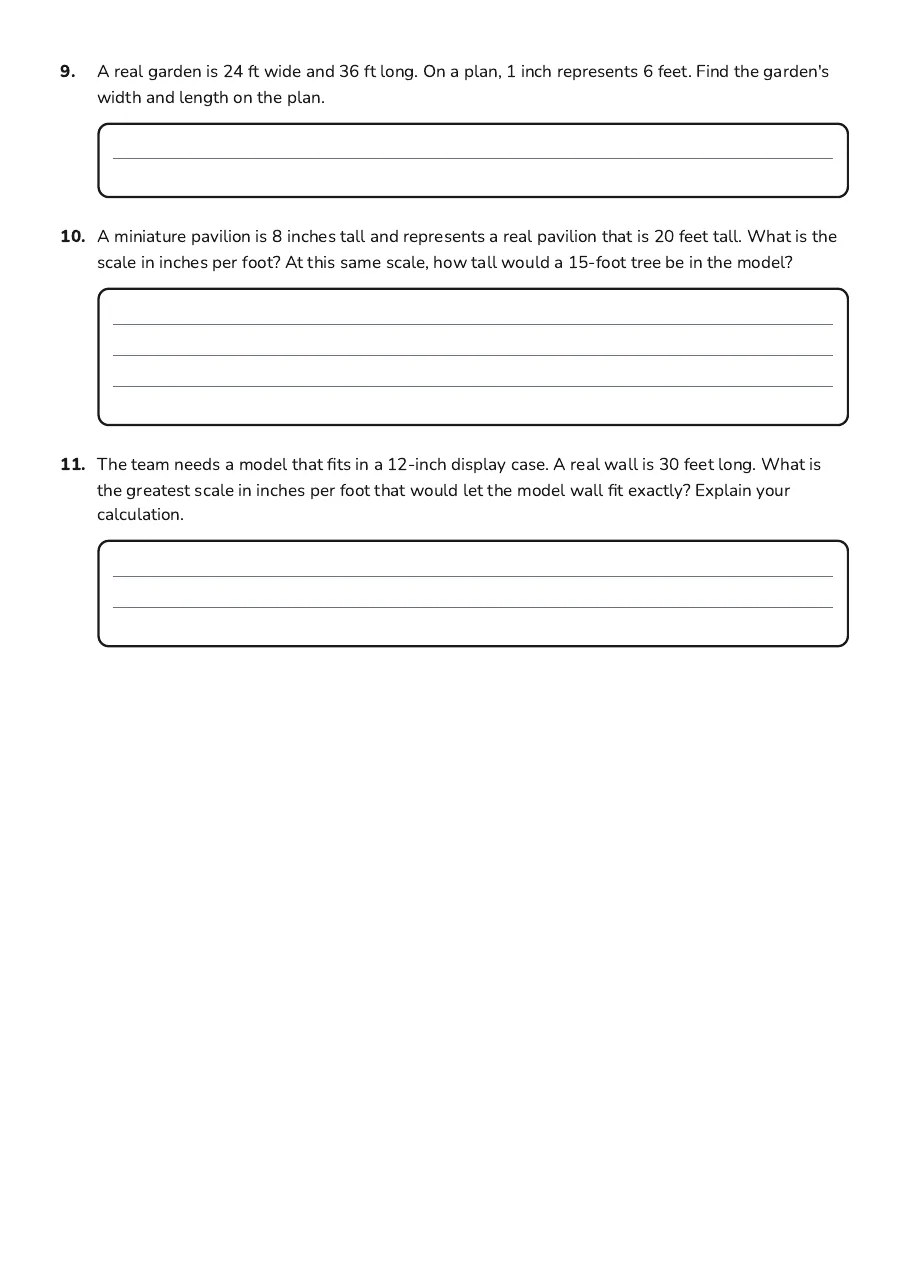
9.A real garden is 24 ft wide and 36 ft long. On a plan, 1 inch represents 6 feet. Find the garden's width and length on the plan.
10.A miniature pavilion is 8 inches tall and represents a real pavilion that is 20 feet tall. What is the scale in inches per foot? At this same scale, how tall would a 15-foot tree be in the model?
11.The team needs a model that fits in a 12-inch display case. A real wall is 30 feet long. What is the greatest scale in inches per foot that would let the model wall fit exactly? Explain your calculation.

3 printable pages

  • Similarity and Scale Factors, page 1 of 3: Similar shapes

    Page 1

  • Similarity and Scale Factors, page 2 of 3: Dilation coordinates, Scale maps and designs

    Page 2

  • Similarity and Scale Factors, page 3 of 3: 9. A real garden is 24 ft wide and 36 ft long. On a plan, 1 inch represents 6 feet. Find…

    Page 3

About This Worksheet

Free in Kuraplan

Sign up free, grab the PDF, and customize it for your class.

Print-Ready

Formatted for standard paper. Clean layout, easy to read.

AI-Generated

Created with Kuraplan's AI, designed for real classroom use.

For Teachers & Parents

Use in classrooms, for homework, tutoring, or homeschool.

Need a custom version of this worksheet?

Kuraplan's AI generates custom worksheets in seconds — differentiated for every learner, aligned to your curriculum.

Generate Custom Worksheets — Free
No credit card Curriculum-aligned Under 60 seconds