ScienceFreePrintable

Water Cycle Basics

A free science worksheet ready for your classroom. Open in Kuraplan to grab the print-ready PDF, customize it for your students, or generate a fresh version in seconds.
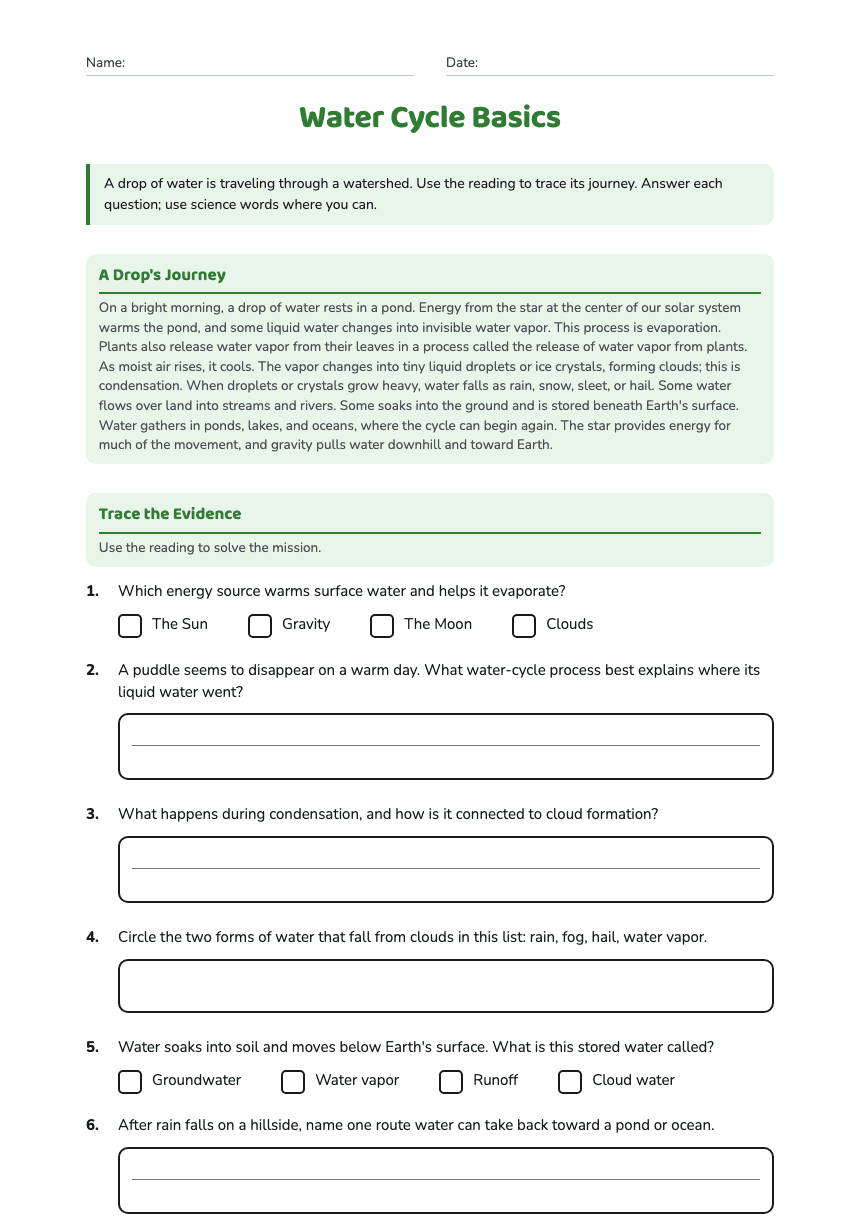
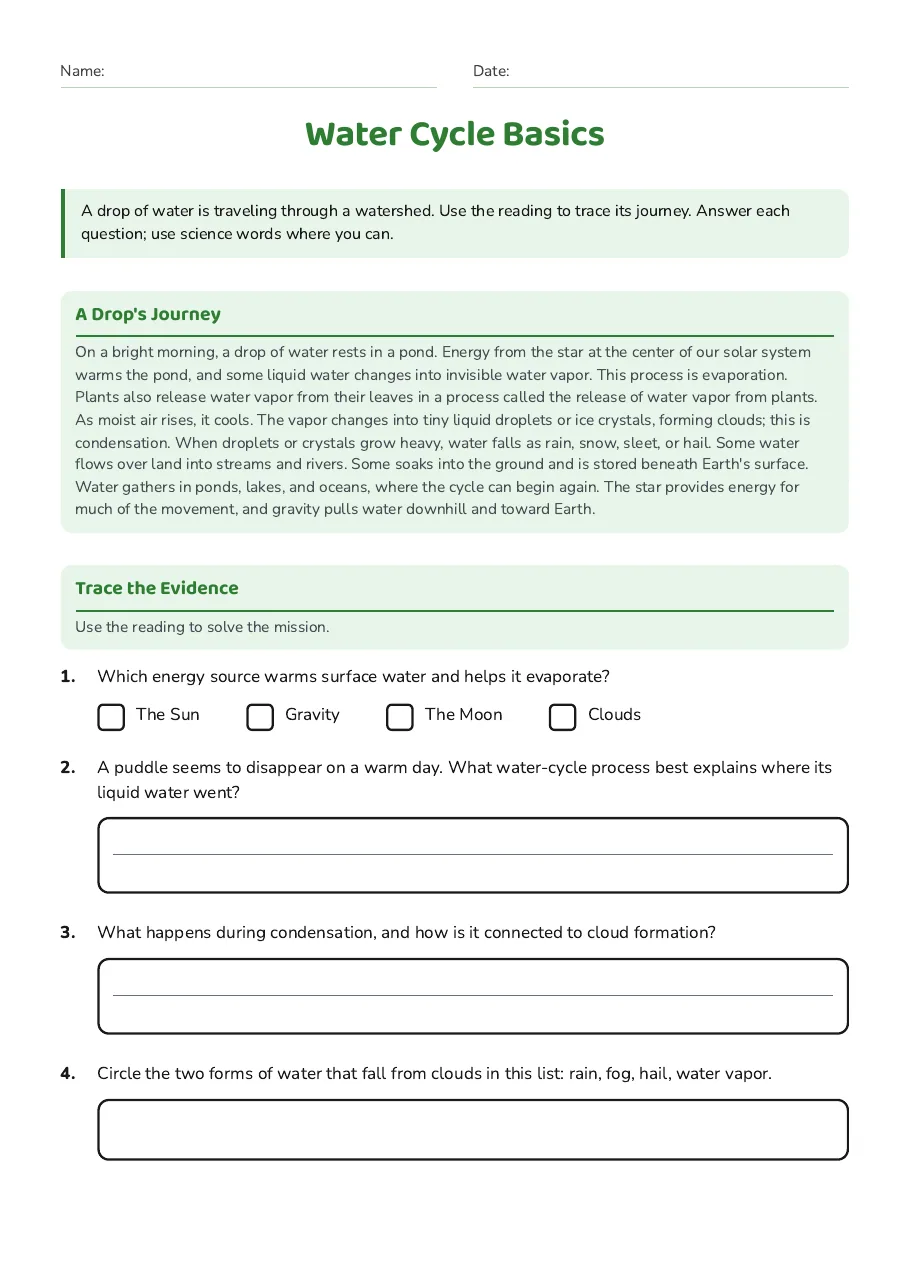
Water Cycle Basics worksheet preview
Name:Date:

Water Cycle Basics

A drop of water is traveling through a watershed. Use the reading to trace its journey. Answer each question; use science words where you can.

A Drop's Journey

On a bright morning, a drop of water rests in a pond. Energy from the star at the center of our solar system warms the pond, and some liquid water changes into invisible water vapor. This process is evaporation. Plants also release water vapor from their leaves in a process called the release of water vapor from plants. As moist air rises, it cools. The vapor changes into tiny liquid droplets or ice crystals, forming clouds; this is condensation. When droplets or crystals grow heavy, water falls as rain, snow, sleet, or hail. Some water flows over land into streams and rivers. Some soaks into the ground and is stored beneath Earth's surface. Water gathers in ponds, lakes, and oceans, where the cycle can begin again. The star provides energy for much of the movement, and gravity pulls water downhill and toward Earth.

Trace the Evidence

Use the reading to solve the mission.

1.Which energy source warms surface water and helps it evaporate?
  • The Sun
  • Gravity
  • The Moon
  • Clouds
2.A puddle seems to disappear on a warm day. What water-cycle process best explains where its liquid water went?
3.What happens during condensation, and how is it connected to cloud formation?
4.Circle the two forms of water that fall from clouds in this list: rain, fog, hail, water vapor.
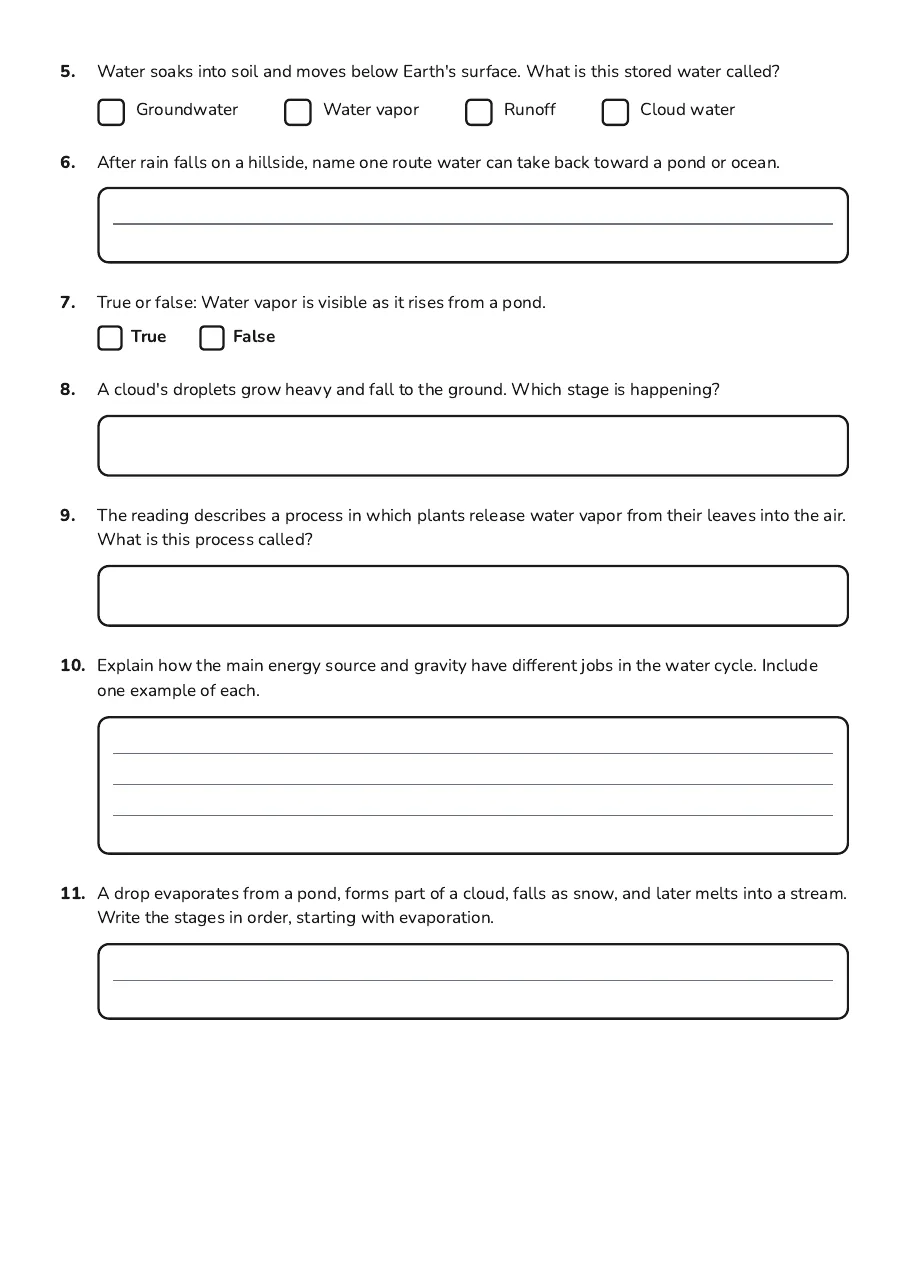
5.Water soaks into soil and moves below Earth's surface. What is this stored water called?
  • Groundwater
  • Water vapor
  • Runoff
  • Cloud water
6.After rain falls on a hillside, name one route water can take back toward a pond or ocean.
7.True or false: Water vapor is visible as it rises from a pond.
TrueFalse
8.A cloud's droplets grow heavy and fall to the ground. Which stage is happening?
9.The reading describes a process in which plants release water vapor from their leaves into the air. What is this process called?
10.Explain how the main energy source and gravity have different jobs in the water cycle. Include one example of each.
11.A drop evaporates from a pond, forms part of a cloud, falls as snow, and later melts into a stream. Write the stages in order, starting with evaporation.
12.Why is the water cycle called a cycle? Use at least two stages to explain how water can keep moving.

3 printable pages

  • Water Cycle Basics, page 1 of 3: A Drop's Journey, Trace the Evidence

    Page 1

  • Water Cycle Basics, page 2 of 3: 5. Water soaks into soil and moves below Earth's surface. What is this stored water…

    Page 2

  • Water Cycle Basics, page 3 of 3: 12. Why is the water cycle called a cycle? Use at least two stages to explain how water…

    Page 3

About This Worksheet

Free in Kuraplan

Sign up free, grab the PDF, and customize it for your class.

Print-Ready

Formatted for standard paper. Clean layout, easy to read.

AI-Generated

Created with Kuraplan's AI, designed for real classroom use.

For Teachers & Parents

Use in classrooms, for homework, tutoring, or homeschool.

Need a custom version of this worksheet?

Kuraplan's AI generates custom worksheets in seconds — differentiated for every learner, aligned to your curriculum.

Generate Custom Worksheets — Free
No credit card Curriculum-aligned Under 60 seconds