ScienceFreePrintable

Balancing Chemical Equations

A free science worksheet ready for your classroom. Open in Kuraplan to grab the print-ready PDF, customize it for your students, or generate a fresh version in seconds.
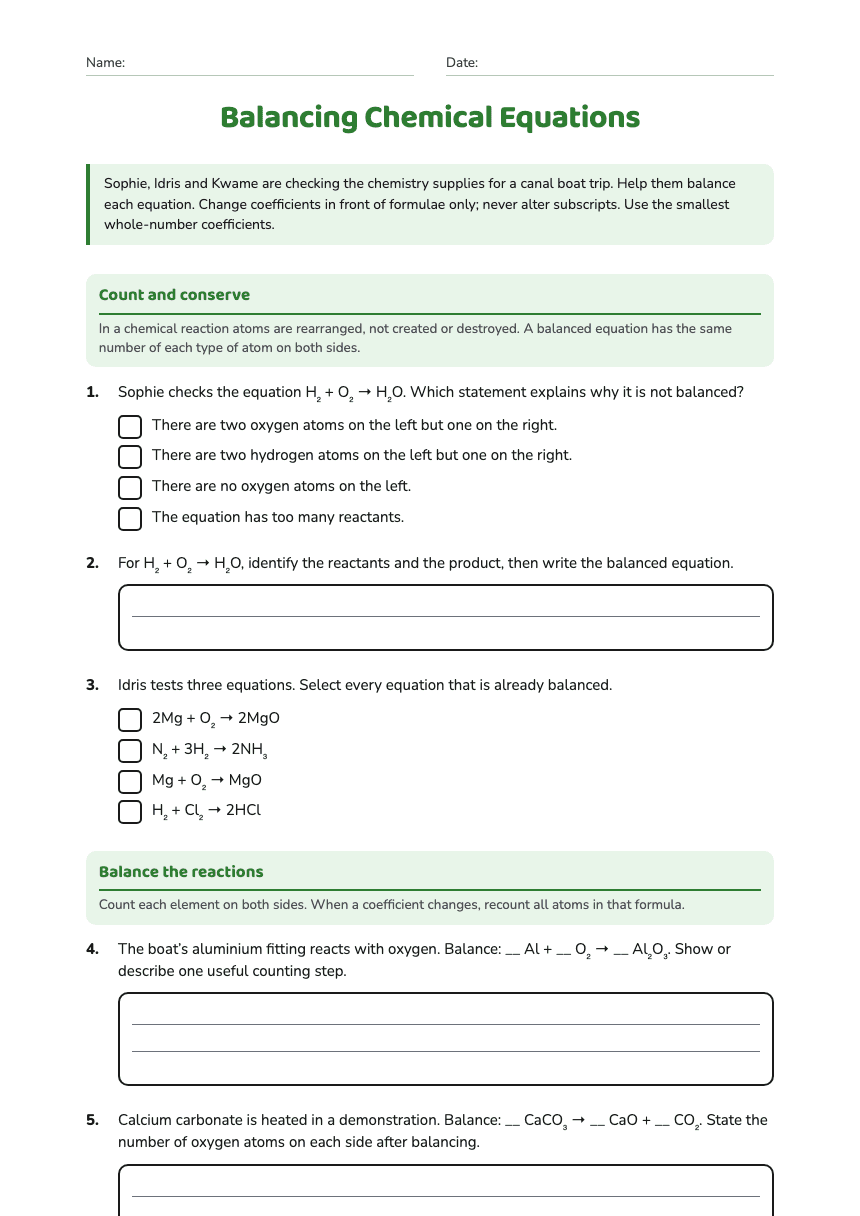
Balancing Chemical Equations worksheet preview
Name:Date:

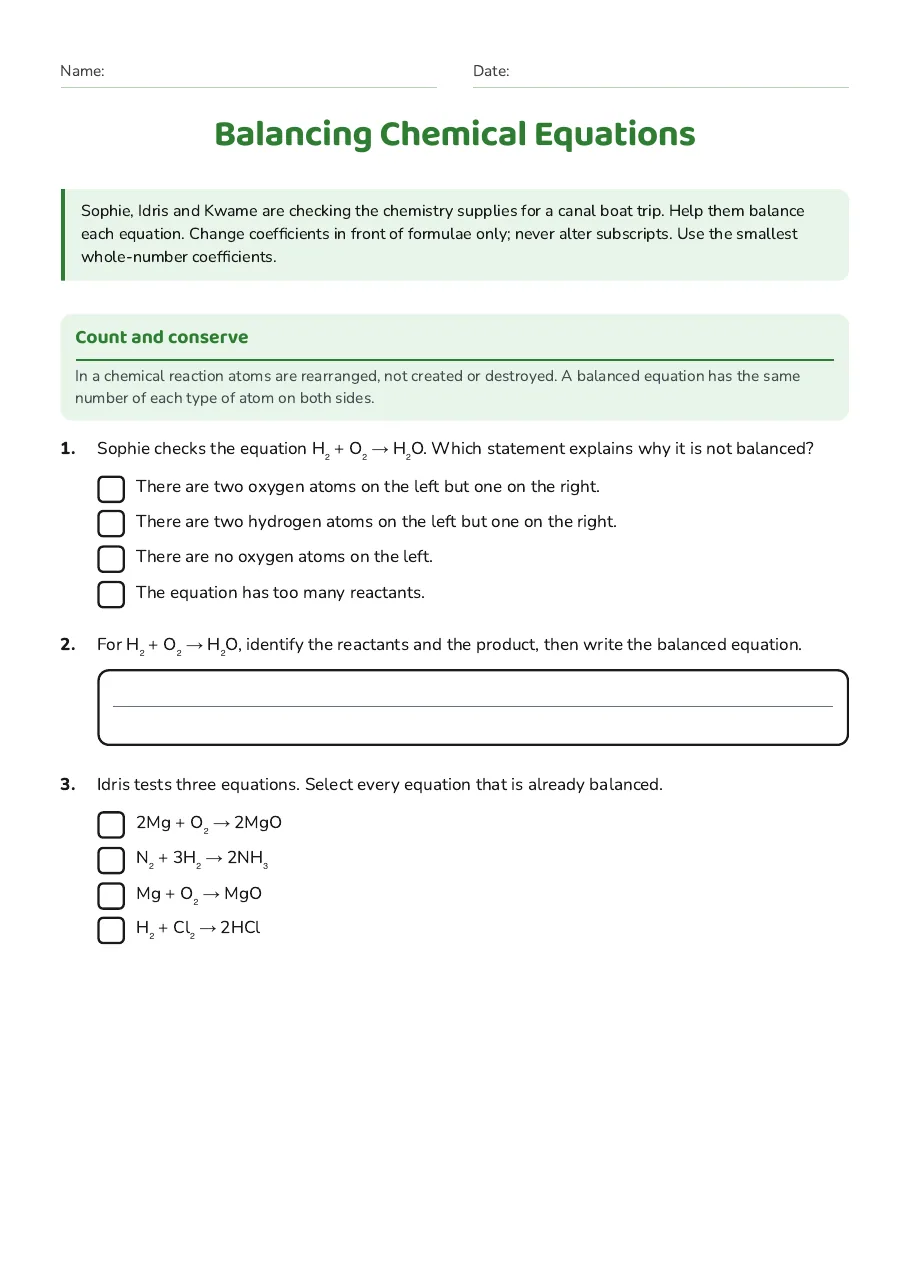
Balancing Chemical Equations

Sophie, Idris and Kwame are checking the chemistry supplies for a canal boat trip. Help them balance each equation. Change coefficients in front of formulae only; never alter subscripts. Use the smallest whole-number coefficients.

Count and conserve

In a chemical reaction atoms are rearranged, not created or destroyed. A balanced equation has the same number of each type of atom on both sides.

1.Sophie checks the equation H₂ + O₂ → H₂O. Which statement explains why it is not balanced?
  • There are two oxygen atoms on the left but one on the right.
  • There are two hydrogen atoms on the left but one on the right.
  • There are no oxygen atoms on the left.
  • The equation has too many reactants.
2.For H₂ + O₂ → H₂O, identify the reactants and the product, then write the balanced equation.
3.Idris tests three equations. Select every equation that is already balanced.
  • 2Mg + O₂ → 2MgO
  • N₂ + 3H₂ → 2NH₃
  • Mg + O₂ → MgO
  • H₂ + Cl₂ → 2HCl

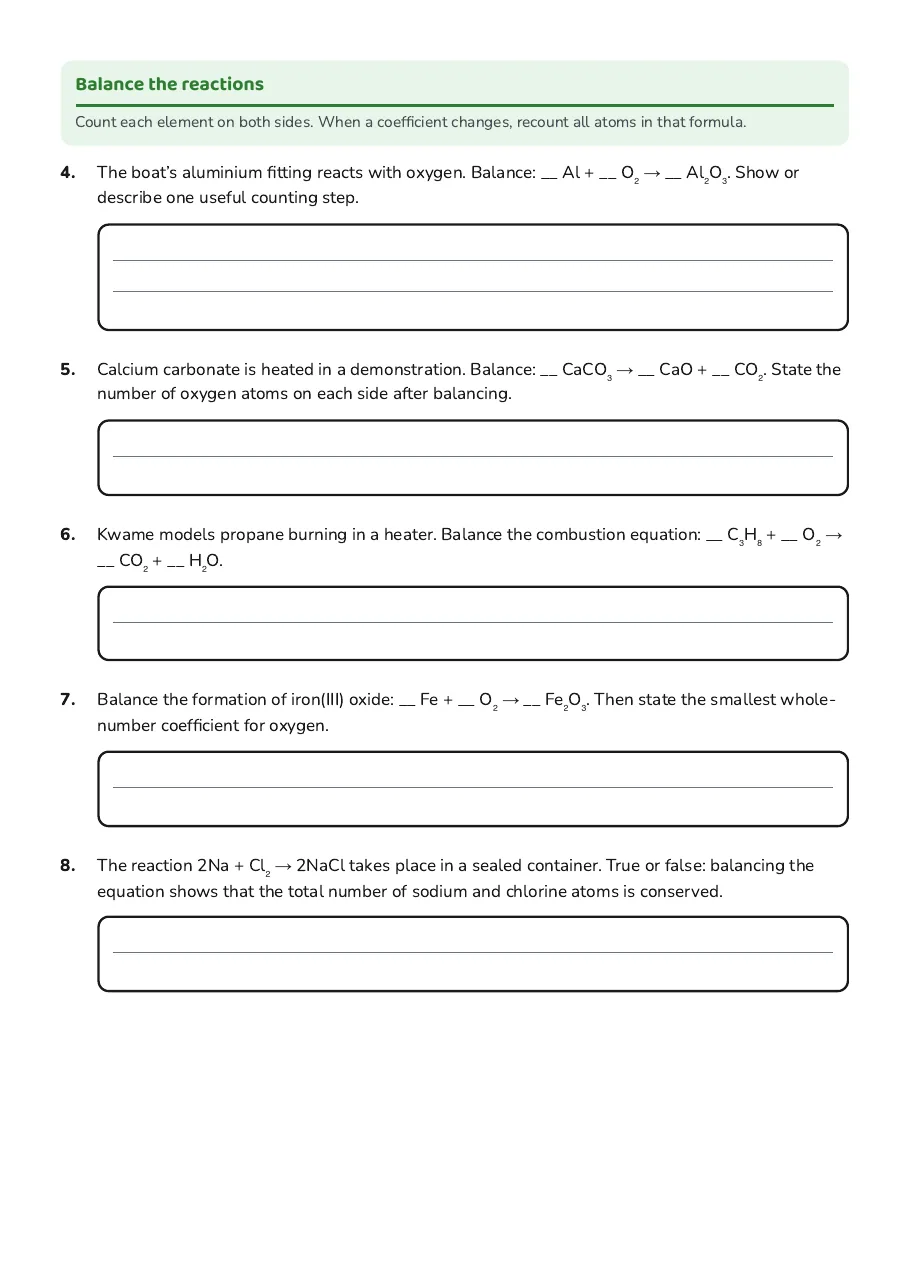
Balance the reactions

Count each element on both sides. When a coefficient changes, recount all atoms in that formula.

4.The boat’s aluminium fitting reacts with oxygen. Balance: __ Al + __ O₂ → __ Al₂O₃. Show or describe one useful counting step.
5.Calcium carbonate is heated in a demonstration. Balance: __ CaCO₃ → __ CaO + __ CO₂. State the number of oxygen atoms on each side after balancing.
6.Kwame models propane burning in a heater. Balance the combustion equation: __ C₃H₈ + __ O₂ → __ CO₂ + __ H₂O.
7.Balance the formation of iron(III) oxide: __ Fe + __ O₂ → __ Fe₂O₃. Then state the smallest whole-number coefficient for oxygen.
8.The reaction 2Na + Cl₂ → 2NaCl takes place in a sealed container. True or false: balancing the equation shows that the total number of sodium and chlorine atoms is conserved.

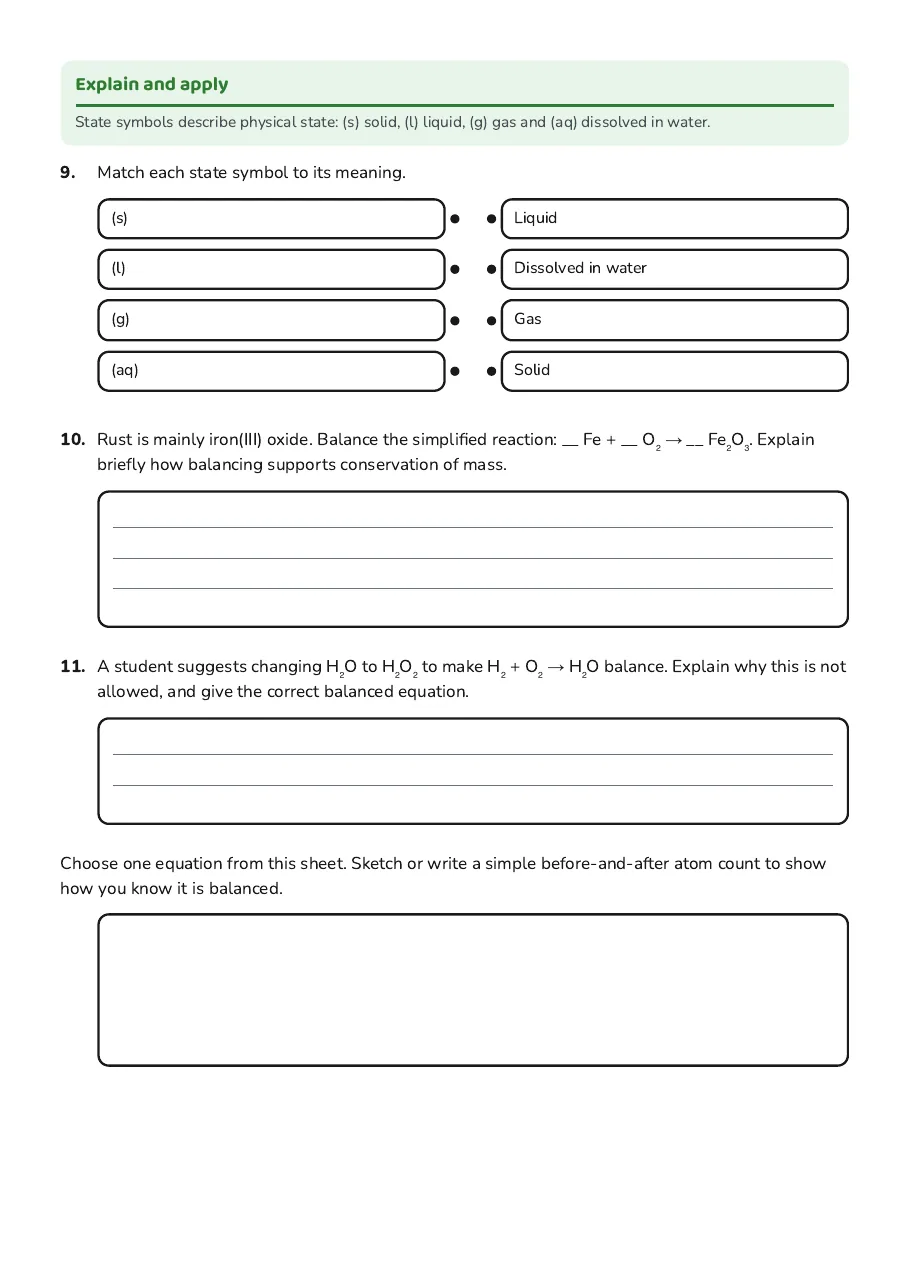
Explain and apply

State symbols describe physical state: (s) solid, (l) liquid, (g) gas and (aq) dissolved in water.

9.Match each state symbol to its meaning.
  • (s)
  • (l)
  • (g)
  • (aq)
  • Liquid
  • Dissolved in water
  • Gas
  • Solid
10.Rust is mainly iron(III) oxide. Balance the simplified reaction: __ Fe + __ O₂ → __ Fe₂O₃. Explain briefly how balancing supports conservation of mass.
11.A student suggests changing H₂O to H₂O₂ to make H₂ + O₂ → H₂O balance. Explain why this is not allowed, and give the correct balanced equation.
Choose one equation from this sheet. Sketch or write a simple before-and-after atom count to show how you know it is balanced.

3 printable pages

  • Balancing Chemical Equations, page 1 of 3: Count and conserve

    Page 1

  • Balancing Chemical Equations, page 2 of 3: Balance the reactions

    Page 2

  • Balancing Chemical Equations, page 3 of 3: Explain and apply

    Page 3

About This Worksheet

Free in Kuraplan

Sign up free, grab the PDF, and customize it for your class.

Print-Ready

Formatted for standard paper. Clean layout, easy to read.

AI-Generated

Created with Kuraplan's AI, designed for real classroom use.

For Teachers & Parents

Use in classrooms, for homework, tutoring, or homeschool.

Need a custom version of this worksheet?

Kuraplan's AI generates custom worksheets in seconds — differentiated for every learner, aligned to your curriculum.

Generate Custom Worksheets — Free
No credit card Curriculum-aligned Under 60 seconds