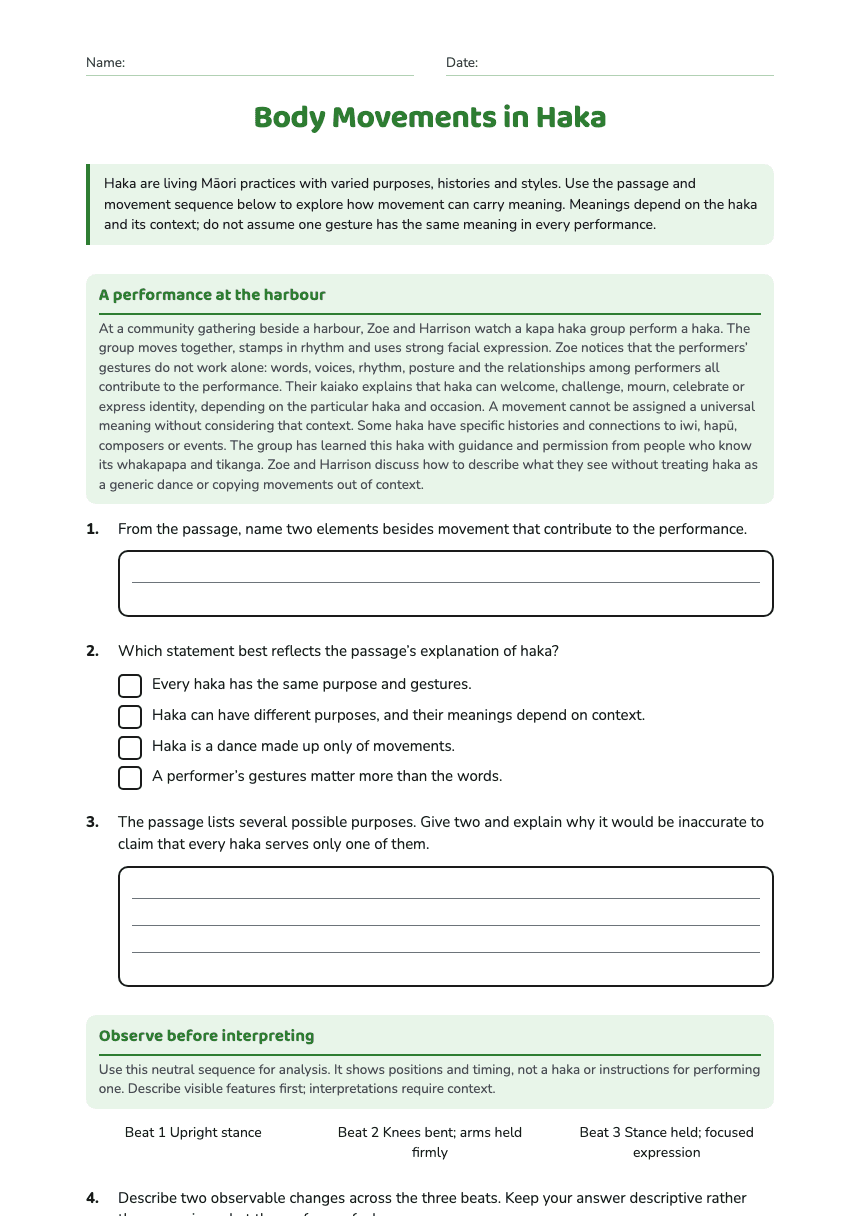
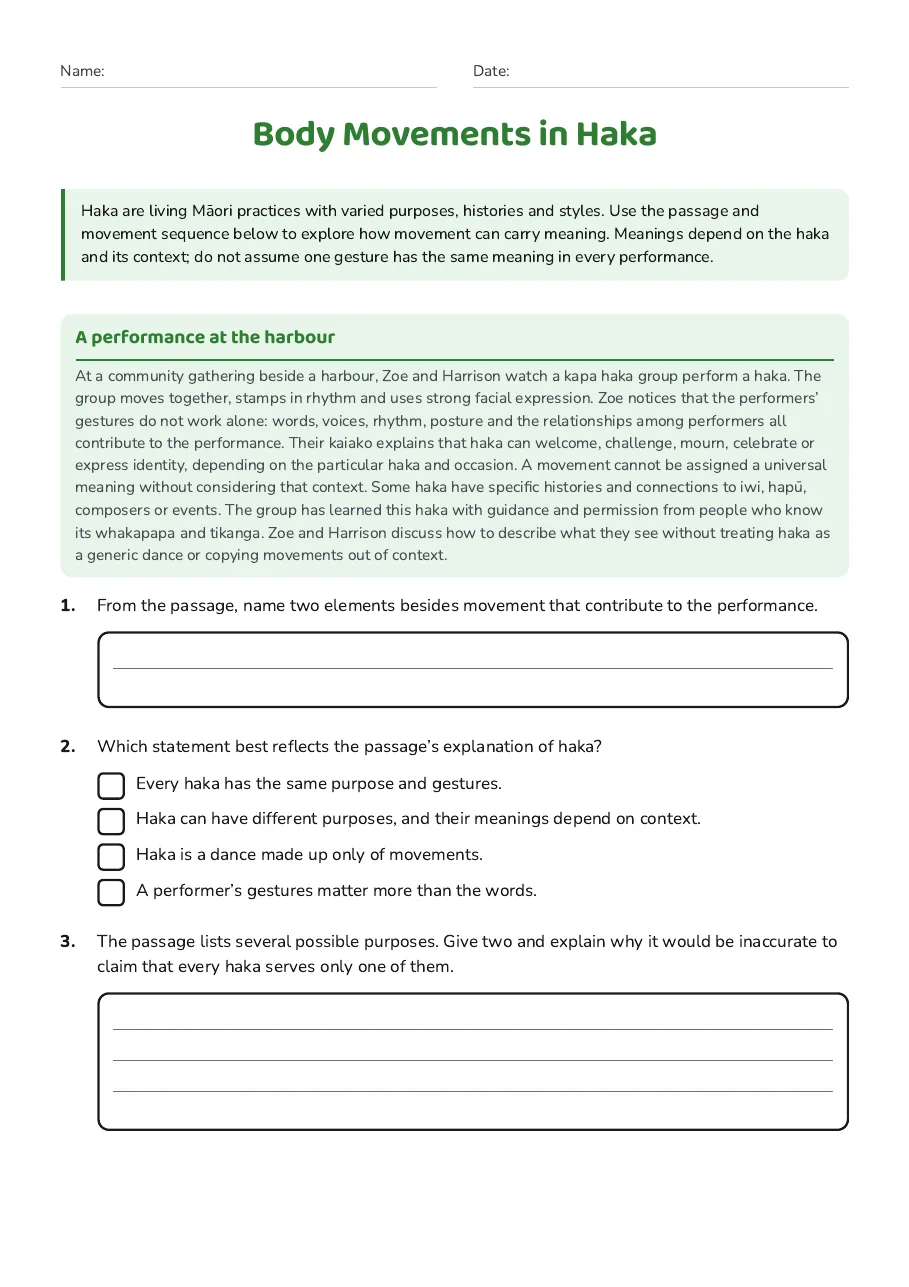
Body Movements in Haka
A free te reo māori worksheet ready for your classroom. Open in Kuraplan to grab the print-ready PDF, customize it for your students, or generate a fresh version in seconds.
Body Movements in Haka
A performance at the harbour
At a community gathering beside a harbour, Zoe and Harrison watch a kapa haka group perform a haka. The group moves together, stamps in rhythm and uses strong facial expression. Zoe notices that the performers’ gestures do not work alone: words, voices, rhythm, posture and the relationships among performers all contribute to the performance. Their kaiako explains that haka can welcome, challenge, mourn, celebrate or express identity, depending on the particular haka and occasion. A movement cannot be assigned a universal meaning without considering that context. Some haka have specific histories and connections to iwi, hapū, composers or events. The group has learned this haka with guidance and permission from people who know its whakapapa and tikanga. Zoe and Harrison discuss how to describe what they see without treating haka as a generic dance or copying movements out of context.
- Every haka has the same purpose and gestures.
- Haka can have different purposes, and their meanings depend on context.
- Haka is a dance made up only of movements.
- A performer’s gestures matter more than the words.
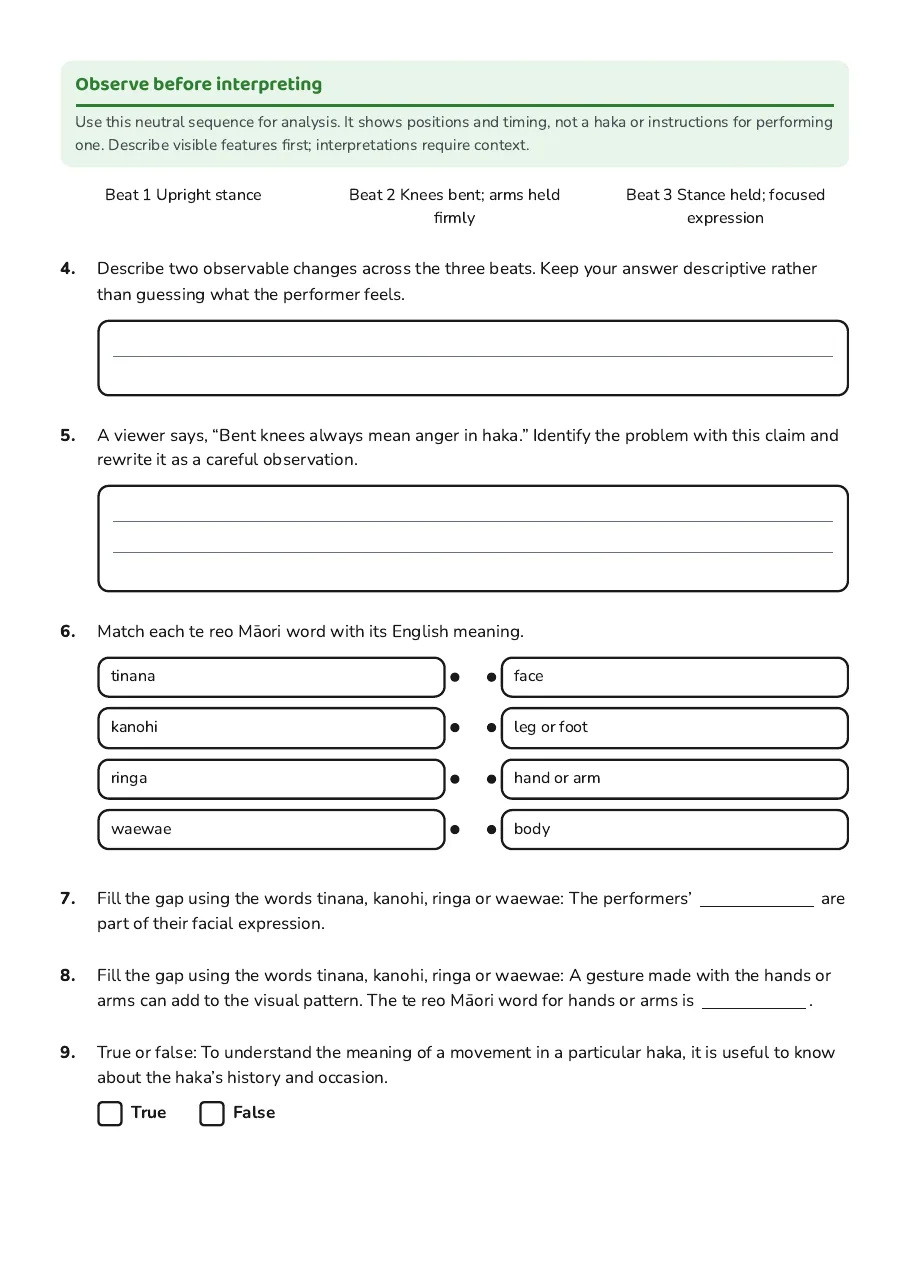
Observe before interpreting
Use this neutral sequence for analysis. It shows positions and timing, not a haka or instructions for performing one. Describe visible features first; interpretations require context.
Beat 1 Upright stance
Beat 2 Knees bent; arms held firmly
Beat 3 Stance held; focused expression
- tinana
- kanohi
- ringa
- waewae
- face
- leg or foot
- hand or arm
- body
3 printable pages
Page 1
Page 2
Page 3
About This Worksheet
Free in Kuraplan
Sign up free, grab the PDF, and customize it for your class.
Print-Ready
Formatted for standard paper. Clean layout, easy to read.
AI-Generated
Created with Kuraplan's AI, designed for real classroom use.
For Teachers & Parents
Use in classrooms, for homework, tutoring, or homeschool.
Need a custom version of this worksheet?
Kuraplan's AI generates custom worksheets in seconds — differentiated for every learner, aligned to your curriculum.
Generate Custom Worksheets — Free