ScienceFreePrintable

Cell Structure and Function

A free science worksheet ready for your classroom. Open in Kuraplan to grab the print-ready PDF, customize it for your students, or generate a fresh version in seconds.
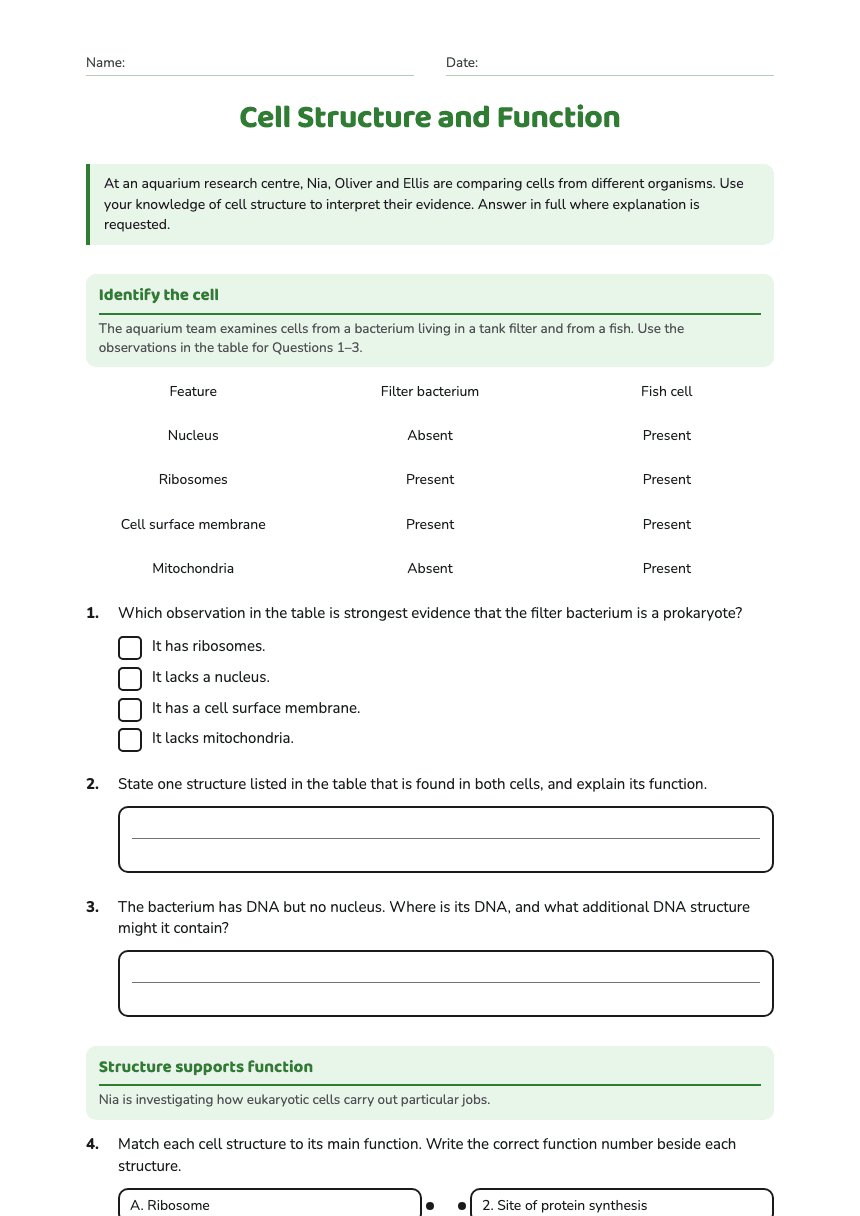
Cell Structure and Function worksheet preview
Name:Date:

Cell Structure and Function

At an aquarium research centre, Nia, Oliver and Ellis are comparing cells from different organisms. Use your knowledge of cell structure to interpret their evidence. Answer in full where explanation is requested.

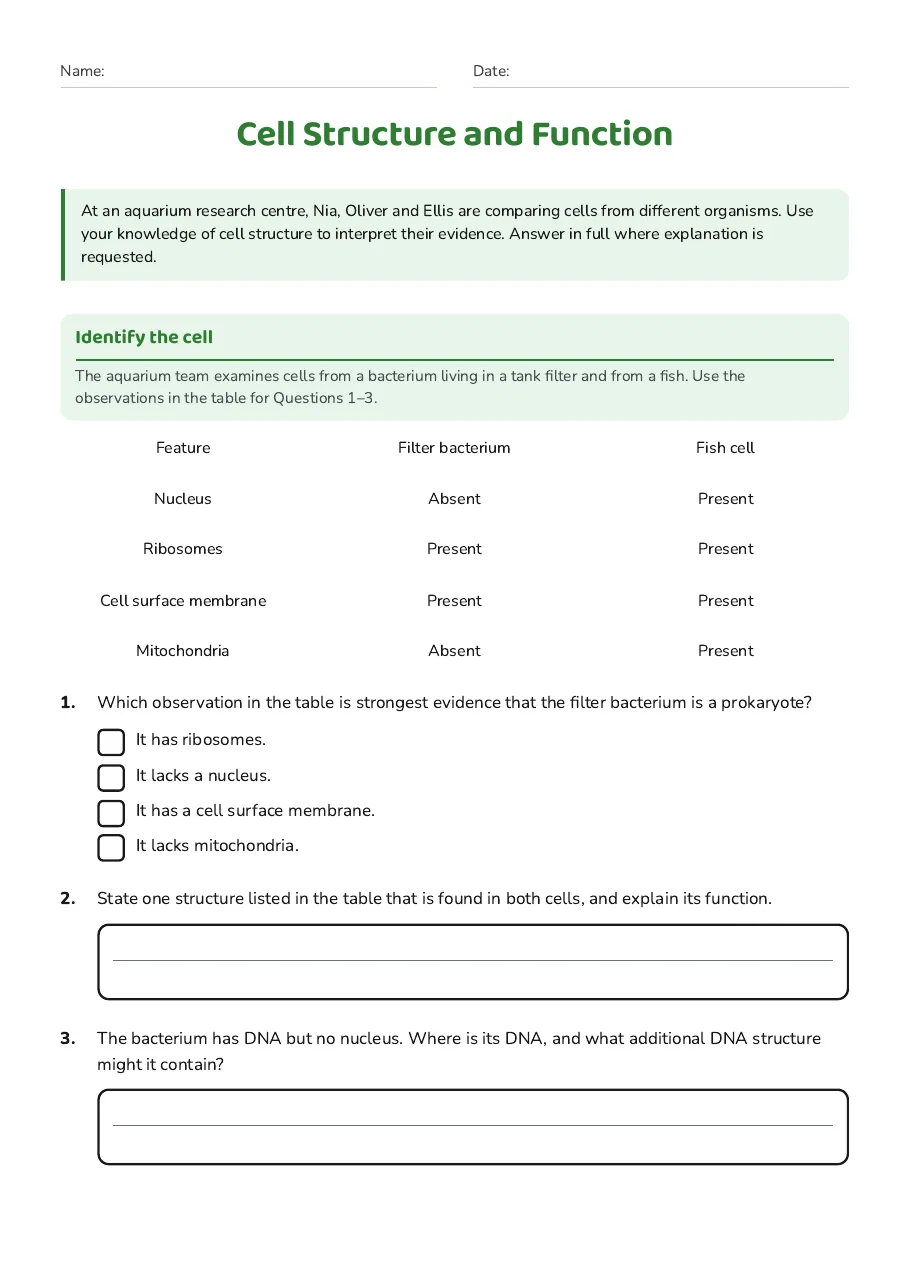
Identify the cell

The aquarium team examines cells from a bacterium living in a tank filter and from a fish. Use the observations in the table for Questions 1–3.

Feature

Filter bacterium

Fish cell

Nucleus

Absent

Present

Ribosomes

Present

Present

Cell surface membrane

Present

Present

Mitochondria

Absent

Present

1.Which observation in the table is strongest evidence that the filter bacterium is a prokaryote?
  • It has ribosomes.
  • It lacks a nucleus.
  • It has a cell surface membrane.
  • It lacks mitochondria.
2.State one structure listed in the table that is found in both cells, and explain its function.
3.The bacterium has DNA but no nucleus. Where is its DNA, and what additional DNA structure might it contain?

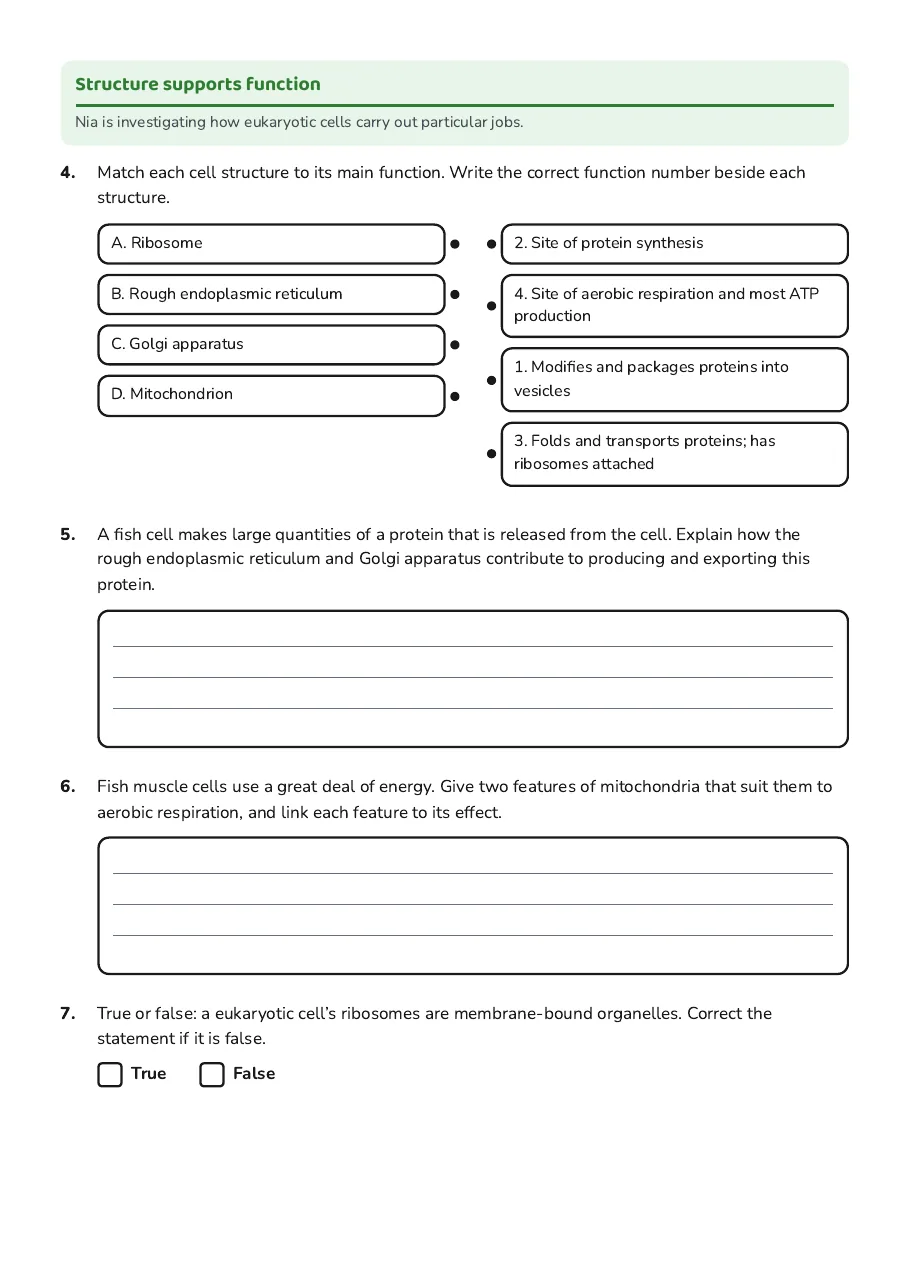
Structure supports function

Nia is investigating how eukaryotic cells carry out particular jobs.

4.Match each cell structure to its main function. Write the correct function number beside each structure.
  • A. Ribosome
  • B. Rough endoplasmic reticulum
  • C. Golgi apparatus
  • D. Mitochondrion
  • 2. Site of protein synthesis
  • 4. Site of aerobic respiration and most ATP production
  • 1. Modifies and packages proteins into vesicles
  • 3. Folds and transports proteins; has ribosomes attached
5.A fish cell makes large quantities of a protein that is released from the cell. Explain how the rough endoplasmic reticulum and Golgi apparatus contribute to producing and exporting this protein.
6.Fish muscle cells use a great deal of energy. Give two features of mitochondria that suit them to aerobic respiration, and link each feature to its effect.
7.True or false: a eukaryotic cell’s ribosomes are membrane-bound organelles. Correct the statement if it is false.
TrueFalse

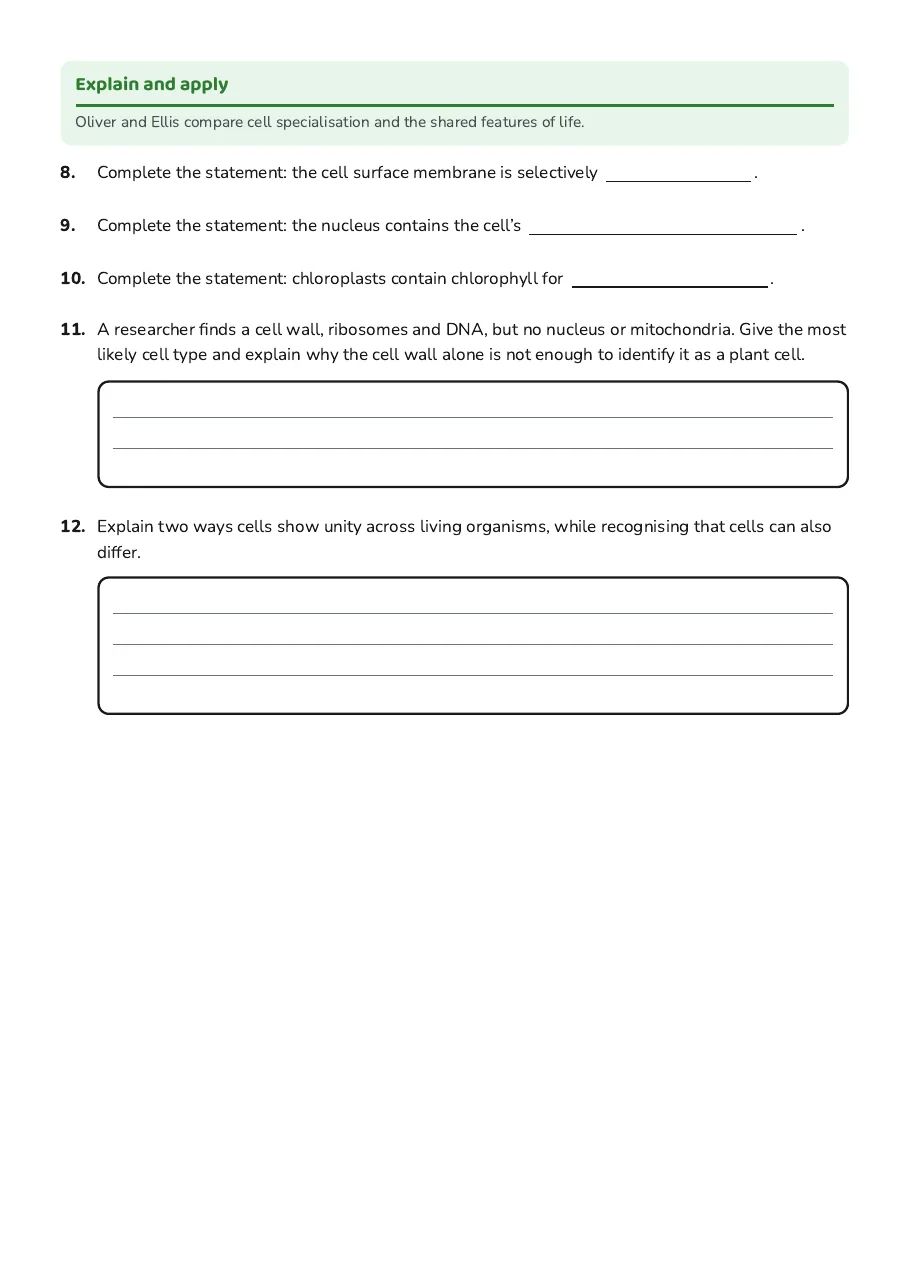
Explain and apply

Oliver and Ellis compare cell specialisation and the shared features of life.

8.Complete the statement: the cell surface membrane is selectively .
9.Complete the statement: the nucleus contains the cell’s .
10.Complete the statement: chloroplasts contain chlorophyll for .
11.A researcher finds a cell wall, ribosomes and DNA, but no nucleus or mitochondria. Give the most likely cell type and explain why the cell wall alone is not enough to identify it as a plant cell.
12.Explain two ways cells show unity across living organisms, while recognising that cells can also differ.

3 printable pages

  • Cell Structure and Function, page 1 of 3: Identify the cell

    Page 1

  • Cell Structure and Function, page 2 of 3: Structure supports function

    Page 2

  • Cell Structure and Function, page 3 of 3: Explain and apply

    Page 3

About This Worksheet

Free in Kuraplan

Sign up free, grab the PDF, and customize it for your class.

Print-Ready

Formatted for standard paper. Clean layout, easy to read.

AI-Generated

Created with Kuraplan's AI, designed for real classroom use.

For Teachers & Parents

Use in classrooms, for homework, tutoring, or homeschool.

Need a custom version of this worksheet?

Kuraplan's AI generates custom worksheets in seconds — differentiated for every learner, aligned to your curriculum.

Generate Custom Worksheets — Free
No credit card Curriculum-aligned Under 60 seconds