ScienceFreePrintable

Chemical Reactions Exploration

A free science worksheet ready for your classroom. Open in Kuraplan to grab the print-ready PDF, customize it for your students, or generate a fresh version in seconds.
Chemical Reactions Exploration worksheet preview
Name:Date:

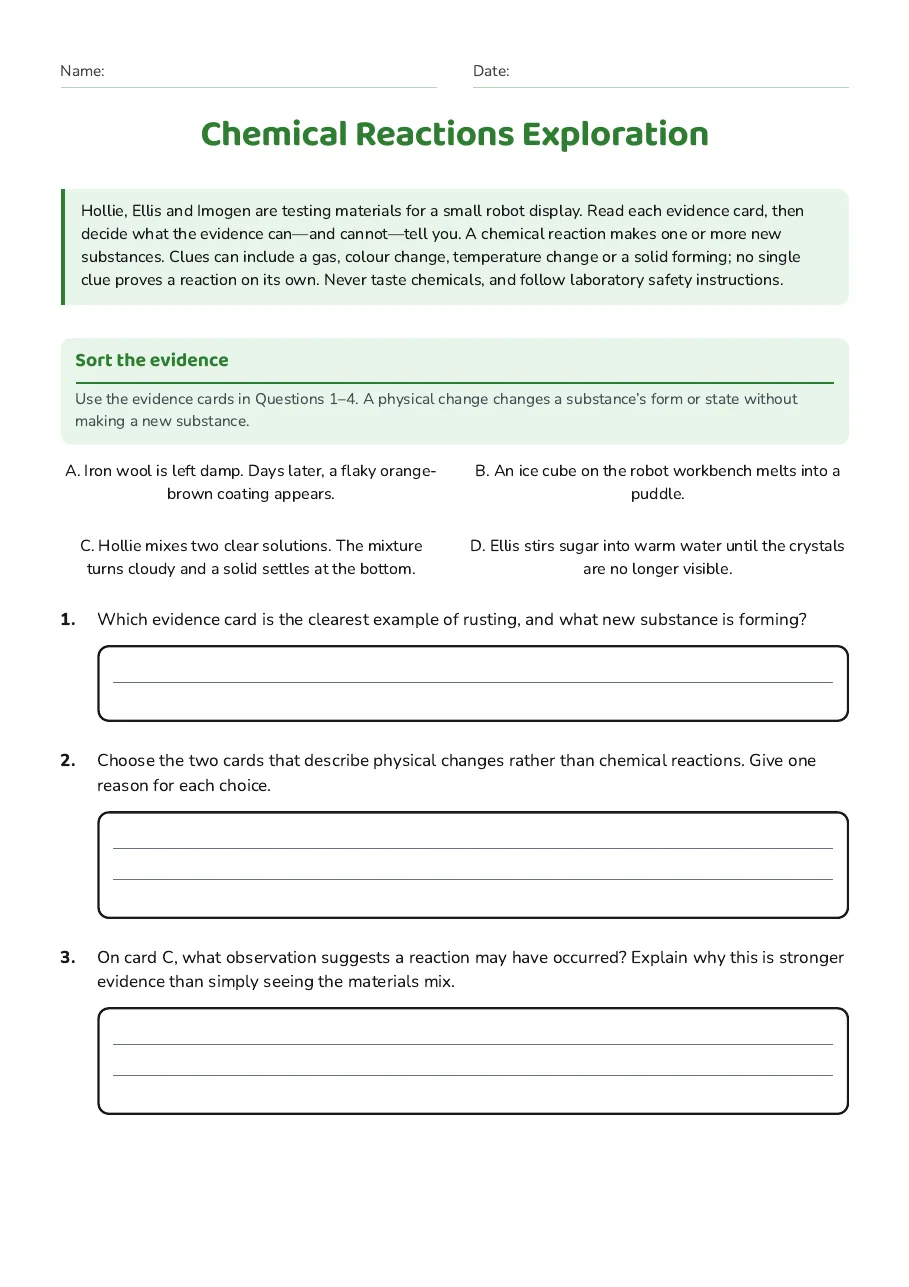
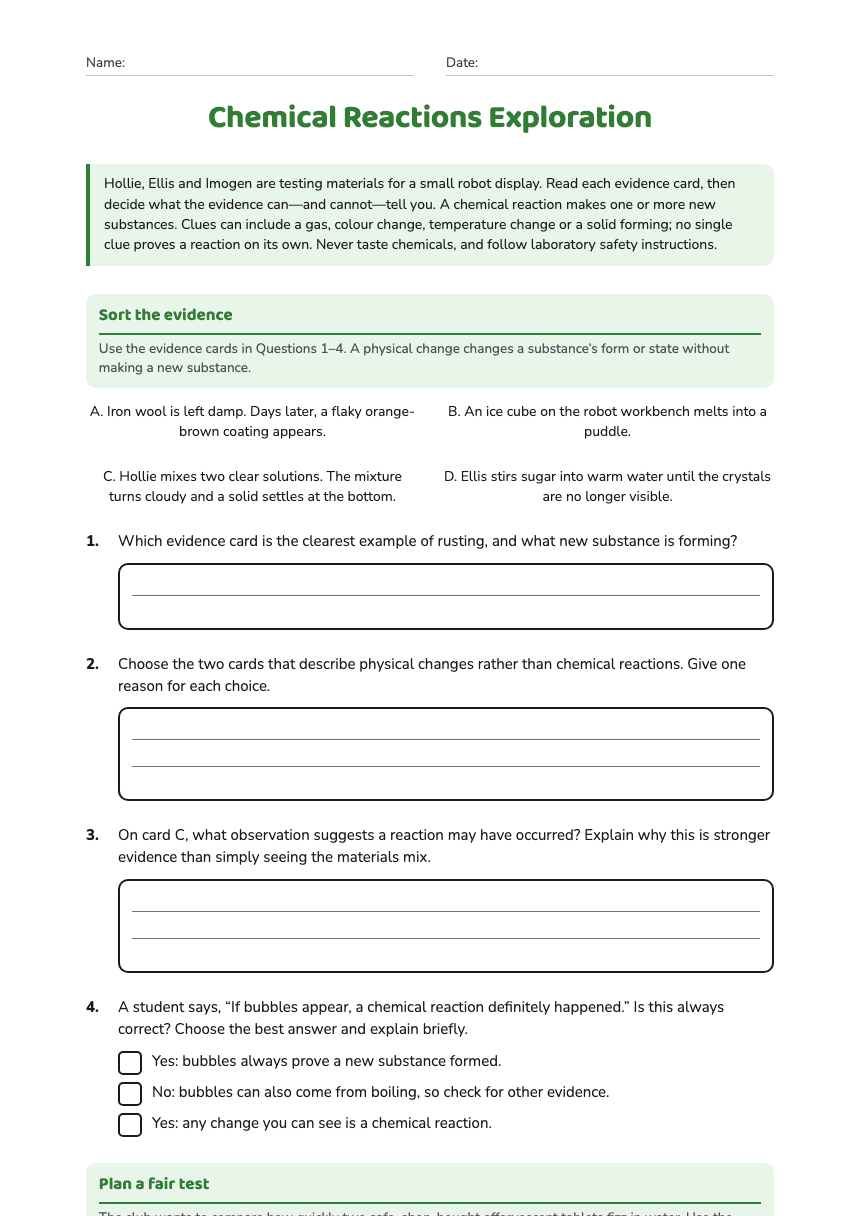
Chemical Reactions Exploration

Hollie, Ellis and Imogen are testing materials for a small robot display. Read each evidence card, then decide what the evidence can—and cannot—tell you. A chemical reaction makes one or more new substances. Clues can include a gas, colour change, temperature change or a solid forming; no single clue proves a reaction on its own. Never taste chemicals, and follow laboratory safety instructions.

Sort the evidence

Use the evidence cards in Questions 1–4. A physical change changes a substance’s form or state without making a new substance.

A. Iron wool is left damp. Days later, a flaky orange-brown coating appears.

B. An ice cube on the robot workbench melts into a puddle.

C. Hollie mixes two clear solutions. The mixture turns cloudy and a solid settles at the bottom.

D. Ellis stirs sugar into warm water until the crystals are no longer visible.

1.Which evidence card is the clearest example of rusting, and what new substance is forming?
2.Choose the two cards that describe physical changes rather than chemical reactions. Give one reason for each choice.
3.On card C, what observation suggests a reaction may have occurred? Explain why this is stronger evidence than simply seeing the materials mix.
4.A student says, “If bubbles appear, a chemical reaction definitely happened.” Is this always correct? Choose the best answer and explain briefly.
  • Yes: bubbles always prove a new substance formed.
  • No: bubbles can also come from boiling, so check for other evidence.
  • Yes: any change you can see is a chemical reaction.

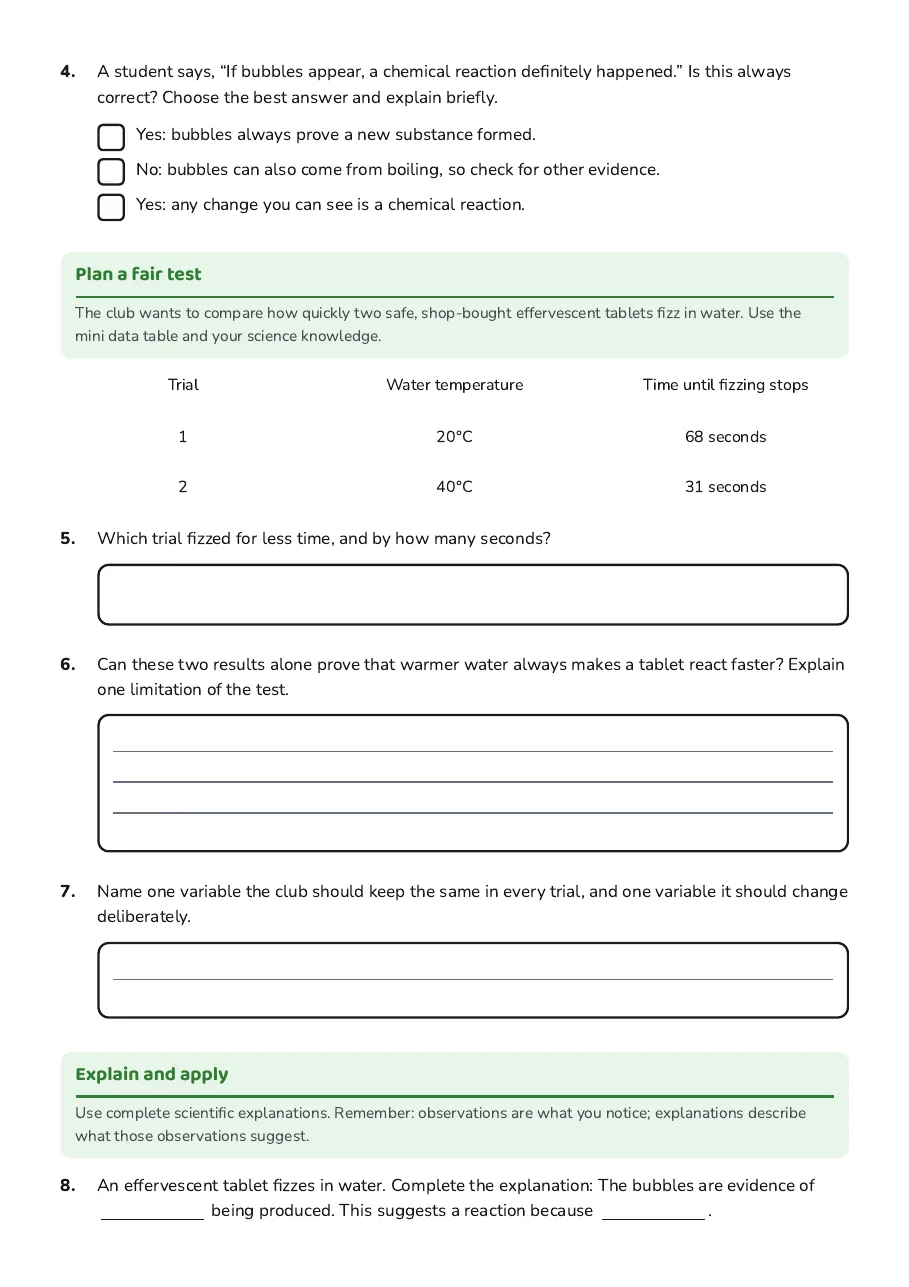
Plan a fair test

The club wants to compare how quickly two safe, shop-bought effervescent tablets fizz in water. Use the mini data table and your science knowledge.

Trial

Water temperature

Time until fizzing stops

1

20°C

68 seconds

2

40°C

31 seconds

5.Which trial fizzed for less time, and by how many seconds?
6.Can these two results alone prove that warmer water always makes a tablet react faster? Explain one limitation of the test.
7.Name one variable the club should keep the same in every trial, and one variable it should change deliberately.

Explain and apply

Use complete scientific explanations. Remember: observations are what you notice; explanations describe what those observations suggest.

8.An effervescent tablet fizzes in water. Complete the explanation: The bubbles are evidence of being produced. This suggests a reaction because .
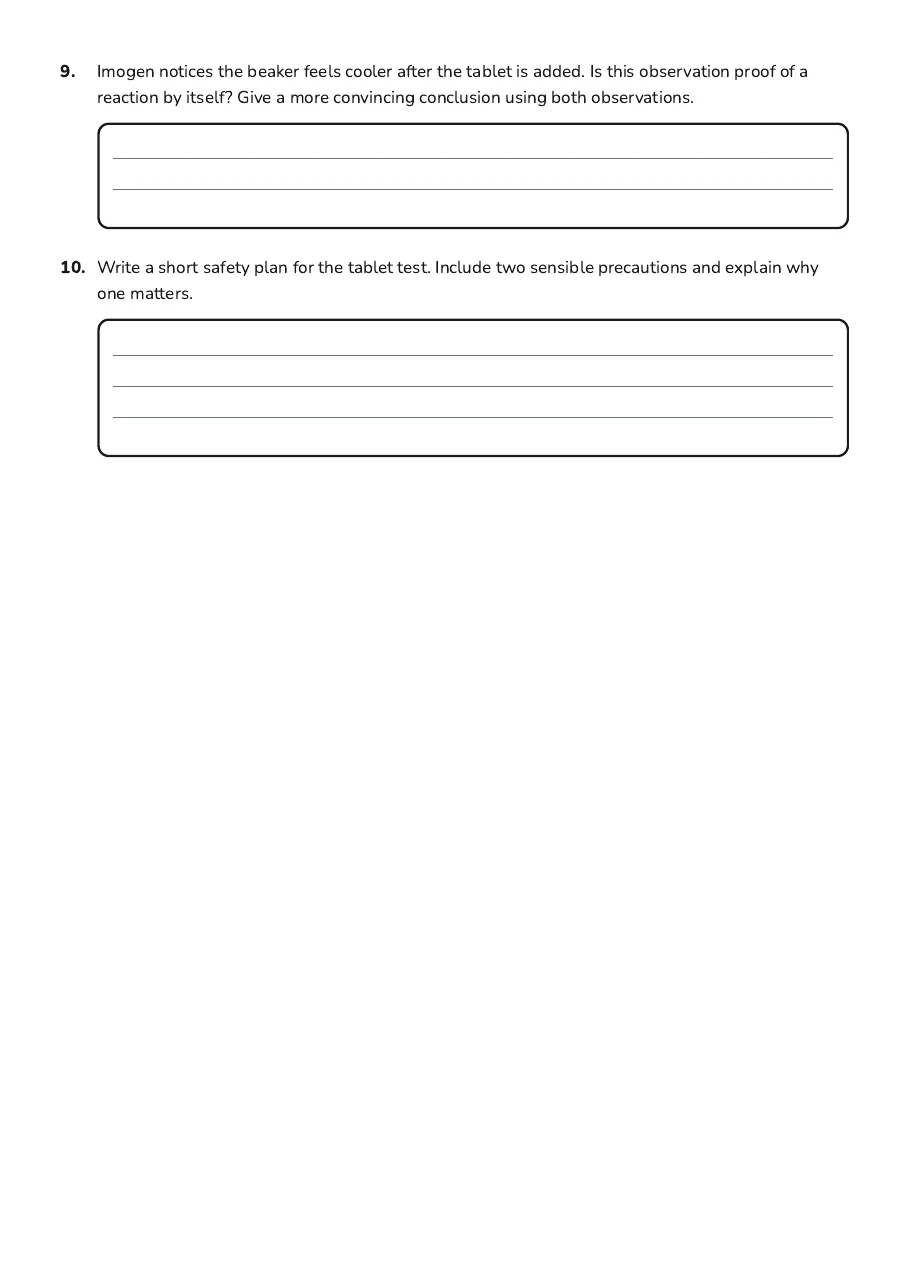
9.Imogen notices the beaker feels cooler after the tablet is added. Is this observation proof of a reaction by itself? Give a more convincing conclusion using both observations.
10.Write a short safety plan for the tablet test. Include two sensible precautions and explain why one matters.

3 printable pages

  • Chemical Reactions Exploration, page 1 of 3: Sort the evidence

    Page 1

  • Chemical Reactions Exploration, page 2 of 3: Plan a fair test, Explain and apply

    Page 2

  • Chemical Reactions Exploration, page 3 of 3: 9. Imogen notices the beaker feels cooler after the tablet is added. Is this observation…

    Page 3

About This Worksheet

Free in Kuraplan

Sign up free, grab the PDF, and customize it for your class.

Print-Ready

Formatted for standard paper. Clean layout, easy to read.

AI-Generated

Created with Kuraplan's AI, designed for real classroom use.

For Teachers & Parents

Use in classrooms, for homework, tutoring, or homeschool.

Need a custom version of this worksheet?

Kuraplan's AI generates custom worksheets in seconds — differentiated for every learner, aligned to your curriculum.

Generate Custom Worksheets — Free
No credit card Curriculum-aligned Under 60 seconds