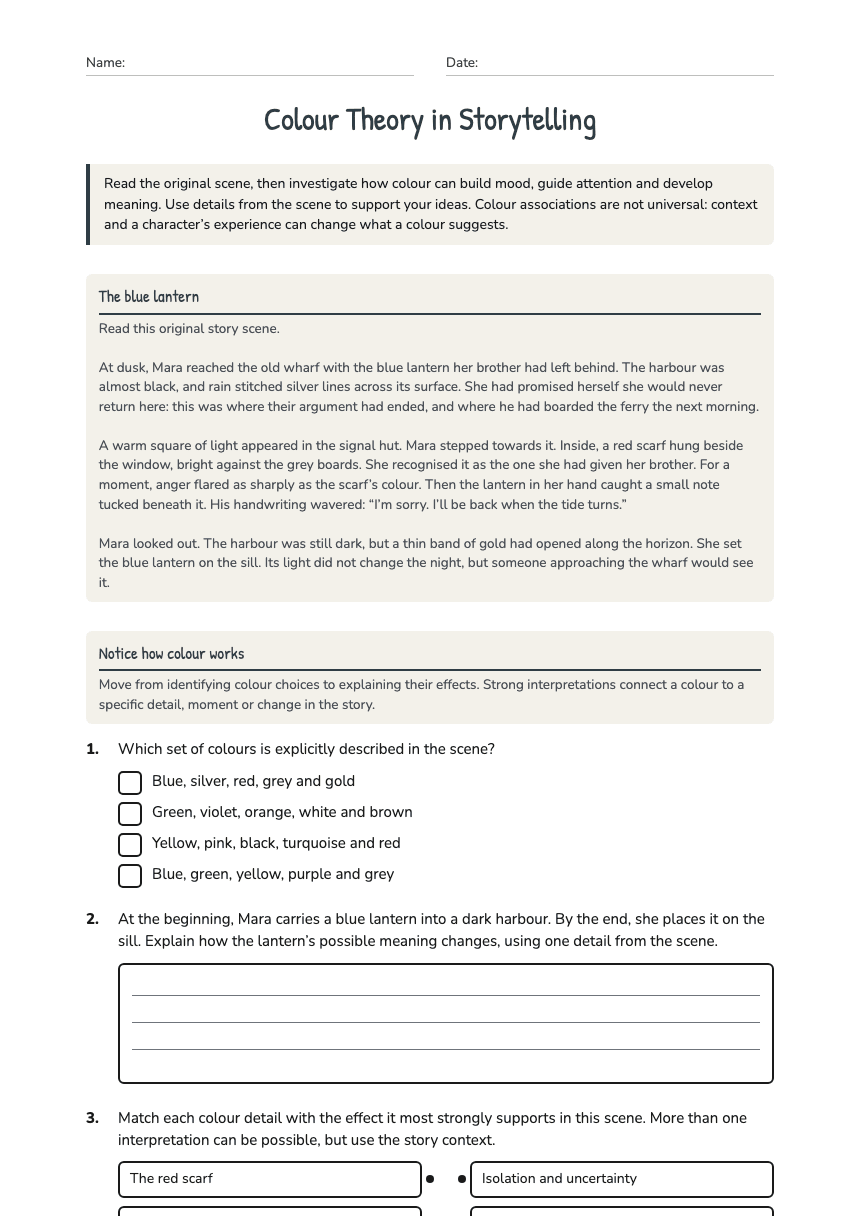
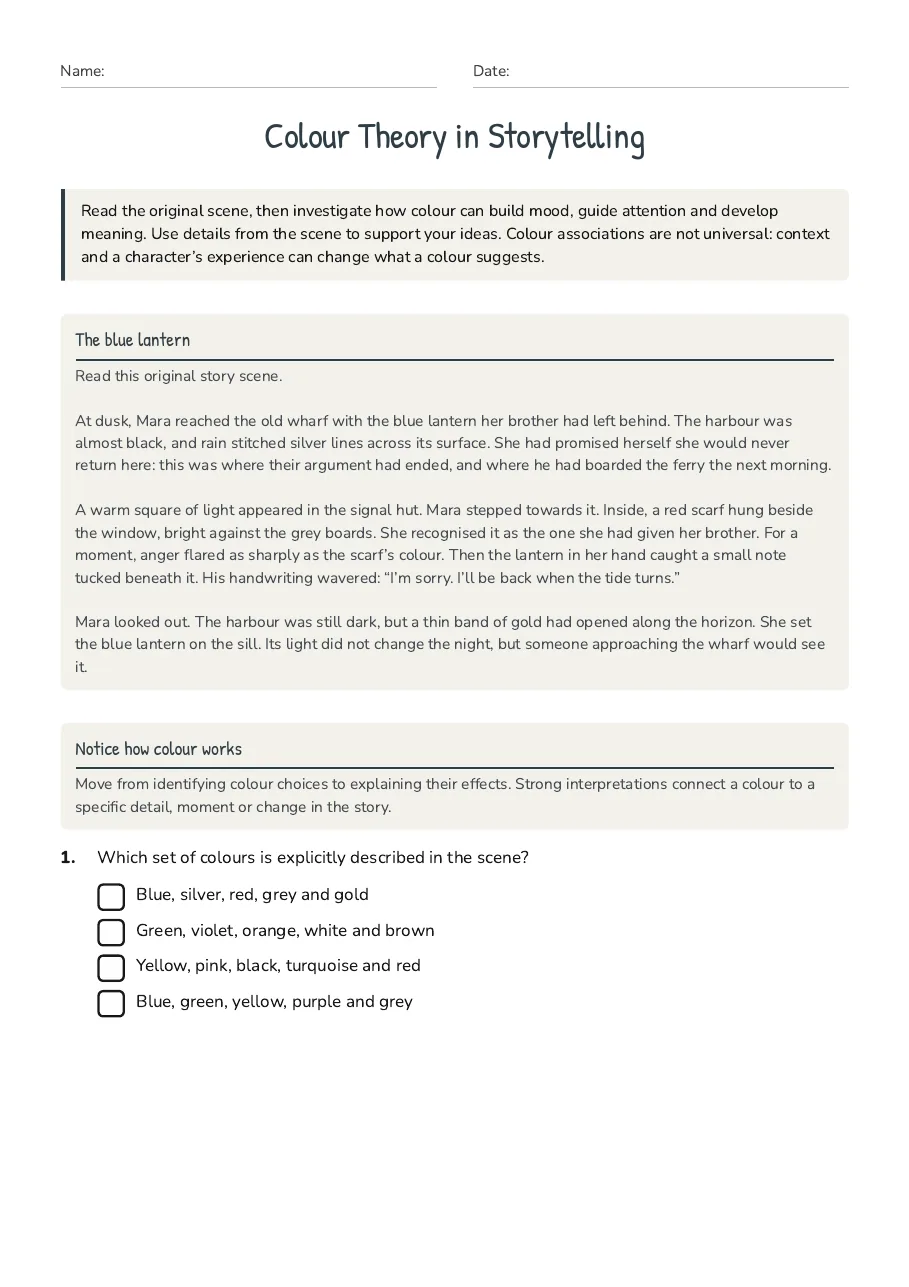
Colour Theory in Storytelling
A free english worksheet ready for your classroom. Open in Kuraplan to grab the print-ready PDF, customize it for your students, or generate a fresh version in seconds.
Colour Theory in Storytelling
The blue lantern
Read this original story scene. At dusk, Mara reached the old wharf with the blue lantern her brother had left behind. The harbour was almost black, and rain stitched silver lines across its surface. She had promised herself she would never return here: this was where their argument had ended, and where he had boarded the ferry the next morning. A warm square of light appeared in the signal hut. Mara stepped towards it. Inside, a red scarf hung beside the window, bright against the grey boards. She recognised it as the one she had given her brother. For a moment, anger flared as sharply as the scarf’s colour. Then the lantern in her hand caught a small note tucked beneath it. His handwriting wavered: “I’m sorry. I’ll be back when the tide turns.” Mara looked out. The harbour was still dark, but a thin band of gold had opened along the horizon. She set the blue lantern on the sill. Its light did not change the night, but someone approaching the wharf would see it.
Notice how colour works
Move from identifying colour choices to explaining their effects. Strong interpretations connect a colour to a specific detail, moment or change in the story.
- Blue, silver, red, grey and gold
- Green, violet, orange, white and brown
- Yellow, pink, black, turquoise and red
- Blue, green, yellow, purple and grey
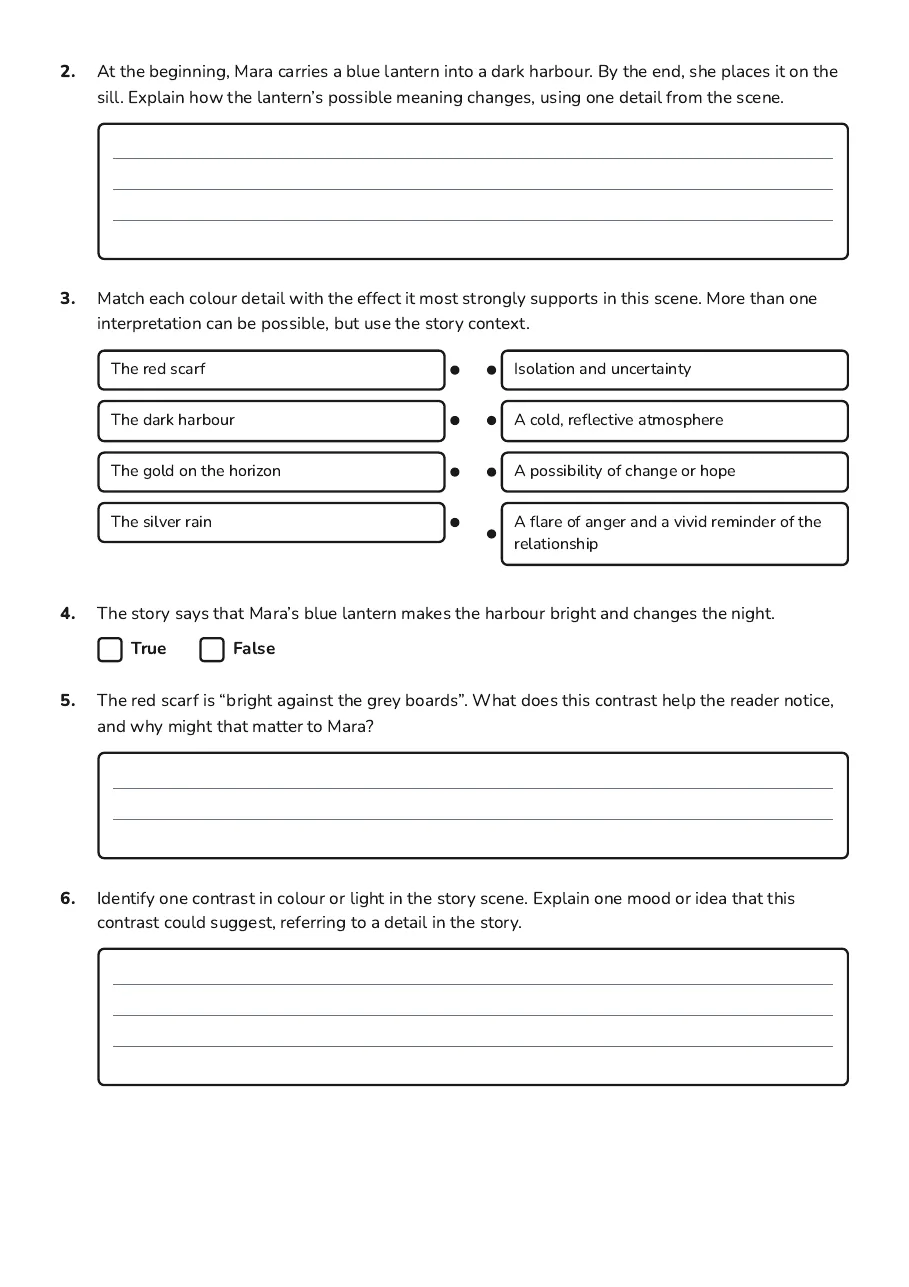
- The red scarf
- The dark harbour
- The gold on the horizon
- The silver rain
- Isolation and uncertainty
- A cold, reflective atmosphere
- A possibility of change or hope
- A flare of anger and a vivid reminder of the relationship
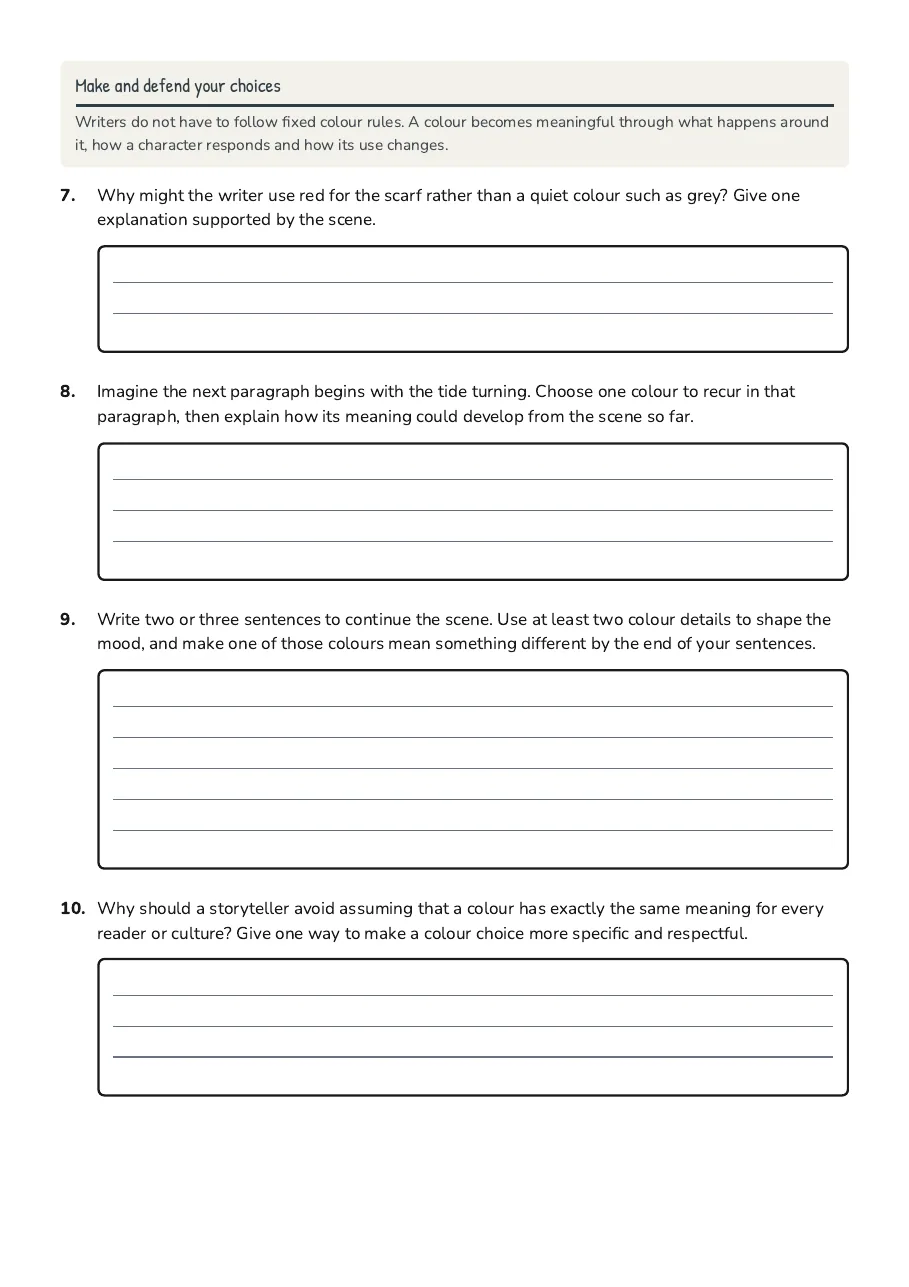
Make and defend your choices
Writers do not have to follow fixed colour rules. A colour becomes meaningful through what happens around it, how a character responds and how its use changes.
3 printable pages
Page 1
Page 2
Page 3
About This Worksheet
Free in Kuraplan
Sign up free, grab the PDF, and customize it for your class.
Print-Ready
Formatted for standard paper. Clean layout, easy to read.
AI-Generated
Created with Kuraplan's AI, designed for real classroom use.
For Teachers & Parents
Use in classrooms, for homework, tutoring, or homeschool.
Need a custom version of this worksheet?
Kuraplan's AI generates custom worksheets in seconds — differentiated for every learner, aligned to your curriculum.
Generate Custom Worksheets — Free