ScienceFreePrintable

Covalent Bonding Properties Revision

A free science worksheet ready for your classroom. Open in Kuraplan to grab the print-ready PDF, customize it for your students, or generate a fresh version in seconds.

Covalent Bonding Properties Revision worksheet preview
Name:Date:

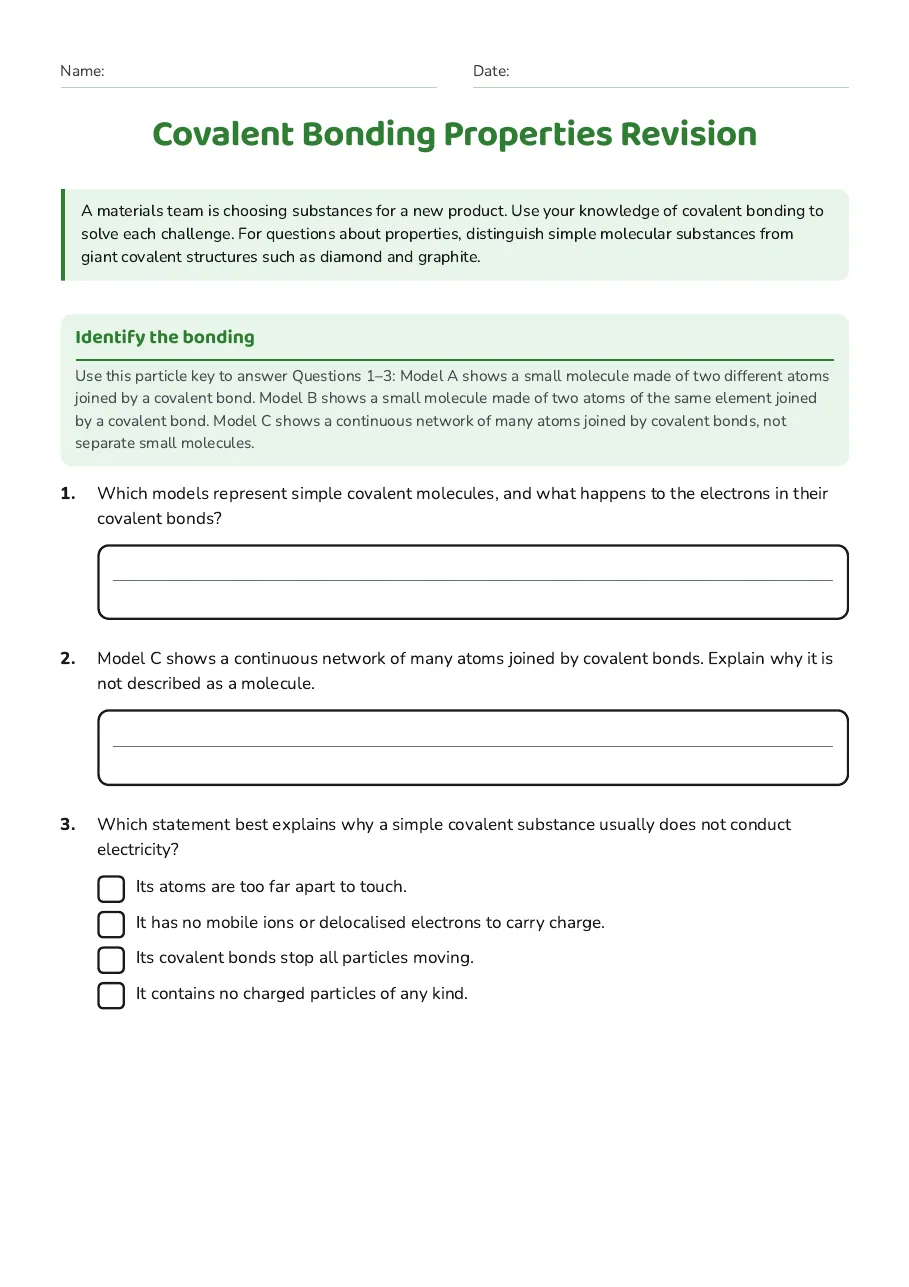
Covalent Bonding Properties Revision

A materials team is choosing substances for a new product. Use your knowledge of covalent bonding to solve each challenge. For questions about properties, distinguish simple molecular substances from giant covalent structures such as diamond and graphite.

Identify the bonding

Use this particle key to answer Questions 1–3: Model A shows a small molecule made of two different atoms joined by a covalent bond. Model B shows a small molecule made of two atoms of the same element joined by a covalent bond. Model C shows a continuous network of many atoms joined by covalent bonds, not separate small molecules.

1.Which models represent simple covalent molecules, and what happens to the electrons in their covalent bonds?
2.Model C shows a continuous network of many atoms joined by covalent bonds. Explain why it is not described as a molecule.
3.Which statement best explains why a simple covalent substance usually does not conduct electricity?
  • Its atoms are too far apart to touch.
  • It has no mobile ions or delocalised electrons to carry charge.
  • Its covalent bonds stop all particles moving.
  • It contains no charged particles of any kind.

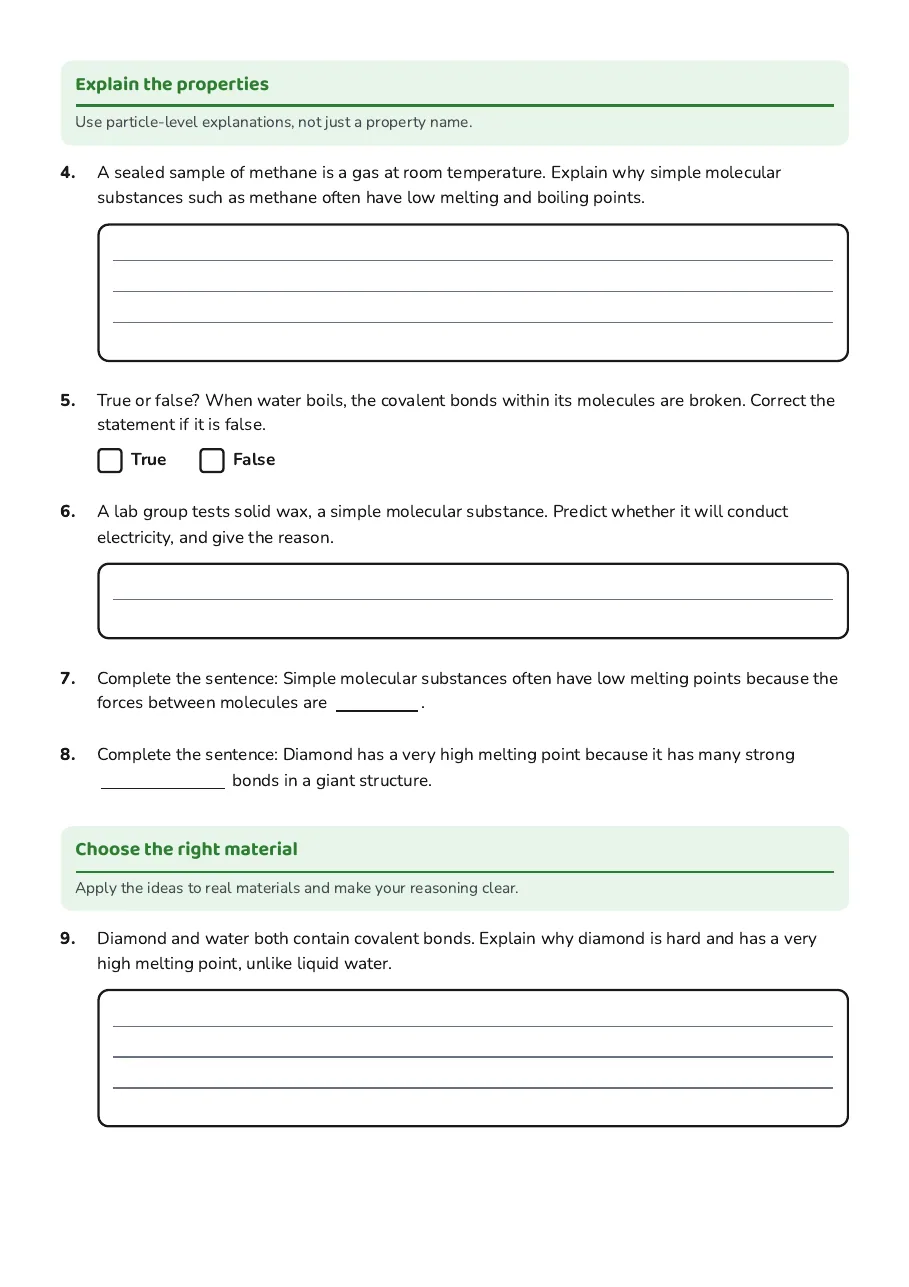
Explain the properties

Use particle-level explanations, not just a property name.

4.A sealed sample of methane is a gas at room temperature. Explain why simple molecular substances such as methane often have low melting and boiling points.
5.True or false? When water boils, the covalent bonds within its molecules are broken. Correct the statement if it is false.
TrueFalse
6.A lab group tests solid wax, a simple molecular substance. Predict whether it will conduct electricity, and give the reason.
7.Complete the sentence: Simple molecular substances often have low melting points because the forces between molecules are .
8.Complete the sentence: Diamond has a very high melting point because it has many strong bonds in a giant structure.

Choose the right material

Apply the ideas to real materials and make your reasoning clear.

9.Diamond and water both contain covalent bonds. Explain why diamond is hard and has a very high melting point, unlike liquid water.
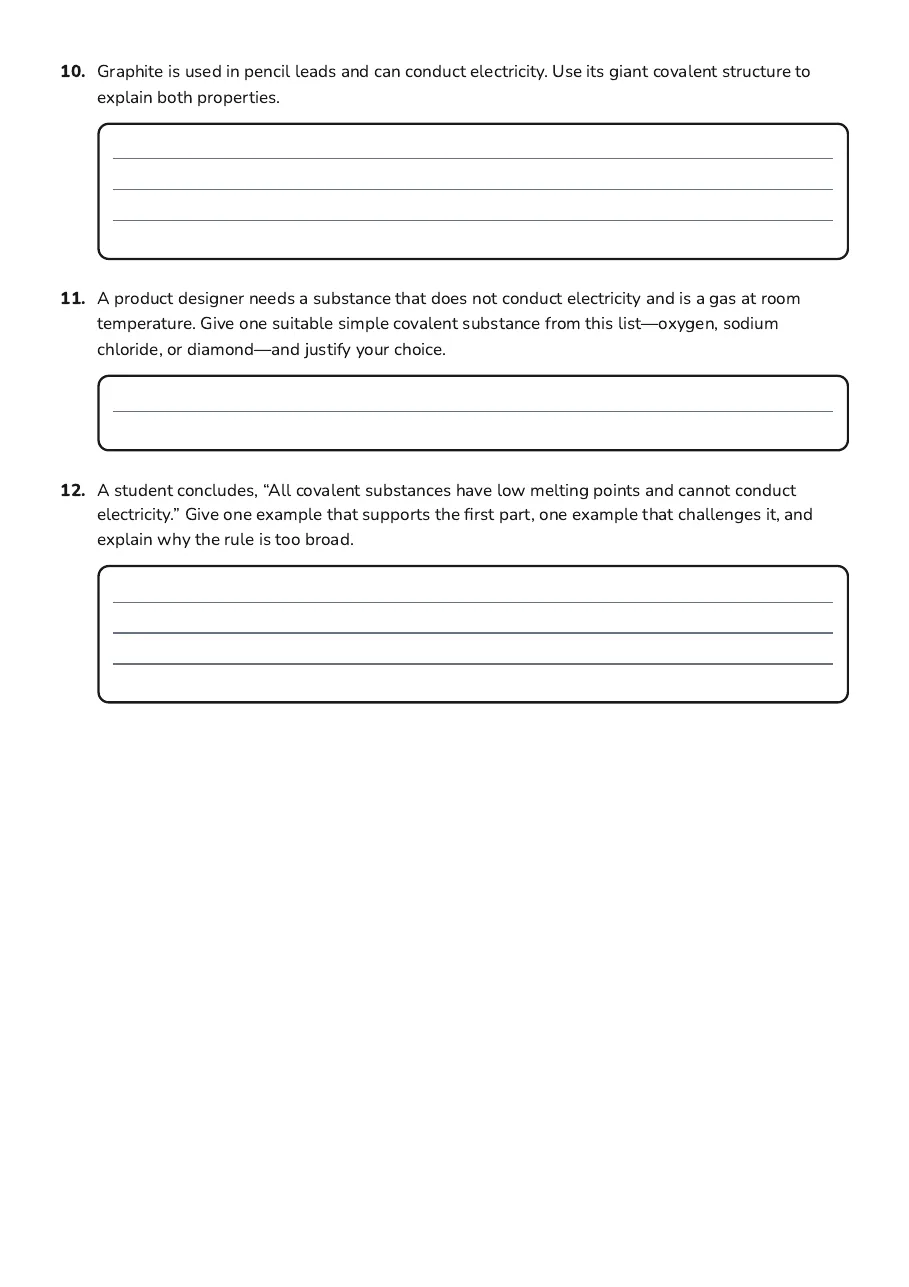
10.Graphite is used in pencil leads and can conduct electricity. Use its giant covalent structure to explain both properties.
11.A product designer needs a substance that does not conduct electricity and is a gas at room temperature. Give one suitable simple covalent substance from this list—oxygen, sodium chloride, or diamond—and justify your choice.
12.A student concludes, “All covalent substances have low melting points and cannot conduct electricity.” Give one example that supports the first part, one example that challenges it, and explain why the rule is too broad.

3 printable pages

  • Covalent Bonding Properties Revision, page 1 of 3: Identify the bonding

    Page 1

  • Covalent Bonding Properties Revision, page 2 of 3: Explain the properties, Choose the right material

    Page 2

  • Covalent Bonding Properties Revision, page 3 of 3: 10. Graphite is used in pencil leads and can conduct electricity. Use its giant covalent…

    Page 3

About This Worksheet

Free in Kuraplan

Sign up free, grab the PDF, and customize it for your class.

Print-Ready

Formatted for standard paper. Clean layout, easy to read.

AI-Generated

Created with Kuraplan's AI, designed for real classroom use.

For Teachers & Parents

Use in classrooms, for homework, tutoring, or homeschool.

Need a custom version of this worksheet?

Kuraplan's AI generates custom worksheets in seconds — differentiated for every learner, aligned to your curriculum.

Generate Custom Worksheets — Free
No credit card Curriculum-aligned Under 60 seconds