MathsFreePrintable

Data Source Evaluation

A free maths worksheet ready for your classroom. Open in Kuraplan to grab the print-ready PDF, customize it for your students, or generate a fresh version in seconds.
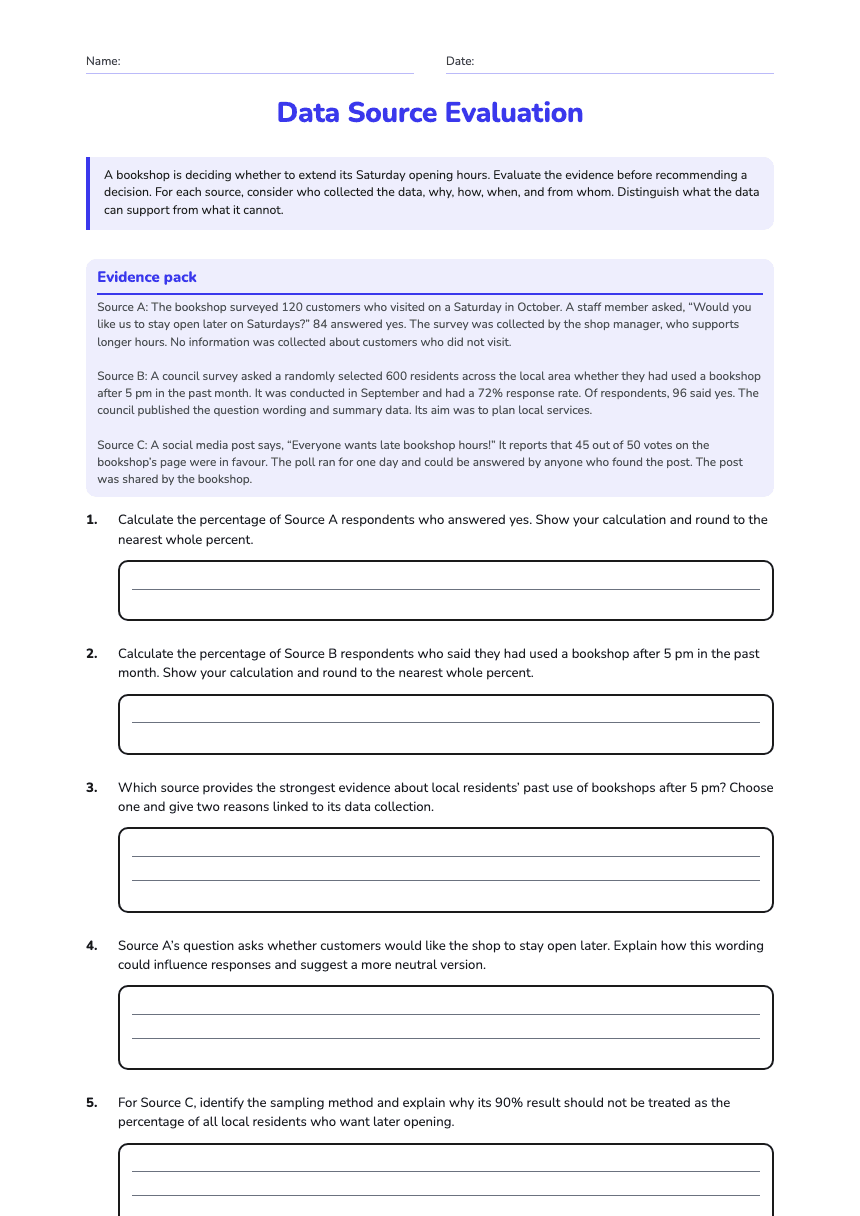
Data Source Evaluation worksheet preview
Name:Date:

Data Source Evaluation

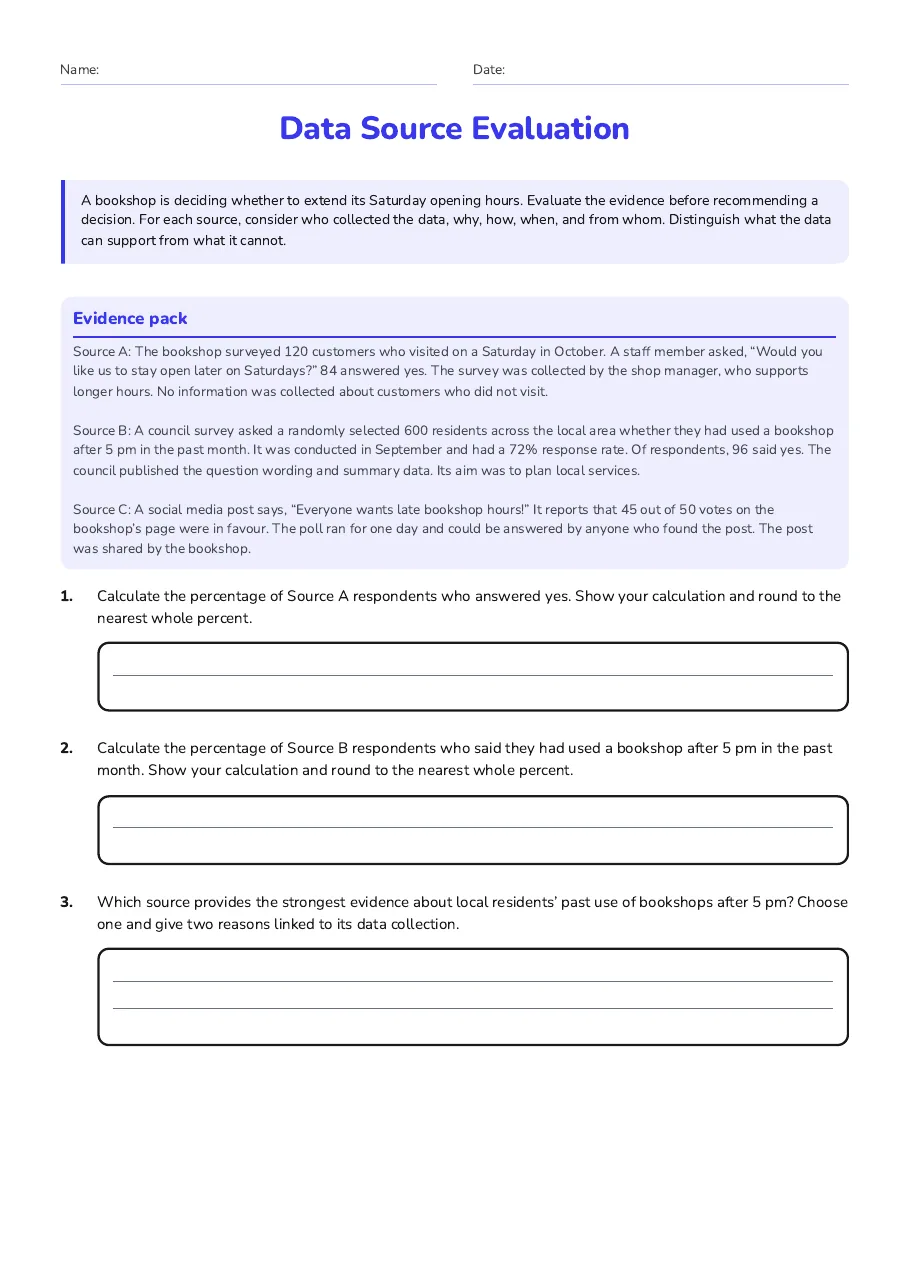
A bookshop is deciding whether to extend its Saturday opening hours. Evaluate the evidence before recommending a decision. For each source, consider who collected the data, why, how, when, and from whom. Distinguish what the data can support from what it cannot.

Evidence pack

Source A: The bookshop surveyed 120 customers who visited on a Saturday in October. A staff member asked, “Would you like us to stay open later on Saturdays?” 84 answered yes. The survey was collected by the shop manager, who supports longer hours. No information was collected about customers who did not visit. Source B: A council survey asked a randomly selected 600 residents across the local area whether they had used a bookshop after 5 pm in the past month. It was conducted in September and had a 72% response rate. Of respondents, 96 said yes. The council published the question wording and summary data. Its aim was to plan local services. Source C: A social media post says, “Everyone wants late bookshop hours!” It reports that 45 out of 50 votes on the bookshop’s page were in favour. The poll ran for one day and could be answered by anyone who found the post. The post was shared by the bookshop.

1.Calculate the percentage of Source A respondents who answered yes. Show your calculation and round to the nearest whole percent.
2.Calculate the percentage of Source B respondents who said they had used a bookshop after 5 pm in the past month. Show your calculation and round to the nearest whole percent.
3.Which source provides the strongest evidence about local residents’ past use of bookshops after 5 pm? Choose one and give two reasons linked to its data collection.
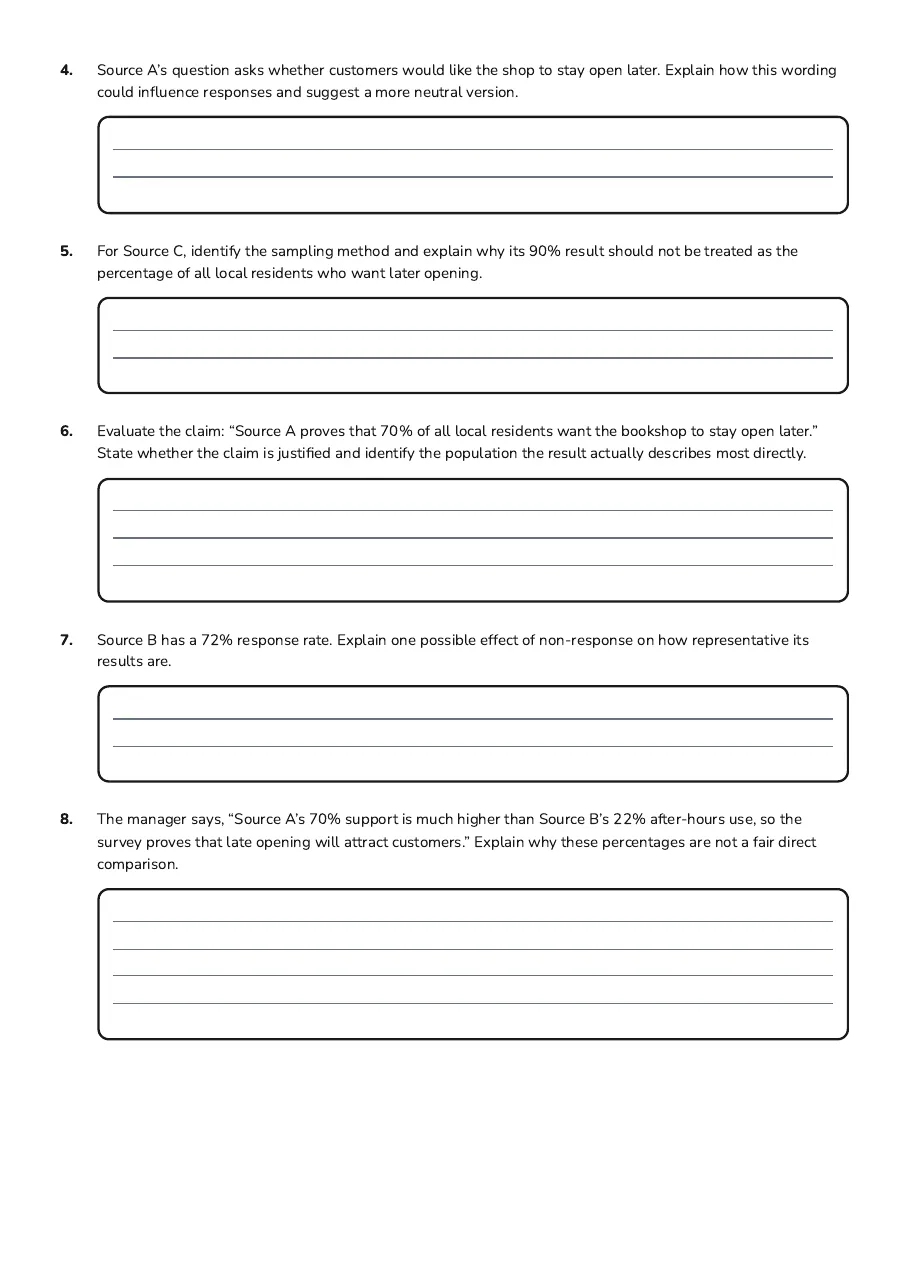
4.Source A’s question asks whether customers would like the shop to stay open later. Explain how this wording could influence responses and suggest a more neutral version.
5.For Source C, identify the sampling method and explain why its 90% result should not be treated as the percentage of all local residents who want later opening.
6.Evaluate the claim: “Source A proves that 70% of all local residents want the bookshop to stay open later.” State whether the claim is justified and identify the population the result actually describes most directly.
7.Source B has a 72% response rate. Explain one possible effect of non-response on how representative its results are.
8.The manager says, “Source A’s 70% support is much higher than Source B’s 22% after-hours use, so the survey proves that late opening will attract customers.” Explain why these percentages are not a fair direct comparison.
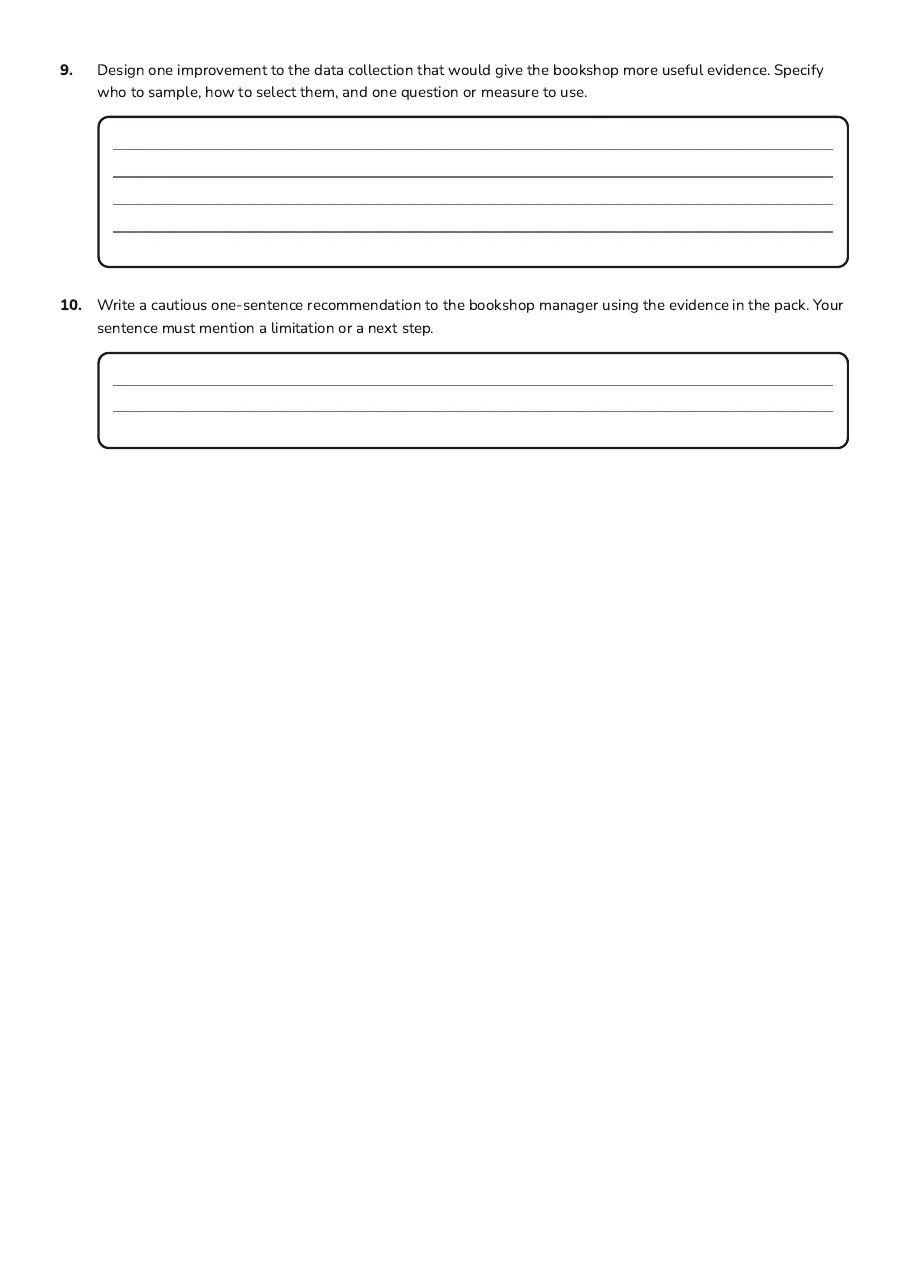
9.Design one improvement to the data collection that would give the bookshop more useful evidence. Specify who to sample, how to select them, and one question or measure to use.
10.Write a cautious one-sentence recommendation to the bookshop manager using the evidence in the pack. Your sentence must mention a limitation or a next step.

3 printable pages

  • Data Source Evaluation, page 1 of 3: Evidence pack

    Page 1

  • Data Source Evaluation, page 2 of 3: 4. Source A’s question asks whether customers would like the shop to stay open later.…

    Page 2

  • Data Source Evaluation, page 3 of 3: 9. Design one improvement to the data collection that would give the bookshop more useful…

    Page 3

About This Worksheet

Free in Kuraplan

Sign up free, grab the PDF, and customize it for your class.

Print-Ready

Formatted for standard paper. Clean layout, easy to read.

AI-Generated

Created with Kuraplan's AI, designed for real classroom use.

For Teachers & Parents

Use in classrooms, for homework, tutoring, or homeschool.

Need a custom version of this worksheet?

Kuraplan's AI generates custom worksheets in seconds — differentiated for every learner, aligned to your curriculum.

Generate Custom Worksheets — Free
No credit card Curriculum-aligned Under 60 seconds