Drug Development Process
A free science worksheet ready for your classroom. Open in Kuraplan to grab the print-ready PDF, customize it for your students, or generate a fresh version in seconds.
Drug Development Process
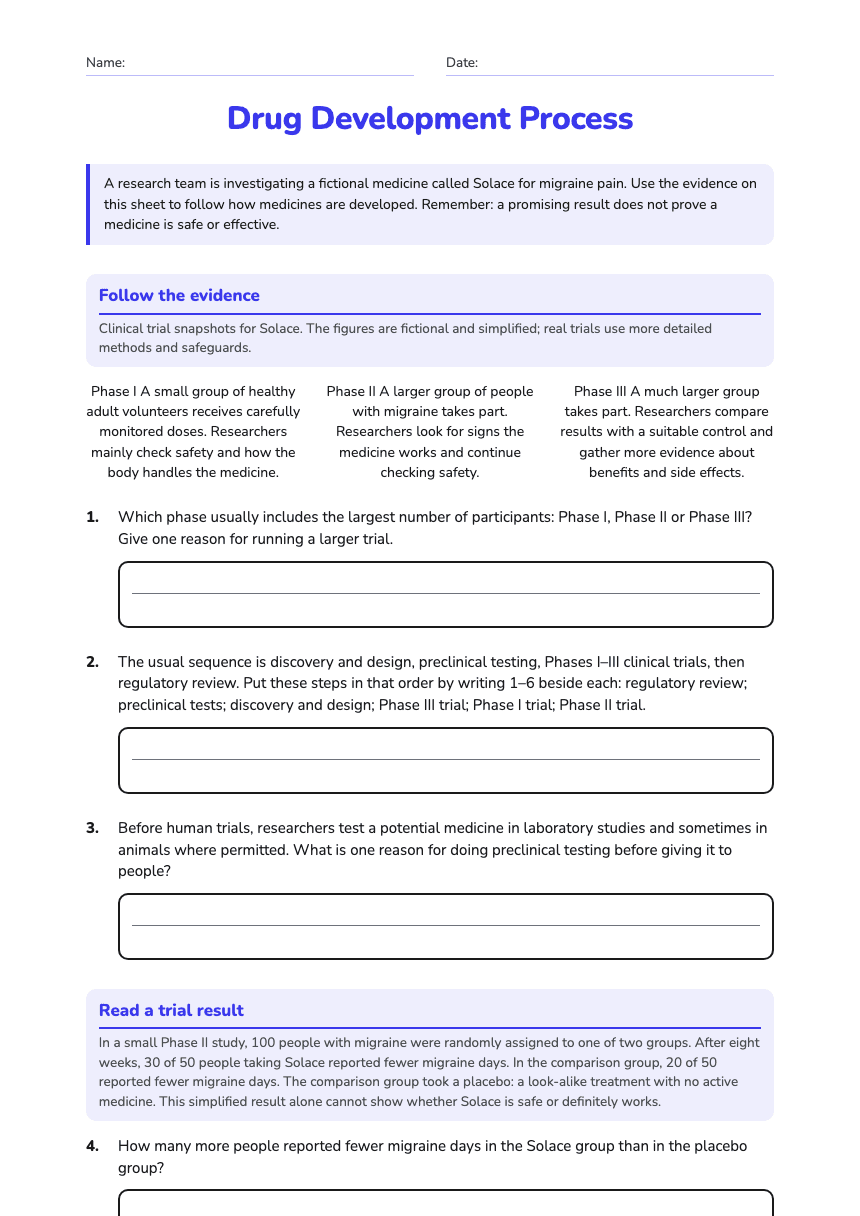
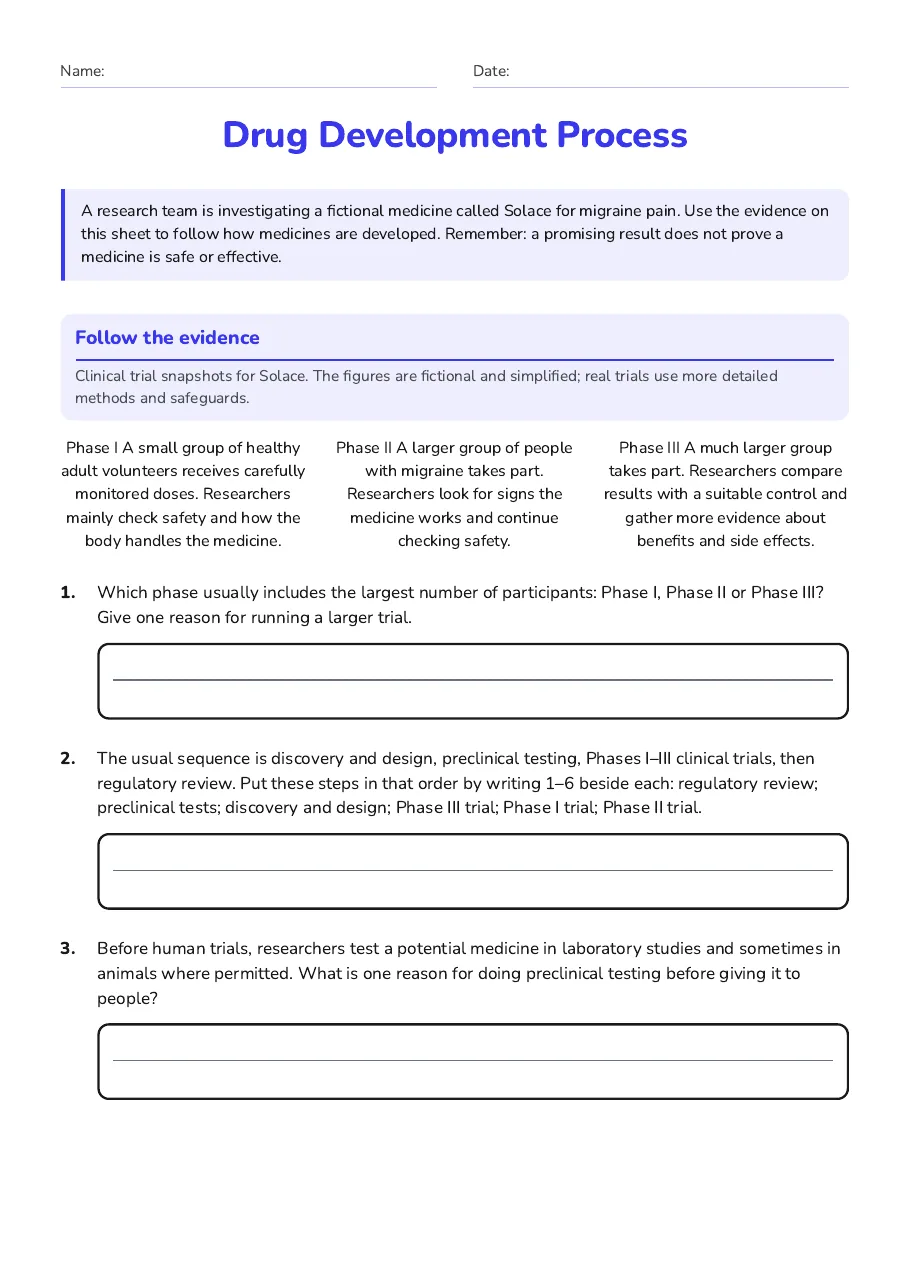
Follow the evidence
Clinical trial snapshots for Solace. The figures are fictional and simplified; real trials use more detailed methods and safeguards.
Phase I A small group of healthy adult volunteers receives carefully monitored doses. Researchers mainly check safety and how the body handles the medicine.
Phase II A larger group of people with migraine takes part. Researchers look for signs the medicine works and continue checking safety.
Phase III A much larger group takes part. Researchers compare results with a suitable control and gather more evidence about benefits and side effects.
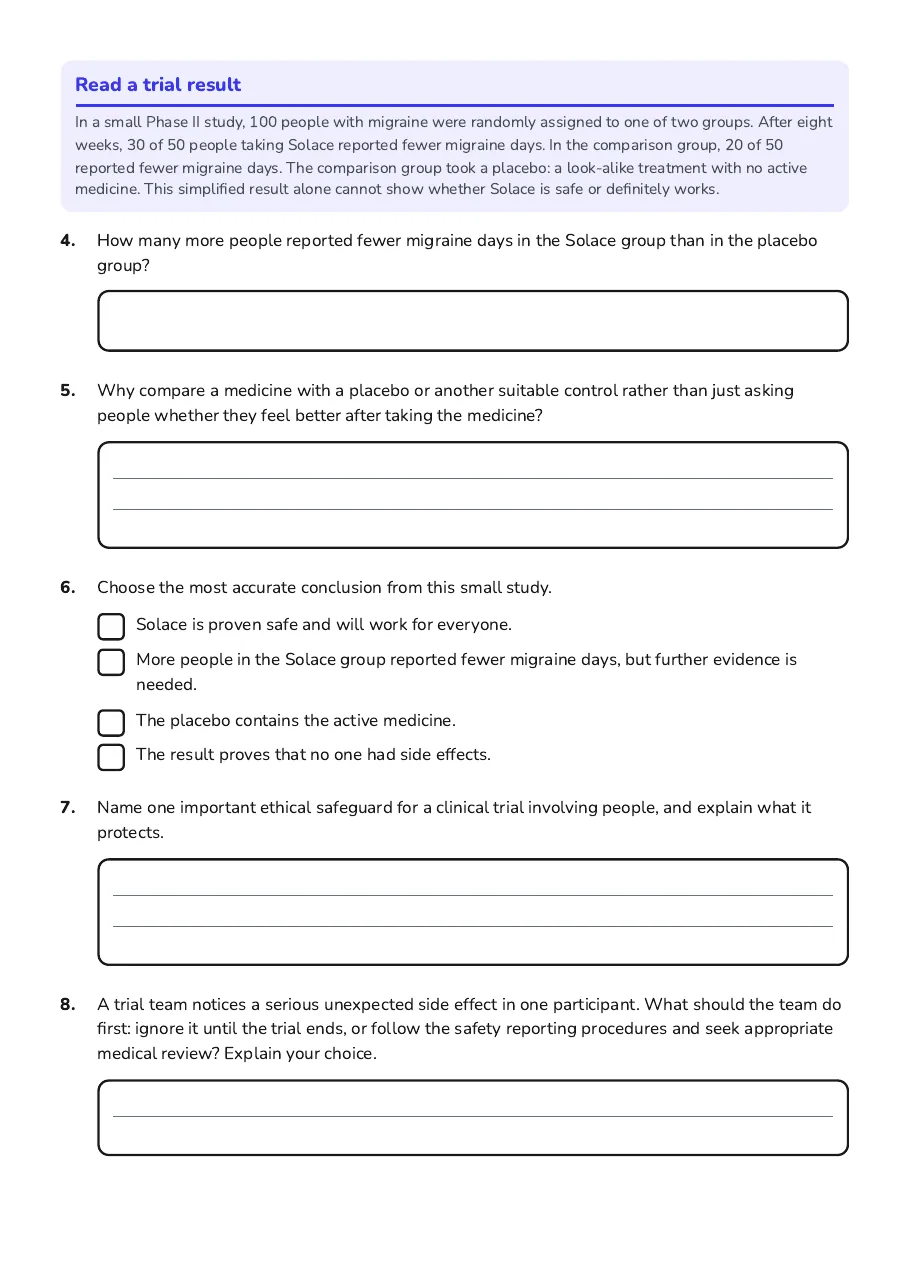
Read a trial result
In a small Phase II study, 100 people with migraine were randomly assigned to one of two groups. After eight weeks, 30 of 50 people taking Solace reported fewer migraine days. In the comparison group, 20 of 50 reported fewer migraine days. The comparison group took a placebo: a look-alike treatment with no active medicine. This simplified result alone cannot show whether Solace is safe or definitely works.
- Solace is proven safe and will work for everyone.
- More people in the Solace group reported fewer migraine days, but further evidence is needed.
- The placebo contains the active medicine.
- The result proves that no one had side effects.
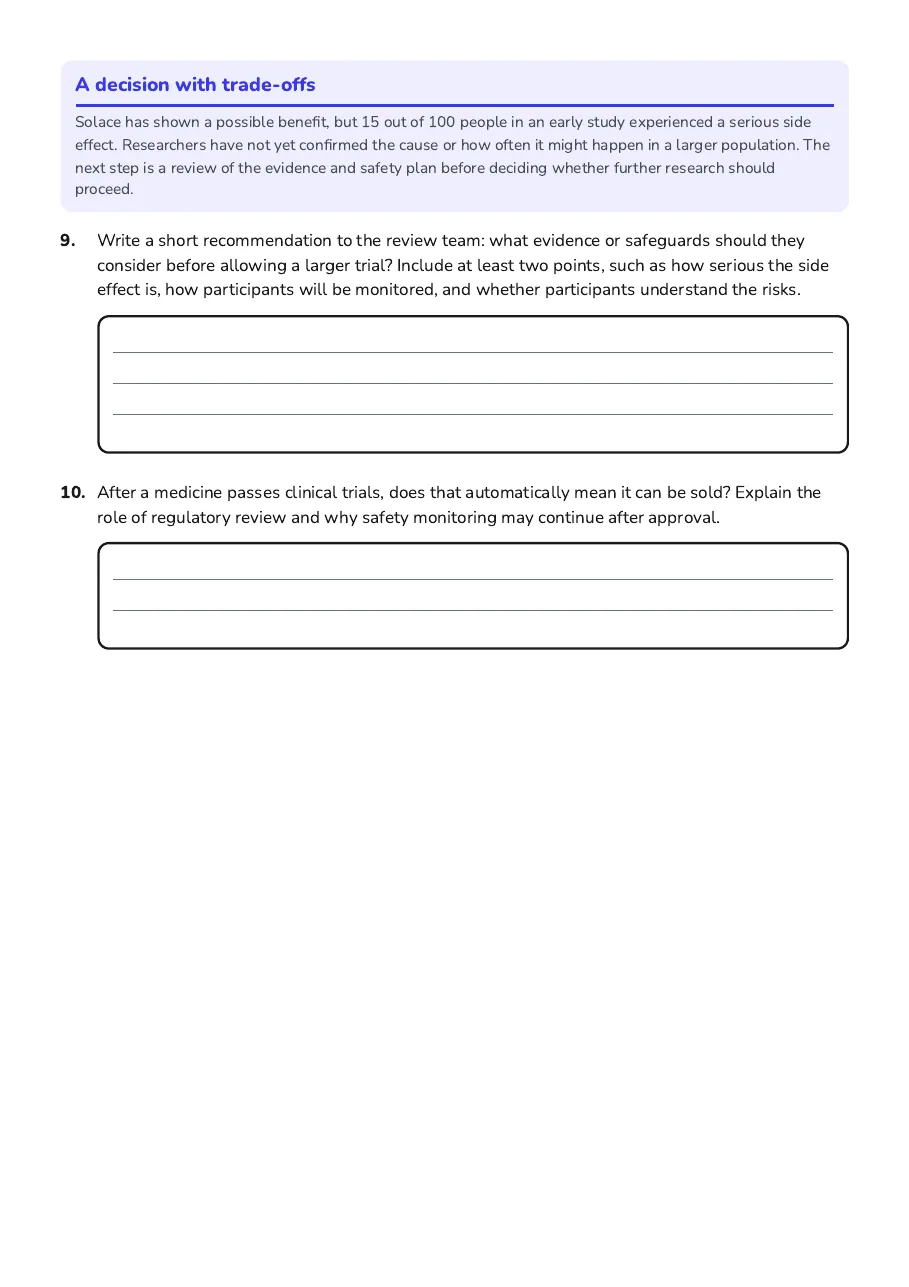
A decision with trade-offs
Solace has shown a possible benefit, but 15 out of 100 people in an early study experienced a serious side effect. Researchers have not yet confirmed the cause or how often it might happen in a larger population. The next step is a review of the evidence and safety plan before deciding whether further research should proceed.
3 printable pages
Page 1
Page 2
Page 3
About This Worksheet
Free in Kuraplan
Sign up free, grab the PDF, and customize it for your class.
Print-Ready
Formatted for standard paper. Clean layout, easy to read.
AI-Generated
Created with Kuraplan's AI, designed for real classroom use.
For Teachers & Parents
Use in classrooms, for homework, tutoring, or homeschool.
Need a custom version of this worksheet?
Kuraplan's AI generates custom worksheets in seconds — differentiated for every learner, aligned to your curriculum.
Generate Custom Worksheets — Free