ScienceFreePrintable
Earth Science Test
A free science worksheet ready for your classroom. Open in Kuraplan to grab the print-ready PDF, customize it for your students, or generate a fresh version in seconds.
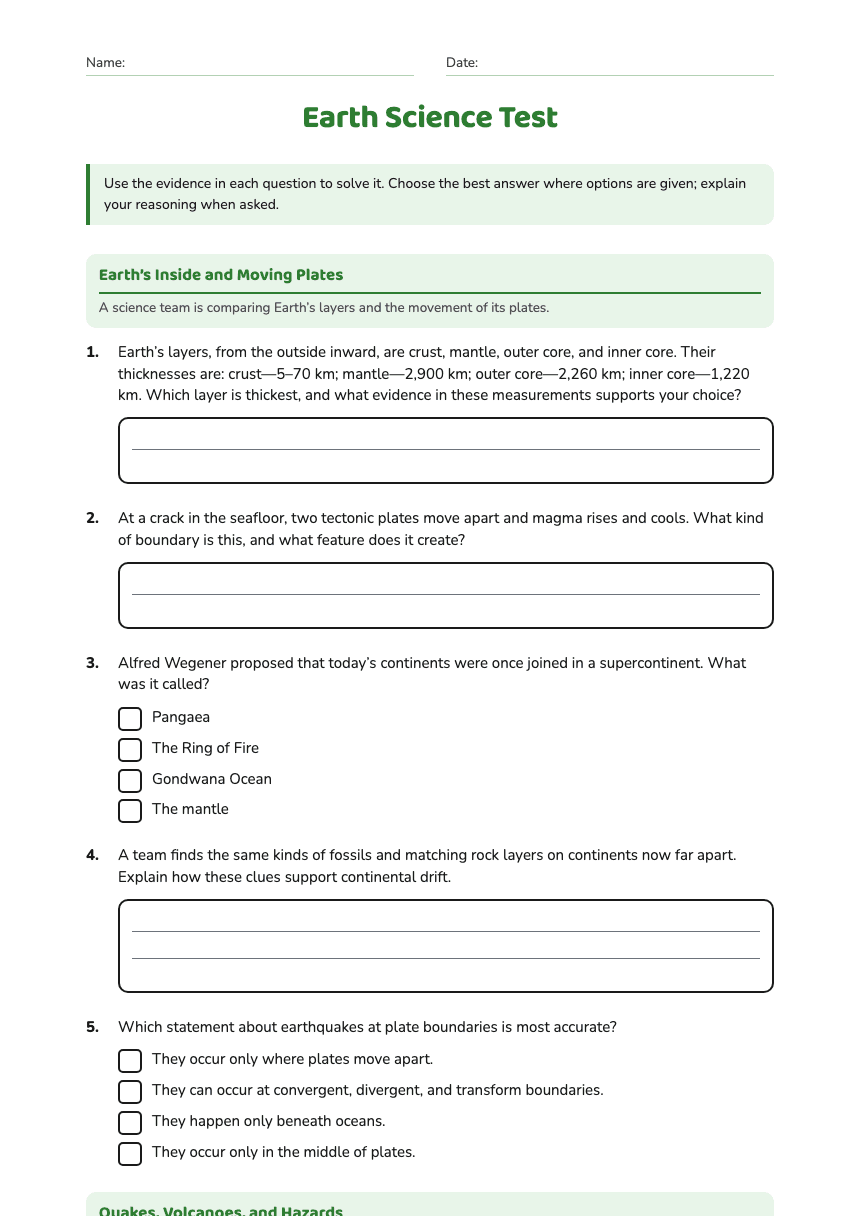
Name:Date:
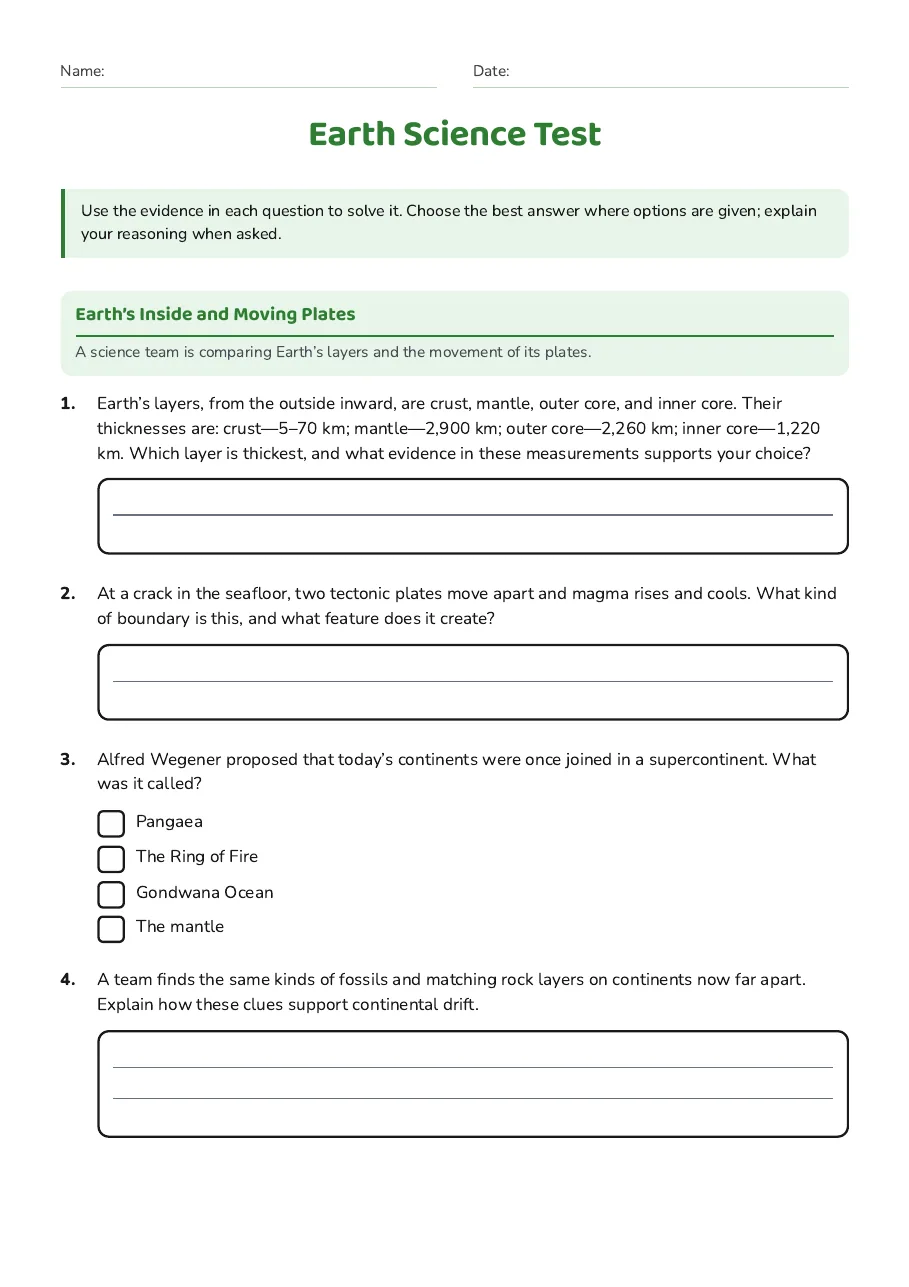
Earth Science Test
Use the evidence in each question to solve it. Choose the best answer where options are given; explain your reasoning when asked.
Earth’s Inside and Moving Plates
A science team is comparing Earth’s layers and the movement of its plates.
1.Earth’s layers, from the outside inward, are crust, mantle, outer core, and inner core. Their thicknesses are: crust—5–70 km; mantle—2,900 km; outer core—2,260 km; inner core—1,220 km. Which layer is thickest, and what evidence in these measurements supports your choice?
2.At a crack in the seafloor, two tectonic plates move apart and magma rises and cools. What kind of boundary is this, and what feature does it create?
3.Alfred Wegener proposed that today’s continents were once joined in a supercontinent. What was it called?
- Pangaea
- The Ring of Fire
- Gondwana Ocean
- The mantle
4.A team finds the same kinds of fossils and matching rock layers on continents now far apart. Explain how these clues support continental drift.
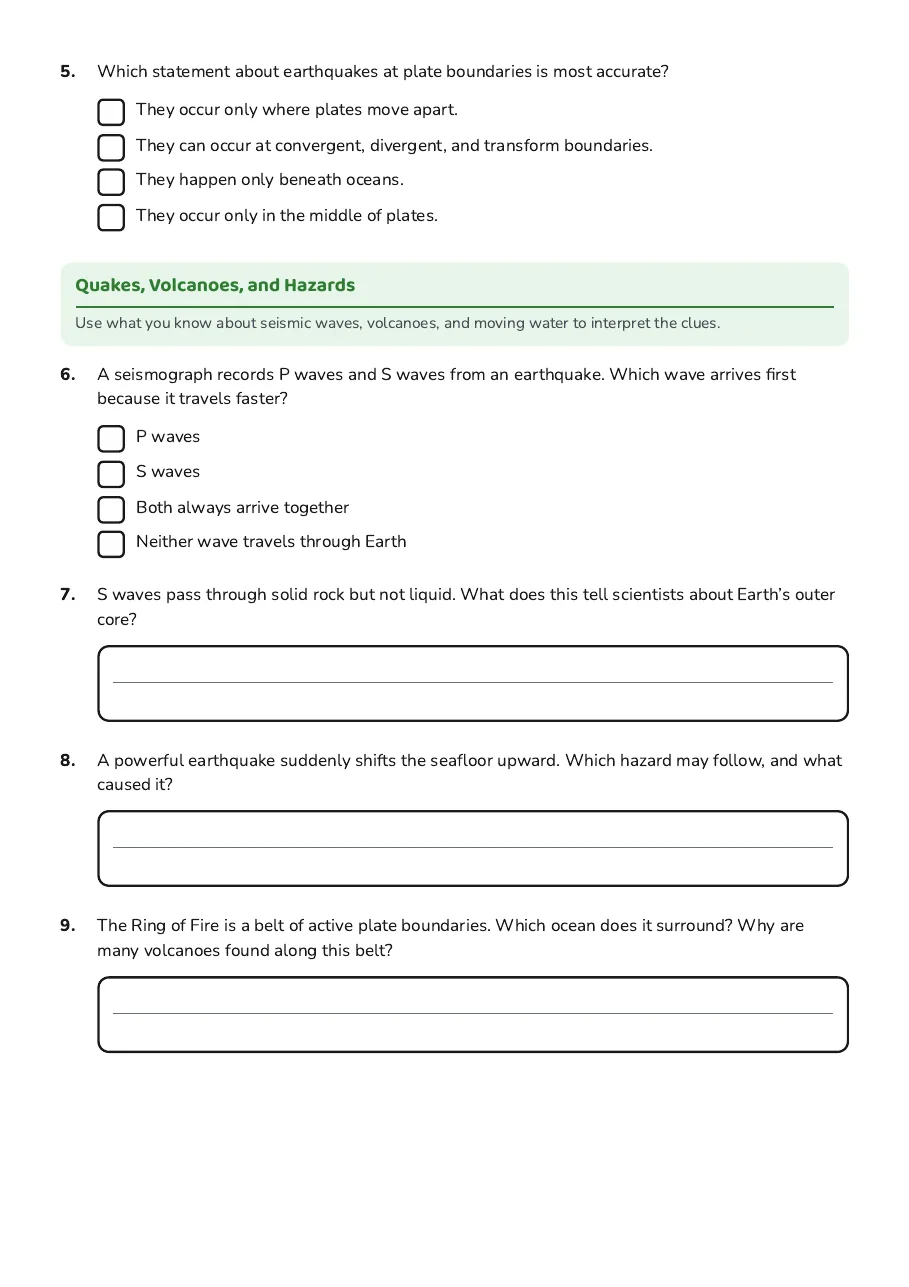
5.Which statement about earthquakes at plate boundaries is most accurate?
- They occur only where plates move apart.
- They can occur at convergent, divergent, and transform boundaries.
- They happen only beneath oceans.
- They occur only in the middle of plates.
Quakes, Volcanoes, and Hazards
Use what you know about seismic waves, volcanoes, and moving water to interpret the clues.
6.A seismograph records P waves and S waves from an earthquake. Which wave arrives first because it travels faster?
- P waves
- S waves
- Both always arrive together
- Neither wave travels through Earth
7.S waves pass through solid rock but not liquid. What does this tell scientists about Earth’s outer core?
8.A powerful earthquake suddenly shifts the seafloor upward. Which hazard may follow, and what caused it?
9.The Ring of Fire is a belt of active plate boundaries. Which ocean does it surround? Why are many volcanoes found along this belt?
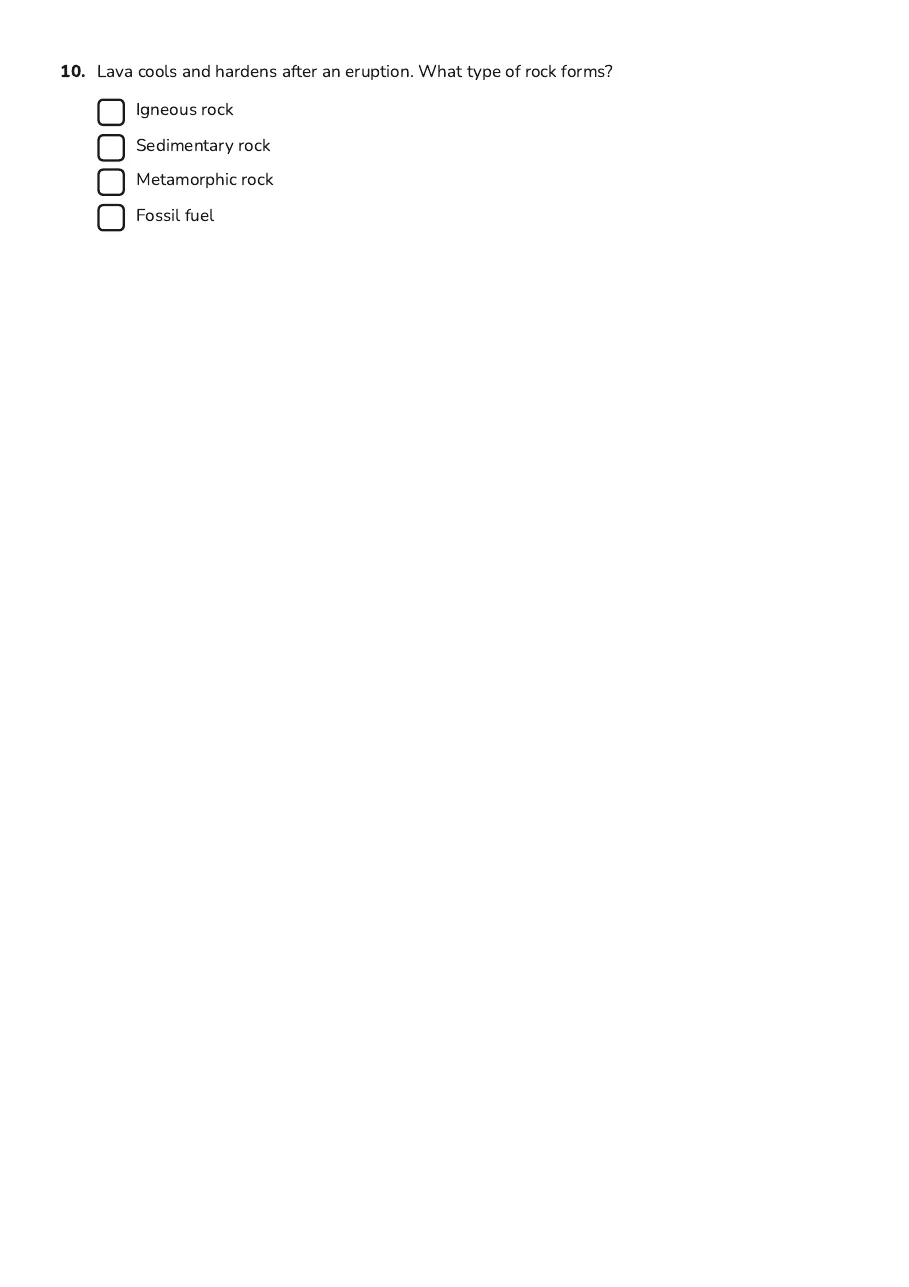
10.Lava cools and hardens after an eruption. What type of rock forms?
- Igneous rock
- Sedimentary rock
- Metamorphic rock
- Fossil fuel
3 printable pages
Page 1
Page 2
Page 3
About This Worksheet
Free in Kuraplan
Sign up free, grab the PDF, and customize it for your class.
Print-Ready
Formatted for standard paper. Clean layout, easy to read.
AI-Generated
Created with Kuraplan's AI, designed for real classroom use.
For Teachers & Parents
Use in classrooms, for homework, tutoring, or homeschool.
Need a custom version of this worksheet?
Kuraplan's AI generates custom worksheets in seconds — differentiated for every learner, aligned to your curriculum.
Generate Custom Worksheets — Free No credit card Curriculum-aligned Under 60 seconds