ScienceFreePrintable

Earthquake-Proof Structure Investigation

A free science worksheet ready for your classroom. Open in Kuraplan to grab the print-ready PDF, customize it for your students, or generate a fresh version in seconds.
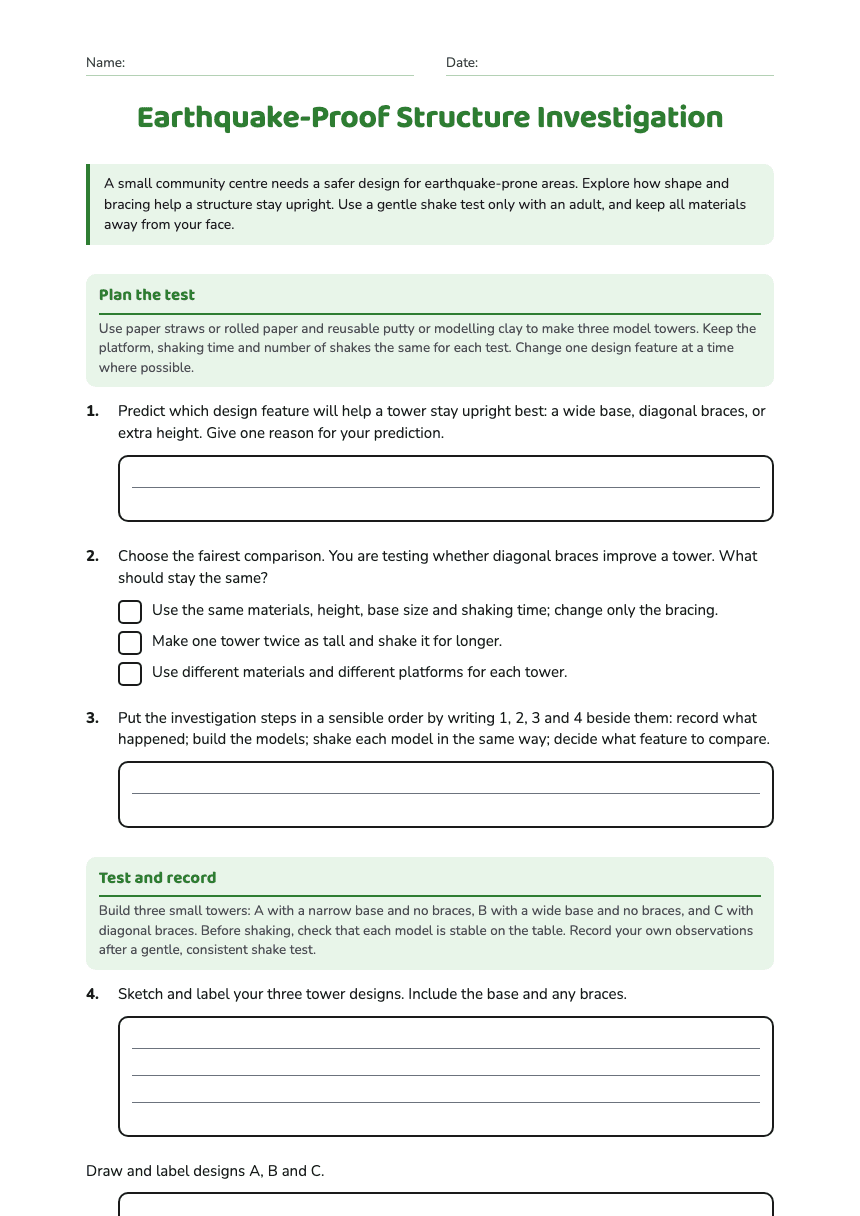
Earthquake-Proof Structure Investigation worksheet preview
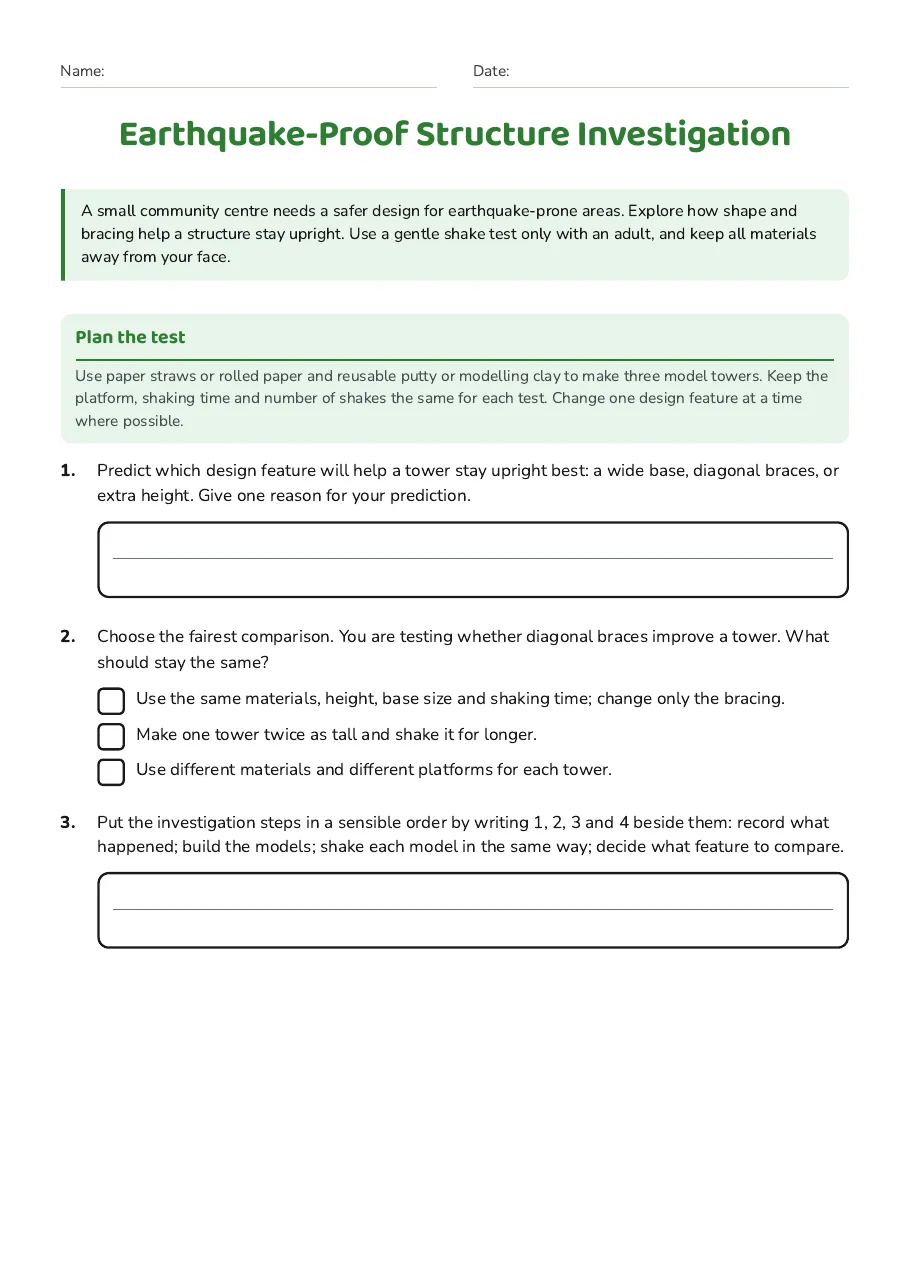
Name:Date:

Earthquake-Proof Structure Investigation

A small community centre needs a safer design for earthquake-prone areas. Explore how shape and bracing help a structure stay upright. Use a gentle shake test only with an adult, and keep all materials away from your face.

Plan the test

Use paper straws or rolled paper and reusable putty or modelling clay to make three model towers. Keep the platform, shaking time and number of shakes the same for each test. Change one design feature at a time where possible.

1.Predict which design feature will help a tower stay upright best: a wide base, diagonal braces, or extra height. Give one reason for your prediction.
2.Choose the fairest comparison. You are testing whether diagonal braces improve a tower. What should stay the same?
  • Use the same materials, height, base size and shaking time; change only the bracing.
  • Make one tower twice as tall and shake it for longer.
  • Use different materials and different platforms for each tower.
3.Put the investigation steps in a sensible order by writing 1, 2, 3 and 4 beside them: record what happened; build the models; shake each model in the same way; decide what feature to compare.

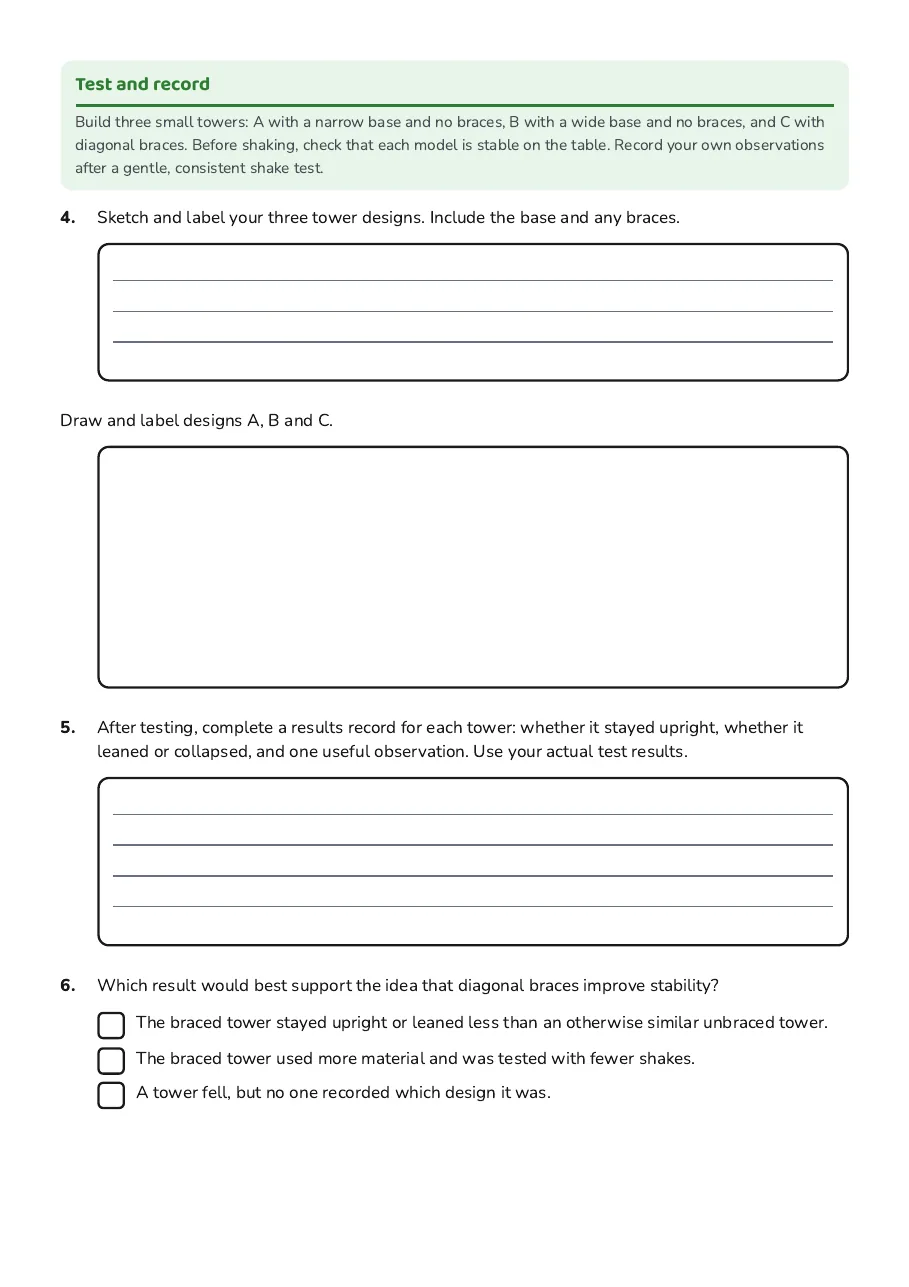
Test and record

Build three small towers: A with a narrow base and no braces, B with a wide base and no braces, and C with diagonal braces. Before shaking, check that each model is stable on the table. Record your own observations after a gentle, consistent shake test.

4.Sketch and label your three tower designs. Include the base and any braces.
Draw and label designs A, B and C.
5.After testing, complete a results record for each tower: whether it stayed upright, whether it leaned or collapsed, and one useful observation. Use your actual test results.
6.Which result would best support the idea that diagonal braces improve stability?
  • The braced tower stayed upright or leaned less than an otherwise similar unbraced tower.
  • The braced tower used more material and was tested with fewer shakes.
  • A tower fell, but no one recorded which design it was.
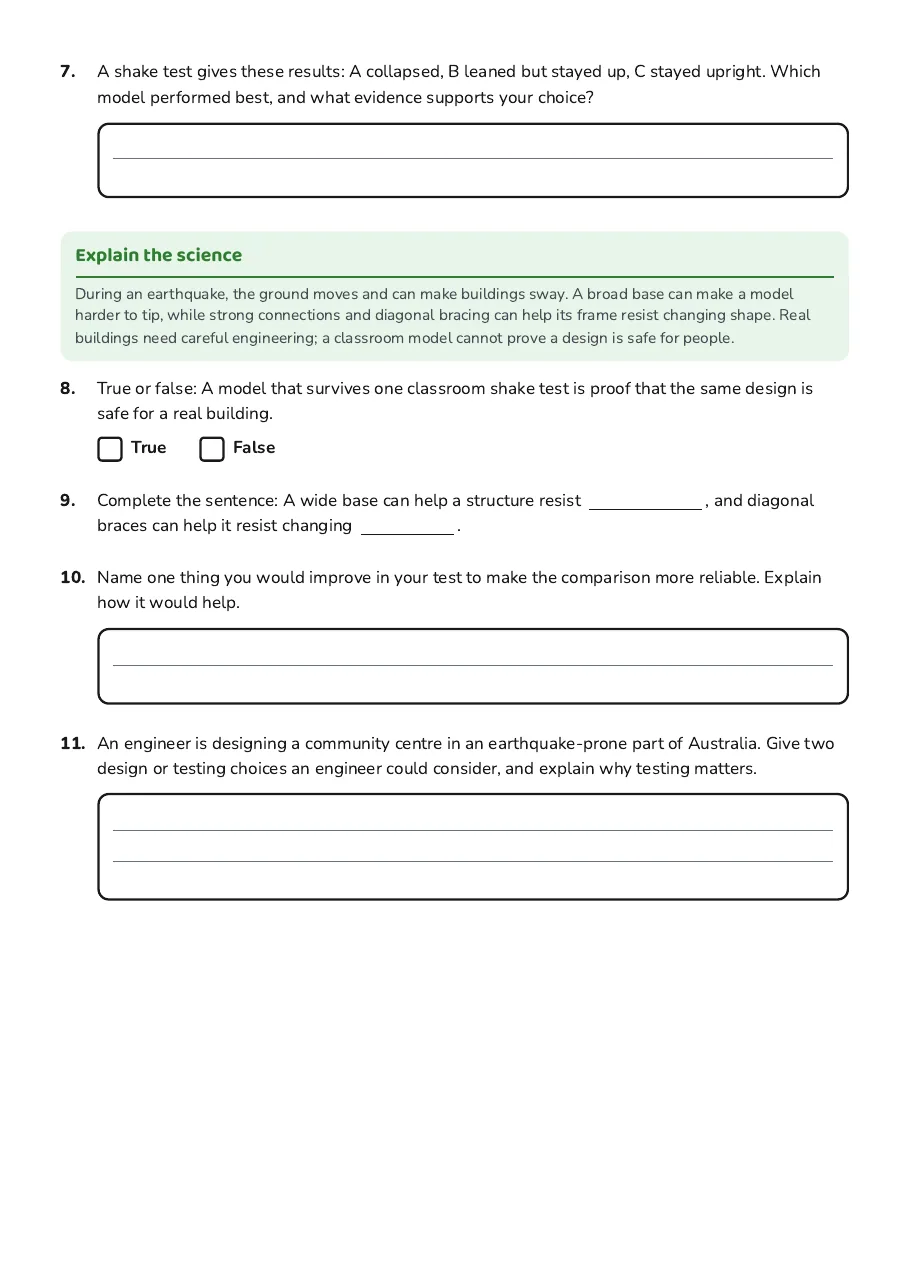
7.A shake test gives these results: A collapsed, B leaned but stayed up, C stayed upright. Which model performed best, and what evidence supports your choice?

Explain the science

During an earthquake, the ground moves and can make buildings sway. A broad base can make a model harder to tip, while strong connections and diagonal bracing can help its frame resist changing shape. Real buildings need careful engineering; a classroom model cannot prove a design is safe for people.

8.True or false: A model that survives one classroom shake test is proof that the same design is safe for a real building.
TrueFalse
9.Complete the sentence: A wide base can help a structure resist , and diagonal braces can help it resist changing .
10.Name one thing you would improve in your test to make the comparison more reliable. Explain how it would help.
11.An engineer is designing a community centre in an earthquake-prone part of Australia. Give two design or testing choices an engineer could consider, and explain why testing matters.

3 printable pages

  • Earthquake-Proof Structure Investigation, page 1 of 3: Plan the test

    Page 1

  • Earthquake-Proof Structure Investigation, page 2 of 3: Test and record

    Page 2

  • Earthquake-Proof Structure Investigation, page 3 of 3: Explain the science

    Page 3

About This Worksheet

Free in Kuraplan

Sign up free, grab the PDF, and customize it for your class.

Print-Ready

Formatted for standard paper. Clean layout, easy to read.

AI-Generated

Created with Kuraplan's AI, designed for real classroom use.

For Teachers & Parents

Use in classrooms, for homework, tutoring, or homeschool.

Need a custom version of this worksheet?

Kuraplan's AI generates custom worksheets in seconds — differentiated for every learner, aligned to your curriculum.

Generate Custom Worksheets — Free
No credit card Curriculum-aligned Under 60 seconds